
ปัจจัยที่มีอิทธิพลต่อพฤติกรรมการบริโภคอาหารของประชาชนวัยทำงานในประเทศไทย
คำสำคัญ:
ปัจจัย, พฤติกรรมการบริโภคอาหาร, ประชาชนวัยทำงาน, ประเทศไทยบทคัดย่อ
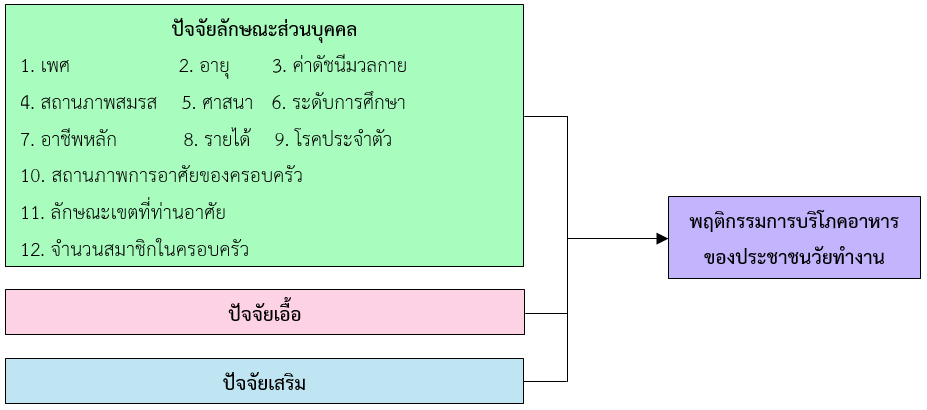
การวิจัยเชิงสำรวจแบบภาคตัดขวางนี้มีวัตถุประสงค์เพื่อวิเคราะห์ปัจจัยที่มีอิทธิพลต่อพฤติกรรมการบริโภคอาหารของประชาชนวัยทำงานในประเทศไทย กลุ่มตัวอย่าง คือ ประชาชนวัยทำงานที่มีอายุ 19-59 ปี จำนวน 10,260 คน เครื่องมือที่ใช้เป็นแบบสอบถามออนไลน์ ได้แก่ แบบสอบถามปัจจัยลักษณะส่วนบุคคล ปัจจัยเอื้อในการบริโภคอาหาร ปัจจัยเสริมในการบริโภคอาหาร และพฤติกรรมในการบริโภคอาหาร วิเคราะห์ข้อมูลโดยใช้สถิติเชิงพรรณนา และสถิติถดถอยแบบขั้นตอน
ผลการวิจัยพบว่า ปัจจัยเอื้อในการบริโภคอาหาร อยู่ในระดับสูง (Mean = 4.08, S.D.= 0.61) ปัจจัยเสริมในการบริโภคอาหาร อยู่ในระดับปานกลาง (Mean = 3.44, S.D. = 0.38) สำหรับพฤติกรรมในการบริโภคอาหาร พบว่า อยู่ในระดับปานกลาง (Mean = 3.30, S.D. = 0.26) ตัวแปรที่สามารถทำนายพฤติกรรมในการบริโภคอาหาร ได้แก่ ปัจจัยเสริมในการบริโภคอาหาร (ß = 0.24; p-value < 0.001) ปัจจัยเอื้อในการบริโภคอาหาร (ß = 0.04; p-value < 0.001) ครอบครัวเดี่ยว (ß = 0.03; p-value < 0.001) การไม่มีโรคประจำตัว (ß = 0.02; p-value < 0.001) เพศชาย (ß = -0.01; p-value = 0.04) และจำนวนสมาชิกในครอบครัว (ß = -0.008; p-value < 0.001) สามารถทำนายพฤติกรรมในการบริโภคอาหารของประชาชนวัยทำงานได้ ร้อยละ 14.80 (adjR2 = 0.15) จากผลการวิจัยพบว่า ปัจจัยเสริมและปัจจัยเสริมในการบริโภคอาหารมีอำนาจทำนายมากเป็น 2 อันดับแรก ดังนั้นบุคลากรด้านสุขภาพควรให้ความรู้ด้านโภชนาการที่สนับสนุนการให้ข้อมูลข่าวสารที่เหมาะสมในวัยทำงาน เน้นการสร้างความตระหนักในการวางแผนการบริโภคในครอบครัว และให้ประชาชนสามารถซื้ออาหารมาบริโภคได้อย่างเหมาะสม
เอกสารอ้างอิง
กระทรวงสาธารณสุข. (2561). รายงานสถานการณ์โรคไม่ติดต่อเรื้อรังของประเทศไทย. นนทบุรี: กระทรวงสาธารณสุข.
กระทรวงสาธารณสุข. (2567). ข้อมูลทั่วไป. นนทบุรี. สืบค้นเมื่อ 20 มีนาคม 2567 จาก https://hdc.moph.go.th/center.
กรมควบคุมโรค กระทรวงสาธารณสุข. (2562). สถานการณ์การดำเนินงานด้านการป้องกัน ควบคุมโรคไม่ติดต่อ (NCDs). (พิมพ์ครั้งที่ 2). นนทบุรี: กรมควบคุมโรค กระทรวงสาธารณสุข.
กรมอนามัย. (2562). พฤติกรรมสุขภาพของประชากรไทย. นนทบุรี: กระทรวงสาธารณสุข.
กัลยา วานิชย์บัญชา. (2551) การใช้ SPSS for Windows ในการวิเคราะห์ข้อมูล. (พิมพ์ครั้งที่ 11). กรุงเทพฯ: สำนักพิมพ์จุฬาลงกรณ์มหาวิทยาลัย.
จินตรัตน์ อินทมาศ. (2559). ปัจจัยที่มีผลต่อพฤติกรรมการบริโภคอาหารมื้อเช้าของวัยทำงานในเขตพื้นที่กรุงเทพมหานคร. ปริญญาการจัดการมหาบัณฑิต สาขาวิชาการจัดการธุรกิจอาหาร วิทยาลัยการจัดการ มหาวิทยาลัยมหิดล
เบญจมาศ เผยกลาง และเบญจา มุกตพันธุ์. (2561). ความสัมพันธ์ระหว่างระดับความรอบรู้ด้านสุขภาพกับพฤติกรรมการบริโภคอาหารและกิจกรรมทางกายของหญิงวัยกลางคน อาศัยอยู่ที่ตำบลโตนด อำเภอโนนสูง จังหวัดนครราชสีมา. วารสารวิจัยสาธารณสุขศาสตร์ มหาวิทยาลัยขอนแก่น, 12(1), 51-61.
พิชศาล พันธุ์วัฒนา. (2562). พฤติกรรมการบริโภคอาหารของคนเมืองวัยทำงานในกรุงเทพมหานคร. สำนักงานป้องกันควบคุมโรคที่ 7 ขอนแก่น, 26(2), 93-103.
วรางคณา บุญยงค์ และสุวลี โล่วิรกรณ์. (2561). พฤติกรรมการบริโภคอาหารและภาวะโภชนาการของวัยแรงงานที่ทำงานในโรงงานอุตสาหกรรมสิ่งทอ อำเภอจังหาร จังหวัดร้อยเอ็ด. วารสารวิจัยสาธารณสุขศาสตร์ มหาวิทยาลัยขอนแก่น, 11(4), 1-9.
วสุนธรา รตโนภาส และตรรกพร สุขเกษม. (2565). พฤติกรรมการบริโภคอาหารของประชาชนในเขตพื้นที่ตำบลคลองพิไกร อำเภอพรานกระต่าย จังหวัดกำแพงเพชร. วารสารวิจัยรำไพพรรณี, 16(1), 58-65.
สำนักอาหาร สำนักงานคณะกรรมการอาหารและยา. (2559). องค์ความรู้ด้านอาหารและโภชนาการสำหรับทุกช่วงวัย. นนทบุรี: สำนักงานคณะกรรมการอาหารและยา.
สโรชิน สมพงษ์พันธุ์ และอรัญญา อุดมเวช. (2566). พฤติกรรมการบริโภคอาหารของบุคลากร ณ ศูนย์หัวใจสิริกิติ์ ภาคตะวันออกเฉียงเหนือ. ศรีนครินทร์เวชสาร, 38(2), 152-160.
สำนักงานสถิติแห่งชาติ. (2561). การสำรวจพฤติกรรมการบริโภคอาหารของประชากร พ.ศ. 2560. กรุงเทพฯ:กระทรวงดิจิทัลเพื่อเศรษฐกิจและสังคม.
สำนักงานสถิติแห่งชาติ. (2564). การสำรวจพฤติกรรมการบริโภคอาหารของประชากร พ.ศ. 2560. กรุงเทพฯ:กระทรวงดิจิทัลเพื่อเศรษฐกิจและสังคม.
สำนักโภชนาการ. (2562). แผนปฏิบัติการด้านโภชนาการระดับชาติ 5 ปี พ.ศ. 2562-2566. นนนบุรี: กรมอนามัย กระทรวงสาธารณสุข.
สำนักโภชนาการ. (2568). แผนปฏิบัติการด้านโภชนาการแห่งชาติ ระยะที่ 1 (พ.ศ.2566-2570) ในช่วงครึ่งปีหลัง ของแผน (พ.ศ. 2568-2570). นนทบุรี: กรมอนามัย กระทรวงสาธารณสุข.
สำนักคณะกรรมการอาหารและยา. (2559). องค์ความรู้ด้านอาหารและโภชนาการสำหรับทุกช่วงวัย. นนทบุรี: สำนักงานคณะกรรมการอาหารและยา กระทรวงสาธารณสุข.
เสกสรรณ์ สกุลเอื้อ. (2565). ปัจจัยที่มีความสัมพันธ์กับพฤติกรรมการบริโภคอาหารของอาสาสมัครสาธารณสุขประจำหมู่บ้าน อำเภอเมือง จังหวัดสมุทรสงคราม. วารสารวิจัยเพื่อการส่งเสริมสุขภาพและคุณภาพชีวิต, 2(3), 59-70.
Best, J. W. (1977). Research in education. Englewood Cliffs, New Jersy: Pretice Hall.
Carins, J. E., Thiele, S. R. R., & Parkinson, J. E. (2017). Delivering healthy food choice: A dual-process model enquiry. Social Marketing Quarterly, 23(3), 266-83.
Cronbach, L. J. (1951). Coefficient alpha and the internal structure of tests. Psychometrika, 16(3), 297-334.
Green, L. M. & Kreuter, M. W. (2005). Health promotion planning an education and ecological approach. (4th ed). Toronto: Mayfield Publishing Company.
Hartman-Petrycka, M., Witkoś, J., Lebiedowska, A., & Błońska-Fajfrowska, B. (2022). Individual characteristics, including olfactory efficiency, age, body mass index, smoking and the sex hormones status, and food preferences of women in Poland. PeerJ, 10, e13538. https://doi.org/10.7717/peerj.13538.
Kotler, P. & Keller, K. L. (2016). Marketing management (15th ed.). Upper Saddle River, NJ: Pearson Education.
Mazalán, P., Kita, P., Kita, J., Žambochová, M., Hasan, J., & Prochotzký, A. (2021). Slovakians' adversarial attitude towards consumption of functional food. Central European Journal of Public Health, 29(2), 122-129. https://doi.org/10.21101/cejph.a6431
Neuman, W. L. (1991). Social research methods: Qualitative and quantitative approaches. Boston: Allyn and Bacon.
Naing, L., Winn, T., & Rusli, B. N. (2006). Practical issues in calculating the sample size for prevalence studies. Archives of Orofacial Sciences, 1(1), 9-14.
Rovinelli, R. J. & Hambleton, R. K. (1977). On the use of content specialists in the assessment of criterion-referenced test item validity. Dutch Journal of Educational Measurement, 2, 49-60.
Sooriyaarachchi, P. & Jayawardena, R. (2023). Impact of the economic crisis on food consumption of Sri Lankans: An online cross-sectional survey. Diabetes & Metabolic Syndrome, 17(6), 102786. https://doi.org/10.1016/j.dsx.2023.102786
Trewern, J., Chenoweth, J., & Christie, I. (2022). Sparking change: Evaluating the effectiveness of a multi-component intervention at encouraging more sustainable food behaviors. Appetite, 171, 105933. https://doi.org/10.1016/j.appet.2022.105933
ดาวน์โหลด
เผยแพร่แล้ว
รูปแบบการอ้างอิง
ฉบับ
ประเภทบทความ
สัญญาอนุญาต
ลิขสิทธิ์ (c) 2026 วารสารวิจัยการพยาบาลและการสาธารณสุข

อนุญาตภายใต้เงื่อนไข Creative Commons Attribution-NonCommercial-NoDerivatives 4.0 International License.
1. บทความหรือข้อคิดเห็นใด ๆ ที่ปรากฏในวารสารวิจัยการพยาบาลและการสาธารณสุข ที่เป็นวรรณกรรมของผู้เขียน บรรณาธิการไม่จำเป็นต้องเห็นด้วย
2. บทความที่ได้รับการตีพิมพ์ถือเป็นลิขสิทธิ์ของ วารสารวิจัยการพยาบาลและการสาธารณสุข
 Indexed in TCI