การพัฒนาระบบการประเมินเพื่อเฝ้าระวังอาการทรุดลงด้วยแบบบันทึกสัญญาณเตือน พระจอมเกล้ามิวสกอร์ ในผู้ป่วยโรคเลือดออกในสมอง
คำสำคัญ:
ระบบการประเมิน, เฝ้าระวังอาการทรุดลง, ระบบสัญญาณเตือนก่อนวิกฤต, โรคเลือดออกในสมองบทคัดย่อ
การวิจัยและพัฒนานี้ มีวัตถุประสงค์เพื่อพัฒนาระบบการประเมินเพื่อเฝ้าระวังอาการทรุดลงด้วยแบบบันทึกสัญญาณเตือนพระจอมเกล้ามิวสกอร์ ในผู้ป่วยกลุ่มโรคเลือดออกในสมอง ประกอบด้วย 4 ขั้นตอน คือ 1) ศึกษาสถานการณ์และประเด็นปัญหาโดยการทบทวนเวชระเบียน สัมภาษณ์กึ่งโครงสร้างและอภิปรายกลุ่ม กลุ่มตัวอย่างประกอบแพทย์ หัวหน้าหอผู้ป่วยและพยาบาลวิชาชีพ จำนวน 12 คน 2) พัฒนาระบบการประเมินโดยกระบวนการใช้หลักฐานเชิงประจักษ์ 3) ทดลองใช้ระบบการประเมินด้วยแบบแผนการวิจัยกึ่งทดลองในผู้ป่วยกลุ่มโรคเลือดออกในสมองจำนวน 37 รายต่อกลุ่ม และ 4) ประเมินผลลัพธ์ของการใช้ระบบ โดยพยาบาลวิชาชีพจำนวน 44 คน เครื่องมือวิจัย คือ เครื่องมือเชิงคุณภาพใช้แบบสัมภาษณ์กึ่งโครงสร้างและอภิปรายกลุ่ม และเชิงปริมาณเป็นแบบประเมินความพึงพอใจและแบบประเมินความเป็นไปได้ของการใช้ระบบ วิเคราะห์ข้อมูลเชิงคุณภาพโดยการวิเคราะห์เนื้อหาและข้อมูลเชิงปริมาณใช้ค่าความถี่และร้อยละ
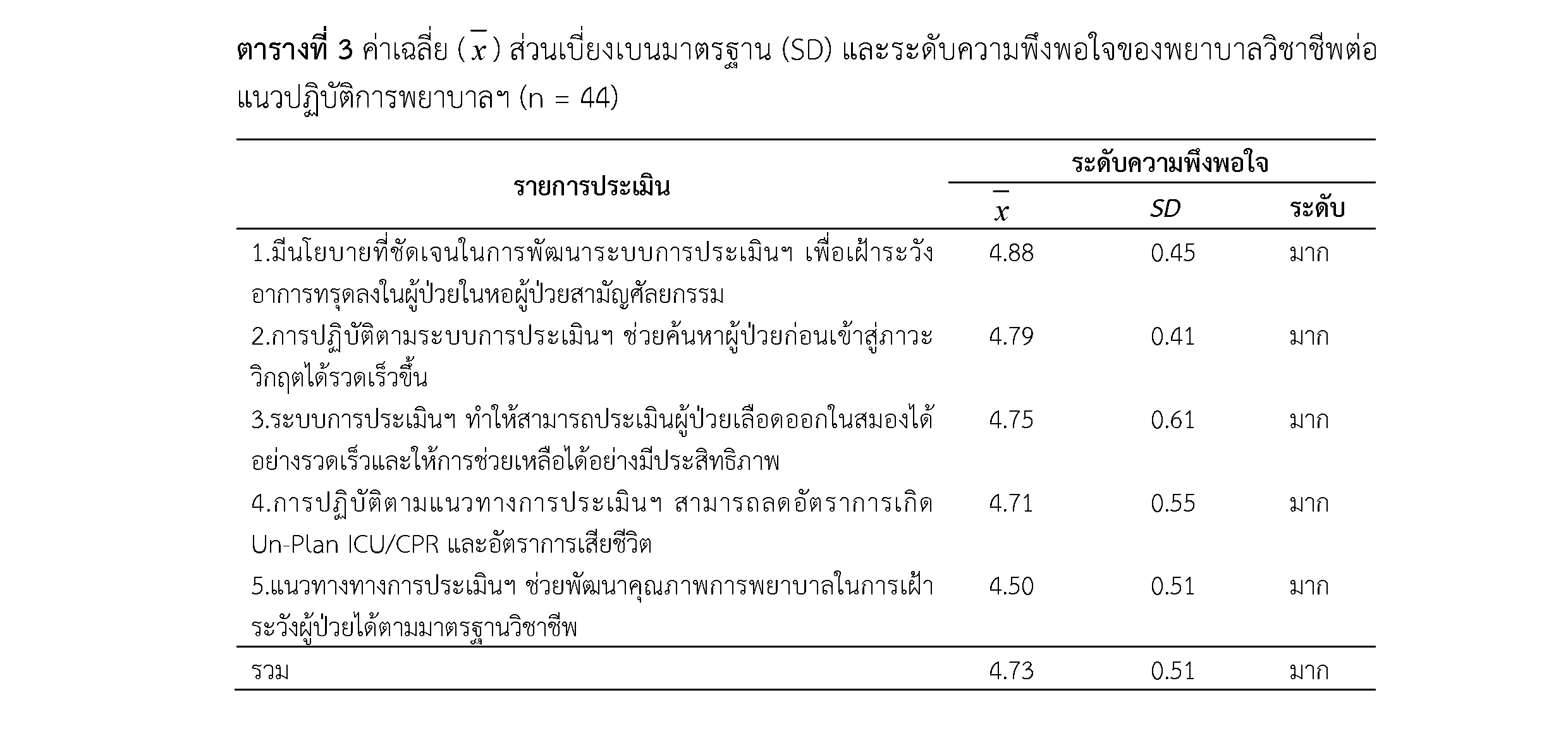
ผลการวิจัย พบว่า การพัฒนาระบบการประเมินเพื่อเฝ้าระวังอาการทรุดลง ในผู้ป่วยกลุ่มโรคเลือดออกในสมอง มีองค์ประกอบการพัฒนา คือ 1) การวางแผนการทํางานร่วมกัน 2) การกําหนดบทบาทหน้าที่อย่างชัดเจน 3) การสื่อสารที่มีประสิทธิภาพ และ 4) การควบคุม กํากับ ติดตามการปฏิบัติ การประเมินผลลัพธ์หลังการใช้ระบบการประเมินเพื่อเฝ้าระวังอาการทรุดลง พบว่า ร้อยละของการย้ายเข้าหอผู้ป่วยวิกฤติโดยไม่ได้วางแผนลดลงจากร้อยละ 27.28 ในกลุ่มควบคุม เป็นร้อยละ 9.09 ในกลุ่มทดลอง และความคิดเห็นของพยาบาลวิชาชีพต่อความเป็นไปได้ในการใช้ระบบการประเมินอยู่ในระดับมาก (= 4.43) และความพึงพอใจของพยาบาลวิชาชีพต่อระบบการประเมินอยู่ในระดับมาก (
= 4.73) จากผลการวิจัยนี้ พยาบาลหรือบุคลากรการแพทย์อื่นๆสามารถนําระบบการประเมินไปประยุกต์ใช้ในการเฝ้าระวังอาการทรุดลงในผู้ป่วยกลุ่มโรคอื่นเพื่อพัฒนาคุณภาพการดูแลผู้ป่วยให้ดียิ่งขึ้น
เอกสารอ้างอิง
Abidin, Z., Sila, N. A., Revai, A., & Liputo, G. P. (2017). Modified early warning system (Mews), indicator of changes in patient’s condition in the general wards: A systematic review. In 8th International Nursing Conference on Education, Practice and Research Development in Nursing, 3(1), 51-55.
Cohen, J. (1992). Statistical power analysis. Current Directions in Psychological Science, 1(3), 98-101.
Diana, M., Prayoga, D. H., & Wijayanti, D. P. (2021). Implementation of Early Warning System In Nursing Ward: A Literature Review. Nurse and Health: Journal Keperawatan, 10(1), 126-134.
Downey, C. L., Tahir, W., Randell, R., Brown, J. M., & Jayne, D. G. (2017). Strengths and limitations of early warning scores: A systematic review and narrative synthesis. International Journal of Nursing Studies, 76, 106-119.
Drower, D., McKeany, R., Jogia, P., & Jull, A. (2013). Evaluating the impact of implementing an early warning score system on incidence of in-hospital cardiac arrest. New zealand Medical Journal, 126(1385), 26-34.
Hester, J., Youn, T. S., Trifilio, E., Robinson, C. P., Babi, M. A., Ameli, P., ... & Busl, K. M. (2021). The Modified Early Warning Score: A Useful Marker of Neurological Worsening but Unreliable Predictor of Sepsis in the Neurocritically Ill—A Retrospective Cohort Study. Critical Care Explorations, 3(5), 1-11.
Karsy, M., Couldwell, W. T., Stanford, M., Breviu, A., & Horton, D. (2020). Using the Modified Early Warning Score (mEWS) to Improve Prediction of Outcome in Neurosurgical Patients. Neurosurgery, 67(Supplement_1), nyaa447_501.
Kim, D. K., Lee, D. H., Lee, B. K., Cho, Y. S., Ryu, S. J., Jung, Y. H., ... & Han, J. H. (2021). Performance of Modified Early Warning Score (MEWS) for predicting in-hospital mortality in traumatic brain injury patients. Journal of Clinical Medicine, 10(9), 1915.
Kirshner, H., & Schrag, M. (2021). Management of Intracerebral Hemorrhage: Update and Future Therapies. Current Neurology and Neuroscience Reports, 21(10), 1-5.
Kyriacos, U., Jelsma, J., James, M., & Jordan, S. (2015). Early warning scoring systems versus standard observations charts for wards in South Africa: A cluster randomized controlled trial. Trials, 16(1), 1-15.
Lagadec,L. M. D., Dwyer, T., & Browne, M. (2020). The efficacy of twelve early warning systems for potential use in regional medical facilities in Queensland, Australia. Australian Critical Care, 33(1), 47-53.
Le Lagadec, M. D., & Dwyer, T. (2017). Scoping review: the use of early warning systems for the identification of in-hospital patients at risk of deterioration. Australian Critical Care, 30(4), 211-218.
Le Lagadec, M. D., Dwyer, T., & Browne, M. (2020). The efficacy of twelve early warning systems for potential use in regional medical facilities in Queensland, Australia. Australian Critical Care, 33(1), 47-53.
Merriel, A., van der Nelson, H., Merriel, S., Bennett, J., Donald, F., Draycott, T., & Siassakos, D. (2016). Identifying deteriorating patients through multidisciplinary team training. American Journal of Medical Quality, 31(6), 589-595.
Nishijima, I., Oyadomari, S., Maedomari, S., Toma, R., Igei, C., Kobata, S., ... & Iha, K. (2016). Use of a modified early warning score system to reduce the rate of in-hospital cardiac arrest. Journal of Intensive Care, 4(1), 1-6.
O’Neill, S. M., Clyne, B., Bell, M., Casey, A., Leen, B., Smith, S. M., ... & O’Neill, M. (2021). Why do healthcare professionals fail to escalate as per the early warning system (EWS) protocol? A qualitative evidence synthesis of the barriers and facilitators of escalation. BMC Emergency Medicine, 21(1), 1-19.
Pimentel, M. A., Redfern, O. C., Malycha, J., Meredith, P., Prytherch, D., Briggs, J., ... & Watkinson, P. J. (2021). Detecting deteriorating patients in hospital: development and validation of a novel scoring system. American Journal of Respiratory and Critical Care Medicine, 204(1), 44-52.
Polit, D. F. B & Beck, CT (2014). Essentials of Nursing Research: Appraising Evidence for Nursing Practice. London, Lippincott.
Spencer, W., Smith, J., Date, P., de Tonnerre, E., & Taylor, D. M. (2019). Determination of the best early warning scores to predict clinical outcomes of patients in the emergency department. Emergency Medicine Journal, 36(12), 716-721.
Wang, A. Y., Fang, C. C., Chen, S. C., Tsai, S. H., & Kao, W. F. (2016). Periarrest Modified Early Warning Score (MEWS) predicts the outcome of in-hospital cardiac arrest. Journal of the Formosan Medical Association, 115(2), 76-82.
ดาวน์โหลด
เผยแพร่แล้ว
รูปแบบการอ้างอิง
ฉบับ
ประเภทบทความ
สัญญาอนุญาต
1. บทความหรือข้อคิดเห็นใด ๆ ที่ปรากฏในวารสารวิจัยการพยาบาลและการสาธารณสุข ที่เป็นวรรณกรรมของผู้เขียน บรรณาธิการไม่จำเป็นต้องเห็นด้วย
2. บทความที่ได้รับการตีพิมพ์ถือเป็นลิขสิทธิ์ของ วารสารวิจัยการพยาบาลและการสาธารณสุข
 Indexed in TCI