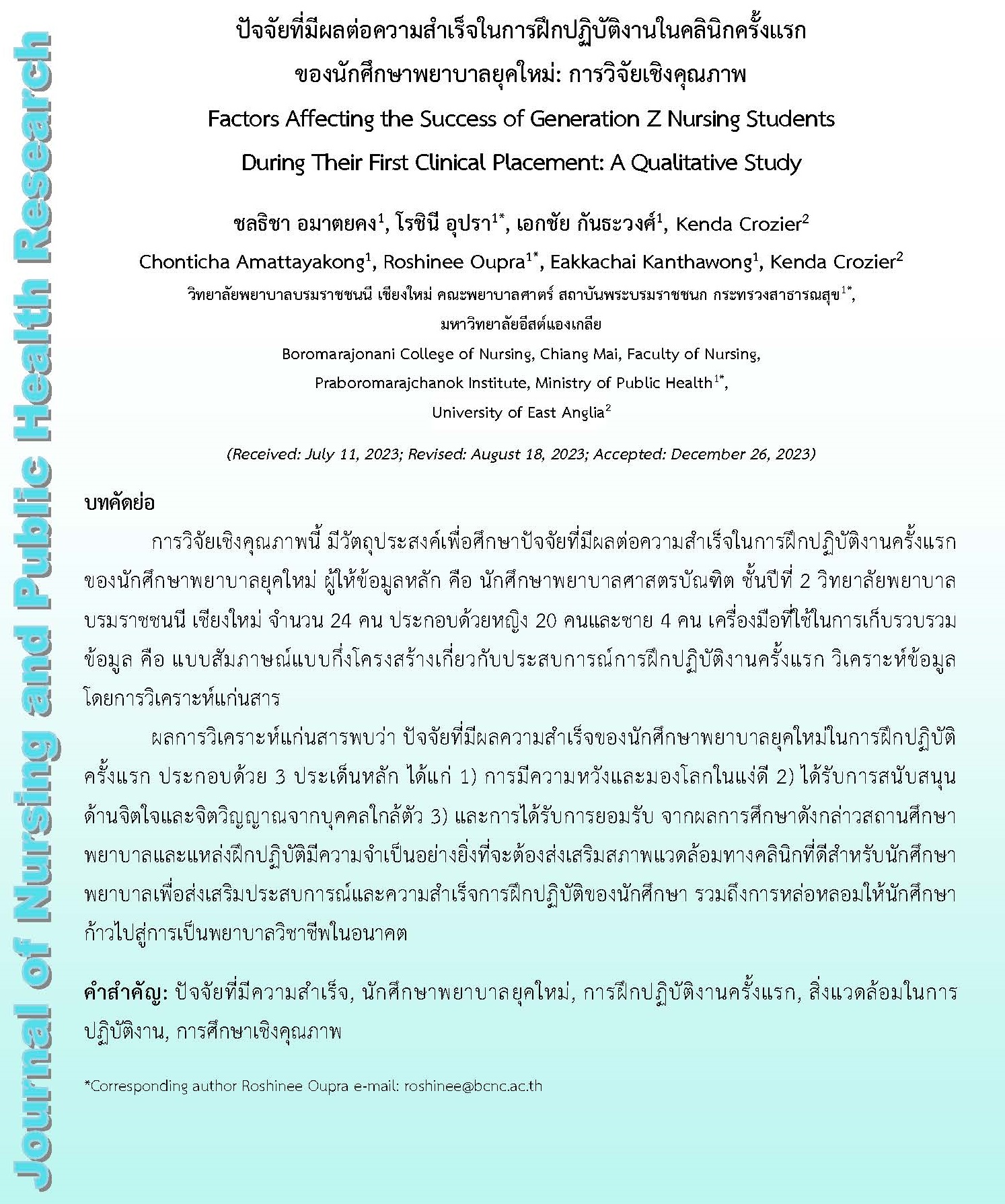
ปัจจัยที่มีผลต่อความสำเร็จในการฝึกปฏิบัติงานในคลินิกครั้งแรกของนักศึกษาพยาบาลยุคใหม่: การวิจัยเชิงคุณภาพ
คำสำคัญ:
ปัจจัยที่มีความสำเร็จ, นักศึกษาพยาบาลยุคใหม่, การฝึกปฏิบัติงานครั้งแรก, สิ่งแวดล้อมในการปฏิบัติงาน, การศึกษาเชิงคุณภาพบทคัดย่อ
การวิจัยเชิงคุณภาพนี้ มีวัตถุประสงค์เพื่อศึกษาปัจจัยที่มีผลต่อความสำเร็จในการฝึกปฏิบัติงานครั้งแรกของนักศึกษาพยาบาลยุคใหม่ ผู้ให้ข้อมูลหลัก คือ นักศึกษาพยาบาลศาสตรบัณฑิต ชั้นปีที่ 2 วิทยาลัยพยาบาล บรมราชชนนี เชียงใหม่ จำนวน 24 คน ประกอบด้วยหญิง 20 คนและชาย 4 คน เครื่องมือที่ใช้ในการเก็บรวบรวมข้อมูล คือ แบบสัมภาษณ์แบบกึ่งโครงสร้างเกี่ยวกับประสบการณ์การฝึกปฏิบัติงานครั้งแรก วิเคราะห์ข้อมูลโดยการวิเคราะห์แก่นสาร
ผลการวิเคราะห์แก่นสารพบว่า ปัจจัยที่มีผลความสำเร็จของนักศึกษาพยาบาลยุคใหม่ในการฝึกปฏิบัติ ครั้งแรก ประกอบด้วย 3 ประเด็นหลัก ได้แก่ 1) การมีความหวังและมองโลกในแง่ดี 2) ได้รับการสนับสนุน ด้านจิตใจและจิตวิญญาณจากบุคคลใกล้ตัว 3) และการได้รับการยอมรับ จากผลการศึกษาดังกล่าวสถานศึกษาพยาบาลและแหล่งฝึกปฏิบัติมีความจำเป็นอย่างยิ่งที่จะต้องส่งเสริมสภาพแวดล้อมทางคลินิกที่ดีสำหรับนักศึกษาพยาบาลเพื่อส่งเสริมประสบการณ์และความสำเร็จการฝึกปฏิบัติของนักศึกษา รวมถึงการหล่อหลอมให้นักศึกษาก้าวไปสู่การเป็นพยาบาลวิชาชีพในอนาคต
เอกสารอ้างอิง
Allen, E. (2021). Supporting the generation Z nursing student in professional identity formation. Retrieved May 12, 2023 from https://www.ajj.com/sites/default/files/fall2021.
Amattayakong, C., Klunklin, A., Kunawiktikul, W., Kuntaruksa, K., & Turale, S. (2020). Wellness among nursing students: A qualitative study. Nurse Education in Practice, 48, 102867. https://doi.org/10.1016/j.nepr.2020.102867
Anderson, C., Moxham, L., & Broadbent, M. (2016). Providing support to nursing students in the clinical environment: A nursing standard requirement. Contemporary Nurse, 52(5), 636-642. https://doi.org/10.1080/10376178.2016.1215774
Atakro, C. A., et al. (2019). Clinical placement experiences by undergraduate nursing students in selected teaching hospitals in Ghana. BMC Nursing, 18, 1. https://doi.org/10.1186/s12912 018-0325-8
Baldwin-White, A. J. M., Kiehne, E., Umaña-Taylor, A., & Marsiglia, F. F. (2017). In pursuit of belonging: acculturation, perceived discrimination, and ethnic-racial identity among Latino youths. Social Work Research, 41(1), 43–52. https://doi.org/10.1093/swr/svw029
Barrett, D. & Harris, M. (2020). Nurse educators must demonstrate care, competence and integrity to enhance students' trust in them. Evidence-Based Nursing, 23(2), 46. https://doi.org/10.1136/ebnurs-2018-103042
Brown, J., et al. (2021). Nursing students’ academic success factors: A quantitative cross sectional study. Nurse Educator, 46(2), E23-E27 https://doi.org/10.1097/nne.0000000000000882
Chicca, J. & Shellenbarger, T. (2018). Connecting with generation Z: Approaches in nursing education. Teaching and Learning in Nursing, 13, 180-184. https://dli.org/10.1016.j.teln.2018.03.008
Creswell, J. (2008). Research design: Qualitative, quantitative and mixed methods approaches (3rd ed.). Thousand Oaks, CA: Sage Publications.
Flott, E. A. & Linden, L. (2016). The clinical learning environment in nursing education: A concept analysis. Journal of Advanced Nursing, 72(3), 501-513. https://doi.org/10.1111/jan.12861
Gaberson, K. B., Oermann, M. H., & Shellenbarger, T. (2015). Clinical teaching strategies in nursing. New York, NY: Springer.
Graneheim, U. H. & Lundman, B. (2004). Qualitative content analysis in nursing research: Concepts, procedures and measures to achieve trustworthiness. Nurse Education Today, 24(2), 105-112. https://doi.org/10.1016/j.nedt.2003.10.001
Gray, J. R. (2017). Qualitative Research Methods. In J. R. Gray, S. K. Grove, & S. Sutherland (Eds.), Burns and Grove's the practice of nursing research: Appraisal, synthesis, and generation of evidence (8th ed.). St. Louis, Missouri: Elsevier.
Hashemiparast, M., Negarandeh, R., & Theofanidis, D. (2019). Exploring the barriers of utilizing theoretical knowledge in clinical settings: A qualitative study. International Journal of Nursing Sciences, 6(4), 399-405. https://doi.org/10.1016/j.ijnss.2019.09.008
Holloway, I., & Wheeler, S., (2013). Qualitative research in nursing and healthcare, 3rd. New Jersey, United States: Wiley-Blackwell.
Holloway, I. & Galvin, K. (2016). Qualitative research in nursing and health care, 4th. New Jersey, United States: Wiley-Blackwell.
Jafarian-Amiri, S. R., Zabihi, A., & Qalehsari, M. Q. (2020). The challenges of supporting nursing students in clinical education. Journal of Education and Health Promotion, 9, 216. https://doi.org/10.4103/jehp.jehp_13_20
Johansen, M. L. & O' Brien, J. L. (2016). Decision making in nursing practice: A concept analysis. Nursing Forum, 51(1), 40–48. https://doi.org/10.1111/nuf.12119
Kupcewicz, E., Mikla, M., Kadučáková, H., Schneider-Matyka, D., & Grochans, E. (2022). Health behaviours and the sense of optimism in nursing students in Poland, Spain and Slovakia during the COVID-19 pandemic. International Journal of Environmental Research and Public Health, 19(4), 2388. https://doi.org/10.3390/ijerph19042388
Lobo, C., Paul, R., & Crozier, K. (2021). Collaborative learning in practice: Coaching to support student learners in healthcare. John Wiley & Son, Ltd.
Marć, M., Bartosiewicz, A., Burzyńska, J., Chmiel, Z., & Januszewicz, P. (2019). A nursing shortage a prospect of global and local policies. International Nursing Review, 66(1), 9-16. https://doi.org/10.1111/inr.12473
Morse, J, M. & Niehaus, L. (2016). Mixed method design principle and procedure. Routledge.
Pålsson, Y., Mårtensson, G., Swenne, C. L., Ädel, E., & Engström, M. (2017). A peer learning intervention for nursing students in clinical practice education: A quasi-experimental study. Nurse Education Today, 51, 81–87. https://doi.org/10.1016/j.nedt.2017.01.011
Russ, D. Whiteing, N. Aggar, C. (2023). An integrative review of nursing students’ clinical placement experiences throughout their nursing degrees. Collegian, 30(1), 154-162. https://doi.org/10.1016/j.colegn.2022.07.002
Schmitt, C.A. & Lancaster, R.L. (2019). Readiness to practice in Gen Z Nursing Students. Journal of Nursing Education, 58(10), 604-606. https://doi.org/10.3928/01484834-20190923-09
Torbjørnsen, A., Hessevaagbakke, E., Grov, E. K., & Bjørnnes, A. K. (2021). Enhancing students learning experiences in nursing programmes: An integrated review. Nurse Education in Practice, 52, 103038. https://doi.org/10.1016/j.nepr.2021.103038
van Dyk, E. C., van Rensburg, G. H., & van Rensburg, E. S. J. (2021). A model to foster and facilitate trust and trusting relationships in the nursing education context. Health SA=SA Gesondheid, 26, 1645. https://doi.org/10.4102/hsag.v26i0.1645
Varagona, L. M. & Hold, J. L. (2019). Nursing students' perceptions of faculty trustworthiness: thematic analysis of a longitudinal study. Nurse Education Today, 72, 27-31. https://doi.org/10.1016/j.nedt.2018.10.008
Willis, L. (2023). Shape of caring: A review of the future education and training of registered nurses and care assistants. Retrieved January 12, 2023 from https://www.nmc.org.uk/news/press-releases/2015/shape-of-caring-review-publishes finalrecommendations/.
World Health Organisation. (2020). State of the world’s nursing 2020: Investing in education, jobs and leadership. Retrieved August 10, 2023 from https://www.who.int/publications/i/item/9789240003279.
ดาวน์โหลด
เผยแพร่แล้ว
รูปแบบการอ้างอิง
ฉบับ
ประเภทบทความ
สัญญาอนุญาต
ลิขสิทธิ์ (c) 2023 วารสารวิจัยการพยาบาลและการสาธารณสุข

อนุญาตภายใต้เงื่อนไข Creative Commons Attribution-NonCommercial-NoDerivatives 4.0 International License.
1. บทความหรือข้อคิดเห็นใด ๆ ที่ปรากฏในวารสารวิจัยการพยาบาลและการสาธารณสุข ที่เป็นวรรณกรรมของผู้เขียน บรรณาธิการไม่จำเป็นต้องเห็นด้วย
2. บทความที่ได้รับการตีพิมพ์ถือเป็นลิขสิทธิ์ของ วารสารวิจัยการพยาบาลและการสาธารณสุข
 Indexed in TCI