ความรอบรู้ด้านสุขภาพที่มีผลต่อการจำแนกภาวะซึมเศร้าในผู้ป่วยมะเร็งเต้านม
คำสำคัญ:
ภาวะซึมเศร้า, ผู้ป่วยมะเร็งเต้านม, ความรอบรู้ด้านสุขภาพบทคัดย่อ
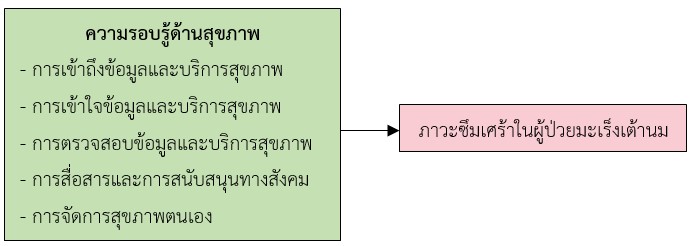
การวิจัยเชิงสำรวจนี้มีวัตถุประสงค์เพื่อการศึกษาความรอบรู้ด้านสุขภาพที่มีผลต่อการจำแนกภาวะซึมเศร้าในผู้ป่วยมะเร็งเต้านม กลุ่มตัวอย่าง คือ ผู้ป่วยโรคมะเร็งเต้านมที่รับการรักษาที่โรงพยาบาลมะเร็งชลบุรี คัดเลือกโดยวิธีการสุ่มอย่างง่ายตามคุณสมบัติที่กำหนด จำนวน 153 คน เครื่องมือที่ใช้ในการวิจัย ได้แก่ ข้อมูลส่วนบุคคลทั่วไป แบบวัดความรอบรู้ด้านสุขภาพในผู้ป่วยมะเร็งเต้านม มีค่าความเชื่อมั่นสัมประสิทธิ์แอลฟาครอนบาค 0.98 และแบบวัดภาวะซึมเศร้าในผู้ป่วยมะเร็งเต้านม ซึ่งมีค่าความเชื่อมั่นสัมประสิทธิ์แอลฟาครอนบาค เท่ากับ 0.83 วิเคราะห์ข้อมูลโดยใช้สถิติพรรณนาและการวิเคราะห์อำนาจจำแนก (Discriminant Analysis)
ผลการวิจัย พบว่า กลุ่มตัวอย่างมีคะแนนเฉลี่ยความรอบรู้ด้านสุขภาพโดยรวมอยู่ในระดับมาก (Mean = 187.18, S.D. = 34.23) โดยมีภาวะซึมเศร้าอยู่ในระดับน้อยมากที่สุด จำนวน 133 คน คิดเป็นร้อยละ 86.90 รองลงมา คือ ระดับปานกลาง จำนวน 16 คน คิดเป็นร้อยละ 10.50 และระดับรุนแรงน้อยที่สุด จำนวน 4 คน คิดเป็นร้อยละ 2.60 ตามลำดับ โดยคะแนนเฉลี่ยความรอบรู้ด้านสุขภาพด้านการเข้าถึงข้อมูล และบริการสุขภาพ (Mean = 30.70, S.D. = 6.72) ด้านการตรวจสอบข้อมูลและบริการสุขภาพ (Mean = 24.04, S.D. = 4.88) และด้านการสื่อสารและการสนับสนุนทางสังคม (Mean = 68.88, S.D. = 12.24) สามารถจำแนกระดับภาวะซึมเศร้าในผู้ป่วยมะเร็งเต้านมได้ร้อยละ 60.10 อย่างมีนัยสำคัญทางสถิติที่ระดับ 0.05 ผลการวิจัยนี้พยาบาลและผู้เกี่ยวข้องสามารถนำไปใช้ในการวางแผนพัฒนาโปรแกรมหรือกิจกรรมสร้างเสริมสุขภาพเพื่อส่งเสริมความรอบรู้ด้านสุขภาพ ซึ่งเป็นการป้องกันภาวะซึมเศร้าและส่งผลต่อคุณภาพชีวิตที่ดีในผู้ป่วยมะเร็งเต้านมต่อไป
เอกสารอ้างอิง
กรมสุขภาพจิต. (2562). ป่วยซึมเศร้าเหยื่อสังคม ถูกปรักปรำคดีฆ่าตัวตาย. สืบค้นเมื่อ 14 มกราคม 2567 จาก https://shorturl.asia/RdS5T.
กฤษณะ หงษาครประเสริฐ. (2565). ผลของโปรแกรมการสนับสนุนทางสังคมต่อภาวะซึมเศร้าในผู้สูงอายุโรคซึมเศร้า. วารสารสหวิชาการเพื่อสุขภาพ, 4(2), 15-26.
ขวัญเมือง แก้วดําเกิง. (2561). ความรอบรู้ด้านสุขภาพ: เข้าถึง เข้าใจ และการนําไปใช้. (พิมพ์ครั้งที่ 2). อมรินทร์ พริ้นติ้ง.
จารุวรรณ สกุลคู. (2562). ป่วยซึมเศร้าเหยื่อสังคม ถูกปรักปรำคดีฆ่าตัวตาย. สืบค้นเมื่อ 20 ธันวาคม 2567 จาก https://shorturl.asia/eiVaq.
ธานี ขามชัย, ลาวัลย์ รักษนาเวศ, จันทร์เพ็ญ อุงอำรุง และพัทธ์ชนก วิถีธรรมศักดิ์. (2564). ความสัมพันธ์ระหว่างปัจจัยส่วนบุคคล ความฉลาดทางสุขภาพกับคุณภาพชีวิตของผู้ป่วยมะเร็งเต้านมที่ได้รับการรักษาด้วยยาเคมีบำบัดในโรงพยาบาลมะเร็งชลบุรี. วารสารวิทยาลัยพยาบาลพระปกเกล้า จันทบุรี, 32(2), 71-83.
ปิยนาถ แก้วบัวพันธ์. (2562). การพัฒนารูปแบบการให้ข้อมูลเตรียมความพร้อมเพื่อลดความวิตกกังวลของผู้รับบริการทันตกรรม ในโรงพยาบาลเสลภูมิ จังหวัดร้อยเอ็ด. วารสารส่งเสริมสุขภาพและอนามัยสิ่งแวดล้อม, 13(30), 63-75.
อนุวัติ คูณแก้ว. (2566). การเลือกใช้สถิติพื้นฐานและสถิติขั้นสูงสำหรับการวิจัย การทดสอบข้อตกลงเบื้องต้นการวิเคราะห์ข้อมูลและการนำเสนอผลลัพธ์. สำนักพิมพ์จุฬาลงกรณ์มหาวิทยาลัย.
อรพิน พรรคโยพล. (2561). ผลของโปรแกรมการสนับสนุนทางสังคมต่อภาวะซึมเศร้าของผู้ป่วยโรคซึมเศร้าวัยสูงอายุ. (รายงานวิจัยการวิจัย). สืบค้นเมื่อ 20 ธันวาคม 2567 จาก https://shorturl.asia/BWZ2a.
อัญชลี วิเศษชุณหศิลป์ และคณะ. (2562). ความปวดภาวะซึมเศร้าในผู้ป่วยมะเร็งที่ได้รับรังสีรักษา. วารสารการพยาบาล การสาธารณสุขและการศึกษา, 20(3), 58-69.
Best, John W. (1977). Research in Education. United States: Prentice Hall.
Brådvik, L. (2018). Suicide risk and mental disorders. International Journal of Environmental Research and Public Health, 15(9), 2028. https://doi.org/10.3390/ijerph15092028
Cheong, W. S., Degeras, K., Suliman, K. R., Selvaraju, M., & Subramaniam, K. (2022). The prevalence of depression among students in higher education institution: A repeated cross-sectional study. Journal of Public Mental Health, 21(4), 331-340. https://doi.org/10.1108/JPMH-12-2021-0152
Choi, K. W., et al. (2023). Social support and depression during a global crisis. Nature Mental Health, 1, 428-435. https://doi.org/10.1038/s44220-023-00078-0
Cohen, J. (1992). A power primer. Psychological bulletin, 112(1), 155-159. https://doi.org/10.1037//0033-2909.112.1.155
Faul, F., Erdfelder, E., Lang, A.-G., & Buchner, A. (2007). G*Power 3: A flexible statistical power analysis program for the social, behavioral, and biomedical sciences. Behavior Research Methods, 39, 175-191. https://doi.org/10.3758/bf03193146
Flink, M., Lindblom, S., von Koch, L., Carlsson, A. C., & Ytterberg, C. (2023). Health literacy is associated with less depression symptoms, higher perceived recovery, higher perceived participation, and walking ability one year after stroke: A cross-sectional study. Topics in Stroke Rehabilitation, 30(8), 865-871. https://doi.org/10.1080/10749357.2023.2178133
Frank, P., et al. (2023). Association between depression and physical conditions requiring hospitalization. JAMA Psychiatry, 80(7), 690-699. https://doi:10.1001/jamapsychiatry.2023.0777
Guan, N., Guariglia, A., Moore, P., Xu, F., & Al-Janabi, H. (2022). Financial stress and depression in adults: A systematic review. PloS One, 17(2), e0264041. https://doi.org/10.1371/journal.pone.0264041
Guo, C., et al. (2023). Association between health literacy, depressive symptoms, and suicide- related outcomes in adolescents: A longitudinal study. Journal of Affective Disorders, 327, 15-22. https://doi.org/10.1016/j.jad.2023.01.054
Hair, J. F., Black, W. C., Babin, B. J., & Anderson, R. E. (2019). Multivariate data analysis (8th ed.). Cengage.
Hermans, L., et al. (2021). Mental health, compliance with measures and health prospects during the COVID-19 epidemic: The role of health literacy. BMC Public Health, 21(1), 1365. https://doi.org/10.1186/s12889-021-11437-w
Heumann, E., et al. (2023). Anxiety and depressive symptoms of German university students 20 months after the COVID-19 outbreak - A cross-sectional study. Journal of Affective Disorders, 320, 568-575. https://doi.org/10.1016/j.jad.2022.09.158.
Javan Biparva, A., et al. (2023). Global depression in breast cancer patients: Systematic review and meta-analysis. PloS One, 18(7), e0287372. https://doi.org/10.1371/journal.pone.0287372
Kugbey, N., Meyer-Weitz, A., & Oppong, A. K. (2019). Access to health information, health literacy and health-related quality of life among women living with breast cancer: Depression and anxiety as mediators. Patient Education and Counseling, 102(7), 1357-1363. https://doi.org/10.1016/j.pec.2019.02.014
Li, L., Sun, W., Luo, J., & Huang, H. (2022). Associations between education levels and prevalence of depressive symptoms: NHANES (2005-2018). Journal of Affective Disorders, 301, 360-367. https://doi.org/10.1016/j.jad.2022.01.010
Nutbeam, D. (2000). Health literacy as a public health goal: A challenge for contemporary health education and communication strategies into the 21st century. Health Promotion International, 15(3), 259-267. http://doi: 10.1093/heapro/15.3.259
Richter-Levin, G., & Xu, L. (2018). How could stress lead to major depressive disorder? IBRO Reports, 4, 38-43. https://doi.org/10.1016/j.ibror.2018.04.001
Rojanamatin, J. et al. (2021). Cancer in Thailand. Vol.X, 2016-2018. Retrived December 20, 2023 from https://shorturl.asia/jdSvh.
Tang, J. & Zhang, T. (2022). Causes of the male-female ratio of depression based on the psychosocial factors. Frontiers in Psychology, 13, 1052702. https://doi.org/10.3389/fpsyg.2022.1052702
Thipprakmas, R. (2021). Prevalence and factors associated with depression in the elderly: A systematic review. Regional Health Promotion Center 9 Journal, 15(37), 325-338.
Thongnopakun, S., Visanuyothin, S., Manwong, M., Rodjarkpai, Y., Patipat, P. (2020). Promoting health literacy to prevent depression among workers in industrial factories in the eastern economic corridor of Thailand. Journal of Multidisciplinary Healthcare, 13, 1443-1453. https://doi.org/10.2147/JMDH.S272574
Tseng, H., Lee, J. I., Geng, J. H., & Chen, S. C. (2023). Sex difference in the associations among risk factors with depression in a large Taiwanese population study. Frontiers in Public Health, 11, 1070827. https://doi.org/10.3389/fpubh.2023.1070827
Vandraas, K. F., Reinertsen, K. V., Kiserud, C. E., Bøhn, S. K., & Lie, H. C. (2022). Health literacy among long-term survivors of breast cancer; exploring associated factors in a nationwide sample. Supportive Care in Cancer: Official Journal of the Multinational Association of Supportive Care in Cancer, 30(9), 7587-7596. https://doi.org/10.1007/s00520-022-07183-3
Xia, W., van Wijngaarden, J. D. H., Huijsman, R., & Buljac-Samardžić, M. (2022). Effect of receiving financial support from adult children on depression among older persons and the mediating role of social participation. International Journal of Environmental Research and Public Health, 19(19), 12974. https://doi.org/10.3390/ijerph191912974
Zhong, Y., Schroeder, E., Gao, Y., Guo, X., & Gu, Y. (2021). Social support, health literacy and depressive symptoms among medical students: An analysis of mediating effects. International Journal of Environmental Research and Public Health, 18(2), 633. https://doi.org/10.3390/ijerph18020633
ดาวน์โหลด
เผยแพร่แล้ว
รูปแบบการอ้างอิง
ฉบับ
ประเภทบทความ
สัญญาอนุญาต
ลิขสิทธิ์ (c) 2024 วารสารวิจัยการพยาบาลและการสาธารณสุข

อนุญาตภายใต้เงื่อนไข Creative Commons Attribution-NonCommercial-NoDerivatives 4.0 International License.
1. บทความหรือข้อคิดเห็นใด ๆ ที่ปรากฏในวารสารวิจัยการพยาบาลและการสาธารณสุข ที่เป็นวรรณกรรมของผู้เขียน บรรณาธิการไม่จำเป็นต้องเห็นด้วย
2. บทความที่ได้รับการตีพิมพ์ถือเป็นลิขสิทธิ์ของ วารสารวิจัยการพยาบาลและการสาธารณสุข
 Indexed in TCI