ผลของโปรแกรมการส่งเสริมการจัดการตนเองผ่านแอพพลิเคชันต่อพฤติกรรมการจัดการตนเองและความสามารถในการทำกิจวัตรประจำวันของผู้ป่วยภาวะหัวใจล้มเหลว
คำสำคัญ:
โปรแกรมการส่งเสริมการจัดการตนเอง, พฤติกรรมการจัดการตนเอง, ความสามารถในการทำกิจวัตรประจำวัน, ผู้ป่วยภาวะหัวใจล้มเหลวบทคัดย่อ
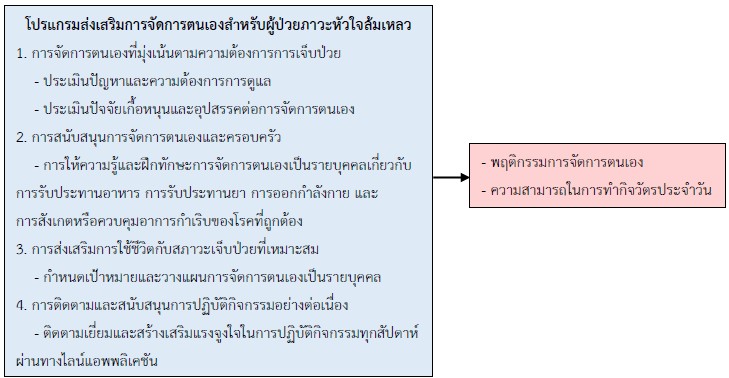
การวิจัยกึ่งทดลองนี้มีวัตถุประสงค์เพื่อศึกษาผลของโปรแกรมการส่งเสริมการจัดการตนเองผ่านแอพพลิเคชันต่อพฤติกรรมการจัดการตนเองและความสามารถในการทำกิจวัตรประจำวันของผู้ป่วยภาวะหัวใจล้มเหลวกลุ่มตัวอย่าง ได้แก่ ผู้ป่วยภาวะหัวใจล้มเหลว จำนวน 48 คน ทำการสุ่มอย่างง่าย ได้กลุ่มทดลอง 24 คน และกลุ่มควบคุม 24 คน เครื่องมือที่ใช้ในการดำเนินการวิจัย ได้แก่ โปรแกรมส่งเสริมการจัดการตนเองผ่านแอพพลิเคชันสำหรับผู้ป่วยภาวะหัวใจล้มเหลวที่ผู้วิจัยพัฒนาขึ้น เครื่องมือที่ใช้ในการเก็บรวบรวมข้อมูล ได้แก่ แบบสอบถามข้อมูลส่วนบุคคล แบบประเมินพฤติกรรมการจัดการตนเอง และแบบประเมินความสามารถในการปฏิบัติกิจวัตรประจำวัน วิเคราะห์ข้อมูลทั่วไป โดยสถิติเชิงพรรณนา เปรียบเทียบคะแนนเฉลี่ยพฤติกรรมการจัดการตนเองและความสามารถในการทำกิจวัตรประจำวันก่อนและหลังการทดลองของกลุ่มทดลองโดยใช้สถิติ Dependent t-test และหลังการทดลองระหว่างกลุ่มทดลองและกลุ่มควบคุม โดยใช้สถิติ Independent t-test
ผลการวิจัย พบว่า ภายหลังการทดลอง กลุ่มทดลองมีคะแนนเฉลี่ยพฤติกรรมการจัดการตนเอง และความสามารถในการทำกิจวัตรประจำวันสูงกว่าก่อนการทดลองอย่างมีนัยสำคัญทางสถิติ (p-value < 0.001) และกลุ่มทดลองมีคะแนนเฉลี่ยพฤติกรรมการจัดการตนเองและความสามารถในการทำกิจวัตรประจำวันสูงกว่ากลุ่มควบคุมอย่างมีนัยสำคัญทางสถิติ (p-value < 0.001) จากผลการศึกษาสรุปได้ว่า โปรแกรมการส่งเสริมการจัดการตนเองผ่านแอพพลิเคชัน ช่วยให้ผู้ป่วยภาวะหัวใจล้มเหลวมีพฤติกรรมการจัดการตนเองและความสามารถในการทำกิจวัตรประจำวันได้อย่างมีประสิทธิภาพ
เอกสารอ้างอิง
กระทรวงสาธารณสุข. (2565). สถิติสาธารณสุข 2565. นนทบุรี: กองยุทธศาสตร์และแผนงาน กระทรวงสาธารณสุข.
โรงพยาบาลสันทราย. (2566). จำนวนผู้ป่วยที่เข้ารับการรักษาในโรงพยาบาล ประจำปี 2566. เชียงใหม่:โรงพยาบาลสันทราย.
ลดาวัลย์ ฤทธิ์กล้า, ชดช้อย วัฒนะ และพีระพิงค์ กิติภาวงค์. (2555). ผลของโปรแกรมการส่งเสริมการจัดการตนเองต่อพฤติกรรมการจัดการตนเอง ภาวะหายใจลำบาก ความสามารถในการทำกิจวัตรประจำวันและคุณภาพชีวิตของผู้ป่วยภาวะหัวใจล้มเหลว. พยาบาลสาร, 39(1), 64-76.
สมาคมแพทย์โรคหัวใจแห่งประเทศไทย. (2562). แนวทางเวชปฏิบัติเพื่อการวินิจฉัยและการดูแลรักษาผู้ป่วย ภาวะหัวใจล้มเหลว พ.ศ. 2562. สมุทรปราการ: ห้างหุ้นส่วนจำกัด เนคสเปต ดีไซน์.
สุทธิชัย จิตะพันธ์กุล. (2541). หลักสำคัญของเวชศาสตร์ผู้สูงอายุ. กรุงเทพฯ: สาขาวิชาเวชศาสตร์ผู้สูงอายุและพฤฒาวิทยา จุฬาลงกรณ์มหาวิทยาลัย.
Abdolahi, M., Doustmohamadi, M. M., & Sheikhbardsiri, H. (2020). The Effect of an educational plan based on the Roy adaptation model for fatigue and activities of daily living of patients with heart failure disease. Ethiopian Journal of Health Sciences, 30(4), 559-566. https://doi.org/10.4314/ejhs.v30i4.11
Amirova, A., Lucas, R., Cowie, M. R., & Haddad, M. (2022). Perceived barriers and enablers influencing physical activity in heart failure: A qualitative one-to-one interview study. PloS One, 17(8), 1-21. https://doi.org/10.1371/journal.pone.0271743
Arrigo, M., et al. (2020). Acute heart failure. Nature reviews. Disease Primers, 6(1), 1-33. https://doi.org/10.1038/s41572-020-0151-7
Chang, H. C., et al. (2020). Nocturnal thoracic volume overload and post-discharge outcomes in patients hospitalized for acute heart failure. ESC Heart Failure, 7(5), 2807-2817. https://doi.org/10.1002/ehf2.12881
Faul, F., Erdfelder, E., Lang, A.-G., & Buchner, A. (2007). G*Power 3: A flexible statistical power analysis program for the social, behavioral, and biomedical sciences. Behavior Research Methods, 39, 175-191. https://doi.org/10.3758/bf03193146
Ghizzardi, G., Arrigoni, C., Dellafiore, F., Vellone, E., & Caruso, R. (2022). Efficacy of motivational interviewing on enhancing self-care behaviors among patients with chronic heart failure: A systematic review and meta-analysis of randomized controlled trials. Heart Failure Reviews, 27(4), 1029-1041. https://doi.org/10.1007/s10741-021-10110-z
Gray, J. R., Grove, S. K., & Sutherland, S. (2017). Burns & Grove’s the practice of nursing research: Appraisal, synthesis, and generation of evidence (8th Edition). Elsevier: St. Louis.
Grey, M., Schulman-Green, D., Knafl, K., & Reynolds, N. R. (2015). A revised Self- and Family Management Framework. Nursing Outlook, 63(2), 162-170. https://doi.org/10.1016/j.outlook.2014.10.003
Heo, S., et al. (2021). Self-care strategies and interventions needed in patients with heart failure: from patient perspectives-a qualitative study. European Journal of Cardiovascular Nursing, 20(6), 540-546. https://doi.org/10.1093/eurjcn/zvaa033
Hsu, M. Y., Chiang, C. W., & Chiou, A. F. (2021). The effects of a self-regulation programme on self-care behavior in patients with heart failure: A randomized controlled trial. International Journal of Nursing Studies, 116, 103778. https://doi.org/10.1016/j.ijnurstu.2020.103778
Jaarsma, T, et al., (2021). Self-care of heart failure patients: Practical management recommendations from the heart failure association of the European society of cardiology. European Journal of Heart Failure, 23(1), 157-174. https://doi.org/10.1002/ejhf.2008
Jiang, Y., et al. (2021). Patients' experiences of a nurse-led, home-based heart failure self-management program: findings from a qualitative process evaluation. Journal of Medical Internet Research, 23(4), e28216. https://doi.org/10.2196/28216
King, C., Khamis, A., Ross, J., Murtagh, F. E. M., Johnson, M. J., & Ramsenthaler, C. (2022). Concurrent validity and prognostic Utility of the needs assessment tool: Progressive disease heart failure. Journal of Pain and Symptom Management, 63(5), 635-644. https://doi.org/10.1016/j.jpainsymman.2022.01.014
Liljeroos, M., et al. (2020). Trajectory of self-care behavior in patients with heart failure: The impact on clinical outcomes and influencing factors. European Journal of Cardiovascular Nursing, 19(5), 421-432. https://doi.org/10.1177/1474515120902317
Liu, W., Zhang, Y., Liu, H. J., Song, T., & Wang, S. (2022). Influence of health education based on IMB on prognosis and self-management behavior of patients with chronic heart failure. Computational and Mathematical Methods in Medicine, 2022, 1-20. https://doi.org/10.1155/2022/8517802
Mahoney, F. I., & Barthel, D. W. (1965). Functional evaluation: The Barthel index. Maryland State Medical Journal, 14, 61-65.
McHorney, C. A., et al. (2021). The impact of heart failure on patients and caregivers: A qualitative study. PloS One, 16(3), 1-19. https://doi.org/10.1371/journal.pone.0248240
Meng, X., Wang, Y., Tang, X., Gu, J., & Fu, Y. (2021). Self-management on heart failure: A meta-analysis. Diabetes & Metabolic Syndrome, 15(4), 1-27. https://doi.org/10.1016/j.dsx.2021.06.013
Peyman, N., Shahedi, F., Abdollahi, M., Doosti, H., & Zadehahmad, Z. (2020). Impact of self-efficacy strategies education on self-care behaviors among heart failure patients. The Journal of Tehran Heart Center, 15(1), 6-11.
Purnamawati, D. A., Arofiati, F., & Relawati, A. (2020). Effect of supportive-educative system of activity daily living (ADL) in heart failure patients. Journal of Physics: Conference Series, 1477(6), 062001. https://doi.org/10.1088/1742-6596/1477/6/062001
Tsao, C. W., et al. (2023). Heart disease and stroke statistics-2023 update: A report from the American Heart Association. Circulation, 147(8), e93-e621. https://doi.org/10.1161/CIR.0000000000001123
Vainauskiene, V. & Vaitkiene, R. (2021). Enablers of patient knowledge empowerment for self-management of chronic disease: An integrative review. International Journal of Environmental Research and Public Health, 18(5), 1-24. https://doi.org/10.3390/ijerph18052247
van der Meer, P., Gaggin, H. K., & Dec, G. W. (2019). ACC/AHA versus ESC guidelines on heart failure: JACC guideline comparison. Journal of the American College of Cardiology, 73(21), 2756-2768. https://doi.org/10.1016/j.jacc.2019.03.478
van Leunen, M. M. C. J., et al. (2023). Telerehabilitation in patients with recent hospitalization due to acute decompensated heart failure: Protocol for the Tele-ADHF randomized controlled trial. BMC Cardiovascular Disorders, 23(1), 379-390. https://doi.org/10.1186/s12872-023-03407-4
Vellone, E., et al. (2020). Motivational interviewing to improve self-care in heart failure patients (MOTIVATE-HF): a randomized controlled trial. ESC Heart Failure, 7, 1309-1318. https://doi.org/10.1002/ehf2.12733
Zaharova, S., Litwack, K., Gopalakrishnan, S., Ellis, J., & Saltzberg, M. T. (2022). Self-management in heart failure: The importance of self-regulation but not complexity of condition. Western Journal of Nursing Research, 44(4), 375-382. https://doi.org/10.1177/0193945921997428
ดาวน์โหลด
เผยแพร่แล้ว
รูปแบบการอ้างอิง
ฉบับ
ประเภทบทความ
สัญญาอนุญาต
ลิขสิทธิ์ (c) 2024 วารสารวิจัยการพยาบาลและการสาธารณสุข

อนุญาตภายใต้เงื่อนไข Creative Commons Attribution-NonCommercial-NoDerivatives 4.0 International License.
1. บทความหรือข้อคิดเห็นใด ๆ ที่ปรากฏในวารสารวิจัยการพยาบาลและการสาธารณสุข ที่เป็นวรรณกรรมของผู้เขียน บรรณาธิการไม่จำเป็นต้องเห็นด้วย
2. บทความที่ได้รับการตีพิมพ์ถือเป็นลิขสิทธิ์ของ วารสารวิจัยการพยาบาลและการสาธารณสุข
 Indexed in TCI