อายุและพฤติกรรมการดูแลตนเองเพื่อคงภาวะสุขภาพของผู้ป่วยโรคหลอดเลือดหัวใจ: เปรียบเทียบระหว่างวัยผู้ใหญ่และผู้สูงอายุ
คำสำคัญ:
อายุ, การดูแลตนเองเพื่อคงภาวะสุขภาพ, โรคหลอดเลือดหัวใจ, ผู้ใหญ่, ผู้สูงอายุบทคัดย่อ
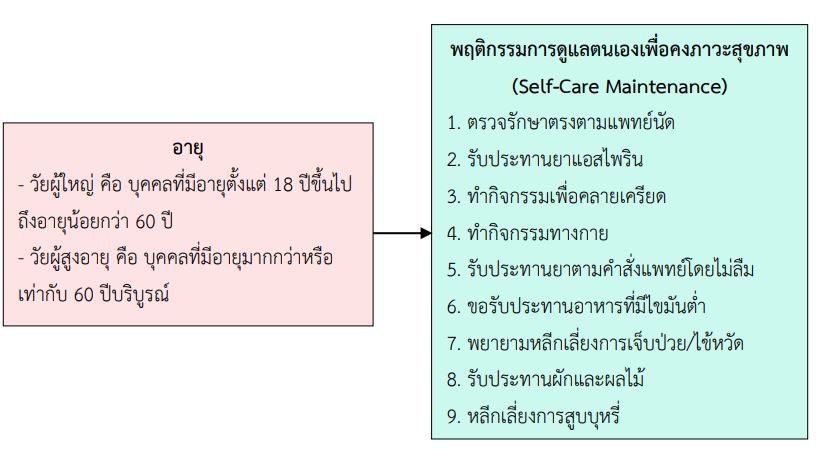
การวิจัยเชิงสำรวจแบบภาคตัดขวางนี้มีวัตถุประสงค์เพื่อศึกษาผลของปัจจัยด้านอายุและพฤติกรรมการดูแลตนเองเพื่อคงภาวะสุขภาพของผู้ป่วยโรคหลอดเลือดหัวใจวัยผู้ใหญ่และผู้สูงอายุ และเปรียบเทียบคะแนนและอัตราส่วนพฤติกรรมการดูแลตนเองเพื่อคงภาวะสุขภาพของผู้ป่วยโรคหลอดเลือดหัวใจวัยผู้ใหญ่และผู้สูงอายุ โดยใช้ข้อมูลทุติยภูมิ กลุ่มตัวอย่าง ได้แก่ ผู้ป่วยที่ได้รับการวินิจฉัยเป็นโรคหลอดเลือดหัวใจ จำนวน 401 ราย เครื่องมือใช้ในการเก็บรวบรวมข้อมูล ได้แก่ แบบสอบถามพฤติกรรมการดูแลตนเองเพื่อคงภาวะสุขภาพ มีค่าความเชื่อมั่นสัมประสิทธิ์แอลฟาของครอนบาคเท่ากับ 0.80 วิเคราะห์ข้อมูลเปรียบเทียบคะแนนเฉลี่ย และอัตราพฤติกรรมการดูแลตนเองเพื่อคงภาวะสุขภาพระหว่างกลุ่มวัยผู้ใหญ่และผู้สูงอายุ โดยใช้สถิติ Independent t-test, Chi-Square และ Odd Ratio
ผลการวิจัยพบว่า ผู้ป่วยโรคหลอดเลือดหัวใจมีคะแนนเฉลี่ยพฤติกรรมการดูแลตนเองเพื่อคงภาวะสุขภาพโดยรวมเหมาะสมเท่ากับ 80.50 คะแนน (S.D. = 14.57) ซึ่งวัยผู้ใหญ่มีคะแนนเฉลี่ยพฤติกรรมการดูแลตนเองโดยรวมเหมาะสมมากกว่าผู้สูงอายุอย่างมีนัยสำคัญทางสถิติ และอัตราส่วนพฤติกรรมการดูแลตนเองเพื่อคงภาวะสุขภาพโดยรวมที่เหมาะสมในวัยผู้ใหญ่สูงกว่าวัยสูงอายุ (OR = 1.30 95%CI: 1.07-1.58) เมื่อพิจารณารายด้าน พบว่าพฤติกรรมการไปตรวจรักษาตรงตามแพทย์นัด (OR = 1.55 95%CI: 1.30-1.86) รับประทานยาแอสไพรินหรือยาต้านการแข็งตัวของเลือด (OR = 1.28 95%CI: 1.06-1.55) ทำกิจกรรมทางกาย (OR = 1.26 95%CI: 1.05-1.52) รับประทานยาตามคำสั่งแพทย์ โดยไม่ลืมรับประทานยา (OR = 1.43 95%CI: 1.19-1.71) พยายามหลีกเลี่ยงการเจ็บป่วย (เช่น ฉีดวัคซีนไข้หวัด ล้างมือ) (OR = 1.45 95%CI: 1.20-1.74) ในวัยผู้ใหญ่มีอัตราส่วนพฤติกรรมการดูแลตนเองที่เหมาะสมมากกว่าวัยสูงอายุ และไม่แตกต่างกันในอีก 4 ด้านที่เหลือ ดังนั้น ควรมีการพัฒนารูปแบบส่งเสริมพฤติกรรมการดูแลตนเองของผู้สูงอายุ โดยเน้นการมาตรวจรักษาตรงแพทย์นัด การรับประทานยาต่อเนื่อง ส่งเสริมการออกแรงกิจกรรมทางกาย รวมไปถึงการเข้าถึงวัคซีนไข้หวัด และวิธีการป้องกันการเจ็บป่วย
เอกสารอ้างอิง
กมลชนก จี้อาทิตย์ และยุพา วงศ์รสไตร. (2566). ผลของโปรแกรมการจัดการตนเองของบุคคลและครอบครัวด้านการออกกำลังกายต่อพฤติกรรมการออกกำลังกายและความสามารถในการออกกำลังกายของผู้สูงอายุภายหลังได้รับการขยายหลอดเลือดหัวใจ. วารสารสภาการพยาบาล, 38(3), 160-181.
ชญาณี สุวรรณสา, วารี กังใจ และสหัทยา รัตนจรณะ. (2566). ปัจจัยที่มีความสัมพันธ์กับพฤติกรรมการจัดการตนเองของผู้สูงอายุโรคหลอดเลือดหัวใจ. วารสารคณะพยาบาลศาสตร์ มหาวิทยาลัยบูรพา, 31(1), 70-80.
ชนิดา ลบแย้ม, อัจฉริยา พ่วงแก้ว, ดวงรัตน์ วัฒนกิจไกรเลิศ และศรีสกุล จิรกาญจนากร. (2566). ปัจจัยทำนายกิจกรรมทางกายในผู้ป่วยภาวะหัวใจล้มเหลว. วารสารสภาการพยาบาล, 38(1), 112-128.
ชาคริญาณ์ บุญเกื้อ, ดวงรัตน์ วัฒนกิจไกรเลิศ, ศรินรัตน์ ศรีประสงค์ และฉัตรกนก ทุมวิภาต. (2564). ปัจจัยทำนายความร่วมมือในการรับประทานยาต้านเกล็ดเลือดสองชนิด ในผู้ป่วยภาวะหัวใจขาดเลือดเฉียบพลันหลังทำหัตถการขยายหลอดเลือดหัวใจ. วารสารพยาบาลศาสตร์, 40(3), 60-75.
ทรัพย์ทวี หิรัญเกิด, อณัญญา ลาลุน และธรณินทร์ คุณแขวน. (2564). ปัจจัยที่มีอิทธิพลต่อพฤติกรรมการดูแลตนเองของผู้ป่วยโรคหลอดเลือดหัวใจที่มารับบริการโรงพยาบาลแก้งคร้อ จังหวัดชัยภูมิ. วารสารการพยาบาลและการดูแลสุขภาพ, 39(2), 97-106.
ลภัสรดา นาชัย, ศรินรัตน์ ศรีประสงค์, จงจิต เสน่หา และธรรมรัฐ ฉันทแดนสุวรรณ. (2565). ปัจจัยทำนายพฤติกรรมการดูแลตนเองของผู้ป่วยโรคหลอดเลือดหัวใจ. วารสารสภาการพยาบาล, 37(3), 93-108.
วัชราภรณ์ เปาโรหิตย์, ธัญรดี ปราบริปู, กิตติยา มหาวิริโยทัย และฉัตรวารินทร์ บุญเดช. (2566). ปัญหาการใช้ยาของผู้ป่วยสูงอายุที่มีโรคเรื้อรังที่มารับบริการในคลินิกอายุรกรรมโรงพยาบาลภูมิพลอดุลยเดช. ราชาวดีสาร วิทยาลัยพยาบาลบรมราชชนนี, 13(2), 48-63.
อรุณศรี รัตนพรหม, นิตยา ศรีสุข และนฤเบศร์ โกศล. (2566). พฤติกรรมการดูแลตนเองของผู้ป่วยโรคหลอดเลือดหัวใจหลังทำหัตถการสวนขยายหลอดเลือดหัวใจ. วารสารพยาบาลศาสตร์, 41(4), 56-72.
Alonso Salinas, G. L., et al. (2024). The impact of geriatric conditions in elderly patients with coronary heart disease: A state-of-the-art review. Journal of Clinical Medicine, 13(7), 1891. https://doi.org/10.3390/jcm13071891
Al-Sutari, M. & Ahmad, M. (2022). Predictors of adherence to self-care behaviors among patients with coronary heart disease. Nursing Practice Today, 9(2), 145-157. https://doi.org/10.18502/npt.v9i2.8897
Belitardo, J. N. & Ayoub, A. C. (2015). Identification of readmission predictors in elderly patients with acute coronary syndrome. International Journal of Cardiovascular Sciences, 28(2), 139-47. https://doi.org/10.5935/2359-4802.20150016
Bhugra, P., et al. (2021). Determinants of influenza vaccine uptake in patients with cardiovascular disease and strategies for improvement. Journal of the American Heart Association, 10(15), e019671. https://doi.org/10.1161/JAHA.120.019671
Borges, K., Yassuda, M., Cesari, M., & Aprahamian, I. (2019). The relationship between physical frailty and mild cognitive impairment in the elderly: A systematic review. The Journal of Frailty & Aging, 8(4), 192-197. https://doi.org/10.14283/jfa.2019.29
Cacciatore, S., Martone, A. M., Landi, F., & Tosato, M. (2023). Acute coronary syndrome in older adults: An update from the 2022 scientific statement by the American Heart Association. Heart, Vessels and Transplantation, 7(1), 7-10. https://doi.org/10.24969/hvt.2023.367
Camici, G. G. & Liberale, L. (2017). Aging: The next cardiovascular disease. European Heart Journal, 38(21), 1621-1623. https://doi.org/10.1093/eurheartj/ehx239
Di Matteo, R., et al. (2024). Self-care behaviors and their determinants in people affected by coronary heart disease. Journal of Clinical Nursing, 00, 1-12. https://doi.org/10.1111/jocn.17299
Dickson, V. V., et al. (2023). Psychometric testing of the self-care of coronary heart disease inventory version 3.0. Journal of Cardiovascular Nursing, 38(4), E131-E140. https://doi.org/10.1097/JCN.0000000000000952
Dickson, V. V., Jun, J., & Melkus, G. D. E. (2021). A mixed methods study describing the self-care practices in an older working population with cardiovascular disease (CVD): Balancing work, life and health. Heart & Lung, 50(3), 447-454. https://doi.org/10.1016/j.hrtlng.2021.02.001
Goyal, P., et al. (2016). Patterns of scheduled follow-up appointments following hospitalization for heart failure: Insights from an urban medical center in the United States. Clinical Interventions in Aging, 1325-1332. https://doi.org/10.2147/CIA.S113442
Ingadóttir, B., Svavarsdóttir, M. H., Jurgens, C. Y., & Lee, C. S. (2024). Self-care trajectories of patients with coronary heart disease: A longitudinal, observational study. European Journal of Cardiovascular Nursing, zvae055. https://doi.org/10.1093/eurjcn/zvae055
Knapik, A., Dąbek, J., & Brzęk, A. (2019). Kinesiophobia as a problem in adherence to physical activity recommendations in elderly polish patients with coronary artery disease. Patient Preference and Adherence, 13, 2129-2135. https://doi.org/10.2147/PPA.S216196
Koson, N., Srisuk, N., Rattanaprom, A., Thompson, D. R., & Ski, C. F. (2023). Psychometric evaluation of the Thai version of the self-care of coronary heart disease inventory version 3. European Journal of Cardiovascular Nursing, 22(3), 311-319. https://doi.org/10.1093/eurjcn/zvac069
Li, Y. L., et al. (2022). A readmission risk prediction model for elderly patients with coronary heart disease. Journal of Clinical and Nursing Research, 6(2), 126-133.
Muir, S. W., Gopaul, K., & Montero Odasso, M. M. (2012). The role of cognitive impairment in fall risk among older adults: A systematic review and meta-analysis. Age and Ageing, 41(3), 299-308. https://doi.org/10.1093/ageing/afs012
Nurdina, G., Daulati, T., & Herdiman, H. (2023). Factors affecting medical adherence in patients with coronary heart disease. Jurnal Keperawatan Komprehensif, 9(2), 157-165. https://doi.org/10.33755/jkk.v9i2.499
Oliveira, L. M. S. M., et al. (2019). Readmission of patients with acute coronary syndrome and determinants. Arquivos Brasileiros de Cardiologia, 113, 42-49. https://doi.org/10.5935/abc.20190104
Pietraszek, A., Sobieszczańska, M., Makuch, S., Dróżdż, M., Mazur, G., & Agrawal, S. (2022). Identification of barriers limiting the use of preventive vaccinations against influenza among the elderly population: A cross-sectional analysis. Vaccines, 10(5), 651. https://doi.org/10.3390/vaccines10050651
Polsook, R. & Aungsuroch, Y. (2021). A cross-sectional study of factors predicting readmission in Thais with coronary artery disease. Journal of Research in Nursing, 26(4), 293-304. https://doi.org/10.1177/1744987120946792
Riegel, B., Dickson, V. V., & Vellone, E. (2022). The Situation-Specific Theory of heart failure self-care: An Update on the Problem, Person, and Environmental Factors Influencing Heart failure self-care. The Journal of Cardiovascular Nursing, 37(6), 515-529. https://doi.org/10.1097/JCN.0000000000000919
Riegel, B., et al. (2017). Self-care for the prevention and management of cardiovascular disease and stroke a scientific statement for healthcare professionals from the American Heart Association. Journal of the American Heart Association, 6(9), e006997. https://doi.org/10.1161/JAHA.117.006997
Riegel, B., et al. (2021). Characteristics of self-care interventions for patients with a chronic condition: A scoping review. International Journal of Nursing Studies, 116, 103713. https://doi.org/10.1016/j.ijnurstu.2020.103713
Riegel, B., Jaarsma, T., & Strömberg, A. (2012). A middle-range theory of self-care of chronic illness. Advances in Nursing Science, 35(3), 194-204. https://doi.org/10.1097/ANS.0b013e318261b1ba
Riegel, B., Jaarsma, T., Lee, C. S., & Strömberg, A. (2019). Integrating symptoms into the middle-range theory of self-care of chronic illness. Advances in Nursing Science, 42(3), 206-215.
Sigamani, A. & Gupta, R. (2022). Revisiting secondary prevention in coronary heart disease. Indian Heart Journal, 74(6), 431-440. https://doi.org/10.1016/j.ihj.2022.11.011
Tabachnick, B. G., & Fidell, L.S. (2007). Using Multivariate Statistics (5th ed.). New York: Allyn and Bacon.
Wang, Y., et al. (2023). Cognitive function and cardiovascular health in the elderly: Network analysis based on hypertension, diabetes, cerebrovascular disease, and coronary heart disease. Frontiers in Aging Neuroscience, 15, 1229559. https://doi.org/10.3389/fnagi.2023.1229559
Yeung, M. P., Lam, F. L., & Coker, R. (2016). Factors associated with the uptake of seasonal influenza vaccination in adults: A systematic review. Journal of Public Health, 38(4), 746-753. https://doi.org/10.1093/pubmed/fdv194
Zhang, N., et al. (2019). Prevalence and prognostic implications of sarcopenia in older patients with coronary heart disease. Journal of Geriatric Cardiology, 16(10), 756-763. https://doi.org/10.11909/j.issn.1671-5411.2019.10.002
Zuo, W. & Wu, J. (2022). The interaction and pathogenesis between cognitive impairment and common cardiovascular diseases in the elderly. Therapeutic Advances in Chronic Disease, 13, 20406223211063020. https://doi.org/10.1177/20406223211063020
ดาวน์โหลด
เผยแพร่แล้ว
รูปแบบการอ้างอิง
ฉบับ
ประเภทบทความ
สัญญาอนุญาต
ลิขสิทธิ์ (c) 2024 วารสารวิจัยการพยาบาลและการสาธารณสุข

อนุญาตภายใต้เงื่อนไข Creative Commons Attribution-NonCommercial-NoDerivatives 4.0 International License.
1. บทความหรือข้อคิดเห็นใด ๆ ที่ปรากฏในวารสารวิจัยการพยาบาลและการสาธารณสุข ที่เป็นวรรณกรรมของผู้เขียน บรรณาธิการไม่จำเป็นต้องเห็นด้วย
2. บทความที่ได้รับการตีพิมพ์ถือเป็นลิขสิทธิ์ของ วารสารวิจัยการพยาบาลและการสาธารณสุข
 Indexed in TCI