การบูรณาการเทคโนโลยีความเป็นจริงและความเป็นจริงเสริม ในการจำลองสถานการณ์ทางการพยาบาล: ความท้าทายในการศึกษาพยาบาล
คำสำคัญ:
การจำลองสถานการณ์, การศึกษาพยาบาล, ความเป็นจริงเสมือน, ความเป็นจริงเสริม, นวัตกรรมการเรียนการสอนบทคัดย่อ
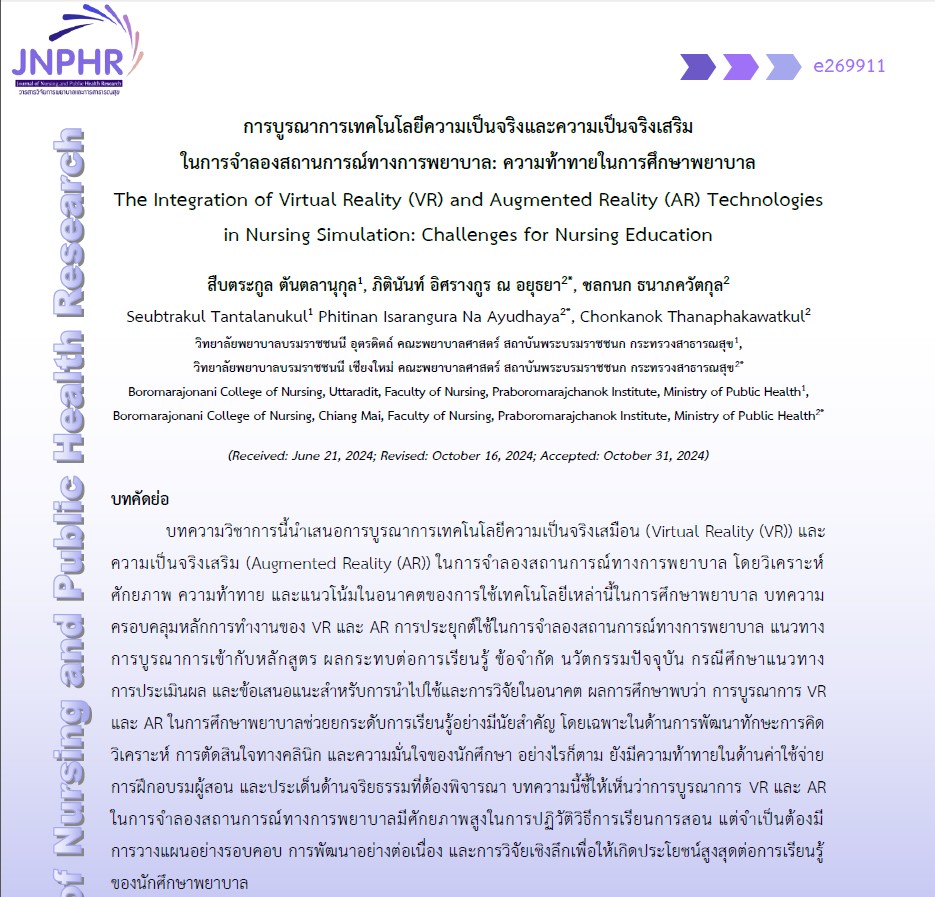
บทความวิชาการนี้นำเสนอการบูรณาการเทคโนโลยีความเป็นจริงเสมือน (Virtual Reality (VR)) และความเป็นจริงเสริม (Augmented Reality (AR)) ในการจำลองสถานการณ์ทางการพยาบาล โดยวิเคราะห์ศักยภาพ ความท้าทาย และแนวโน้มในอนาคตของการใช้เทคโนโลยีเหล่านี้ในการศึกษาพยาบาล บทความครอบคลุมหลักการทำงานของ VR และ AR การประยุกต์ใช้ในการจำลองสถานการณ์ทางการพยาบาล แนวทางการบูรณาการเข้ากับหลักสูตร ผลกระทบต่อการเรียนรู้ ข้อจำกัด นวัตกรรมปัจจุบัน กรณีศึกษาแนวทางการประเมินผล และข้อเสนอแนะสำหรับการนำไปใช้และการวิจัยในอนาคต ผลการศึกษาพบว่า การบูรณาการ VR และ AR ในการศึกษาพยาบาลช่วยยกระดับการเรียนรู้อย่างมีนัยสำคัญ โดยเฉพาะในด้านการพัฒนาทักษะการคิดวิเคราะห์ การตัดสินใจทางคลินิก และความมั่นใจของนักศึกษา อย่างไรก็ตาม ยังมีความท้าทายในด้านค่าใช้จ่าย การฝึกอบรมผู้สอน และประเด็นด้านจริยธรรมที่ต้องพิจารณา บทความนี้ชี้ให้เห็นว่าการบูรณาการ VR และ AR ในการจำลองสถานการณ์ทางการพยาบาลมีศักยภาพสูงในการปฏิวัติวิธีการเรียนการสอน แต่จำเป็นต้องมีการวางแผนอย่างรอบคอบ การพัฒนาอย่างต่อเนื่อง และการวิจัยเชิงลึกเพื่อให้เกิดประโยชน์สูงสุดต่อการเรียนรู้ของนักศึกษาพยาบาล
เอกสารอ้างอิง
Chen, F. Q., et al. (2023). Effectiveness of virtual reality simulation in nursing education: A systematic review and meta-analysis. Nurse Education Today, 95, 104622. https//doi.org/10.1016/j.nedt.2022.104622
Chokprasanchai, T. (2023). Virtual Reality 360° and nursing education towards "Meta Nurse" [Special interview]. Ramathibodi School of Nursing, Faculty of Medicine Ramathibodi Hospital, Mahidol University. Retrived May 15, 2024 from https://www.rama.mahidol.ac.th/nursing/th/special-interview/15112023-0830.
Daley, B. J., Borum, V., Layton, K., & Loftin, C. (2022). Virtual and augmented reality in nursing education: A scoping review. Journal of Nursing Education, 61(2), 69-75. https//doi.org/10.3928/01484834-20220120-03
Dang, B. K., Palicte, J. S., Valdez, A., & O'Leary-Kelley, C. (2021). Assessing simulation, virtual reality, and television modalities in clinical training. Clinical Simulation in Nursing, 51, 35-41. https//doi.org/10.1016/j.ecns.2020.07.003
Eckert, M., Volmerg, J. S., & Friedrich, C. M. (2019). Augmented reality in medicine Systematic and bibliographic review. JMIR mHealth and uHealth, 7(4), e10967. https//doi.org/10.2196/10967
Fealy, S., et al. (2019). The integration of immersive virtual reality in tertiary nursing and midwifery education: A scoping review. Nurse Education Today, 79, 14-19. https//doi.org/10.1016/j.nedt.2019.05.002
Fogg, N., et al. (2021). Transitioning from direct care to virtual clinical experiences during the COVID-19 pandemic. Journal of Professional Nursing, 37(5), 685-691. https//doi.org/10.1016/j.profnurs.2021.03.015
Foronda, C. L., Fernandez-Burgos, M., Nadeau, C., Kelley, C. N., & Henry, M. N. (2020). Virtual simulation in nursing education: A systematic review spanning 1996 to 2018. Simulation in Healthcare, 15(1), 46-54. https//doi.org/10.1097/SIH.0000000000000411
Gerup, J., Soerensen, C. B., & Dieckmann, P. (2020). Augmented reality and mixed reality for healthcare education beyond surgery: An integrative review. International Journal of Medical Education, 11, 1-18. https//doi.org/10.5116/ijme.5e01.eb1a
Goldsworthy, S., Patterson, J. D., Dobbs, M., Afzal, A., & Deboer, S. (2019). How does simulation impact building competency and confidence in recognition and response to the adult and pediatric deteriorating patient among undergraduate nursing students? Clinical Simulation in Nursing, 28, 25-32. https//doi.org/10.1016/j.ecns.2018.12.001
Liaw, S. Y., et al. (2020). "Wow, I can do it!" development of a virtual reality system to enhance nursing students' self-efficacy in performing intravenous cannulation. Nurse Education in Practice, 49, 102887. https//doi.org/10.1016/j.nepr.2020.102887
Lioce, L., et al. (2020). Healthcare simulation dictionary (2nd ed.). Society for Simulation in healthcare. Retrived May 15, 2024 from https://www.ahrq.gov/sites/default/files/wysiwyg/patient-safety/resources/simulation/sim-dictionary-2nd.pdf.
Moro, C., Phelps, C., Redmond, P., & Stromberga, Z. (2021). HoloLens and mobile augmented reality in medical and health science education: A randomised controlled trial. British Journal of Educational Technology, 52(2), 680-694. https//doi.org/10.1111/bjet.13049
Pottle, J. (2019). Virtual reality and the transformation of medical education. Future Healthcare Journal, 6(3), 181-185. https//doi.org/10.7861/fhj.2019-0036
Prasad, S., Jain, A., & Aggarwal, A. (2022). Integration of virtual and augmented reality in medical education: A narrative review. Medical Teacher, 44(10), 1108-1116. https//doi.org/10.1080/0142159X.2022.2058901
Sapiano, A. B., Sammut, R., & Trapani, J. (2022). Effectiveness of virtual reality versus traditional clinical simulation in nursing education: A systematic review. Journal of Nursing Education and Practice, 12(4), 1-9. https//doi.org/10.5430/jnep.v12n4p1
Wang, S., et al. (2021). A virtual reality simulation training system adapted to 5G and Internet of Things networks for improving nursing skills for peripheral intravenous catheterization. International Journal of Nursing Sciences, 8(2), 176-184. https//doi.org/10.1016/j.ijnss.2021.03.007
Wüller, H., Behrens, J., Garthaus, M., Marquard, S., & Remmers, H. (2021). A scoping review of augmented reality in nursing. BMC Nursing, 20(1), 102. https//doi.org/10.1186/s12912-021-00608-0
ดาวน์โหลด
เผยแพร่แล้ว
รูปแบบการอ้างอิง
ฉบับ
ประเภทบทความ
สัญญาอนุญาต
ลิขสิทธิ์ (c) 2024 วารสารวิจัยการพยาบาลและการสาธารณสุข

อนุญาตภายใต้เงื่อนไข Creative Commons Attribution-NonCommercial-NoDerivatives 4.0 International License.
1. บทความหรือข้อคิดเห็นใด ๆ ที่ปรากฏในวารสารวิจัยการพยาบาลและการสาธารณสุข ที่เป็นวรรณกรรมของผู้เขียน บรรณาธิการไม่จำเป็นต้องเห็นด้วย
2. บทความที่ได้รับการตีพิมพ์ถือเป็นลิขสิทธิ์ของ วารสารวิจัยการพยาบาลและการสาธารณสุข
 Indexed in TCI