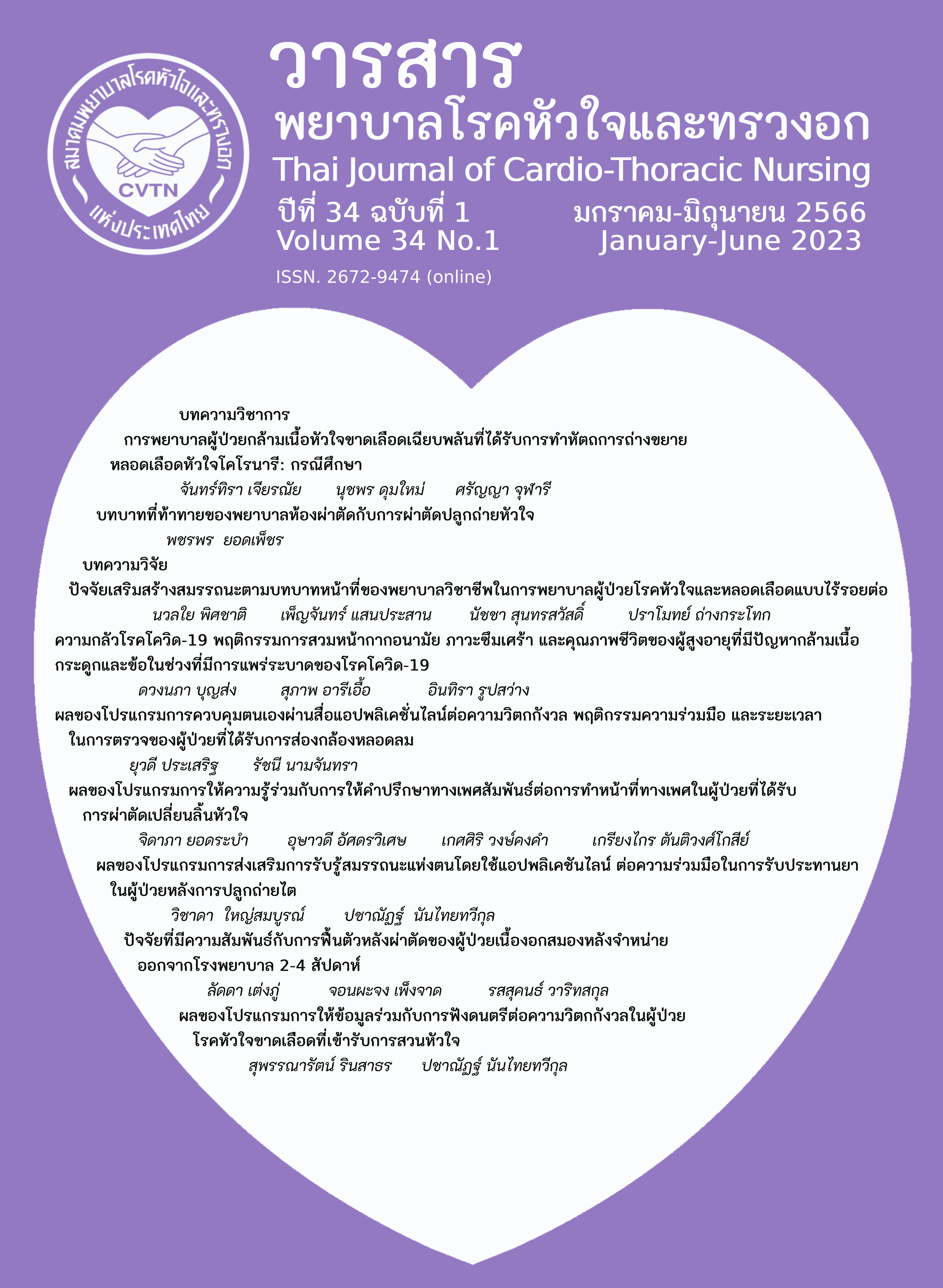
การพยาบาลผู้ป่วยกล้ามเนื้อหัวใจขาดเลือดเฉียบพลันที่ได้รับการทำหัตถการถ่างขยายหลอดเลือดหัวใจโคโรนารี: กรณีศึกษา
คำสำคัญ:
โรคกล้ามเนื้อหัวใจขาดเลือดเฉียบพลัน, การถ่างขยายหลอดเลือดโคโรนารี, การพยาบาลบทคัดย่อ
การทำหัตถการถ่างขยายหลอดเลือดโคโรนารี (Percutaneous coronary intervention: PCI) เป็นหนึ่งในวิธีการรักษาแบบไม่ต้องผ่าตัดสำหรับผู้ป่วยกล้ามเนื้อหัวใจขาดเลือดเฉียบพลันที่มีความปลอดภัย เป้าหมายของการทำหัตถการ PCI คือ ช่วยลดการตีบแคบหรือการอุดตันของหลอดเลือดหัวใจและช่วยให้มีเลือดไหลเวียนไปเลี้ยงกล้ามเนื้อหัวใจที่กำลังขาดเลือด อย่างไรก็ตามการทำ PCI เป็นหัตถการที่มีความซับซ้อนและมีความเสี่ยงต่อการเกิดภาวะแทรกซ้อนที่รุนแรงต่อผู้ป่วย พยาบาลมีบทบาทสำคัญในการดูแลผู้ป่วยที่ได้รับการรักษาด้วย PCI จึงมีความจำเป็นอย่างยิ่งที่พยาบาลต้องมีความรู้ และมีศักยภาพในการดูแลผู้ป่วยหลังได้รับการทำหัตถการถ่างขยายหลอดเลือดโคโรนารี ตลอดจนสามารถให้การพยาบาลอย่างถูกต้องตามมาตรฐาน เพื่อให้ผู้ป่วยรอดพ้นจากภาวะวิกฤติและป้องกันภาวะแทรกซ้อนที่อาจเกิดขึ้น บทความนี้จึงมีวัตถุประสงค์เพื่อนำเสนอความรู้เกี่ยวกับปัจจัยเสี่ยงของภาวะกล้ามเนื้อหัวใจขาดเลือดเฉียบพลัน การรักษาด้วยการทำหัตถการถ่างขยายหลอดเลือดโคโรนารี ภาวะแทรกซ้อนที่สำคัญหลังทำหัตถการ การพยาบาลผู้ป่วยหลังทำหัตถการ กรณีศึกษาที่นำเสนอจะเป็นแนวทางในการจัดการทางการพยาบาลสำหรับผู้ป่วย
เอกสารอ้างอิง
Collet JP, Thiele H, Barbato E, Barthélémy O, Bauersachs J, Bhatt DL, et al. 2020 ESC Guidelines for the management of acute coronary syndromes in patients presenting without persistent ST-segment elevation: the task force for the management of acute coronary syndromes in patients presenting without persistent ST-segment elevation of the European Society of Cardiology (ESC). Eur Heart J. 2021; 42(14): 1289-367.
Wang F, Yu Y, Mubarik S, Zhang Y, Liu X, Cheng Y, et al. Global burden of ischemic heart disease and attributable risk factors, 1990–2017: a secondary analysis based on the global burden of disease study 2017. Clin Epidemiol. 2021; 13: 859-70.
Tsao CW, Aday AW, Almarzooq ZI, Alonso A, Beaton AZ, Bittencourt MS, et al. Heart disease and stroke statistics—2022 update: a report from the American Heart Association. Circulation. 2022; 145(8): e153-639.
Mental Health Strategy and Planning Division, Ministry of Public Health. Public health statistics A.D.2020 [Internet]. 2020 [Cited 2022 Oct 18]. Available from: https://bps.moph.go.th/ new_bps/sites/default/files/2563_0.pdf (in Thai).
Health Information System Development Office, Ministry of Public Health. 10 Health situations A.D.2011 – 2020 [Internet]. 2020 [Cited 2022 Oct 18]. Available from: https:// www.hiso.or.th/thaihealthstat/analysis/10health/54_63/54_63_1.pdf (in Thai).
Puymirat E, Cayla G, Cottin Y, Elbaz M, Henry P, Gerbaud É, et al. Twenty-year trends in profile, management, and outcomes of patients with ST-segment elevation myocardial infarction according to use of reperfusion therapy: data from the FAST-MI program 1995-2015. Am Heart J. 2019; 214: 97-106.
Danchin N, Popovic B, Puymirat E, Goldstein P, Belle L, Cayla G, et al. Five-year outcomes following timely primary percutaneous intervention, late primary percutaneous intervention, or a pharmaco-invasive strategy in ST-segment elevation myocardial infarction: the FAST-MI programme. Am Heart J. 2020; 41(7): 858-66.
Lawton JS, Tamis-Holland JE, Bangalore S, Bates ER, Beckie TM, Bischoff JM, et al. 2021 ACC/AHA/SCAI guideline for coronary artery revascularization: A report of the American College of Cardiology/American Heart Association Joint Committee on clinical practice guidelines. J Am Coll Cardiol. 2022; 79(2): e21-129.
The Heart Association of Thailand under the Royal Patronage of H.M. Thai acute coronary syndromes guidelines 2020. Samut Prakan: Nextstep D-sign; 2020 (in Thai).
Prakash B, Jaiswal A, Shah MM. Demographic & angiographic profile of young patients aged 40 year & less undergoing coronary angiography in a tier II city of Eastern India. J Family Med Prim care. 2020; 9(10): 5183-7.
Dugani SB, Hydoub YM, Ayala AP, Reka R, Nayfeh T, Ding JF, et al. Risk factors for premature myocardial infarction: a systematic review and meta-analysis of 77 studies. Mayo Clin Proc Innov Qual Outcomes. 2021; 5(4): 783-94.
Rodgers JL, Jones J, Bolleddu SI, Vanthenapalli S, Rodgers LE, Shah K, et al. Cardiovascular risks associated with gender and aging. J Cardiovasc Dev Dis. 2019; 6(2): 1-18.
Potts J, Sirker A, Martinez SC, Gulati M, Alasnag M, Rashid M, et al. Persistent sex disparities in clinical outcomes with percutaneous coronary intervention: insights from 6.6 million PCI procedures in the United States. PloS one. 2018; 13(9): e0203325.
Dwivedi AK, Dubey P, Cistola DP, Reddy SY. Association between obesity and cardiovascular outcomes: updated evidence from meta-analysis studies. Cur Cardiol Rep. 2020; 22(4): 1-19.
Hert DM, Detraux J, Vancampfort D. The intriguing relationship between coronary heart disease and mental disorders. Dialogues Clin Neurosci. 2022; 20: 31-40.
Vaccarino V, Badimon L, Bremner JD, Cenko E, Cubedo J, Dorobantu M, et al. Depression and coronary heart disease: 2018 position paper of the ESC working group on coronary pathophysiology and microcirculation. Eur Heart J. 2020; 41(17): 1687-96.
Ellinas H. Disorders of cardiac function, and heart failure and circulatory shock. In: Norris TL, Editor. Porth’s pathophysiology: concepts of altered health states. 10th ed. Philadelphia: Wolters Kluwer; 2019. pp. 753-90.
Alnefaie Z, Barakat R, Aljabri B, Almontashiri A, Jikhaidib M, Alsharif M, et al. Prognosis, complications and quality of life after fibrinolysis versus PCI post MI. Middle East J Intern Med. 2018; 11(2): 9-13.
Vallabhajosyula S, Verghese D, Bell MR, Murphree DH, Cheungpasitporn W, Miller PE, et al. Fibrinolysis vs. primary percutaneous coronary intervention for ST‐segment elevation myocardial infarction cardiogenic shock. ESC Heart Fail. 2021; 8(3): 2025-35.
Knuuti J, Revenco V. 2019 ESC Guidelines for the diagnosis and management of chronic coronary syndromes. Eur Heart J. 2020; 41(5): 407-77.
Khanra D, Mishra V, Jain B, Soni S, Bahurupi Y, Duggal B, et al. Percutaneous coronary intervention provided better long term results than optimal medical therapy alone in patients with chronic total occlusion: a meta-analysis. Indian Heart J. 2020; 72(4): 225-31.
Navarese EP, Lansky AJ, Kereiakes DJ, Kubica J, Gurbel PA, Gorog DA, et al. Cardiac mortality in patients randomised to elective coronary revascularization plus medical therapy or medical therapy alone: a systematic review and meta-analysis. Eur Heart J. 2021; 42(45): 4638-51.
Prateepmanowong J, Chouyboon S, Nareumanphokin N. Nursing care for patients undergoing transradial cardiac catheterization: case study. Thai Journal of Cardio-Thorac Nursing. 2019; 30(2): 2-14 (in Thai).
Nantasukhon A, Ausawakijpanich S, Siripittayakunkit A. A study of the patients’ vascular complications and pain after cardiac catheterization between transfemoral artery and transradial artery approach at post catheterization care unit, Ramathibodi hospital. Mahidol R2R e-Journal. 2019; 6(2): 42-54 (in Thai).
Chiarito M, Cao D, Nicolas J, Roumeliotis A, Power D, Chandiramani R, et al. Radial versus femoral access for coronary interventions: An updated systematic review and meta‐analysis of randomized trials. Catheter Cardiovasc Interv. 2021; 97(7): 1387-96.
Mikhail P, Howden N, Monjur M, Jeyaprakash P, Said C, Bland A, et al. Coronary perforation incidence, outcomes and temporal trends (COPIT): a systematic review and meta-analysis. Open Heart. 2022; 9(2): e002076.
Mefford CL. Disorders of blood flow and blood pressure regulation. In: Norris TL, Editor. Porth’s pathophysiology: concepts of altered health states. 10th ed. Philadelphia: Wolters Kluwer; 2019. pp. 713-52.
Snyder ML, Coombs VJ, Barquist KC, Bullard T, Hammer B, Spannbauer LM, et al. Patient management: cardiovascular system. In: Morton PG, Fortaine DK, Editors. Critical care nursing: a holistic approach. 11th edition. Philadelphia: Wolters Kluwer Health; 2018. pp.261-68.
Curran A. Cardiac catheterization nursing diagnosis and nursing care plan. [Internet]. 2023 [Cited 2023 Jun 8]. Available from: https://nursestudy.net/cardiac-catheterization-nursing-diagnosis/?utm_content=expand _article
Salvador K, Wagner M. Myocardial infarction: Nursing diagnoses, care plans, assessment & interventions. [Internet]. 2023 [Cited 2023 Jun 8]. Available from: https://www.nursetogether. com/myocardial-infarction-nursing-diagnosis-care-plan/
Zhang T, Qi X. Greater nursing role for enhanced post-percutaneous coronary intervention management. Int. J. Gen. Med. 2021;14: 7115-20.
Watson TJ, Ong PJL, Tcheng JE. Primary angioplasty: a practice guide (eBook). 2023 [Cited 2023 Jun 8]. Available from: https://doi. org /10.1007/978-981-13-1114-7
ดาวน์โหลด
เผยแพร่แล้ว
รูปแบบการอ้างอิง
ฉบับ
ประเภทบทความ
สัญญาอนุญาต
ลิขสิทธิ์ (c) 2023 วารสารพยาบาลโรคหัวใจและทรวงอก

อนุญาตภายใต้เงื่อนไข Creative Commons Attribution-NonCommercial-NoDerivatives 4.0 International License.
บทความนี้ยังไม่เคยตีพิมพ์หรืออยู่ในระหว่างส่งไปตีพิมพ์ในวารสารอื่น ๆ มาก่อน และกองบรรณาธิการขอสงวนสิทธิ์ในการตรวจทาน และแก้ไขต้นฉบับตามเกณฑ์ของวารสาร ในกรณีที่เรื่องของท่านได้ได้รับการตีพิมพ์ในวารสารฉบับนี้ถือว่าเป็น ลิขสิทธิ์ของวารสารพยาบาลโรคหัวใจและทรวงอก