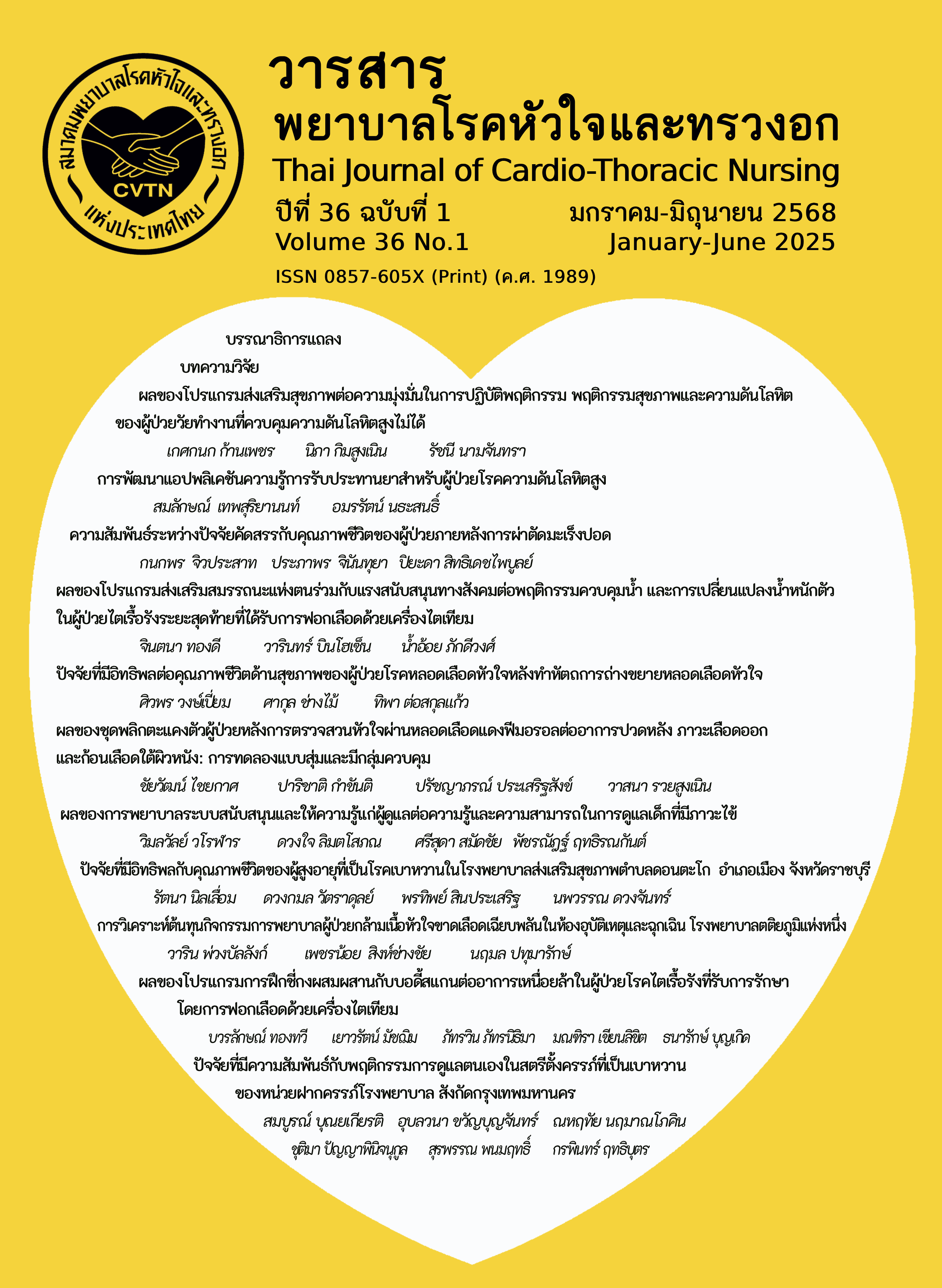
ผลของโปรแกรมส่งเสริมสมรรถนะแห่งตนร่วมกับแรงสนับสนุนทางสังคมต่อพฤติกรรมควบคุมน้ำและการเปลี่ยนแปลงน้ำหนักตัวในผู้ป่วยไตเรื้อรังระยะสุดท้ายที่ได้รับการฟอกเลือดด้วยเครื่องไตเทียม
คำสำคัญ:
สมรรถนะแห่งตน, แรงสนับสนุนทางสังคม, พฤติกรรมควบคุมน้ำ, น้ำหนักตัว, การฟอกเลือดด้วยเครื่องไตเทียมบทคัดย่อ
การวิจัยครั้งนี้เป็นการวิจัยแบบกึ่งทดลอง แบบหนึ่งกลุ่มวัดผลก่อนและหลังการทดลอง (One-group pretest-posttest design) โดยมีการวัดซ้ำ (Repeated measures) เพื่อศึกษาผลของโปรแกรมส่งเสริมสมรรถนะแห่งตนร่วมกับแรงสนับสนุนทางสังคมต่อพฤติกรรมควบคุมน้ำ และการเปลี่ยนแปลงน้ำหนักตัว ในผู้ป่วยไตเรื้อรังระยะสุดท้ายที่ได้รับการฟอกเลือดด้วยเครื่องไตเทียม กลุ่มตัวอย่างเลือกแบบเฉพาะเจาะจง จำนวน 11 คน ได้รับโปรแกรมฯ เป็นเวลา 8 สัปดาห์ เครื่องมือที่ใช้ในการเก็บรวมรวมข้อมูลประกอบด้วย แบบบันทึกข้อมูลส่วนบุคคลและข้อมูลการเจ็บป่วย แบบประเมินการรับรู้สมรรถนะแห่งตนในการควบคุมน้ำ แบบสอบถามแรงสนับสนุนทางสังคม แบบสอบถามพฤติกรรมการควบคุมน้ำ แบบบันทึกการเปลี่ยนแปลงน้ำหนักตัว วิเคราะห์ข้อมูลโดยใช้สถิติเชิง Friedman test และ Wilcoxon Signed Ranks test
ผลการวิจัยพบว่า ภายหลังได้รับโปรแกรมการส่งเสริมสมรรถนะแห่งตน กลุ่มตัวอย่างมีคะแนนเฉลี่ยพฤติกรรมการควบคุมนํ้าดีขึ้น และมีค่าเฉลี่ยการเปลี่ยนแปลงนํ้าหนักตัวลดลงเมื่อเทียบกับก่อนได้รับโปรแกรมอย่างมีนัยสำคัญทางสถิติ (p < 0.01)
งานวิจัยมีข้อเสนอแนะว่าควรนำโปรแกรมส่งเสริมสมรรถนะแห่งตนนี้ไปใช้ในการป้องกันการเกิดภาวะน้ำเกิน และควรมีการศึกษาติดตามพฤติกรรมการควบคุมน้ำและการเปลี่ยนแปลงน้ำหนักตัว เพื่อศึกษาการคงอยู่ของพฤติกรรมในระยะ 6 เดือน และ 1 ปี
เอกสารอ้างอิง
Maurya NK, Arya P, Kumari S, Sengar NS. A review: nutrition in chronic kidney disease patients. Int J Adv Res. 2018:5(3);97-108. doi:10.5281/zenodo.1423081
The Nephrology Society of Thailand. Annual report Thailand renal replacement therapy year 2007-2019 [Internet]. Bangkok: The Institute; 2021 [cited 2023 Jul 27]. Available from https://www.nephrothai.org/annual-report-thailand-renal-replacement-therapy-2007-2019-th
Gojaseni P, Tiranathanagul K, Chanchairujira T, Trakarnvanich T, Pajaree T, Vareesangthip K. Essentials in hemodialysis. Bangkok: Text and Journal Publication; 2014. (in Thai).
Masoudi R, Lotfizade M, Gheysarieha MR, Rabiei L. Evaluating the effect of Pender's health promotion model on self-efficacy and treatment adherence behaviors among patients undergoing hemodialysis. J Educ Health Promot. 2020; 9:138. doi:10.4103/jehp.jehp_747_19
Wongsree C, Krittiyawan J. An intensive educational program on therapeutic volume overload for end stage chronic renal disease patients receiving hemodialysis: hemodialysis nurses' roles. HCU Journal. 2017;21(41):137-50. (in Thai).
Suesoom R, Namjuntra R. Effects of a self-efficacy promotion program on fluid control behaviors and body weight changes in patients undergoing hemodialysis. Thai Red Cross Nursing Journal. 2018;11(2):188-203. (in Thai).
Zoccali C, Moissl U, Chazot C, Mallamaci F, Tripepi G, Arkossy O, et al. Chronic fluid overload and mortality in ESRD J Am Soc Nephrol. 2017;28(8):2491–7. doi:10.1681/asn.2016121341
Wahyuni ED, Haloho FN, Asmoro CP, Laili NR. Factors affecting interdialytic weight gain (IDWG) in hemodialysis patients with precede-proceed theory approach. Conf Ser Earth Environ Sci. 2019; 246: 012034. doi:10.1088/1755-1315/246/1/012034
Ekinci C, Karabork M, Siriopol D, Dincer N, Covic A, Kanbay M. Effects of volume overload and current techniques for the assessment of fluid status in patients with renal disease. Blood Purif. 2018;46(1):34-47. doi: 10.1159/000487702.
McIntyre CW, Salerno FR. Diagnosis and treatment of intradialytic hypotension in maintenance hemodialysis patients. Clin J Am Soc Nephrol. 2018 Mar 7;13(3):486-89. doi: 10.2215/CJN.11131017.
World Health Organization. Adherence to long-term therapies: evidence for action. Geneva: World Health Organization; 2003.
Özkan I, Taylan S. Diet and fluid restriction experiences of patients on hemodialysis: a meta-synthesis study. Rev Nefrol Dial Traspl. 2022;42(1):22-40.
Bossola M. Xerostomia in patients on chronic hemodialysis: an update. Semin Dial. 2019;32(5):467–74. doi:10.1111/sdi.12821
Lambert K, Mullan J, Mansfield K. An integrative review of the methodology and findings regarding dietary adherence in end stage kidney disease. BMC Nephrol. 2017;18(1):1-20. doi:10.1186/s12882-017-0734-z
Murali KM, Mullan J, Roodenrys S, Hassan HC, Lambert K, Lonergan M. Strategies to improve dietary, fluid, dialysis or medication adherence in patients with end stage kidney disease on dialysis: a systematic review and meta-analysis of randomized intervention Trials. PLOS ONE. 2019;14(1):e0211479. doi:10.1371/journal.pone.0211479
Riamchan S, Putkaew S. Perception of volume overload prevention among end stage renal disease patients with hemodialysis. Journal of Prachomklao College of Nursing, Phetchaburi Province. 2019;1(3):25-34. (in Thai).
Wangrat C, Rerkkasem K, SaengyoS, Phongtham S, Pinmas N. Factors predicting dietary behavior of chronic kidney disease patients receiving hemodialysis machine at Maharaj Nakorn Chiang Mai Hospital. Journal Public Health. 2018;12(4):625-35. (in Thai).
Samrannet W, Kor-issaranuphab N, Duangmartpol K. Experience and self–management on volume overload in patients with end–stage renal disease undergoing hemodialysis. J Nurs Sci. 2022;25(2):41-53. (in Thai).
Lee YH, Kim HS. The effect of family support, self-efficacy, and fatigue on the quality of life in hemodialysis patients. Korean J Adult Nurs. 2015;21(1):1-9. doi:10.14370/jewnr.2015.21.1.1
Lee J, Noh D. Factors associated with self-care among patients receiving hemodialysis: a cross-sectional observational study. Res Theory Nurs Pract. 2021 Mar 5:RTNP-D-20-00042. doi: 10.1891/RTNP-D-20-00042.
Martos-Méndez MJ. Self-efficacy and adherence to treatment: the mediating effects of social support. J Behav Health Soc Issues. 2015;7(2):19-29. doi:10.5460/jbhsi.v7.2.52889
Bandura A. Self-efficacy: the exercise of control. New York: W.H. Freeman and Company; 1997.
Schaefer C, Coyne JC, Lazarus RS. The health-related functions of social support. J Behav Med. 1981;4(4):381-406. doi:10.1007/BF00846149
Muangthong C. Behavior and readmission to hospital in people with Heart failure who received a program to promote self-efficacy combined with social support. [Thesis of Master of Nursing Science in Adult Nursing]. Pathum thani: Rangsit University; 2014. (in Thai).
Ramezani T, Sharifirad G, Gharlipour Z, Mohebi S. Effect of educational intervention based on self-efficacy theory on adherence to dietary and fluids-intake restriction in hemodialysis patients. Health Educ Health Promot. 2018;6(1):31-38. doi:10.29252/HEHP.6.1.31
Wijayanti L, Winoto PMP, Nursalam N. how to control interdialytic weight gain (idwg) among hemodialysis patients?. nhjk [Internet]. 2021Dec.18 [cited 2025May25]; 10(2):214-21. Available from: https://ejournal kertacendekia.id/index.php/nhjk/article/view/343
ดาวน์โหลด
เผยแพร่แล้ว
รูปแบบการอ้างอิง
ฉบับ
ประเภทบทความ
สัญญาอนุญาต
ลิขสิทธิ์ (c) 2025 วารสารพยาบาลโรคหัวใจและทรวงอก

อนุญาตภายใต้เงื่อนไข Creative Commons Attribution-NonCommercial-NoDerivatives 4.0 International License.
บทความนี้ยังไม่เคยตีพิมพ์หรืออยู่ในระหว่างส่งไปตีพิมพ์ในวารสารอื่น ๆ มาก่อน และกองบรรณาธิการขอสงวนสิทธิ์ในการตรวจทาน และแก้ไขต้นฉบับตามเกณฑ์ของวารสาร ในกรณีที่เรื่องของท่านได้ได้รับการตีพิมพ์ในวารสารฉบับนี้ถือว่าเป็น ลิขสิทธิ์ของวารสารพยาบาลโรคหัวใจและทรวงอก