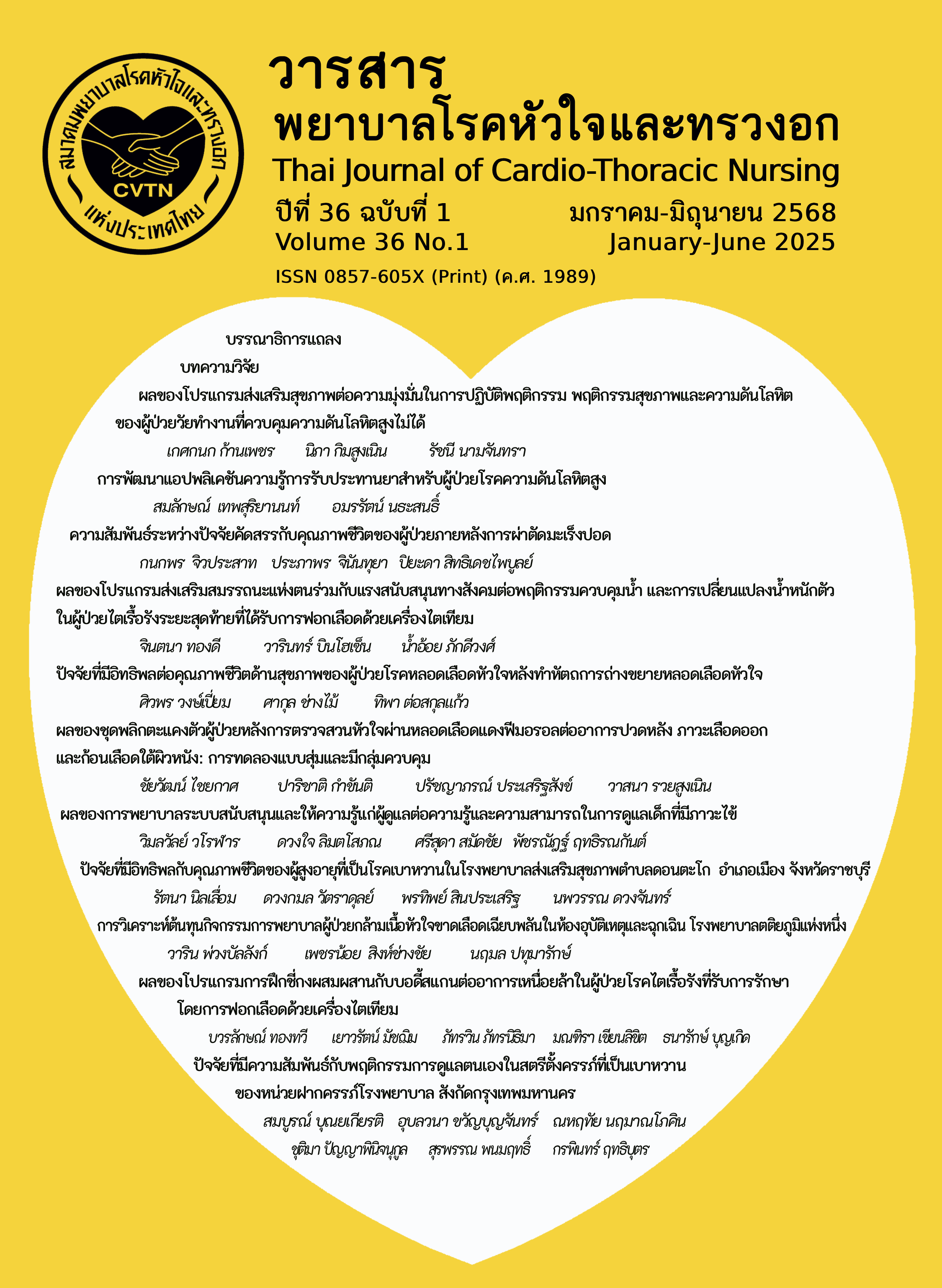
ผลของการพยาบาลระบบสนับสนุนและให้ความรู้แก่ผู้ดูแลต่อความรู้และความสามารถในการดูแลเด็กที่มีภาวะไข้
คำสำคัญ:
การพยาบาลระบบสนับสนุนและให้ความรู้, ผู้ดูแล, เด็กมีไข้บทคัดย่อ
การวิจัยครั้งนี้เป็นการวิจัยกึ่งทดลองชนิดกลุ่มเดียว วัดก่อนและหลังการทดลอง เพื่อศึกษาถึงผลของการพยาบาลระบบสนับสนุนและให้ความรู้ต่อความรู้และความสามารถของผู้ดูแลในการดูแลเด็กที่มีภาวะไข้ กลุ่มตัวอย่างคือ ผู้ดูแลเด็กอายุแรกเกิด ถึง 5 ปี ที่มีไข้ อุณหภูมิร่างกายมากกว่า 37.5 องศาเซลเซียส มารับบริการตรวจที่แผนกผู้ป่วยนอกกุมารเวชกรรม สถาบันบำราศนราดูร จังหวัดนนทบุรี โดยเลือกแบบสะดวก จำนวน 48 ราย เครื่องมือที่ใช้ในการรวบรวมข้อมูล ประกอบด้วย แบบสอบถามข้อมูลทั่วไปของเด็ก แบบสอบถามข้อมูลทั่วไปของผู้ดูแล แบบประเมินความรู้ของผู้ดูแลในการดูแลเด็กที่มีภาวะไข้ และแบบประเมินความสามารถของผู้ดูแลเด็กที่มีภาวะไข้ ส่วนเครื่องมือที่ใช้ในการทดลอง คือ โปรแกรมที่ผู้วิจัยพัฒนาขึ้น โดยใช้การพยาบาลระบบสนับสนุนและให้ความรู้ของโอเร็ม วิเคราะห์ข้อมูลโดยใช้สถิติเชิงพรรณา และสถิติทดสอบที
ผลการวิจัยพบว่า กลุ่มตัวอย่างมีค่าคะแนนเฉลี่ยความรู้ภายหลังได้รับการพยาบาลระบบสนับสนุนและให้ความรู้สูงกว่าก่อนทดลองอย่างมีนัยสำคัญทางสถิติที่ (t=-12.692, p<.05) และคะแนนเฉลี่ยความสามารถของผู้ดูแลเด็กที่มีภาวะไข้สูงกว่าเกณฑ์มาตรฐาน แสดงให้เห็นว่า ระบบการพยาบาลแบบสนับสนุนและให้ความรู้ ส่งเสริมให้ผู้ดูแลเด็กมีพฤติกรรมการดูแลเด็กที่มีภาวะไข้ได้อย่างมีประสิทธิภาพ
ข้อเสนอแนะจากงานวิจัยนี้ สามารถนำการพยาบาลระบบสนับสนุนและให้ความรู้ไปใช้ในการส่งเสริมการดูแลลดไข้เด็กเพื่อให้ผู้ดูแลมีความรู้และความสามารถในการเช็ดตัวและให้ยาลดไข้เด็กที่ถูกต้อง และมีประสิทธิภาพ
เอกสารอ้างอิง
National Statistical Office, Thailand. Project to survey the situation of children and women in Thailand 2019, complete report. Bangkok: National Statistical Office, Thailand. 2020. (in Thai).
Shakya P, Adhikari B, Nepal AS, Pandey P, Maheshwari A. Rotavirus Infection in Neonates and Young Infants. Newborn. 2022; 1(1):142-50.
Chen Y, Huang R, Lu Y, Zhang K. Education fever in China: Children’s academic performance and parent’s life satisfaction. J Happiness Stud. 2012; 22(2):927-54.
Epidemiological surveillance report, Department of Disease Control, Ministry of Public Health; 2020. (in Thai).
Byeon JH, Kim G-H, Eun B-L. Prevalence, Incidence, and Recurrence of Febrile Seizures in Korean Children Based on National Registry Data. J Clin Neurol Seoul Korea. 2018; 14(1):43-7. doi:10.3988/jcn.2018.14.1.43
Itsaraphakdirat K. Prevalence and risk factors affecting the recurrence of febrile seizures after the first febrile seizure in pediatric patients at Sawan Pracharak Hospital. Region 3 Medical and Public Health Journal. 2022; 19(2):155-67. (in Thai).
Visser AM, Jaddoe VW, Ghassabian A, Schenk JJ, Verhulst FC, Hofman A, et al. Febrile seizures and behavioral and cognitive outcomes in preschool children: the Generation R study. Dev Med Child Neurol. 2012; 54:1006-11.
Setthana N. Febrile seizure. [document on internet]. Med Park Hospital; 2022 [ updated 2022 Sep 22; cited 2022 Oct 24]. Available from: https://www.medparkhospital.com/disease-and-treatment/febrile-seizures. (in Thai).
Charoensatsiri R. Behavior of parents in caring for children who have seizures caused by high fever. The Journal of Prapokklao Hospital Clinical Medical Education Center. 2018; 35(1): 40-6. (in Thai).
Clinica E. Effect of Tepid Sponge on changes in body temperature in children under five who have fever in Dr. Achmad Mochtar Bukittinggi Hospital. Enferm Clin. 2019; 29(1):91-3.
Barutcu A, Barutcu S. Evaluation of Knowledge, Attitude and Practices of Parents Presenting to a Hospital Emergency Department with a Complaint of Fever in a Child. Signa Vitae. 2020; 16(1):123-9. DOI:10.22514/sv.2020.16.0016
Westin E, Levander MS. Parent’s experiences of their children suffering febrile seizures. J Pediatr Nurs. 2018; 38:68-73.
Kelly M, McCarthy S, O’Sullivan R, Shiely F, Larkin P, Brenner M, et al. Drivers for inappropriate fever management in children: a systematic review. Int J Clin Pharm. 2016; 38(4):761-70.
Clericetti CM, Milani GP, Bianchetti MG, Simonetti GD, Fossali EF, Balestra AM, et al. Systematic review finds that fever phobia is a worldwide issue among caregivers and healthcare providers. Acta Paediatr. 2019; 108:1393-7. DOI: 10.1111/apa.14739
Panalikul W. Effects of caregiver participation enhancing program on ability to care for pediatric patients with febrile convulsion. Nursing, Health, and Education Journal. 2020; 3(2):44-55. (in Thai).
Tavan A, Monemi E, Keshavarz F, Kazemi B, Nematollahi M. The effect of simulation-based education on parental management of fever in children: a quasi-experimental study. BMC Nursing. 2022; 21:168 DOI:10.1186/s12912-022-00938-7.
Chaiwchan T. The effectiveness of teaching with a video set, tepid sponge, by applying the protection motivation theory for caregivers of febrile children, Pediatric Surgery King Chulalongkorn Memorial Hospital. [Master of Education]. Bangkok: Srinakharinwirot University; 2019. (in Thai).
Chomboon S, Noonil N, Ekwarangkul S, Kuson K. The effects of discharge educating for caregivers on the revisit of children with acute febrile illness at Nakhon Si Thammarat Municipality Hospital. Kuakarun Journal of Nursing. 2019; 26(1):92-100. (in Thai).
Saenchai P, Panyayen J, Napaiboon U, Kapchai A, Sribunyawat N, Thongbanchob K. Childhood fever management education program for parents. Chiang Mai Medical Journal. 2017; 6(2):97-106. (in Thai).
Pediatric outpatient statistics report Bamrasnaradura Infectious Diseases Institute 2021-2022. Bamrasnaradura Infectious Diseases Institute; 2022.
Hanucharoenkul S. Orem Nursing Theory in Somjit Hanucharoenkul, editor, Self-Care: The Science and Art of Nursing. 6th printing. VJ Printing, 2001; p17-55. (in Thai).
Orem, ED. Nursing concepts of practice. St. Louis: Mosby. 2001.
Cloke H. Edgar Dale’s Cone of Experience: A Comprehensive Guide. 2023. [updated 2023 June 1; cited 2025 April 14]. Available from: https://www.growthengineering.co.uk/what-is-edgar-dales-cone-of-experience/
Srisathitnarakun B. Research methods in nursing science. 5th edition; You & I Inter Media; 2010.
Senadisai S, Prapaipanich W. Basic nursing care. 2nd revision. 2nd printing (revised edition). Bangkok: Jut Thong; 2021.
Setthana N. Febrile seizure. [document on internet]. Med Park Hospital; 2022 [ updated 2022 Sep 22; cited 2022 Oct 24]. Available from: https://www.medparkhospital.com/disease-and-treatment/febrile-seizures. (in Thai).
Thanasuwan W. Results of a caregiver education program for managing fever in children, Thabo crown Prince Hospital. J Community Health Res. 2024; 2(2):70-81. (in Thai).
Najimi A, Dolatabadi NK, Esmaeili AA, Sharifirad GR. The effect of educational program on knowledge, attitude and practice of mothers regarding prevention of febrile seizure in children. J Educ Health Promot. 2013; 2:26. doi:10.4103/2277-9531.112703. PMCID: PMC3778569 PMID: 24083276.
Kelly M, Sahm L, McCarthy S, O’Sullivan R, Mc GiLllicuddy A, Shiely F. Randomisied controlled trial of an intervention to improve parental knowledge and management practice of fever. BMC Pediatrics. 2019; 19:447.
ดาวน์โหลด
เผยแพร่แล้ว
รูปแบบการอ้างอิง
ฉบับ
ประเภทบทความ
สัญญาอนุญาต
ลิขสิทธิ์ (c) 2025 วารสารพยาบาลโรคหัวใจและทรวงอก

อนุญาตภายใต้เงื่อนไข Creative Commons Attribution-NonCommercial-NoDerivatives 4.0 International License.
บทความนี้ยังไม่เคยตีพิมพ์หรืออยู่ในระหว่างส่งไปตีพิมพ์ในวารสารอื่น ๆ มาก่อน และกองบรรณาธิการขอสงวนสิทธิ์ในการตรวจทาน และแก้ไขต้นฉบับตามเกณฑ์ของวารสาร ในกรณีที่เรื่องของท่านได้ได้รับการตีพิมพ์ในวารสารฉบับนี้ถือว่าเป็น ลิขสิทธิ์ของวารสารพยาบาลโรคหัวใจและทรวงอก