
Impact of orthognathic surgical procedure and surgical movement distance on obstructive sleep apnea in skeletal class III malocclusion
Article Sidebar
Main Article Content
Abstract
Objectives: To investigate the incidence of obstructive sleep apnea (OSA) in relation to the type of surgical procedure and the amount of mandibular setback.
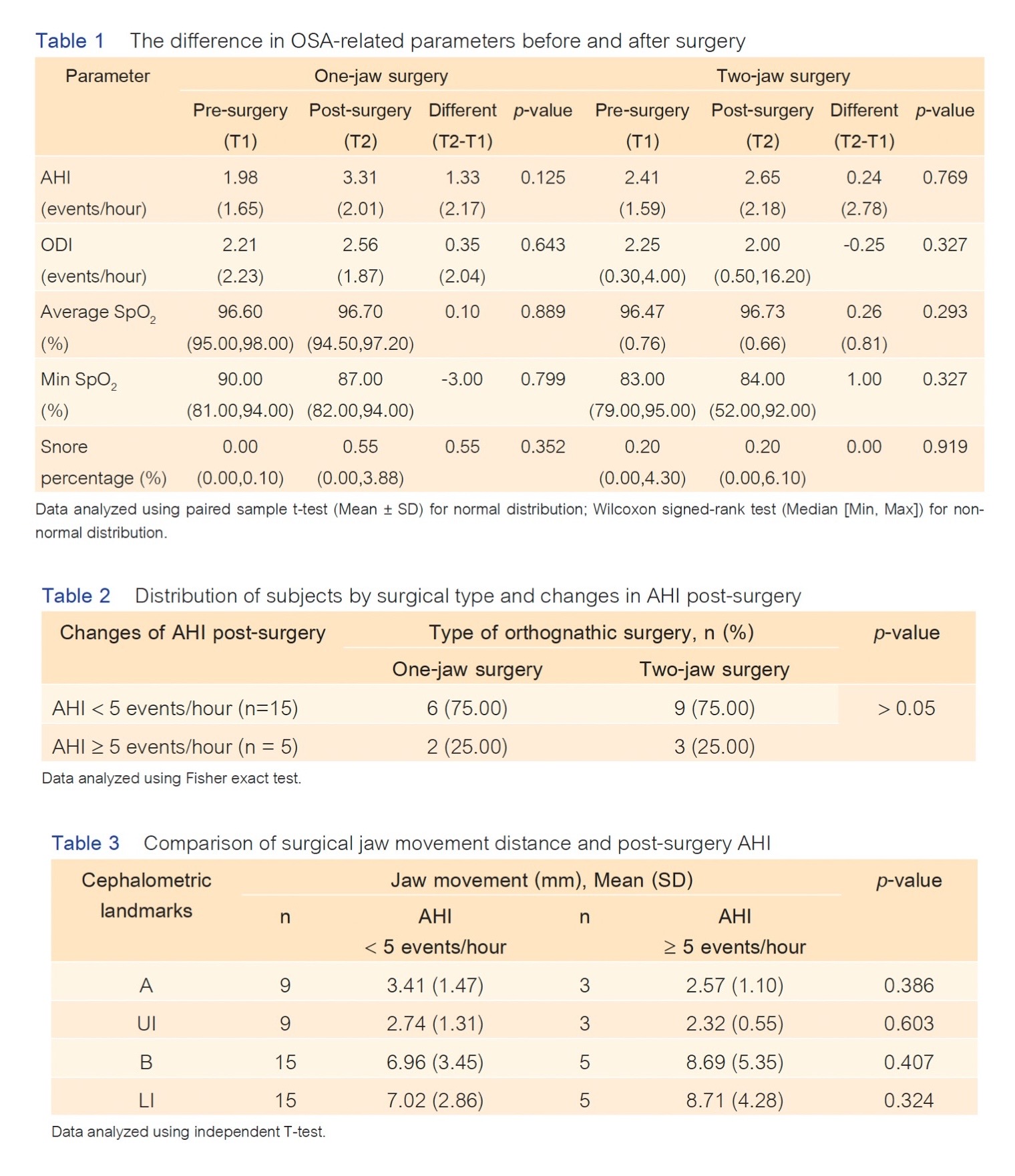
Materials and Methods: The cohort study involved 20 participants (mean age: 25.1 ± 5.74) with skeletal Class III malocclusion. All participants had no prior history of sleep disorders and an apnea-hypopnea index (AHI) of fewer than 5 events/hour pre-surgery. They underwent either mandibular setback alone or two-jaw surgery (maxillary advancement and mandibular setback). OSA-related parameters were assessed at two time points: pre-surgery (T1) and six months post-surgery (T2), using a home sleep test device. The magnitude of surgical jaw movements was determined through data obtained from virtual surgical planning. The association between the type of surgical procedure, the categorized extent of mandibular setback, and the development of OSA was analyzed using Fisher’s exact test.
Results: Twenty- five percent of participants developed an AHI of ≥ 5 events/hour at 6 months post-surgery, regardless of the type of surgical procedure. Notably, 11.11% of patients with a mandibular setback of < 7 mm demonstrated an AHI of ≥ 5 events/hour post-surgery, whereas 36.36% of those with a setback of ≥ 7 mm exhibited similar AHI levels post-surgery. Participants who maintained an AHI of < 5 events/hour post-surgery, had greater maxillary advancement and less mandibular setback compared to those with higher AHI levels.
Conclusions: No statistically significant differences in the incidence of OSA were observed between one-jaw and two-jaw surgeries or between surgical distances using a 7 mm cutoff. However, greater maxillary advancement, combined with limiting mandibular setback to less than 7 mm, may be associated with a lower risk of developing OSA.
Article Details

This work is licensed under a Creative Commons Attribution-NonCommercial-NoDerivatives 4.0 International License.
References
Kapur VK, Auckley DH, Chowdhuri S, Kuhlmann DC, Mehra R, Ramar K, et al. Clinical Practice Guideline for Diagnostic Testing for Adult Obstructive Sleep Apnea: An American Academy of Sleep Medicine Clinical Practice Guideline. J Clin Sleep Med. 2017 Mar;13(3):479-504. doi: 10.5664/jcsm.6506.
Kushida CA, Littner MR, Morgenthaler T, Alessi CA, Bailey D, Coleman J Jr., et al. Practice parameters for the indications for polysomnography and related procedures: an update for 2005. Sleep. 2005 Apr;28(4):499-521. doi: 10.1093/sleep/28.4.499.
Lurie A. Obstructive sleep apnea in adults: epidemiology, clinical presentation, and treatment options. Adv Cardiol. 2011 Oct;46:1-42. doi: 10.1159/000327660.
Punjabi NM. The epidemiology of adult obstructive sleep apnea. Proc Am Thorac Soc. 2008 Feb 15;5(2):136-143. doi: 10.1513/pats.200709-155MG.
Miles PG, Vig PS, Weyant RJ, Forrest TD, Rockette HE Jr. Craniofacial structure and obstructive sleep apnea syndrome--a qualitative analysis and meta-analysis of the literature. Am J Orthod Dentofacial Orthop. 1996 Feb;109(2):163-172. doi: 10.1016/s0889-5406(96)70177-4.
Pereira-Filho VA, Castro-Silva LM, de Moraes M, Gabrielli MF, Campos JA, Juergens P. Cephalometric evaluation of pharyngeal airway space changes in class III patients undergoing orthognathic surgery. J Oral Maxillofac Surg. 2011 Nov;69(11):e409-415. doi: 10.1016/j.joms.2011.02.132.
Honglertnapakul Y, Peanchitlertkajorn S, Likitkulthanaporn A, Saengfai NN, Chaweewannakorn C, Boonpratham S. Impacts of mandibular setback with or without maxillary advancement for class III skeletal correction on sleep-related respiratory parameters: A systematic review and meta-analysis. Orthod Craniofac Res. 2024 Dec;27(6):839-852. doi: 10.1111/ocr.12798.
Uesugi T, Kobayashi T, Hasebe D, Tanaka R, Ike M, Saito C. Effects of orthognathic surgery on pharyngeal airway and respiratory function during sleep in patients with mandibular prognathism. Int J Oral Maxillofac Surg. 2014 Sep;43(9):1082-1090. doi: 10.1016/j.ijom.2014.06.010.
Gokce SM, Gorgulu S, Gokce HS, Bengi AO, Karacayli U, Ors F. Evaluation of pharyngeal airway space changes after bimaxillary orthognathic surgery with a 3-dimensional simulation and modeling program. Am J Orthod Dentofacial Orthop. 2014 Oct;146(4):477-492. doi: 10.1016/j.ajodo.2014.06.017.
Hasebe D, Kobayashi T, Hasegawa M, Iwamoto T, Kato K, Izumi N, et al. Changes in oropharyngeal airway and respiratory function during sleep after orthognathic surgery in patients with mandibular prognathism. Int J Oral Maxillofac Surg. 2011 Jun;40(6):584-592. doi: 10.1016/j.ijom.2011.01.011.
Demetriades N, Chang DJ, Laskarides C, Papageorge M. Effects of mandibular retropositioning, with or without maxillary advancement, on the oro-naso-pharyngeal airway and development of sleep-related breathing disorders. J Oral Maxillofac Surg. 2010 Oct;68(10):2431-2436. doi: 10.1016/j.joms.2010.02.033.
Abbasi S, Rahpeyma A, Shooshtari Z, Rezaeetalab F, Vaezi T, Samieirad S. Bimaxillary Orthognathic Surgery Does Not Induce Obstructive Sleep Apnea in Skeletal Class III Patients. J Oral Maxillofac Surg. 2022 Aug;80(8):1340-1353. doi: 10.1016/j.joms.2022.04.010.
Engboonmeskul T, Leepong N, Chalidapongse P. Effect of surgical mandibular setback on the occurrence of obstructive sleep apnea. J Oral Biol Craniofac Res. 2020 Oct-Dec;10(4):597-602. doi: 10.1016/j.jobcr.2020.08.008.
Emiko Kamanoa MT, Toru Kitahara, Ichiro Takahashi. Three-dimensional analysis of changes in pharyngeal airway space after mandibular setback surgery. Orthod Waves. 2017 Mar;76:1:1-8. doi: 10.1016/j.odw.2016.10.009.
Ngan P. Early treatment of Class III malocclusion: is it worth the burden? Am J Orthod Dentofacial Orthop. 2006 Apr;129(4 Suppl):S82-85. doi: 10.1016/j.ajodo.2005.09.017.
Jang SI, Ahn J, Paeng JY, Hong J. Three-dimensional analysis of changes in airway space after bimaxillary orthognathic surgery with maxillomandibular setback and their association with obstructive sleep apnea. Maxillofac Plast Reconstr Surg. 2018 Nov 9;40(1):33. doi: 10.1186/s40902-018-0171-3.
Schilbred Eriksen E, Gulati S, Moen K, Wisth PJ, Loes S. Apnea-hypopnea index in healthy class III patients treated wth intraoral vertical ramus osteotomy: A prospective cohort study. J Oral Maxillofac Surg. 2019 Mar;77(3):582-590. doi: 10.1016/j.joms.2018.07.017.
Yang HJ, Jung YE, Kwon IJ, Lee JY, Hwang SJ. Airway changes and prevalence of obstructive sleep apnoea after bimaxillary orthognathic surgery with large mandibular setback. Int J Oral Maxillofac Surg. 2020 Mar;49(3):342-349. doi: 10.1016/j.ijom.2019.07.012.
de Haan IF, Ciesielski R, Nitsche T, Koos B. Evaluation of relapse after orthodontic therapy combined with orthognathic surgery in the treatment of skeletal class III. J Orofac Orthop. 2013 Sep;74(5):362-369. doi: 10.1007/s00056-013-0161-0.
Proffit WR, Turvey TA, Phillips C. The hierarchy of stability and predictability in orthognathic surgery with rigid fixation: an update and extension. Head Face Med. 2007 Apr 30;3:21. doi: 10.1186/1746-160X-3-21.
Yamada T MK, Matsumura T, Moritani N, Sugahara T. Respiratory status during sleep following orthognathic mandibular setback surgery. J Oral Maxillofac Surg Med Pathol. 2008 Mar;20(1):12-15. doi: 10.1016/S0915-6992(08)80002-7.
Cairns A, Wickwire E, Schaefer E, Nyanjom D. A pilot validation study for the NOX T3(TM) portable monitor for the detection of OSA. Sleep Breath. 2014 Sep;18(3):609-614. doi: 10.1007/s11325-013-0924-2.
Xu L, Han F, Keenan BT, Kneeland-Szanto E, Yan H, Dong X, et al. Validation of the Nox-T3 portable monitor for diiagnosis of obstructive sleep apnea in chinese adults. J Clin Sleep Med. 2017 May;13(5):675-683. doi: 10.5664/jcsm.6582.
Pitkanen M, Nath RK, Korkalainen H, Nikkonen S, Mahamid A, Oksenberg A, et al. Respiratory event index underestimates severity of sleep apnea compared to apnea-hypopnea index. Sleep Adv. 2023 Dec 22;5(1):zpad054. doi: 10.1093/sleepadvances/zpad054.
Adams GL, Gansky SA, Miller AJ, Harrell WE Jr., Hatcher DC. Comparison between traditional 2-dimensional cephalometry and a 3-dimensional approach on human dry skulls. Am J Orthod Dentofacial Orthop. 2004 Oct;126(4):397-409. doi: 10.1016/j.ajodo.2004.03.023.
Heinz J, Stewart K, Ghoneima A. Evaluation of two-dimensional lateral cephalogram and three-dimensional cone beam computed tomography superimpositions: a comparative study. Int J Oral Maxillofac Surg. 2019 Apr;48(4):519-525. doi: 10.1016/j.ijom.2018.10.002.
Chin SJ, Wilde F, Neuhaus M, Schramm A, Gellrich NC, Rana M. Accuracy of virtual surgical planning of orthognathic surgery with aid of CAD/CAM fabricated surgical splint-A novel 3D analyzing algorithm. J Craniomaxillofac Surg. 2017 Dec;45(12):1962-1970. doi: 10.1016/j.jcms.2017.07.016.
Zhang N, Liu S, Hu Z, Hu J, Zhu S, Li Y. Accuracy of virtual surgical planning in two-jaw orthognathic surgery: comparison of planned and actual results. Oral Surg Oral Med Oral Pathol Oral Radiol. 2016 Aug;122(2):143-151. doi: 10.1016/j.oooo.2016.03.004.
Do J, Yang HJ. Adaptation of soft tissue following bilateral sagittal split ramus osteotomy in skeletal class III patients with facial asymmetry: A retrospective study. J Stomatol Oral Maxillofac Surg. 2024 Sep;125(5S1):101941. doi: 10.1016/j.jormas.2024.101941.
Edwards BA, Redline S, Sands SA, Owens RL. More than the sum of the respiratory events: personalized medicine approaches for obstructive sleep apnea. Am J Respir Crit Care Med. 2019 Sep;200(6):691-703. doi: 10.1164/rccm.201901-0014TR.
Pevernagie DA, Gnidovec-Strazisar B, Grote L, Heinzer R, McNicholas WT, Penzel T, et al. On the rise and fall of the apnea-hypopnea index: A historical review and critical appraisal. J Sleep Res. 2020 Aug;29(4):e13066. doi: 10.1111/jsr.13066.
