
Effect of restorative factors on the periapical status of well-obturated endodontically treated teeth: A retrospective cohort study
Article Sidebar
Main Article Content
Abstract
Objectives: This retrospective cohort study evaluated the effect of restorative factors on the periapical status of well-obturated endodontically treated teeth.
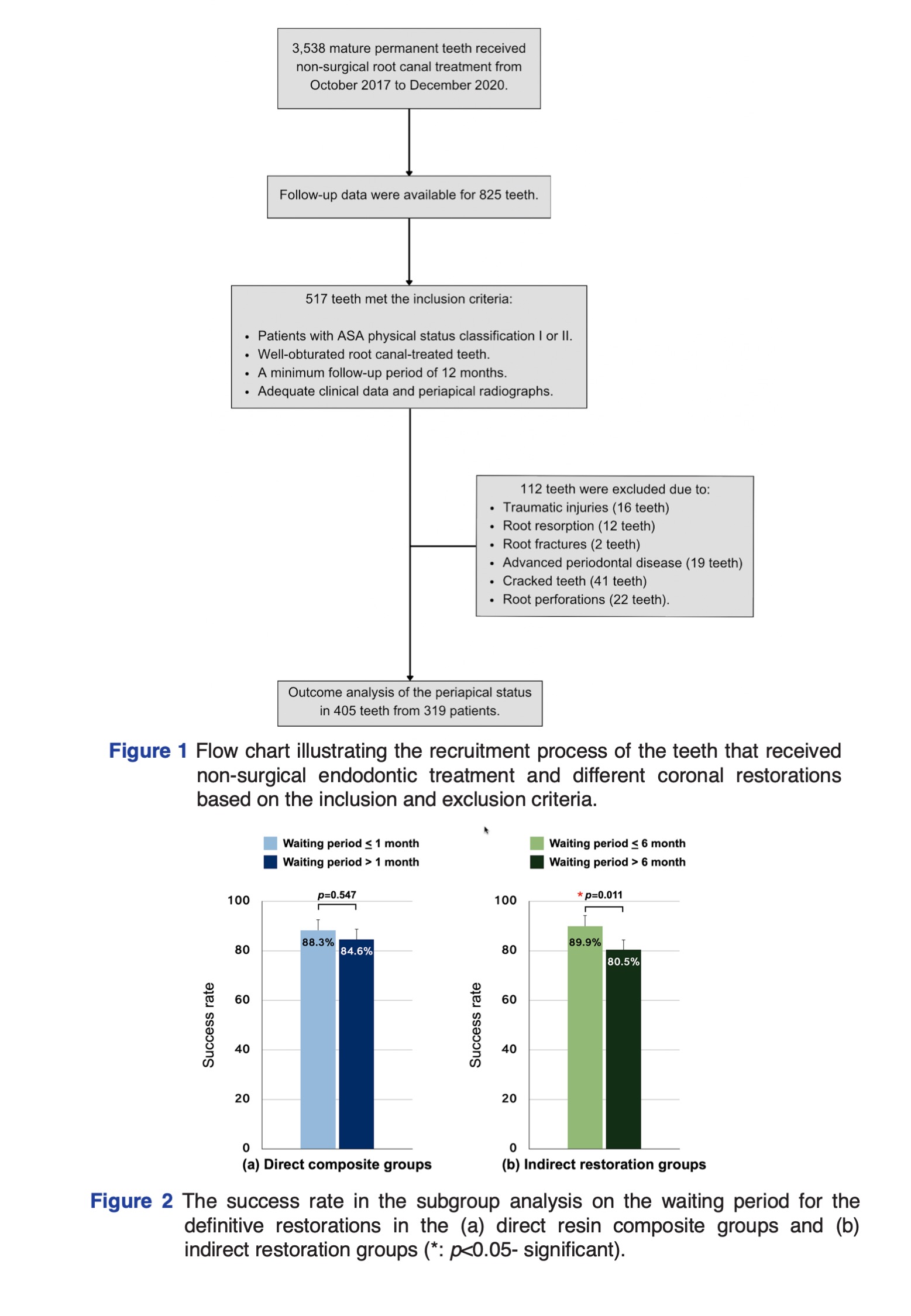
Materials and Methods: The clinical/radiographic data of restorative factors were gathered from patients receiving non-surgical root canal treatment at the Faculty of Dentistry/Mahidol University, Thailand, from October 2017 to December 2020; only well-obturated endodontically treated teeth were included. Coronal restoration quality, type of restoration, definitive restoration status, defective restorations during follow-up, waiting period for the definitive restoration, post placement, and other factors associated with post-retained restorations were collected. From the clinical/radiographic assessments, endodontic outcomes were evaluated as success (healed) or failure (healing/disease) rate. Multivariable modified Poisson regression analyses were conducted to identify significant risk factors to the outcome.
Results: The study analyzed 405 well-obturated endodontically treated teeth from 319 patients, 9-83 years old. At the 29.9 + 13.9-month recall, the overall success rate (healed) was 84.4%. The restorative factors that significantly decreased the success rate were (1) inadequate/unsealed coronal restoration, (2) temporary (e.g. Cavit or IRM) restoration, (3) absence of a definitive restoration, and (4) >6-month waiting period for definitive indirect restoration. For teeth with post-retained restorations, <4-mm remaining root filling and misdirected post-space preparation significantly reduced the success rate.
Conclusions: The success rate of well-obturated endodontic treatment was 84.4%. The adequate/sealed, definitive coronal restoration and placing an indirect restoration within 6 months improved the success rate. Moreover, >4-mm remaining root filling and appropriate post-space preparation significantly increased the success rate.
Article Details

This work is licensed under a Creative Commons Attribution-NonCommercial-NoDerivatives 4.0 International License.
References
Ray HA, Trope M. Periapical status of endodontically treated teeth in relation to the technical quality of the root filling and the coronal restoration. Int Endod J. 1995 Jan;28(1):12-18. doi: 10.1111/j.1365-2591.1995.tb00150.x.
Song M, Park M, Lee CY, Kim E. Periapical status related to the quality of coronal restorations and root fillings in a Korean population. J Endod. 2014 Feb;40(2):182-186. doi: 10.1016/j.joen.2013.10.017.
Thampibul P, Jantarat J, Arayasantiparb R. Post-treatment apical periodontitis related to the technical quality of root fillings and restorations in Thai population. Aust Endod J. 2019 Aug;45(2):163-170. doi: 10.1111/aej.12302.
Ree M, Schwartz RS. The endo-restorative interface: current concepts. Dent Clin North Am. 2010 Apr;54(2):345-374. doi: 10.1016/j.cden.2009.12.005.
Polesel A. Restoration of the endodontically treated posterior tooth. G Ital Endod. 2014 Jun;28(1):2-16. doi: 10.1016/j.gien.2014.05.007.
Hommez GMG, Coppens CRM, De Moor RJG. Periapical health related to the quality of coronal restorations and root fillings. Int Endod J. 2002 Aug;35(8):680-689. doi: 10.1046/j.1365-2591.2002.00546.x.
Tavares PBL, Bonte E, Boukpessi T, Siqueira JF Jr,Lasfargues JJ. Prevalence of apical periodontitis in root canal-treated teeth from an urban French population: influence of the quality of root canal fillings and coronal restorations. J Endod. 2009 Jun;35(6):810-813. doi: 10.1016/j.joen.2009.03.048.
Kalender A, Orhan K, Aksoy U, Basmaci F, Er F, Alankus A. Influence of the quality of endodontic treatment and coronal restorations on the prevalence of apical periodontitis in a Turkish Cypriot population. Med Princ Pract. 2013;22(2):173-177. doi: 10.1159/000341753.
Craveiro MA, Fontana CE, de Martin AS, Bueno CE. Influence of coronal restoration and root canal filling quality on periapical status: clinical and radiographic evaluation. J Endod. 2015 Jun;41(6):836-840. doi: 10.1016/j.joen.2015.02.017.
AAE COLLEAGUES ONLINE. Coronal leakage: clinical and biological implications in endodontic success [Internet]. Endodontics: Colleagues for Excellence Fall-Winter. 2002. Available from: https://www.aae.org/specialty/wp-content/uploads/sites/2/2017/07/fw02ecfe.pdf.
Chugal NM, Clive JM, Spångberg LSW. Endodontic treatment outcome: effect of the permanent restoration. Oral Surg Oral Med Oral Pathol Oral Radiol Endod. 2007 Oct;104(4):576-582. doi: 10.1016/j.tripleo.2007.04.011.
Stenhagen S, Skeie H, Bårdsen A, Laegreid T. Influence of the coronal restoration on the outcome of endodontically treated teeth. Acta Odontol Scand. 2020 Mar;78(2):81-86. doi: 10.1080/00016357.2019.1640390.
Baba NZ, Goodacre CJ. Restoration of endodontically treated teeth: contemporary concepts and future perspectives. Endod Topics. 2014 Nov;31(1):68-83. doi: 10.1111/etp.12066.
Kvist T, Rydin E, Reit C. The relative frequency of periapical lesions in teeth with root canal-retained posts. J Endod. 1989 Dec;15(12):578-580. doi: 10.1016/s0099-2399(89)80153-0.
Mattison GD, Delivanis PD, Thacker RW Jr, Hassell KJ. Effect of post preparation on the apical seal. J Prosthet Dent. 1984 Jun;51(6):785-789. doi: 10.1016/0022-3913(84)90377-9.
Tronstad L, Asbjørnsen K, Døving L, Pedersen I, Eriksen HM. Influence of coronal restorations on the periapical health of endodontically treated teeth. Endod Dent Traumatol. 2000 Oct;16(5):218-221. doi: 10.1034/j.1600-9657.2000.016005218.x.
Sjogren U, Hagglund B, Sundqvist G, Wing K. Factors affecting the long-term results of endodontic treatment. J Endod. 1990 Oct;16(10):498-504. doi: 10.1016/s0099-2399(07)80180-4.
Maslamani M, Khalaf M, Mitra AK. Association of quality of coronal filling with the outcome of endodontic treatment: A follow-up study. Dent J (Basel). 2017 Jan 11;5(1):5. doi: 10.3390/dj5010005.
Liu M-C. Restoration of endodontically treated premolars and molars: A review of rationales and techniques. J Prosthodont Implantol. 2014;3(1):2-16. doi: 10.6926/JPI.201408_3(1).0001.
Stockton LW. Factors affecting retention of post systems: a literature review. J Prosthet Dent. 1999 Apr;81(4):380-385. doi: 10.1016/s0022-3913(99)80002-x.
Fayad MI, Ashkenaz PJ, Johnson BR. Different representations of vertical root fractures detected by cone-beam volumetric tomography: a case series report. J Endod. 2012 Oct;38(10):1435-1442. doi: 10.1016/j.joen.2012.05.015.
Goodacre CJ, Spolnik KJ. The prosthodontic management of endodontically treated teeth: a literature review. Part III. Tooth preparation considerations. J Prosthodont. 1995 Jun;4(2):122-128. doi: 10.1111/j.1532-849x.1995.tb00327.x.
Landis JR, Koch GG. The measurement of observer agreement for categorical data. Biometrics. 1977 Mar;33(1):159-174. doi: 10.2307/2529310.
Friedman S, Mor C. The success of endodontic therapy--healing and functionality. J Calif Dent Assoc. 2004 Jun;32(6):493-503. doi: 10.1080/19424396.2004.12223997.
Strindberg LZ. The dependence of the results of pulp therapy on certain factors: an analytic study based on radiographic and clinical follow-up examinations. Acta Odontol Scand. 1956;14:1-175.
Imura N, Pinheiro ET, Gomes BP, Zaia AA, Ferraz CC, Souza-Filho FJ. The outcome of endodontic treatment: a retrospective study of 2000 cases performed by a specialist. J Endod. 2007 Nov;33(11):1278-1282. doi: 10.1016/j.joen.2007.07.018.
Ng YL, Mann V, Gulabivala K. A prospective study of the factors affecting outcomes of nonsurgical root canal treatment: part 1: periapical health. Int Endod J. 2011 Jul;44(7):583-609. doi: 10.1111/j.1365-2591.2011.01872.x.
Llena C, Nicolescu T, Perez S, Gonzalez de Pereda S, Gonzalez A, Alarcon I, et al. Outcome of root canal treatments provided by endodontic postgraduate students. a retrospective study. J Clin Med. 2020 Jun;9(6):1-14. doi: 10.3390/jcm9061994.
Pontoriero DIK, Grandini S, Spagnuolo G, Discepoli N, Benedicenti S, Maccagnola V, et al. Clinical outcomes of endodontic treatments and restorations with and without posts up to 18 years. J Clin Med. 2021 Feb;10(5):1-12. doi: 10.3390/jcm10050908.
Bukmir RP, Paljevic E, Vidas J, Glazar I, Pezelj-Ribaric S, Prso IB. Is coronal restoration a predictor of posttreatment apical periodontitis?. Eur J Dent. 2022 May;16(2):386-395. doi: 10.1055/s-0041-1735909.
Byström A, Sundqvist G. Bacteriologic evaluation of the efficacy of mechanical root canal instrumentation in endodontic therapy. Scand J Dent Res. 1981 Aug;89(4):321-328. doi: 10.1111/j.1600-0722.1981.tb01689.x.
Byström A, Sundqvist G. Bacteriologic evaluation of the effect of 0.5 percent sodium hypochlorite in endodontic therapy. Oral Surg Oral Med Oral Pathol. 1983 Mar;55(3):307-312. doi: 10.1016/0030-4220(83)90333-x.
Shuping GB, Orstavik D, Sigurdsson A, Trope M. Reduction of intracanal bacteria using nickel-titanium rotary instrumentation and various medications. J Endod. 2000 Dec;26(12):751-755. doi: 10.1097/00004770-200012000-00022.
Siqueira JF Jr, Rôças IN, Alves FR, Campos LC. Periradicular status related to the quality of coronal restorations and root canal fillings in a Brazilian population. Oral Surg Oral Med Oral Pathol Oral Radiol Endod. 2005 Sep;100(3):369-374. doi: 10.1016/j.tripleo.2005.03.029.
Gillen BM, Looney SW, Gu LS, Loushine BA, Weller RN, Loushine RJ, et al. Impact of the quality of coronal restoration versus the quality of root canal fillings on success of root canal treatment: a systematic review and meta-analysis. J Endod. 2011Jul;37(7):895-902. doi: 10.1016/j.joen.2011.04.002.
Orstavik D. Time-course and risk analyses of the development and healing of chronic apical periodontitis in man. Int Endod J. 1996 May;29(3):150-155. doi: 10.1111/j.1365-2591.1996.tb01361.x.
Gulabivala K, Ng YL. Factors that affect the outcomes of root canal treatment and retreatment—A reframing of the principles. Int Endod J. 2023 Mar;56 Suppl 2:82-115. doi: 10.1111/iej.13897.
Juric R, Vidmar G, Blagus R, Jan J. Factors associated with the outcome of root canal treatment-A cohort study conducted in a private practice. Int Endod J. 2024 Apr;57(4):377-393. doi: 10.1111/iej.14022.
Pietrzycka K, Radwanski M, Matinlinna JP, Lukomska-Szymanska M. The prevalence of root canal treatment, periapical status, and coronal restorations in elderly patients in the Polish population. Heliyon. 2024 Aug 21;10(17):e35584. doi: 10.1016/j.heliyon.2024.e35584.
Vieira AR, Pacheco-Yanes J, Gazzaneo ID, Neves MAS, Siqueira JF, Jr., Goncalves LS. Factors influencing the outcome of nonsurgical root canal treatment and retreatment: A retrospective study. Aust Endod J. 2024 Aug;50(2):245-259. doi: 10.1111/aej.12828.
Park DM, Seok WH, Yoon JY. Factors influencing non-surgical root canal treatment outcomes in mandibular second molars: A retrospective cone-beam computed tomography analysis. J Clin Med. 2024 May 16;13(10). doi: 10.3390/jcm13102931.
Ciftçi A, Vardarli DA, Sönmez IS. Coronal microleakage of four endodontic temporary restorative materials: an in vitro study. Oral Surg Oral Med Oral Pathol Oral Radiol Endod. 2009 Oct;108(4):e67-70. doi: 10.1016/j.tripleo.2009.05.015.
Jirathanyanatt T, Srisatjaluk R, Choenklang P. Bacterial leakage through double seal intermediate restorative materials. M Dent J. 2015;35(3):291-298.
Safavi KE, Dowden WE, Langeland K. Influence of delayed coronal permanent restoration on endodontic prognosis. Endod Dent Traumatol. 1987 Aug;3(4):187-191. doi: 10.1111/j.1600-9657.1987.tb00622.x.
Moshonov J, Slutzky-Goldberg I, Gottlieb A, Peretz B. The effect of the distance between post and residual gutta-percha on the clinical outcome of endodontic treatment. J Endod. 2005 Mar;31(3):177-179. doi: 10.1097/01.don.0000137646.07662.8e.
Ozkurt Z, Kayahan MB, Sunay H, Kazazoglu E, Bayirli G. The effect of the gap between the post restoration and the remaining root canal filling on the periradicular status in a Turkish subpopulation. Oral Surg Oral Med Oral Pathol Oral Radiol Endod. 2010 Jul;110(1):131-135. doi: 10.1016/j.tripleo.2010.02.036.
