
Evaluation of maximum contact jaw position across three head postures using digital technology in TMD and Non-TMD patients
Article Sidebar
Main Article Content
Abstract
Objectives: To investigate how head posture affects maximum contact jaw position (MCJP) in patients with temporomandibular disorder (TMD) and non-TMD conditions, and to compare the subjective perception of MCJP with the actual measurements under various head postures.
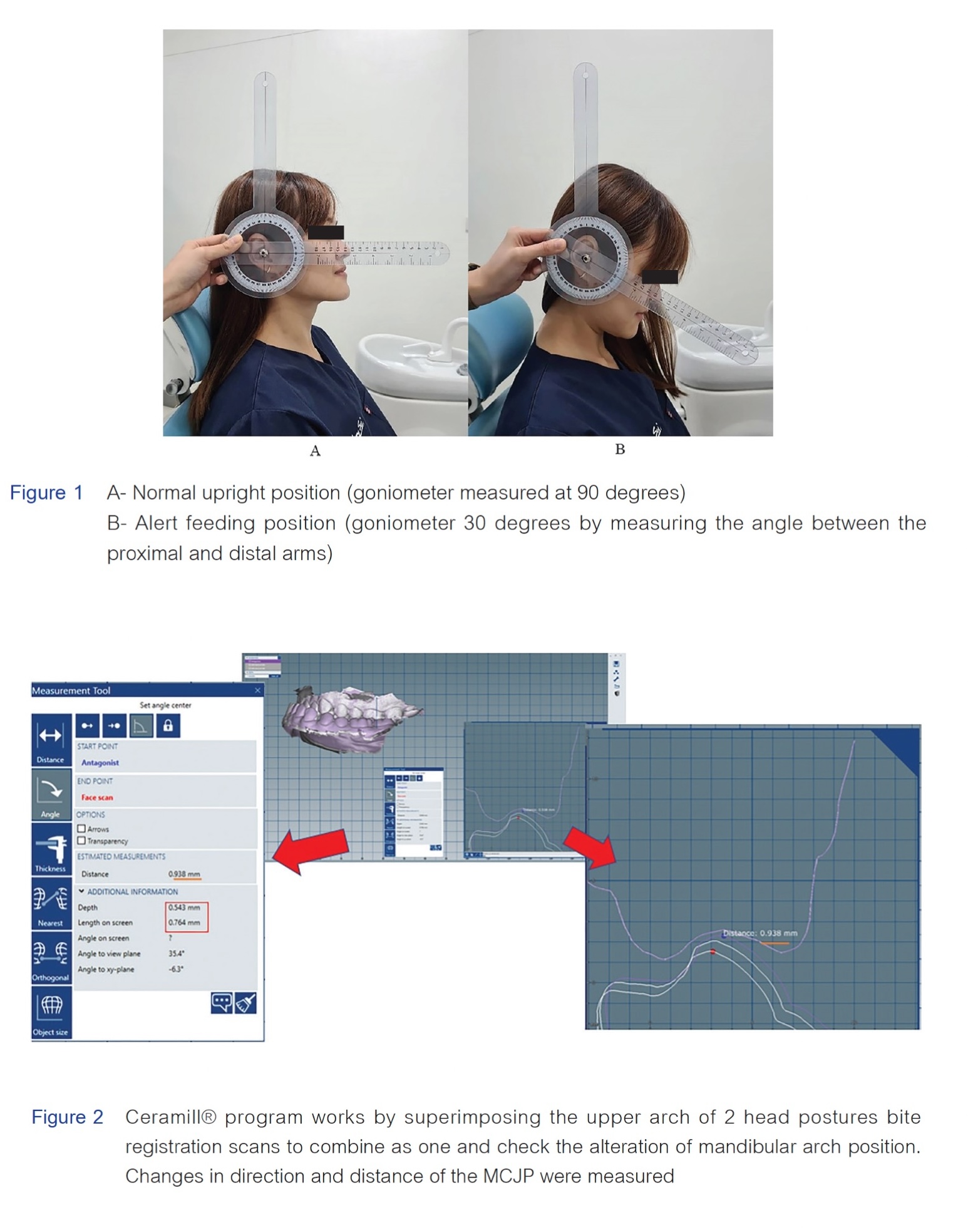
Methods and Methods: This case-control study included 68 participants comprising both TMD (n=34) and non-TMD (n=34) patients. The evaluation of head postures included three positions: supine, normal upright, and alert feeding positions. To record MCJP, we utilized the Three shape® TRIOS 3 WIRE Pengrip and TRIOS Cart S1A systems. The data were analyzed using the Ceramill® program to assess the variations in MCJP across the three head positions in vertical, anteroposterior, and mediolateral directions. Additionally, we obtained participants’ perceptions regarding the differences in MCJP experienced during the three head positions.
Results: Patients with TMD and non-TMD did not exhibit significant differences in MCJP distance, except in the vertical direction, where the MCJP distance differences between the supine and alert feeding head positions were statistically significant (p=0.04). In both non-TMD and TMD patients, a significant relationship was found between their perceptions of head posture’s influence on MCJP and the actual digitally measured MCJP differences across all head positions and directions (p<0.05 all positions).
Conclusion: MCJP differs in varied head positions, particularly in the vertical dimension between supine and alert feeding postures, and these measurable differences align with participants’ perceptions in both TMD and non-TMD groups.
Article Details

This work is licensed under a Creative Commons Attribution-NonCommercial-NoDerivatives 4.0 International License.
References
Haralur S, Al-Gadhaan S, Al-Qahtani A, Mossa A, Al-Shehri W, Addas M. Influence of functional head postures on the dynamic functional occlusal parameters. Ann Med Health Sci Res. 2014 Jul;4(4):562-566. doi: 10.4103/2141-9248.139319.
Ross IF. Occlusal contacts of the natural teeth. J Prosthet Dent. 1974 Dec;32(6):660-667. doi: 10.1016/0022-3913(74)90076-6.
Türp JC, Schindler HJ, Pritsch M, Rong Q. Antero-posterior activity changes in the superficial masseter muscle after exposure to experimental pain. Eur J Oral Sci. 2002 Apr;110(2):83-91. doi: 10.1034/j.1600-0722.2002.11198.x.
Luschei E, Goldberg L. Neural mechanisms of mandibular control: mastication and voluntary biting. 2011.
Seaver EP. The neuromuscular control of the mandible. Am J Orthod Oral Surg. 1942 April;28(4):222-229. doi: 10.1016/S0096-6347(42)90107-8.
Reinhardt R, Tremel T, Wehrbein H, Reinhardt W. The unilateral chewing phenomenon, occlusion, and TMD. Cranio. 2006 Jul;24(3):166-170. doi: 10.1179/crn.2006.027.
Manfredini D, Stellini E, Marchese-Ragona R, Guarda-Nardini L. Are occlusal features associated with different temporomandibular disorder diagnoses in bruxers? Cranio. 2014 Oct;32(4):283-288. doi: 10.1179/2151090314Y.0000000008.
Palla S, Klineberg I. Occlusion and adaptation to change: neuroplasticity and its implications for cognition. In: Klineberg I, Eckert S, editors. Functional occlusion in restorative dentistry and prosthodontics. St. Louis (MO): Mosby; 2016. p. 43–53.
Gil-Martínez A, Paris-Alemany A, López-de-Uralde-Villanueva I, La Touche R. Management of pain in patients with temporomandibular disorder (TMD): challenges and solutions. J Pain Res. 2018 Mar;11:571-587. doi: 10.2147/JPR.S127950.
Monaco A, Cattaneo R, Ortu E, Constantinescu MV, Pietropaoli D. Sensory trigeminal ULF-TENS stimulation reduces HRV response to experimentally induced arithmetic stress: A randomized clinical trial. Physiol Behav. 2017 May;173:209-215. doi: 10.1016/j.physbeh.2017.02.014.
Michelotti A, Buonocore G, Manzo P, Pellegrino G, Farella M. Dental occlusion and posture: an overview. Prog Orthod. 2011;12(1):53-58. doi: 10.1016/j.pio.2010.09.010.
Davies PL. Electromyographic study of superficial neck muscles in mandibular function. J Dent Res. 1979 Jan;58(1):537-538. doi: 10.1177/00220345790580011701.
Kawamura T. Electromyographic study on the activities of the neck muscles during various mandibular movements. Kokubyo Gakkai Zasshi. 1983 Mar;50(1):94-115.
Yoshida K. Electromyographical analysis of function of sternocleidomastoid muscle during occlusal function. Kokubyo Gakkai Zasshi. 1988 Mar;55(1):53-70. doi: 10.5357/koubyou.55.53.
Kohno S, Yoshida K, Kobayashi H. Pain in the sternocleidomastoid muscle and occlusal interferences. J Oral Rehabil. 1988 Jul;15(4):385-392. doi: 10.1111/j.1365-2842.1988.tb00173.x.
Goldstein DF, Kraus SL, Williams WB, Glasheen-Wray M. Influence of cervical posture on mandibular movement. J Prosthet Dent. 1984 Sep;52(3):421-426. doi: 10.1016/0022-3913(84)90460-8.
Makofsky H. The effect of head posture on muscle contact position: the sliding cranium theory. Cranio. 1989 Oct;7(4):286-292. doi: 10.1080/08869634.1989.11746268.
Makofsky HW, Sexton TR, Diamond DZ, Sexton MT. The effect of head posture on muscle contact position using the T-Scan system of occlusal analysis. Cranio. 1991 Oct;9(4):316-321. doi: 10.1080/08869634.1991.11678378.
Saddu SC, Dyasanoor S, Valappila NJ, Ravi BV. The evaluation of head and craniocervical posture among patients with and without temporomandibular Joint disorders- a comparative study. J Clin Diagn Res. 2015 Aug;9(8):ZC55-58. doi: 10.7860/JCDR/2015/12830.6343.
Ferreira MP, Waisberg CB, Conti PCR, Bevilaqua-Grossi D. Mobility of the upper cervical spine and muscle performance of the deep flexors in women with temporomandibular disorders. J Oral Rehabil. 2019 Dec;46(12):1177-1184. doi: 10.1111/joor.12858.
Okeson JP. Mechanics of mandibular movement. In: Okeson JP, editor. Management of temporomandibular disorders and occlusion. 8th ed. St. Louis (MO): Mosby; 2019. p. 68.
Kibana Y, Ishijima T, Hirai T. Occlusal support and head posture. J Oral Rehabil. 2002 Jan;29(1):58-63. doi: 10.1046/j.1365-2842.2002.00794.x.
Camardella LT, Breuning H, Vilella OV. Are there differences between comparison methods used to evaluate the accuracy and reliability of digital models? Dental Press J Orthod. 2017 Feb;22(1):65-74. doi: 10.1590/2177-6709.22.1.065-074.oar.
Atia MA, El-Gheriani AA, Ferguson DJ. Validity of 3 shape scanner techniques: a comparison with the actual plaster study casts. Biom Biostat Int J. 2015;2(2):64-69. doi: 10.15406/bbij.2015.02.00026.
Bukhari SAA, Reddy KA, Reddy MR, Shah SH. Evaluation of virtual models (3 Shape Ortho System) in assessing accuracy and duration of model analyses based on the severity of crowding. Saudi J Dental Res. 2017;8(1-2):11-18. doi: org/10.1016/j.sjdr.2016.05.004.
Lemos LS, Rebello IM, Vogel CJ, Barbosa MC. Reliability of measurements made on scanned cast models using the 3 Shape R 700 scanner. Dentomaxillofac Radiol. 2015;44(6):20140337. doi: 10.1259/dmfr.20140337.
Braun BL. Postural differences between asymptomatic men and women and craniofacial pain patients. Arch Phys Med Rehabil. 1991 Aug;72(9):653-656.
Korioth TW. Number and location of occlusal contacts in intercuspal position. J Prosthet Dent. 1990 Aug;64(2):206-210. doi: 10.1016/0022-3913(90)90180-k.
Gotfredsen K, Walls AW. What dentition assures oral function? Clin Oral Implants Res. 2007 Jun;18 Suppl 3:34-45. doi: 10.1111/j.1600-0501.2007.01436.x.
Schiffman E, Ohrbach R, Truelove E, Look J, Anderson G, Goulet JP, et al. Diagnostic criteria for temporomandibular disorders (DC/TMD) for clinical and research applications: recommendations of the International RDC/TMD consortium network* and orofacial pain special interest group†. J Oral Facial Pain Headache. 2014;28(1):6-27. doi: 10.11607/jop.1151.
Gupta S, Tarannum F, Gupta NK, Upadhyay M, Abdullah A. Effect of head posture on tooth contacts in dentate and complete denture wearers using computerized occlusal analysis system. J Indian Prosthodont Soc. 2017 Jul-Sep;17(3):250-254. doi: 10.4103/jips.jips_321_16.
Ayub E, Glasheen-Way M, Kraus S. Head posture: a case study of the effects on the rest position of the mandible*. J Orthop Sports Phys Ther. 1984;5(4):179-183. doi: 10.2519/jospt.1984.5.4.179.
Mohl ND. Head posture and its role in occlusion. N Y State Dent J. 1976 Jan;42(1):17-23.
Saad MN, Weiner G, Ehrenberg D, Weiner S. Effects of load and indicator type upon occlusal contact markings. J Biomed Mater Res B Appl Biomater. 2008 Apr;85(1):18-22. doi: 10.1002/jbm.b.30910.
Kihara H, Hatakeyama W, Komine F, Takafuji K, Takahashi T, Yokota J, et al. Accuracy and practicality of intraoral scanner in dentistry: A literature review. J Prosthodont Res. 2020 Apr;64(2):109-113. doi: 10.1016/j.jpor.2019.07.010.
Visscher CM, Lobbezoo F, Naeije M. Comparison of algometry and palpation in the recognition of temporomandibular disorder pain complaints. J Orofac Pain. 2004;18(3):214-229.
Armijo-Olivo S, Magee D. Cervical musculoskeletal impairments and temporomandibular disorders. J Oral Maxillofac Res. 2013 Jan;3(4):e4. doi: 10.5037/jomr.2012.3404.
Mapelli A, Zanandréa Machado BC, Giglio LD, Sforza C, De Felício CM. Reorganization of muscle activity in patients with chronic temporomandibular disorders. Arch Oral Biol. 2016 Dec;72:164-171. doi: 10.1016/j.archoralbio.2016.08.022.
Weber P, Corrêa EC, Ferreira Fdos S, Soares JC, Bolzan Gde P, Silva AM. Cervical spine dysfunction signs and symptoms in individuals with temporomandibular disorder. J Soc Bras Fonoaudiol. 2012;24(2):134-139. doi: 10.1590/s2179-64912012000200008.
Tingey EM, Buschang PH, Throckmorton GS. Mandibular rest position: a reliable position influenced by head support and body posture. Am J Orthod Dentofacial Orthop. 2001 Dec;120(6):614-622. doi: 10.1067/mod.2001.119802.
Woda A, Pionchon P, Palla S. Regulation of mandibular postures: mechanisms and clinical implications. Crit Rev Oral Biol Med. 2001;12(2):166-178. doi: 10.1177/10454411010120020601.
Morimoto Y, Oki K, Iida S, Shirahige C, Maeda N, Kawakami S, et al. Effect of transient occlusal loading on the threshold of tooth tactile sensation perception for tapping like the impulsive stimulation. Odontology. 2013 Jul;101(2):199-203. doi: 10.1007/s10266-012-0072-3.
Ransjo K. Perception of mandibular position in cases of temporomandibular joint disorders. Odontol Foren T. 1963;71:134-144.
Crum RJ, Loiselle RJ. Oral perception and proprioception: a review of the literature and its significance to prosthodontics. J Prosthet Dent. 1972 Aug;28(2):215-230. doi: 10.1016/0022-3913(72)90141-2.
