
Comparison of the bond strength of orthodontic metallic brackets bonded to different tooth-colored restorative materials and the surface roughness of materials before and after removing the brackets
Article Sidebar
Main Article Content
Abstract
Objective: This study aimed to compare the shear bond strength (SBS) of metal orthodontic brackets bonded to different tooth-colored restorative materials and the roughness of the restorations before brackets bonding and after removing the brackets.
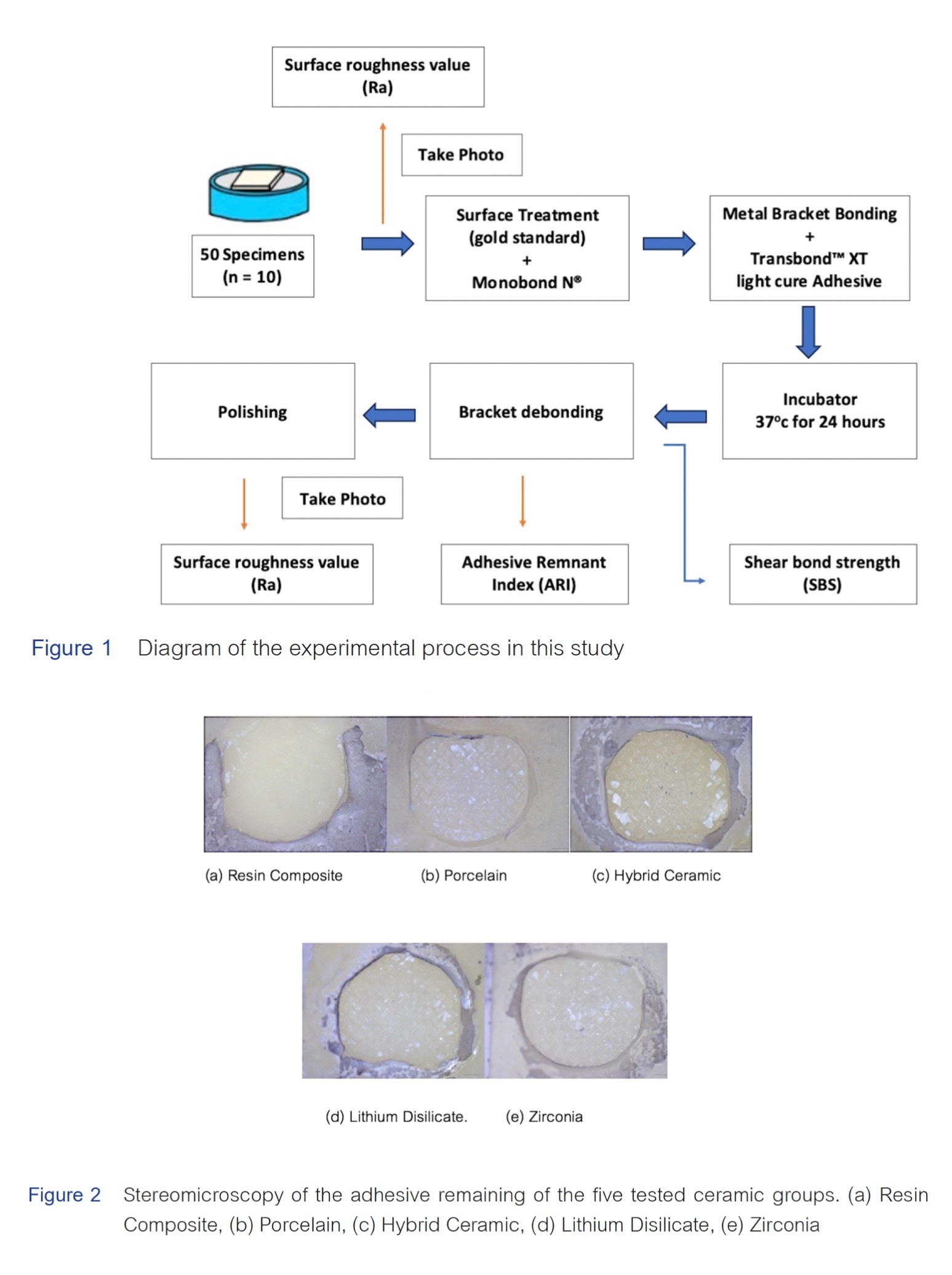
Materials and Methods: The 50 specimens (N=50) were divided into 5 groups (n=10), including Resin Composite (RC), Porcelain Leucite-based ceramic (PL), Lithium Disilicate glass (LD), Zirconia (ZR), and Hybrid ceramic (HC). The metal bracket 0.022” MBT™ System 3M™ Unitek™ Gemini Brackets Kit (3M ESPE, St. Paul, USA) was bonded on specimens with Universal Silane coupling agents (Monobond N®: Ivoclar Vivadent, Schaan, LiechtensteinI) and light-cure Transbond™ XT Primer and orthodontic adhesive (3M ESPE, St. Paul, USA). The shear bond strength (SBS) was measured by using a Universal testing machine. Adhesive Remnant Index (ARI) was observed under a stereomicroscope. All specimens were polished using the polishing protocol from the manufacturer’s instructions, and the surface roughness value (Ra) was recorded using Surface Roughness Tester-Stylus for contact to compare the roughness of the surface before and after removing the brackets.
Result: The highest shear bond strength was PL group (6.24 MPa), and the lowest was RC group (3.23 MPa).
The shear bond strength (SBS) was significantly different among groups (p<0.05). For ARI scores, most of the specimens in the PL, HC, LD, and ZR groups scored 3, whereas the RC group scored 1. The surface roughness value (Ra) before and after polishing of all groups except the HC group is significantly different. (p<0.05)
Conclusion: Only PL and ZR show high shear bond strength for orthodontic bonding. All groups, except the RC group, have adhesive failure at the adhesive-bracket interface. Therefore, the need to remove the remaining adhesives and the possibility of damage to the material surface are high. The HC group had non significantly different roughness values compared before bracket bonding and after removing the brackets.
Article Details

This work is licensed under a Creative Commons Attribution-NonCommercial-NoDerivatives 4.0 International License.
References
Poggio CE, Ercoli C, Rispoli L, Maiorana C, Esposito M. Metal-free materials for fixed prosthodontic restorations. Cochrane Database Syst Rev. 2017 Dec;12(12):Cd009606. doi: 10.1002/14651858.CD009606.pub2.
Grewal Bach GK, Torrealba Y, Lagravère MO. Orthodontic bonding to porcelain: a systematic review. Angle Orthod. 2014 May;84(3):555-560. doi: 10.2319/083013-636.1.
Mehmeti B, Kelmendi J, Iiljazi-Shahiqi D, Azizi B, Jakovljevic S, Haliti F, et al. Comparison of shear bond strength orthodontic brackets bonded to Zirconia and Lithium Disilicate crowns. Acta Stomatol Croat. 2019 Mar;53(1):17-27. doi: 10.15644/asc53/1/2.
Sayed ME. Comparative evaluation of shear bond strength of aesthetic orthodontic brackets bonded to aged composite restorative resin materials. Polymers (Basel). 2025 Feb;17(5):621. doi: 10.3390/polym17050621.
Soliman TA, Ghorab S, Baeshen H. Effect of surface treatments and flash-free adhesive on the shear bond strength of ceramic orthodontic brackets to CAD/CAM provisional materials. Clin Oral Investig. 2022 Jan;26(1):481-492. doi: 10.1007/s00784-021-04022-3.
Ritter DE, Ritter AV, Bruggeman G, Locks A, Tulloch JF. Bond strengths and adhesive remnant index of self-etching adhesives used to bond brackets to instrumented and uninstrumented enamel. Am J Dent. 2006 Feb;19(1):47-50.
Costa AR, Correr AB, Puppin-Rontani RM, Vedovello SA, Valdrighi HC, Correr-Sobrinho L, et al. Effect of bonding material, etching time and silane on the bond strength of metallic orthodontic brackets to ceramic. Braz Dent J. 2012;23(3):223-227. doi: 10.1590/s0103-64402012000300007.
Oz AZ, Oz AA, Ural C, Kaleli N, Duran I. Effectiveness of surface polishing after debonding of metal brackets from different CAD-CAM materials. J Orofac Orthop. 2024 May;85(Suppl 1):19-26. doi: 10.1007/s00056-023-00456-4.
Wongsamut W, Satrawaha S, Wayakanon K. Surface modification for bonding between amalgam and orthodontic brackets. J Orthod Sci. 2017 Oct-Dec;6(4):129-135. doi: 10.4103/jos.JOS_25_17.
Whitlock BO, 3rd, Eick JD, Ackerman RJ, Jr., Glaros AG, Chappell RP. Shear strength of ceramic brackets bonded to porcelain. Am J Orthod Dentofacial Orthop. 1994 Oct;106(4):358-364. doi: 10.1016/s0889-5406(94)70056-7.
Zachrisson YO, Zachrisson BU, Büyükyilmaz T. Surface preparation for orthodontic bonding to porcelain. Am J Orthod Dentofacial Orthop. 1996 Apr;109(4):420-430. doi: 10.1016/s0889-5406(96)70124-5.
Fnu K, Musharbash L, Ozer F, Mante F, Conejo J, Upadhyaya V, et al. The effect of different surface treatments on the bond strength to zirconia. J Prosthodont. 2025 Aug;34(7):734-740. doi: 10.1111/jopr.14068.
Casucci A, Monticelli F, Goracci C, Mazzitelli C, Cantoro A, Papacchini F, et al. Effect of surface pre-treatments on the zirconia ceramic-resin cement microtensile bond strength. Dent Mater. 2011 Oct;27(10):1024-1030. doi: 10.1016/j.dental.2011.07.002.
Rashid H. The effect of surface roughness on ceramics used in dentistry: A review of literature. Eur J Dent. 2014 Oct;8(4):571-579. doi: 10.4103/1305-7456.143646.
Al-Marzok MI, Al-Azzawi HJ. The effect of the surface roughness of porcelain on the adhesion of oral Streptococcus mutans. J Contemp Dent Pract. 2009 Nov;10(6):E017-24.
Abu Alhaija ES, Al-Wahadni AM. Shear bond strength of orthodontic brackets bonded to different ceramic surfaces. Eur J Orthod. 2007 Aug;29(4):386-389. doi: 10.1093/ejo/cjm032.
Abu Alhaija ES, Abu AlReesh IA, AlWahadni AM. Factors affecting the shear bond strength of metal and ceramic brackets bonded to different ceramic surfaces. Eur J Orthod. 2010 Jun;32(3):274-280. doi: 10.1093/ejo/cjp098.
Puppin-Rontani J, Sundfeld D, Costa AR, Correr AB, Puppin-Rontani RM, Borges GA, et al. Effect of Hydrofluoric Acid Concentration and Etching Time on Bond Strength to Lithium Disilicate Glass Ceramic. Oper Dent. 2017 Nov-Dec;42(6):606-615. doi: 10.2341/16-215-l.
Valente F, Mavriqi L, Traini T. Effects of 10-MDP based primer on shear bond strength between zirconia and new experimental resin Cement. Materials (Basel). 2020 Jan;13(1):235. doi: 10.3390/ma13010235.
Llerena-Icochea AE, Costa RM, Borges A, Bombonatti J, Furuse AY. Bonding polycrystalline zirconia with 10-MDP-containing adhesives. Oper Dent. 2017 May-Jun;42(3):335-341. doi: 10.2341/16-156-l.
El-Damanhoury HM, Gaintantzopoulou MD. Self-etching ceramic primer versus hydrofluoric acid etching: Etching efficacy and bonding performance. J Prosthodont Res. 2018 Jan;62(1):75-83. Epub 20170623. doi: 10.1016/j.jpor.2017.06.002.
Zimmermann M, Ender A, Egli G, Özcan M, Mehl A. Fracture load of CAD/CAM-fabricated and 3D-printed composite crowns as a function of material thickness. Clin Oral Investig. 2019 Jun;23(6):2777-2784. doi: 10.1007/s00784-018-2717-2.
Eggmann F, Mante FK, Ayub JM, Conejo J, Ozer F, Blatz MB. Influence of universal adhesives and silane coupling primer on bonding performance to CAD-CAM resin-based composites: A laboratory investigation. J Esthet Restor Dent. 2024 Apr;36(4):620-631. doi: 10.1111/jerd.13165.
Fahimi MA, Azarbayejani S, Mohammadi-Bassir M. Comparing the effect of two polishing systems on surface roughness of feldspathic, lithium disilicate, and translucent zirconia ceramics after orthodontic bracket debonding: An in vitro study. Int Orthod. 2024 Dec;22(4):100923. doi: 10.1016/j.ortho.2024.100923.
da Silva MA, Fardin AB, de Vasconcellos RC, Santos Lde M, Tonholo J, da Silva JG, Jr., et al. Analysis of roughness and surface hardness of a dental composite using atomic force microscopy and microhardness testing. Microsc Microanal. 2011 Jun;17(3):446-451. doi: 10.1017/s1431927611000250.
Sarac D, Sarac YS, Yuzbasioglu E, Bal S. The effects of porcelain polishing systems on the color and surface texture of feldspathic porcelain. J Prosthet Dent. 2006 Aug;96(2):122-128. doi: 10.1016/j.prosdent.2006.05.009.
Furtado de Mendonca A, Shahmoradi M, Gouvêa CVD, De Souza GM, Ellakwa A. Microstructural and mechanical characterization of CAD/CAM materials for monolithic dental restorations. J Prosthodont. 2019 Feb;28(2):e587-e594. Epub 20180818. doi: 10.1111/jopr.12964.
Xu Z, Yu P, Arola DD, Min J, Gao S. A comparative study on the wear behavior of a polymer infiltrated ceramic network (PICN) material and tooth enamel. Dent Mater. 2017 Dec;33(12):1351-1361. doi: 10.1016/j.dental.2017.08.190.
