
Comparative analysis of fracture resistance and film thickness between flowable composites and resin cement luted lithium disilicate ceramics
Article Sidebar
Main Article Content
Abstract
Objectives: This study investigated the fracture resistance and film thickness of the different composite cements that can be used with lithium disilicate-based ceramic restoration (IPS e.max CAD).
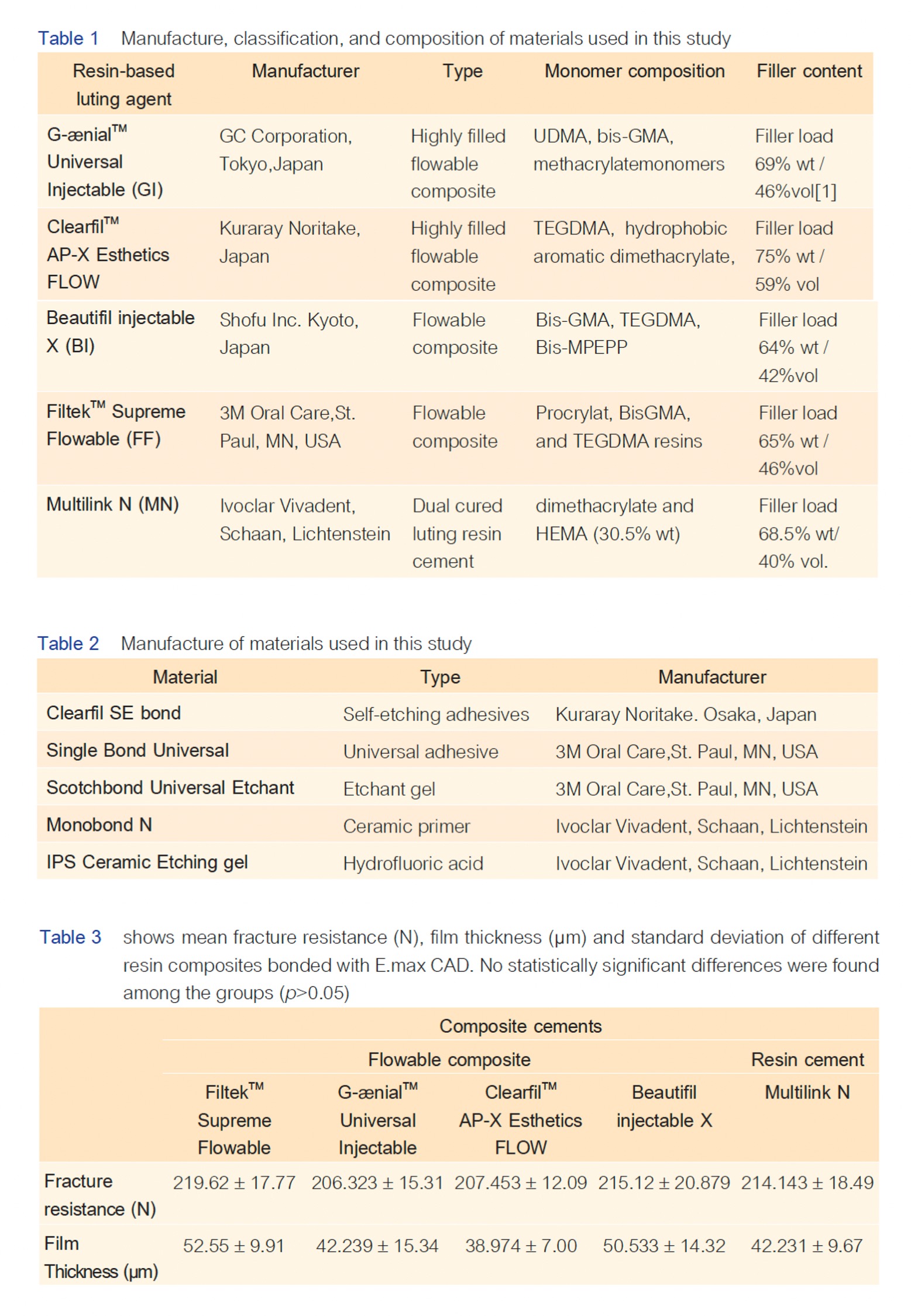
Materials and Methods: Twenty-five (25) IPS e.max CAD discs (A2, shade HT/C14) with a 10 mm diameter and 1 mm thickness were randomly assigned to five experimental groups (n = 5) according to luting agent G-ænialTM Universal Injectable (GC Corporation, Japan), ClearfilTM AP-X Esthetics FLOW (Kuraray Noritake, Japan), Beautifil injectable X (Shofu Inc., Japan), and FiltekTM Supreme Flowable (3M Oral Care, USA). Flowable composites were bonded between the ceramic disc and dentin. The control group sample was dual-cured resin cement, Multilink N (Ivoclar Vivadent, Liechtenstein). A universal testing machine (Model LR10K; Lloyd Instruments, Fareham, UK) was used to conduct a three-point bending test to determine the fracture resistance. The film thickness was analyzed using scanning electron microscopy (SEM, JSM 6610LV, JEOL, Peabody, PA, USA). The data were analyzed using a one-way ANOVA.
Results: Flowable composites presented fracture resistance values comparable to the resin cement, with acceptable film thickness values meeting ISO requirements, except for FiltekTM Supreme Flowable. However, no statistically significant differences were found among groups (p>0.05)
Conclusions: Flowable composites could be potential alternatives for ceramic luting, although further studies are needed to confirm their long-term clinical performance.
Article Details

This work is licensed under a Creative Commons Attribution-NonCommercial-NoDerivatives 4.0 International License.
References
The glossary of prosthodontic terms. Ninth Edition. J Prosthet Dent. 2017 May;117:e1-e105. doi: 10.1016/j.prosdent.2016.12.001.
Hill E, Lott J. A clinically focused discussion of luting materials. Aust Dent J. 2011 Jun;56 Suppl 1:67-76 doi: 10.1111/j.1834-7819.2010.01297.x.
Sakaguchi RL, Powers JM. Craig's Restorative dental materials-E-Book: Craig's restorative dental materials-E-book: Elsevier health sciences; 2011.
Heboyan A, Zafar MS, Karobari MI, Tribst JPM. Insights into polymeric materials for prosthodontics and dental implantology. Materials (Basel). 2022 Aug 4;15(15):5383. doi: 10.3390/ma15155383.
Zimmerli B, Strub M, Jeger F, Stadler O, Lussi A. Composite materials: composition, properties and clinical applications. A literature review. Schweiz Monatsschr Zahnmed. 2010;120(11):972-986.
Shinkai K, Taira Y, Suzuki S, Kawashima S, Suzuki M. Effect of filler size and filler loading on wear of experimental flowable resin composites. J Appl Oral Sci. 2018 Feb;26:e20160652. doi: 10.1590/1678-7757-2016-0652.
Pereira JSdC, Reis JA, Martins F, Maurício P, Fuentes MV. The effect of feldspathic thickness on fluorescence of a variety of resin cements and flowable composites. Appl. Sci. 2022;12(13):6535. doi: 10.3390/app12136535.
Kanar Ö, Meşeli S, Korkut B, Köken S, Tağtekin D, Yanıkoğlu F. Assessment of a highly-filled flowable composite for the repair of indirect composites. J Oral Sci. 2024;66(1):42-49. doi: 10.2334/josnusd.23-0166.
Tribst JPM, Etoeharnowo L, Tadros M, Feilzer AJ, Werner A, Kleverlaan CJ, et al. The influence of pre-heating the restoration and luting agent on the flexural strength of indirect ceramic and composite restorations. Biomater Investig Dent. 2023 Nov;10(1):2279066. doi: 10.1080/26415275.2023.2279066.
David-Pérez M, Ramírez-Suárez JP, Latorre-Correa F, Agudelo-Suárez AA. Degree of conversion of resin-cements (light-cured/dual-cured) under different thicknesses of vitreous ceramics: systematic review. J Prosthodont Res. 2022 Jul;66(3):385-394. doi: 10.2186/jpr.JPR_D_20_00090.
Nazari A, Sadr A, Saghiri MA, Campillo-Funollet M, Hamba H, Shimada Y, et al. Non-destructive characterization of voids in six flowable composites using swept-source optical coherence tomography. Dent Mater. 2013 Mar;29(3):278-286. doi: 10.1016/j.dental.2012.11.004.
Jang JH, Park SH, Hwang IN. Polymerization shrinkage and depth of cure of bulk-fill resin composites and highly filled flowable resin. Oper Dent. 2015 Apr;40(2):172-180. doi: 10.2341/13-307-L.
Kitasako Y, Sadr A, Burrow MF, Tagami J. Thirty-six month clinical evaluation of a highly filled flowable composite for direct posterior restorations. Aust Dent J. 2016 Sep;61(3):366-373. doi: 10.1111/adj.12387.
Sabbagh J, Ryelandt L, Bacherius L, Biebuyck JJ, Vreven J, Lambrechts P, et al. Characterization of the inorganic fraction of resin composites. J Oral Rehabil. 2004 Nov;31(11):1090-1101. doi: 10.1111/j.1365-2842.2004.01352.x.
Ikeda I, Otsuki M, Sadr A, Nomura T, Kishikawa R, Tagami J. Effect of filler content of flowable composites on resin-cavity interface. Dent Mater J. 2009 Nov;28(6):679-685. doi: 10.4012/dmj.28.679.
Jurado CA, Davila CE, Davila A, Hernandez AI, Odagiri Y, Afrashtehfar KI, et al. Influence of occlusal thickness on the fracture resistance of chairside milled lithium disilicate posterior full-coverage single-unit prostheses containing virgilite: A comparative in vitro study. J Prosthodont. 2024 May. doi:10.1111/jopr.13870.
Sayed SME, Emam ZN. Marginal gap distance and fracture resistance of lithium disilicate and zirconia-reinforced lithium disilicate all-ceramic crowns constructed with two different processing techniques with two different processing techniques. Egypt. Dent. J. 2019 Oct;65(4):3871-3881. doi:10.21608/edj.2019.76035.
Luekiatpaisarn J. Fracture resistance of occlusal ceramic and composite molar onlay comparing to lithium disilicate molar crown. Chula ETD 2018:2363.
Comba A, Baldi A, Carossa M, Michelotto Tempesta R, Garino E, Llubani X, et al. Post-fatigue fracture resistance of lithium disilicate and polymer-infiltrated ceramic network indirect restorations over endodontically-treated molars with different preparation designs: An In-vitro study. Polymers (Basel). 2022 Nov;14(23):5084.. doi: 10.3390/polym14235084.
Jurado CA, Bora PV, Azpiazu-Flores FX, ChZXXo SH, Afrashtehfar KI. Effect of resin cement selection on fracture resistance of chairside CAD-CAM lithium disilicate crowns containing virgilite: A comparative in vitro study. J Prosthet Dent. 2025 Jan;133(1):203-207. doi: 10.1016/j.prosdent.2023.08.019.
Tomaselli LO, Oliveira D, Favarao J, Silva AFD, Pires-de-Souza FCP, Geraldeli S, et al. Influence of pre-heating regular resin composites and flowable composites on luting ceramic veneers with different thicknesses. Braz Dent J. 2019 Oct;30(5):459-466. doi: 10.1590/0103-6440201902513.
Manso AP, Silva NR, Bonfante EA, Pegoraro TA, Dias RA, Carvalho RM. Cements and adhesives for all-ceramic restorations. Dent Clin North Am. 2011 Apr;55(2):311-332 doi: 10.1016/j.cden.2011.01.011.
Gressler May L, Kelly JR, Bottino MA, Hill T. Influence of the resin cement thickness on the fatigue failure loads of CAD/CAM feldspathic crowns. Dent Mater. 2015 Aug;31(8):895-900. doi: 10.1016/j.dental.2015.04.019.
Simon JF, Darnell LA. Considerations for proper selection of dental cements. Compend Contin Educ Dent. 2012 Jan;33(1): 28-30, 32, 34-35; quiz 36, 38.
Furtos G, Baldea B, Silaghi-Dumitrescu L, Moldovan M, Prejmerean C, Nica L. Influence of inorganic filler content on the radiopacity of dental resin cements. Dent Mater J. 2012;31(2):266-272. doi: 10.4012/dmj.2011-225.
Mirică IC, Furtos G, Bâldea B, Lucaciu O, Ilea A, Moldovan M, et al. Influence of filler loading on the mechanical properties of flowable resin composites. Materials (Basel). 2020 Mar;13(6):1477. doi: 10.3390/ma13061477.
Guess PC, Schultheis S, Wolkewitz M, Zhang Y, Strub JR. Influence of preparation design and ceramic thicknesses on fracture resistance and failure modes of premolar partial coverage restorations. J Prosthet Dent. 2013 Oct;110(4):264-273. doi: 10.1016/s0022-3913(13)60374-1.
Jurado CA, Pinedo F, Trevino DAC, Williams Q, Marquez-Conde A, Irie M, et al. CAD/CAM lithium disilicate ceramic crowns: Effect of occlusal thickness on fracture resistance and fractographic analysis. Dent Mater J. 2022 Oct;41(5):705-709. doi: 10.4012/dmj.2022-018.
Guimarães RCC, Oliveira Dd, Rocha MG, Roulet J-F, Geraldeli S, Sinhoreti MAC. Effect of glass-ceramic thickness on the degree of conversion, polymerization shrinkage stress, and bond strength of resin cements. Int J Adhes Adhes 2025;136:103871. doi: 10.1016/j.ijadhadh.2024.103871.
Fonseca RG, Cruz CA, Adabo GL. The influence of chemical activation on hardness of dual-curing resin cements. Braz Oral Res. 2004 Jul-Sep;18(3):228-232. doi: 10.1590/s1806-83242004000300009.
Pongprueksa P, De Munck J, Karunratanakul K, Barreto BC, Van Ende A, Senawongse P, et al. Dentin bonding testing using a mini-interfacial fracture toughness approach. J Dent Res. 2016 Mar;95(3):327-333. doi: 10.1177/0022034515618960.
Tzimas K, Pappa E, Fostiropoulou M, Rahiotis C, Papazoglou S. Flowable Composite Resins as Sole Restorative Materials. 2025.
Taylor DF, Kalachandra S, Sankarapandian M, McGrath JE. Relationship between filler and matrix resin characteristics and the properties of uncured composite pastes. Biomaterials. 1998 Jan-Feb;19(1-3):197-204. doi: 10.1016/s0142-9612(98)80001-x.
Schulze KA, Zaman AA, Soderholm KJ. Effect of filler fraction on strength, viscosity and porosity of experimental compomer materials. J Dent. 2003 Aug;31(6):373-382. doi: 10.1016/s0300-5712(03)00091-5.
De Souza G, Braga RR, Cesar PF, Lopes GC. Correlation between clinical performance and degree of conversion of resin cements: a literature review. J Appl Oral Sci. 2015 Jul-Aug;23(4):358-368. doi: 10.1590/1678-775720140524.
Abouelleil H, Colon P, Jeannin C, Goujat A, Attik N, Laforest L, et al. Impact of the microstructure of CAD/CAM blocks on the bonding strength and the bonded interface. J Prosthodont. 2022 Jan;31(1):72-78. doi: 10.1111/jopr.13361.
Passos SP, Kimpara ET, Bottino MA, Rizkalla AS, Santos GC, Jr. Effect of ceramic thickness and shade on mechanical properties of a resin luting agent. J Prosthodont. 2014 Aug;23(6):462-466.
doi: 10.1111/jopr.12140.
Alberto Jurado C, Kaleinikova Z, Tsujimoto A, Alberto Cortés Treviño D, Seghi RR, Lee DJ. Comparison of fracture resistance for chairside CAD/CAM lithium disilicate crowns and overlays with different designs. J Prosthodont. 2022 Apr;31(4):341-347. doi: 10.1111/jopr.13411.
