
The effect of light curing intensity on dentin bond strength of a dual-cure resin cement polymerized under a lithium disilicate ceramic
Article Sidebar
Main Article Content
Abstract
Objectives: To evaluate the impact of different light curing intensities on the bond strength of dual-cure resin cement under lithium disilicate ceramic.
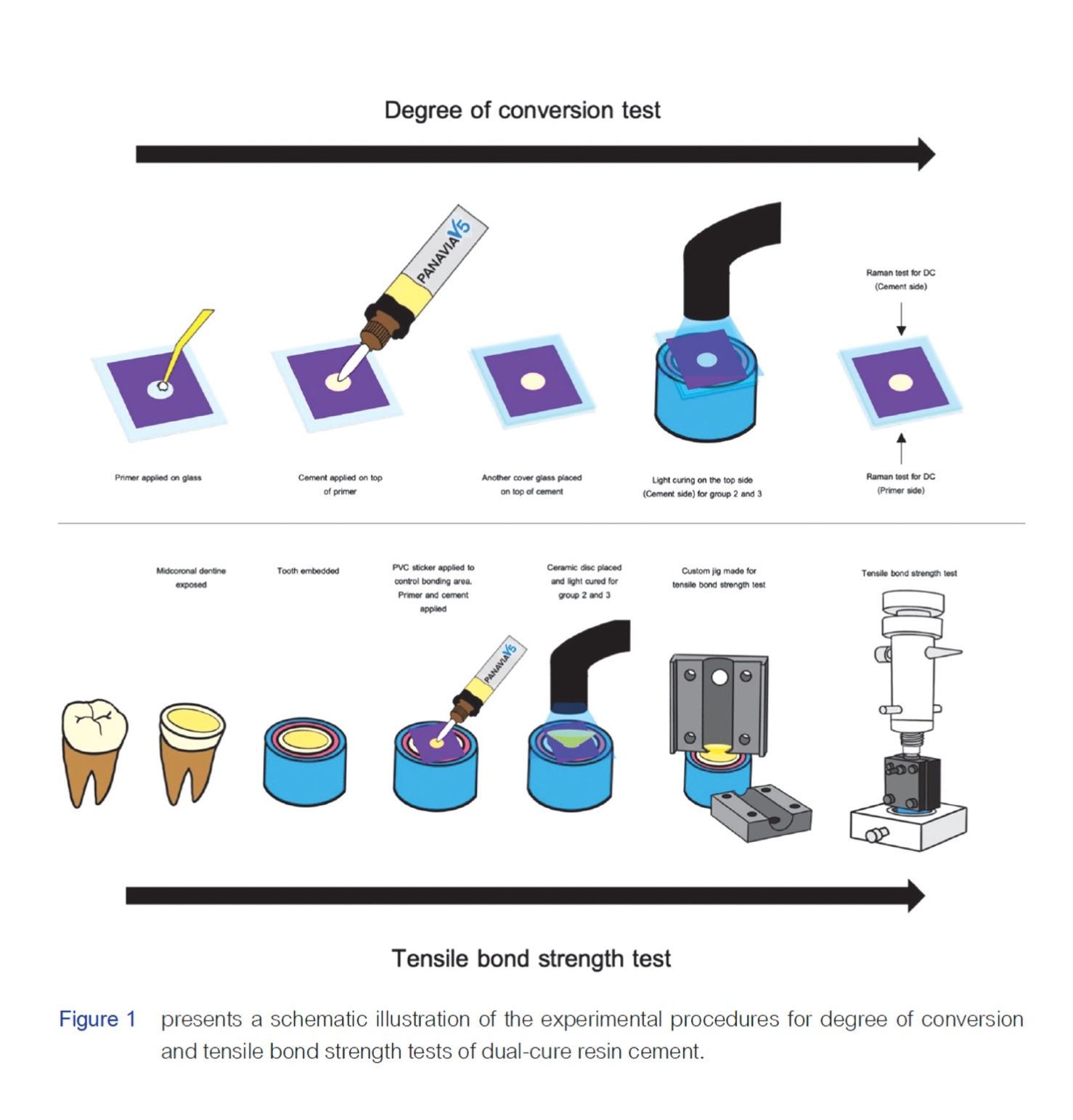
Materials and Methods: Thirty-third molars were sectioned to expose midcoronal dentin, divided into three experimental groups with 10 specimens. Each group was bonded to truncated cone-shaped lithium disilicate ceramics using Panavia V5 dual-cure resin cement that were polymerized with 3 conditions: group 1, no light-curing, group 2, light cured with High mode (1123±4.83 mW/cm²), and with Turbo mode (1981±11.00 mW/cm²) in group 3. The light-curing for 60 seconds was used in this study. After 24 hours, the degree of conversion (DC) was measured on both primer and cement sides using a Raman spectrometer, and all bonded specimens underwent a tensile bond strength test.
Results: The uncured cement showed the lowest DC (70.88±0.55%), while light-curing significantly increased DC (High mode: 73.56±0.25%, Turbo mode: 75.94±0.61%). No significant differences were found in DC on the primer side of cement for uncured, High mode, and Turbo mode (98.91±0.04%, 98.92±0.03% to 98.93±0.03% accordingly). Mean TBS for groups 1, 2, and 3 were 5.53 MPa, 11.27 MPa, and 14.52 MPa, respectively, showing significant differences.
Conclusion: DC improved significantly with light curing on the cement side, though it did not affect the adhesive side. The tensile bond strength was enhanced with increased light curing intensity.
Article Details

This work is licensed under a Creative Commons Attribution-NonCommercial-NoDerivatives 4.0 International License.
References
Barizon KT, Bergeron C, Vargas MA, Qian F, Cobb DS, Gratton DG, et al. Ceramic materials for porcelain veneers: part II. Effect of material, shade, and thickness on translucency. J Prosthet Dent. 2014 Oct;112(4):864-870. doi: 10.1016/j.prosdent.2014.05.016.
Heboyan A, Zafar MS, Karobari MI, Tribst JPM. Insights into polymeric materials for prosthodontics and dental implantology. Materials (Basel). 2022 Aug;15(15):5383. doi: 10.3390/ma15155383.
El-Deeb HA, Mobarak EH. Repair bond strength of high-viscosity glass-ionomer cements using resin composite bonded with light- and self-cured adhesive systems. Oper Dent. 2021 Jan;46(1):45-53. doi: 10.2341/19-186-L.
Platt JA. Resin cements: into the 21st century. Compend Contin Educ Dent. 1999 Dec;20(12):1173-1176, 1178, 1180-1182; quiz 1184.
Miotti LL, Follak AC, Montagner AF, Pozzobon RT, da Silveira BL, Susin AH. Is conventional resin cement adhesive performance to dentin better than self-adhesive? A systematic review and meta-analysis of laboratory studies. Oper Dent. 2020 Sep;45(5):484-495. doi: 10.2341/19-153-L.
Hill EE, Lott J. A clinically focused discussion of luting materials. Aust Dent J. 2011 Jun;56 Suppl 1:67-76. doi: 10.1111/j.1834-7819.2010.01297.x.
Archegas LR, de Menezes Caldas DB, Rached rN, Soares P, Souza EM. Effect of ceramic veneer opacity and exposure time on the polymerization efficiency of resin cements. Oper Dent. 2012 May-Jun;37(3):281-289. doi: 10.2341/11-134-L.
David-Pérez M, Ramírez-Suárez JP, Latorre-Correa F, Agudelo-Suárez AA. Degree of conversion of resin-cements (light-cured/dual-cured) under different thicknesses of vitreous ceramics: systematic review. J Prosthodont Res. 2022 Jul 30;66(3):385-394. doi: 10.2186/jpr.JPR_D_20_00090.
Silva EM, Noronha-Filho JD, Amaral CM, Poskus LT, Guimarães JG. Long-term degradation of resin-based cements in substances present in the oral environment: influence of activation mode. J Appl Oral Sci. 2013;21(3):271-277. doi: 10.1590/1679-775720130026.
Kitasako Y, Burrow MF, Katahira N, Nikaido T, Tagami J. Shear bond strengths of three resin cements to dentine over 3 years in vitro. J Dent. 2001 Feb;29(2):139-144. doi: 10.1016/s0300-5712(00)00058-0.
D'Arcangelo C, Zarow M, De Angelis F, Vadini M, Paolantonio M, Giannoni M, et al. Five-year retrospective clinical study of indirect composite restorations luted with a light-cured composite in posterior teeth. Clin Oral Investig. 2014;18(2):615-624. doi: 10.1007/s00784-013-1001-8.
Abed YA, Sabry HA, Alrobeigy NA. Degree of conversion and surface hardness of bulk-fill composite versus incremental-fill composite. Tanta Dental J. 2015 Jun;12(2):71-80. doi:10.1016/J.TDJ.2015.01.003
Bansal R, Taneja S, Kumari M. Effect of ceramic type, thickness, and time of irradiation on degree of polymerization of dual-cure resin cement. J Conserv Dent. 2016 Sep-Oct;19(5):414-418. doi: 10.4103/0972-0707.190010.
Kilinc E, Antonson SA, Hardigan PC, Kesercioglu A. The effect of ceramic restoration shade and thickness on the polymerization of light- and dual-cure resin cements. Oper Dent. 2011 Nov-Dec;36(6):661-669. doi: 10.2341/10-206-L.
Heyder M, Kranz S, Beck J, Wettemann M, Hennig CL, Schulze-Späte U, et al. Influence of layer thickness and shade on the transmission of light through contemporary resin composites. Materials (Basel). 2024 Mar 28;17(7):1554. doi: 10.3390/ma17071554.
Pereira CB, Magalhães CS, Lages FS, Ferreira RC, da Silva EH, da Silveira RR, et al. Moreira AN. Degree of conversion and microhardness of resin cements photoactivated through glass ceramic. J Clin Exp Dent. 2021 Nov;13(11):e1068-e1075. doi: 10.4317/jced.58630.
Zhang X, Wang F. Hardness of resin cement cured under different thickness of lithium disilicate-based ceramic. Chin Med J (Engl). 2011 Nov;124(22):3762-3767.
David-Pérez M, Ramírez-Suárez JP, Latorre-Correa F, Agudelo-Suárez AA. Degree of conversion of resin-cements (light-cured/dual-cured) under different thicknesses of vitreous ceramics: systematic review. J Prosthodont Res. 2022 Jul;66(3):385-394. doi: 10.2186/jpr.JPR_D_20_00090.
Li Q, Lin HL, Zheng M, Ozcan M, Yu H. Minimum radiant exposure and irradiance for triggering adequate polymerization of a photo-polymerized resin cement. Materials (Basel). 2021 Apr;14(9):2341. doi: 10.3390/ma14092341.
Ilie N, Hickel R. Correlation between ceramics translucency and polymerization efficiency through ceramics. Dent Mater. 2008 Jul;24(7):908-914. doi: 10.1016/j.dental.2007.11.006.
Meng X, Yoshida K, Atsuta M. Influence of ceramic thickness on mechanical properties and polymer structure of dual-cured resin luting agents. Dent Mater. 2008 May;24(5):594-599. doi: 10.1016/j.dental.2007.06.014.
Moraes RR, Faria-e-Silva AL, Ogliari FA, Correr-Sobrinho L, Demarco FF, Piva E. Impact of immediate and delayed light activation on self-polymerization of dual-cured dental resin luting agents. Acta Biomater. 2009 Jul;5(6):2095-2100. doi: 10.1016/j.actbio.2009.01.030.
Vrochari AD, Eliades G, Hellwig E, Wrbas KT. Curing efficiency of four self-etching, self-adhesive resin cements. Dent Mater. 2009 Sep;25(9):1104-1108. doi: 10.1016/j.dental.2009.02.015.
Yoshihara K, Nagaoka N, Benino Y, Nakamura A, Hara T, Maruo Y, et al. Touch-cure polymerization at the composite cement-dentin interface. J Dent Res. 2021 Aug;100(9):935-942. doi: 10.1177/00220345211001020.
Braga RR, Meira JB, Boaro LC, Xavier TA. Adhesion to tooth structure: a critical review of "macro" test methods. Dent Mater. 2010 Feb;26(2):e38-49. doi: 10.1016/j.dental.2009.11.150.
Tsujimoto A, Barkmeier WW, Teixeira EC, Takamizawa T, Miyazaki M, Latta MA. Fatigue bond strength of dental adhesive systems: Historical background of test methodology, clinical considerations and future perspectives. Jpn Dent Sci Rev. 2022 Nov;58:193-207. doi: 10.1016/j.jdsr.2022.05.001.
Arrais CA, Giannini M, Rueggeberg FA, Pashley DH. Microtensile bond strength of dual-polymerizing cementing systems to dentin using different polymerizing modes. J Prosthet Dent. 2007 Feb;97(2):99-106. doi: 10.1016/j.prosdent.2006.12.007.
