
Effect of resin coating on microtensile bond strength of resin cements to dentin and resin nanoceramic material
Article Sidebar
Main Article Content
Abstract
Objective: This study evaluated the effect of a resin coating material on microtensile bond strength between dentin and a resin nanoceramic material using three different resin cements.
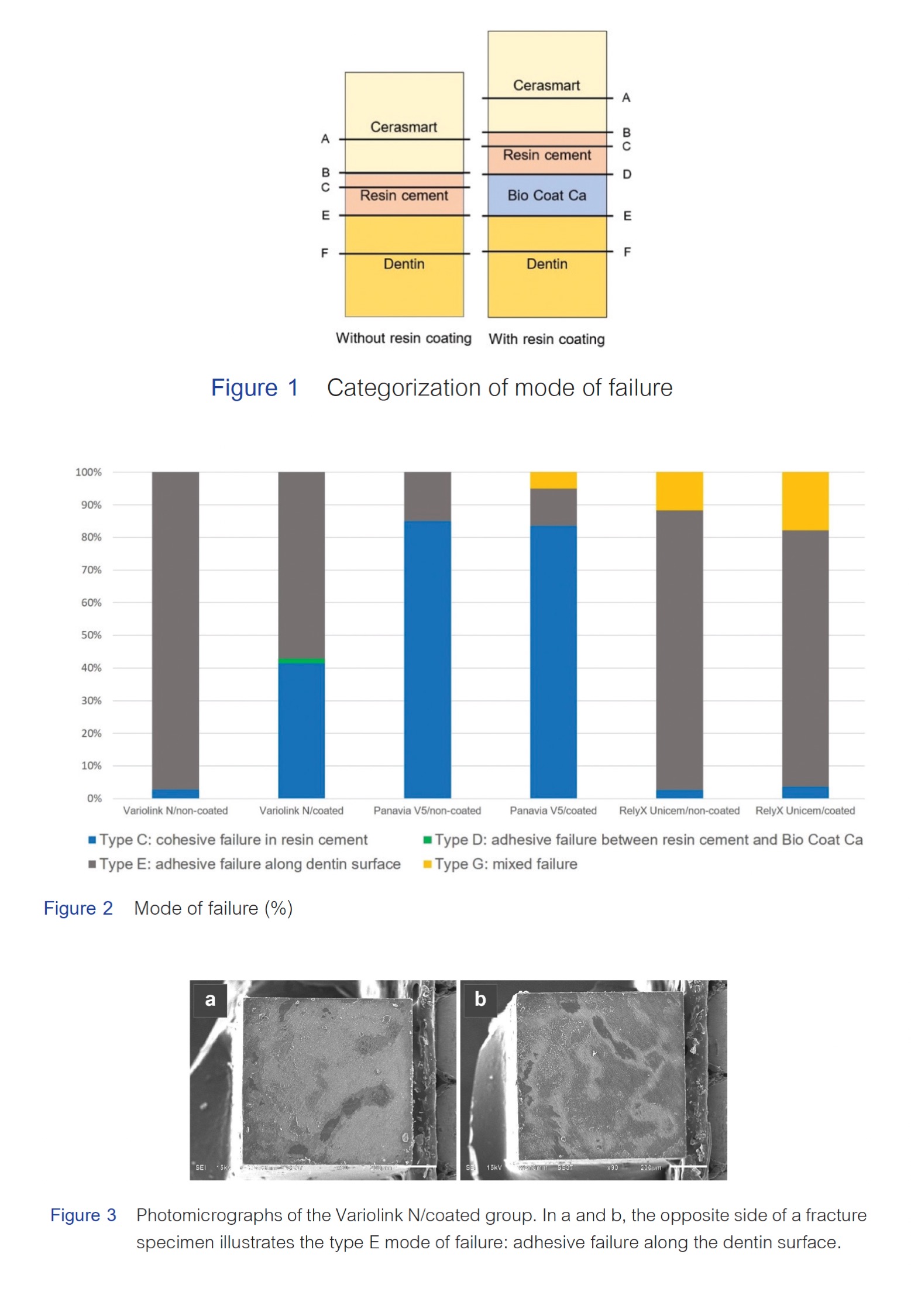
Materials and Methods: Seventy-two sound permanent third molars were randomly assigned into six groups (n = 12 per group) according to resin coating procedure (coated and non-coated) and types of resin cement (Variolink N, Panavia V5, and RelyX Unicem). Cerasmart block was bonded to dentin with the resin cement, with or without the resin coating agent. Each specimen was sectioned into a stick shape with an approximate bonded surface area of 1x1 mm2. The microtensile bond strength (MTBS) was measured and statistically analyzed (α=0.05). The failure mode of the fractured specimen was investigated.
Results: The MTBS of Variolink N/non-coated was statistically lower than Variolink N/coated (p<0.05). In contrast, no significant differences were observed between the Panavia V5/non-coated and Panavia/coated group, nor between RelyX Unicem/non-coated and RelyX Unicem/coated group (p>0.05).
Conclusions: Within the limitations of this study, the effect of Bio Coat Ca as a resin coating material on microtensile bond strength was dependent on the type of resin cement used. The application of Bio Coat Ca significantly enhanced the microtensile bond strength of Variolink N to dentin, whereas no significant effect was observed for Panavia V5 and RelyX Unicem. Importantly, the application of Bio Coat Ca did not impair the bonding performance of Panavia V5 and RelyX Unicem.
Article Details

This work is licensed under a Creative Commons Attribution-NonCommercial-NoDerivatives 4.0 International License.
References
Nikaido T, Inoue G, Takagaki T, Takahashi R, Sadr A, Tagami J, Resin coating technique for protection of pulp and Increasing bonding in indirect restoration. Curr Oral Health Rep. 2015 June;2(2):81-86. doi: 10.1007/s40496-015-0046-y.
Cagidiaco MC, Ferrari M, Garberoglio R, Davidson CL. Dentin contamination protection after mechanical preparation for veneering. Am J Dent. 1996 Apr;9(2):57-60.
Jayasooriya PR, Pereira PN, Nikaido T, Burrow MF, Tagami J. The effect of a "resin coating" on the interfacial adaptation of composite inlays. Oper Dent. 2003 Jan-Feb;28(1):28-35.
Jayasooriya PR, Pereira PN, Nikaido T, Tagami J. Efficacy of a resin coating on bond strengths of resin cement to dentin. J Esthet Restor Dent. 2003;15(2):105-113; discussion 113. doi: 10.1111/j.1708-8240.2003.tb00325.x.
Udo T, Nikaido T, Ikeda M, Weerasinghe DS, Harada N, Foxton RM, et al. Enhancement of adhesion between resin coating materials and resin cements. Dent Mater J. 2007 Jul;26(4):519-525. doi: 10.4012/dmj.26.519.
Nikaido T, Tagami J, Yatani H, Ohkubo C, Nihei T, Koizumi H, et al. Concept and clinical application of the resin-coating technique for indirect restorations. Dent Mater J. 2018 Mar ;37(2):192-196. doi: 10.4012/dmj.2017-253.
Nikaido T, Nakaoki Y, Ogata M, Foxton R, Tagami J. The resin-coating technique. Effect of a single-step bonding system on dentin bond strengths. J Adhes Dent. 2003;5(4):293-300.
Nikaido T, Takahashi R, Ariyoshi,M, Sadr A, Tagami J. Protection and reinforcement of tooth structures by dental coating materials. Coatings. 2012;2(4):210-220. doi: 10.3390/coatings2040210.
Takahashi R, Nikaido T, Ariyoshi M, Kitayama S, Sadr A, Foxton RM, et al. Thin resin coating by dual-application of all-in-one adhesives improves dentin bond strength of resin cements for indirect restorations. Dent Mater J. 2010 Oct;29(5):615-622. doi: 10.4012/dmj.2009-110.
Abdou A, Takahashi R, Saad A, Nozaki K, Nikaido T, Tagami J. Influence of resin-coating on bond strength of resin cements to dentin and CAD/CAM resin block in single-visit and multiple-visit treatment. Dent Mater J. 2021 May ;40(3):674-682. doi: 10.4012/dmj.2020-160.
Takahashi R, Nikaido T, Ariyoshi M, Foxton RM, Tagami J. Microtensile bond strengths of a dual-cure resin cement to dentin resin-coated with an all-in-one adhesive system using two curing modes. Dent Mater J. 2010 May;29(3):268-276. doi: 10.4012/dmj.2009-077.
Islam MR, Takada T, Weerasinghe DS, Uzzaman MA, Foxton RM, Nikaido T, et al. Effect of resin coating on adhesion of composite crown restoration. Dent Mater J. 2006 Jun;25(2):272-279. doi: 10.4012/dmj.25.272.
Kosaka S, Kajihara H, Kurashige H, Tanaka T. Effect of resin coating as a means of preventing marginal leakage beneath full cast crowns. Dent Mater J. 2005 Mar;24(1):117-122. doi: 10.4012/dmj.24.117.
Ito S, Iijima M, Motai F, Mizoguchi I, Saito T. Effects of calcium salts of acidic monomers on mineral induction of phosphoprotein immobilized to agarose beads. J Biomed Mater Res A. 2012 Oct;100(10):2760-2765. doi: 10.1002/jbm.a.34212.
Thaweboon S, Saito T, Nagano K, Thaweboon B. Evaluation of an adhesive containing calcium salt of acidic monomers on inhibition of biofilm formation of bacteria related to root caries. Key Eng Mater, 2020;853:41-45.doi: 10.4028/www.scientific.net/kem.853.41.
Qiu YJ, Tang J, Saito T. A novel bio-active adhesive monomer induces odontoblast differentiation: a comparative study. Int Endod J. 2020 Oct;53(10):1413-1429. doi: 10.1111/iej.13365.
Qiu Y, Saito T. Novel bioactive adhesive monomer CMET promotes odontogenic differentiation and dentin regeneration. Int J Mol Sci. 2021 Nov;22(23):12728. doi: 10.3390/ijms222312728.
Chavali R, Nejat AH, Lawson NC. Machinability of CAD-CAM materials. J Prosthet Dent. 2017 Aug;118(2):194-199. doi: 10.1016/j.prosdent.2016.09.022.
Awada A, Nathanson D. Mechanical properties of resin-ceramic CAD/CAM restorative materials. J Prosthet Dent. 2015 Oct;114(4):587-593. doi: 10.1016/j.prosdent.2015.04.016.
Gracis S, Thompson VP, Ferencz JL, Silva NR, Bonfante EA. A new classification system for all-ceramic and ceramic-like restorative materials. Int J Prosthodont. 2015 May-Jun;28(3):227-235. doi: 10.11607/ijp.4244.
Lawson NC, Bansal R, Burgess JO. Wear, strength, modulus and hardness of CAD/CAM restorative materials. Dent Mater. 2016 Nov;32(11):e275-e283. doi: 10.1016/j.dental.2016.08.222.
Guo Y, Zhou HD, Feng YZ. Effects of hybrid coat on shear bond strength of five cements: an in vitro study. J Adv Prosthodont. 2017 Dec;9(6):447-452. doi: 10.4047/jap.2017.9.6.447.
Van Meerbeek B, Peumans M, Poitevin A, Mine A, Van Ende A, Neves A, et al. Relationship between bond-strength tests and clinical outcomes. Dent Mater. 2010 Feb;26(2):e100-121. doi: 10.1016/j.dental.2009.11.148.
Van Meerbeek B, De Munck J, Yoshida Y, Inoue S, Vargas M, Vijay P, et al. Buonocore memorial lecture. Adhesion to enamel and dentin: current status and future challenges. Oper Dent. 2003 May-Jun;28(3):215-235.
Tay FR, Pashley DH. Have dentin adhesives become too hydrophilic?. J Can Dent Assoc. 2003 Dec;69(11):726-731.
Dietschi D, Magne P, Holz J. Bonded to tooth ceramic restorations: in vitro evaluation of the efficiency and failure mode of two modern adhesives. Schweiz Monatsschr Zahnmed. 1995;105(3):299-305.
Magne P, Douglas WH. Porcelain veneers: dentin bonding optimization and biomimetic recovery of the crown. Int J Prosthodont. 1999 Mar-Apr;12(2):111-121.
Dietschi D, Herzfeld D. In vitro evaluation of marginal and internal adaptation of class II resin composite restorations after thermal and occlusal stressing. Eur J Oral Sci. 1998 Dec;106(6):1033-1042. doi: 10.1046/j.0909-8836.1998.eos106609.x.
Magne P. Immediate dentin sealing: a fundamental procedure for indirect bonded restorations. J Esthet Restor Dent. 2005;17(3):144-154; discussion 155. doi: 10.1111/j.1708-8240.2005.tb00103.x.
Akehashi S, Takahashi R, Nikaido T, Burrow MF, Tagami J. Enhancement of dentin bond strength of resin cement using new resin coating materials. Dent Mater J. 2019 Dec ;38(6):955-962. doi: 10.4012/dmj.2018-328.
Stamatacos C, Simon JF. Cementation of indirect restorations: an overview of resin cements. Compend Contin Educ Dent. 2013 Jan;34(1):42-44
Radovic I, Monticelli F, Goracci C, Vulicevic ZR, Ferrari M. Self-adhesive resin cements: a literature review. J Adhes Dent. 2008 Aug;10(4):251-258.
Suzuki TY, Godas AG, Guedes AP, Catelan A, Pavan S, Briso AL,et al. Microtensile bond strength of resin cements to caries-affected dentin. J Prosthet Dent. 2013 Jul;110(1):47-55. doi: 10.1016/S0022-3913(13)60339-X.
Giannini M, Takagaki T, Bacelar-Sá R, Vermelho PM, Ambrosano GM, Sadr A, et al. Influence of resin coating on bond strength of self-adhesive resin cements to dentin. Dent Mater J. 2015;34(6):822-827. doi: 10.4012/dmj.2015-099.
Pashley EL, Comer RW, Simpson MD, Horner JA, Pashley DH, Caughman WF. Dentin permeability: sealing the dentin in crown preparations. Oper Dent. 1992 Jan-Feb;17(1):13-20.
Magne P, Kim TH, Cascione D, Donovan TE. Immediate dentin sealing improves bond strength of indirect restorations. J Prosthet Dent. 2005 Dec;94(6):511-519. doi: 10.1016/j.prosdent.2005.10.010.
Love RM, Jenkinson HF. Invasion of dentinal tubules by oral bacteria. Crit Rev Oral Biol Med. 2002;13(2):171-183. doi: 10.1177/154411130201300207.
