
Relationships among chronological age, dental age, and bone age in Thai prepubertal females
Article Sidebar
Main Article Content
Abstract
Objectives: The purpose of this study was to investigate the relationships between dental age, skeletal age, and chronological age in Thai girls during the prepubertal period, and to identify dental indicators for assessing advanced bone age.
Materials and methods: This retrospective study examined panoramic and hand-wrist radiographs of Thai girls aged 8-10 years, with images taken within a 3-month interval. Dental age was assessed using Demirjian et al. ’s method by two calibrated dentists. Bone age was determined using BoneXpert® software based on the Greulich & Pyle Atlas. Spearman correlation analyzed relationships among chronological age, skeletal age, and dental age. Subjects were categorized as normal, advanced, or delayed based on dental or bone age relative to chronological age. Chi-square test analyzed the relationship between bone age and dental age groups. Descriptive analysis identified potential tooth indicators for bone age assessment.
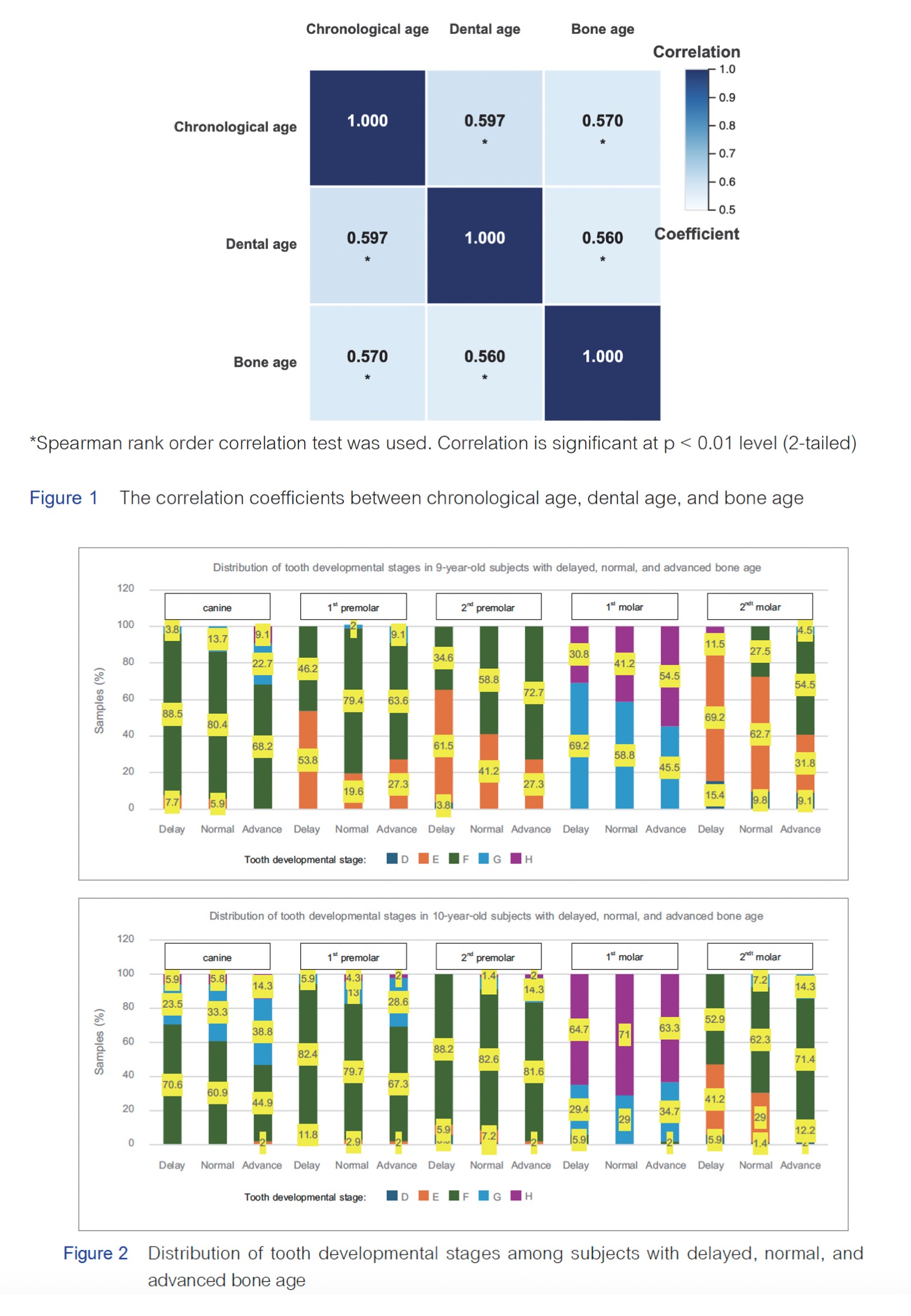
Results: Significant positive correlations were found among chronological age, dental age, and bone age (p < 0.01). Correlation coefficients were 0.597 between chronological and dental age, 0.570 between chronological and bone age, and 0.560 between dental and bone age. Chi-square tests revealed a significant association between bone age groups and dental age groups (p = 0.001). Subjects with advanced bone age demonstrated higher percentages of advanced second molar development compared to those with normal bone age.
Conclusions: This study demonstrated positive correlations among chronological age, dental age, and bone age in Thai prepubertal females, with the correlation between dental age and bone age being rated as moderate. Advanced bone age was associated with accelerated second molar development, suggesting its potential as an indicator for skeletal maturity assessment.
Article Details

This work is licensed under a Creative Commons Attribution-NonCommercial-NoDerivatives 4.0 International License.
References
Eveleth PB, Tanner JM. Worldwide variation in human growth. Cambridge: Cambridge University Press; 1976.
Fishman LS. Radiographic evaluation of skeletal maturation: a clinically oriented method based on hand-wrist films. Angle Orthod. 1982 Apr;52(2):88-112. doi: 10.1043/0003-3219(1982)052<0088:REOSM>2.0.CO;2.
Martin DD, Wit JM, Hochberg Z, Sävendahl L, van Rijn RR, Fricke O, et al. The use of bone age in clinical practice - part 1. Horm Res Paediatr. 2011;76(1):1-9. doi: 10.1159/000329372.
Greulich WW, Pyle SI. Radiograph atlas of skeletal development of the hand and wrist. 2nd ed. California: Stanford University Press;1959.
Tanner JM, Whitehouse RH, Cameron N, Marshall WA, Healy MJ, Goldstein H. Assessment of skeletal maturity and prediction of adult height (TW2 method). London: Academic Press;1983.
Fanning EA. Effect of extraction of deciduous molars on the formation and eruption of their successors. Angle Orthod. 1962;32(1):44-53. doi: 10.1043/0003-3219(1962)032<0044:EOEODM>2.0.CO;2
De Donno A, Angrisani C, Mele F, Introna F, Santoro V. Dental age estimation: Demirjian's versus the other methods in different populations. A literature review. Med Sci Law. 2021 Jan;61(1_suppl):125-129. doi: 10.1177/0025802420934253.
Demirjian A, Goldstein H, Tanner JM. A new system of dental age assessment. Hum Biol. 1973 May;45(2):211-227.
Ontell FK, Ivanovic M, Ablin DS, Barlow TW. Bone age in children of diverse ethnicity. AJR Am J Roentgenol. 1996 Dec;167(6):1395-1398. doi: 10.2214/ajr.167.6.8956565.
Kim JR, Lee YS, Yu J. Assessment of bone age in prepubertal healthy Korean children: comparison among the Korean standard bone age chart, Greulich-Pyle method, and Tanner-Whitehouse method. Korean J Radiol. 2015 Jan-Feb;16(1):201-205. doi: 10.3348/kjr.2015.16.1.201.
Benjavongkulchai S, Pittayapat P. Age estimation methods using hand and wrist radiographs in a group of contemporary Thais. Forensic Sci Int. 2018 Jun; 287:218.e1-218.e8. doi: 10.1016/j.forsciint.2018.03.045.
Melo M, Ata-Ali J. Accuracy of the estimation of dental age in comparison with chronological age in a Spanish sample of 2641 living subjects using the Demirjian and Nolla methods. Forensic Sci Int. 2017 Jan; 270:276.e1-276.e7. doi: 10.1016/j.forsciint.2016.10.001.
Medina AC, Blanco L. Accuracy of dental age estimation in Venezuelan children: comparison of Demirjian and Willems methods. Acta Odontol Latinoam. 2014;27(1):34-41.
Nyachhyon, R. Evaluation of dental age in Nepali children using demirjian’s 7-teeth teeth method. Orthod J Nepal. 2017 Dec;7(2): 37-40. doi: 10.3126/ojn.v7i2.20163
Uysal T, Sari Z, Ramoglu SI, Basciftci FA. Relationships between dental and skeletal maturity in Turkish subjects. Angle Orthod. 2004 Oct;74(5):657-664. doi: 10.1043/0003-3219(2004)074<0657:RBDASM>2.0.CO;2.
Chaudhry K, Agarwal A, Rehani U. Interrelationship among dental, skeletal and chronological ages in urban and rural female children. Int J Clin Pediatr Dent. 2010 May-Aug;3(2):79-86. doi: 10.5005/jp-journals-10005-1058.
Krailassiri S, Anuwongnukroh N, Dechkunakorn S. Relationships between dental calcification stages and skeletal maturity indicators in Thai individuals. Angle Orthod. 2002 Apr;72(2):155-166. doi: 10.1043/0003-3219(2002)072<0155:RBDCSA>2.0.CO;2.
Sørensen K, Mouritsen A, Aksglaede L, Hagen CP, Mogensen SS, Juul A. Recent secular trends in pubertal timing: implications for evaluation and diagnosis of precocious puberty. Horm Res Paediatr. 2012;77(3):137-145. doi: 10.1159/000336325
Thodberg HH, Kreiborg S, Juul A, Pedersen KD. The BoneXpert method for automated determination of skeletal maturity. IEEE Trans Med Imaging. 2009 Jan;28(1):52-66. doi: 10.1109/TMI.2008.926067.
Martin DD, Calder AD, Ranke MB, Binder G, Thodberg HH. Accuracy and self-validation of automated bone age determination. Sci Rep. 2022 Apr 16;12(1):6388. doi: 10.1038/s41598-022-10292-y.
American Academy of Pediatric Dentistry. Prescribing dental radiographs for infants, children, adolescents, and individuals with special health care needs. The reference manual of pediatric dentistry. Chicago, Ill.: American Academy of Pediatric Dentistry; 2024:313-7.
Duangto P, Janhom A, Prasitwattanaseree S, Mahakkanukrauh P, Iamaroon A. New prediction models for dental age estimation in Thai children and adolescents. Forensic Sci Int. 2016 Sep;266:583.e1-583.e5. doi: 10.1016/j.forsciint.2016.05.005.
Duangto P, Janhom A, Prasitwattanaseree S, Iamaroon A. New equations for age estimation using four permanent mandibular teeth in Thai children and adolescents. Int J Legal Med. 2018 Nov;132(6):1743-1747. doi: 10.1007/s00414-018-1805-9.
Garn SM, Lewis AB, Blizzard RM. Endocrine factors in dental development. J Dent Res. 1965 Jan-Feb;44:Suppl:243-258. doi: 10.1177/00220345650440012001.
Lecca-Morales RM, Carruitero MJ. Relationship between dental calcification and skeletal maturation in a Peruvian sample. Dental Press J Orthod. 2017 May-Jun;22(3):89-96. doi: 10.1590/2177-6709.22.3.089-096.oar.
Kumar S, Singla A, Sharma R, Virdi MS, Anupam A, Mittal B. Skeletal maturation evaluation using mandibular second molar calcification stages. Angle Orthod. 2012 May;82(3):501-506. doi:10.2319/051611-334.1.
Balaraj BM, Nithin MD. Determination of adolescent ages 14-16 years by radiological study of permanent mandibular second molars. J Forensic Leg Med. 2010 Aug;17(6):329-332. doi:10.1016/j.jflm.2010.05.003.
