
Dens invaginatus: diagnostic and therapeutic challenges of a rare developmental dental anomaly
Article Sidebar
Main Article Content
Abstract
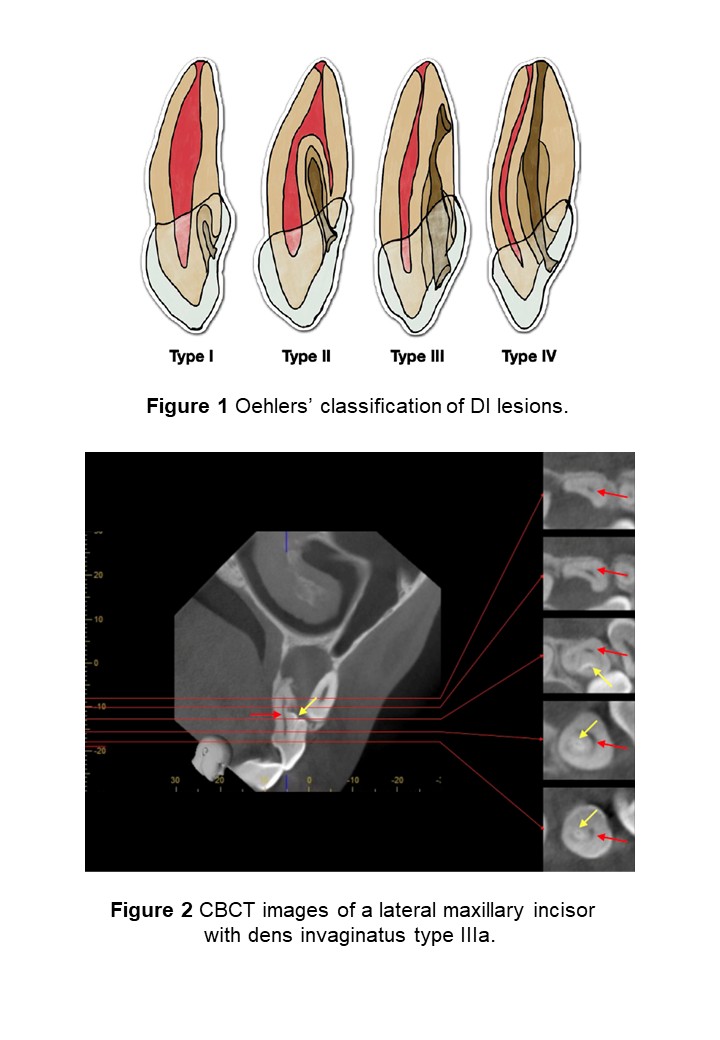
Dens invaginatus (DI) is a rare developmental dental anomaly resulting from the invagination of the enamel organ into the dental papilla during odontogenesis. This condition leads to a broad spectrum of morphological variations, with maxillary lateral incisors being the most frequently affected. The resulting deep pits or invaginations often communicate with the oral cavity, creating ideal environments for bacterial retention. This anatomical irregularity predisposes affected teeth to early onset dental caries, pulpitis, and, if untreated, progression to periapical pathology and soft tissue necrosis. Radiographically, dens invaginatus typically appears as a radiolucent tract surrounded by radiopaque enamel, limited to the crown or extending into the root. The complexity of the internal anatomy poses significant diagnostic and therapeutic challenges, particularly in endodontic management. Management strategies vary depending on the type and severity of the anomaly, ranging from preventive sealing to advanced endodontic procedures such as nonsurgical root canal therapy (NS-RCT), apexification, regenerative endodontic procedures (REPs), surgical root canal treament (S-RCT), or intentional replantation. Regardless of the classification, the invaginated tract should always be addressed, and NS-RCT is indicated when irreversible pulpitis or necrosis is present. This review explores the etiopathogenesis, classification, histopathology, diagnostic approaches, and evidence-based treatment modalities for DI, emphasizing the importance of early diagnosis and tailored management strategies to preserve teeth that were once considered non-restorable.
Article Details

This work is licensed under a Creative Commons Attribution-NonCommercial-NoDerivatives 4.0 International License.
References
Hülsmann M. Dens invaginatus: aetiology, classification, prevalence, diagnosis, and treatment considerations. Int Endod J. 1997 Mar;30(2):79-90. doi: 10.1046/j.1365-2591.1997.00065.x.
Hunter HA. Dilated composite odontome; reports of two cases, one bilateral and one radicular. Oral Surg Oral Med Oral Pathol. 1951 May;4(5):668-673. doi: 10.1016/0030-4220(51)90060-6.
Oehlers FA. Dens invaginatus (dilated composite odontome). I. Variations of the invagination process and associated anterior crown forms. Oral Surg Oral Med Oral Pathol. 1957 Nov;10(11):1204-1218. contd. doi: 10.1016/0030-4220(57)90077-4.
Vincent-Townend J. Dens invaginatus. J Dent. 1974 Nov;2(6):234-238. doi: 10.1016/0300-5712(74)90024-4.
Alani A, Bishop K. Dens invaginatus. Part 1: classification, prevalence and aetiology. Int Endod J. 2008 Dec;41(12):1123-1136. doi: 10.1111/j.1365-2591.2008.01468.x.
Thakur Narbir S,Thakur S. Dens Invaginatus (tooth within tooth). A review of the literature and diagnostic and management guidelines for practicing dentists. Indian J Dent Sci. 2012 Sep;4(3):111-116.
Alimadadi H, Ashraf H, Nasrabadi N. Dens invaginatus with palatal expansion and buccal sinus tract: a case report. Int J Sci Res Dent Med Sci. 2019;1(3):52-56. doi: 10.30485/ijsrdms.2019.197269.1013
Achabi N, Chhoul H, Ramdi H. Clinical guideline for diagnosis and treatment of dens invaginatus. Integr J Med Sci. 2021;8:1-4. doi: 10.15342/ijms.2021.448
Wang Y, Su S, Chen X, Jia X. CBCT analysis of the incidence of maxillary lateral incisor dens invaginatus and its impact on periodontal supporting tissues. BMC Oral Health. 2024 Dec;24(1):1569. doi: 10.1186/s12903-024-05376-2.
Gallacher A, Ali R, Bhakta S. Dens invaginatus: diagnosis and management strategies. Br Dent J. 2016 Oct;221(7):383-387. doi: 10.1038/sj.bdj.2016.724.
Siqueira JF Jr, Rôças IN, Hernández SR, Brisson-Suárez K, Baasch AC, Pérez AR, et al. Dens invaginatus: clinical implications and antimicrobial endodontic treatment considerations. J Endod. 2022 Feb;48(2):161-170. doi: 10.1016/j.joen.2021.11.014.
Bishop K, Alani A. Dens invaginatus. Part 2: clinical, radiographic features and management options. Int Endod J. 2008 Dec;41(12):1137-1154. doi: 10.1111/j.1365-2591.2008.01469.x.
Colak H, Tan E, Aylikcı BU, Uzgur R, Turkal M, Hamidi MM. Radiographic study of the prevalence of dens invaginatus in a sample set of Turkish dental patients. J Clin Imaging Sci. 2012;2:34. doi: 10.4103/2156-7514.97755.
Hamasha AA, Alomari QD. Prevalence of dens invaginatus in Jordanian adults. Int Endod J. 2004 May;37(5):307-310. doi: 10.1111/j.0143-2885.2004.00797.x.
Gündüz K, Çelenk P, Canger EM, Zengin Z, Sümer P. A retrospective study of the prevalence and characteristics of dens invaginatus in a sample of the Turkish population. Med Oral Patol Oral Cir Bucal. 2013 Jan;18(1):e27-32. doi: 10.4317/medoral.18285.
Capar ID, Ertas H, Arslan H, Tarim Ertas E. A retrospective comparative study of cone-beam computed tomography versus rendered panoramic images in identifying the presence, types, and characteristics of dens invaginatus in a Turkish population. J Endod. 2015 Apr;41(4):473-478. doi: 10.1016/j.joen.2014.12.001.
Chen L, Li Y, Wang H. Investigation of dens invaginatus in a Chinese subpopulation using cone-beam computed tomography. Oral Dis. 2021 Oct;27(7):1755-1760. doi: 10.1111/odi.13702.
Mabrouk R, Berrezouga L, Frih N. The accuracy of CBCT in the detection of dens invaginatus in a Tunisian population. Int J Dent. 2021 Jan;2021:8826204. doi: 10.1155/2021/8826204.
Alkadi M, Almohareb R, Mansour S, Mehanny M, Alsadhan R. Assessment of dens invaginatus and its characteristics in maxillary anterior teeth using cone-beam computed tomography. Sci Rep. 2021 Oct;11(1):19727. doi: 10.1038/s41598-021-99258-0.
Varun K, Arora M, Pubreja L, Juneja R, Middha M. Prevalence of dens invaginatus and palatogingival groove in North India: A cone-beam computed tomography-based study. J Conserv Dent. 2022 May-Jun;25(3):306-310. doi: 10.4103/jcd.jcd_46_22.
Hegde V, Mujawar A, Shanmugasundaram S, Sidhu P, Narasimhan S, Setzer FC, et al. Prevalence of dens invaginatus and its association with periapical lesions in a Western Indian population-a study using cone-beam computed tomography. Clin Oral Investig. 2022 Sep;26(9):5875-5883. doi: 10.1007/s00784-022-04545-3.
González-Mancilla S, Montero-Miralles P, Saúco-Márquez JJ, Areal-Quecuty V, Cabanillas-Balsera D, Segura-Egea JJ. Prevalence of dens invaginatus assessed by CBCT: systematic review and meta-analysis. J Clin Exp Dent. 2022 Nov;14(11):e959-e966. doi: 10.4317/jced.59849.
Alves Dos Santos GN, Sousa-Neto MD, Assis HC, Lopes-Olhê FC, Faria ESAL, Oliveira ML, et al. Prevalence and morphological analysis of dens invaginatus in anterior teeth using cone beam computed tomography: A systematic review and meta-analysis. Arch Oral Biol. 2023 Jul;151:105715. doi: 10.1016/j.archoralbio.2023.105715.
Shi S, Duan X, Shao J, Duan Q, Peng S. Dens Invaginatus in ancient chinese teeth of 2,000 years ago. Anat Rec (Hoboken). 2013 Oct;296(10):1628-1633. doi: 10.1002/ar.22738.
Rozylo TK, Rozylo-Kalinowska I, Piskorz M. Cone-beam computed tomography for assessment of dens invaginatus in the Polish population. Oral Radiol. 2018;34(2):136-142. doi: 10.1007/s11282-017-0295-7.
Kharangate N, Figueiredo NR, Fernandes M, Lambor R. Bilateral dens invaginatus in the mandibular premolars - Diagnosis and treatment. Contemp Clin Dent. 2015;6(3):428-431. doi: 10.4103/0976-237X.161911.
Kronfeld R. Dens in dente. J Dent Res. 1934 Feb;14(1):49-66. doi: 10.1177/00220345340140010801
Rushton MA. A collection of dilated composite odontomes. Br Dent J. 1937;63:65–86.
Bruszt P. Über die Entstehung des 'Dens in dente'. [Etiology of dens in dente]. Schweiz Monatsschr Zahnheilkd. 1950 Jun;60(6):534–542.
Baumgart M, Hänni S, Suter B, Schaffner M, Lussi A. Dens invaginatus review of the literature and diagnostic and therapeutic guidelines. Schweiz Monatsschr Zahnmed. 2009;119(7):697-714.
Gustafson G, Sundberg S. Dens in dente. Br Dent J. 1950;88:83-8, 111-122, 144-146.
Sprawson EC. Odontomes. Br Dent J. 1937;62:177–201.
Fischer C. Zur Frage des Dens in dente. Dtsch Zahn Mund Kieferheilkd. 1936;3:621-634.
Segura JJ, Hattab F, Rios V. Maxillary canine transpositions in two brothers and one sister: associated dental anomalies and genetic basis. ASDC J Dent Child. 2002 Jan-Apr;69(1):54-58.
Atkinson SR. The permanent maxillary lateral incisor. Am J Orthod Oral Surg. 1943 Dec;29(12):685-698. doi: 10.1016/S0096-6347(43)90330-8.
Grahnen H. Dens invaginatus. I. A clinical, roentgenological and genetical study of permanent upper lateral incisors. Odontol Revy. 1959;10:115-137.
Kansu O, Avcu N. Mandibular lateral incisor-canine transposition associated with dental anomalies. Clin Anat. 2005 Sep;18(6):446-448. doi: 10.1002/ca.20136.
Kettunen P, Laurikkala J, Itäranta P, Vainio S, Itoh N, Thesleff I. Associations of FGF-3 and FGF-10 with signaling networks regulating tooth morphogenesis. Dev Dyn. 2000 Nov;219(3):322-332. doi: 10.1002/1097-0177(2000)9999:9999<::AID-DVDY1062>3.0.CO;2-J.
Casamassimo PS, Nowak AJ, Ettinger RL, Schlenker DJ. An unusual triad: microdontia, taurodontia, and dens invaginatus. Oral Surg Oral Med Oral Pathol. 1978 Jan;45(1):107-112. doi: 10.1016/0030-4220(78)90232-3.
Ireland EJ, Black JP, Scures CC. Short roots, taurodontia and multiple dens invaginatus. J Pedod. 1987;11(2):164-175.
Pokala P, Acs G. A constellation of dental anomalies in a chromosomal deletion syndrome (7q32): case report. Pediatr Dent. 1994 Jul-Aug;16(4):306-309.
Hosey MT, Bedi R. Multiple dens invaginatus in two brothers. Endod Dental Traumatol. 1996 Feb;12(1):44-47. doi: 10.1111/j.1600-9657.1996.tb00094.x.
Hallett GE. Incidence, nature, and clinical significance of palatal invaginations in the maxillary incisor teeth. Proc R Soc Med. 1953 Jul;46(7):491-499. doi: 10.1177/003591575304600703.
Ulmansky M, Hermel J. Double dens in dente in a single tooth: report of a case and radiologic study of the incidence of small dens in dente. Oral Surg Oral Med Oral Pathol. 1964 Jan;17(1):92-97. doi: 10.1016/0030-4220(64)90320-2.
Schulze C, Brand E. Uber den Dens invaginatus (Dens in denta [Dens invaginatus (dens in dente)]. Zwr. 1972 Jul;81(14):653-660
Ridell K, Mejare I, Matsson L. Dens invaginatus: a retrospective study of prophylactic invagination treatment. Int J Paediatr Dent. 2001 Mar;11(2):92-97. doi: 10.1046/j.1365-263x.2001.00234.x.
Dembinskaite A, Veberiene R, Machiulskiene V. Successful treatment of dens invaginatus type 3 with infected invagination, vital pulp, and cystic lesion: a case report. Clin Case Rep. 2018 Jun;6(8):1565-1570. doi: 10.1002/ccr3.1647.
Hegde V, Morawala A, Gupta A, Khandwawala N. Dens in dente: a minimally invasive nonsurgical approach. J Conserv Dent. 2016 Sep-Oct;19(5):487-489. doi: 10.4103/0972-0707.190014.
Patel S. The use of cone beam computed tomography in the conservative management of dens invaginatus: a case report. Int Endod J. 2010 Aug;43(8):707-713. doi: 10.1111/j.1365-2591.2010.01734.x.
Pandiar D, Vijayalakshmi C, Kumar A, Maliyekkal SP, Pattamparambath M. Light microscopic features of type II dens invaginatus in a deciduous mandibular molar. J Clin Diagn Res. 2017 May;11(5):ZJ03-ZJ4. doi: 10.7860/JCDR/2017/26493.9800.
Ricucci D, Milovidova I, Siqueira JF Jr. Unusual location of dens invaginatus causing a difficult-to-diagnose pulpal involvement. J Endod. 2020 Oct;46(10):1522-1529. doi: 10.1016/j.joen.2020.07.004.
Jiang L, Ma X, Liu Y, Zhong M, Chen X. Histopathological analysis of dens invaginatus in an immature permanent incisor. J Clin Diagn Res. 2018 May;12(5):ZD09-ZD10. doi: 10.7860/JCDR/2018/31771.11559
Tebbeb N, Zaabar D, Zouiten S, Boughzala A. Dens invaginatus: a review and case series. Saudi Endod J. 2018 Jan–Apr;8(1):44-49. doi: 10.4103/sej.sej_70_16
Abduljabbar F, Aljehani M, Sharafi E, Bakhsh A, Abed H, Aburahma A. Anatomical modification for dens invaginatus treatment: a literature review and a case report. J Int Oral Health. 2015 Oct;7(12):119-125.
Girsch WJ, McClammy TV. Microscopic removal of dens invaginatus. J Endod. 2002 Apr;28(4):336-339. doi: 10.1097/00004770-200204000-00020.
Genaro LE, Conte MB, Anovazzi G, Gonçalves A, Gonçalves MA, Capote TSO. Analysis of the association of foramen cecum and dens in dente in maxillary lateral incisor. Eur J Dent. 2021 May;15(2):242-246. doi: 10.1055/s-0040-1717157.
Kfir A, Flaisher Salem N, Natour L, Metzger Z, Sadan N, Elbahary S. Prevalence of dens invaginatus in young Israeli population and its association with clinical morphological features of maxillary incisors. Sci Rep. 2020 Oct;10(1):17131. doi: 10.1038/s41598-020-74396-z.
Zhu J, Wang X, Fang Y, Von den Hoff JW, Meng L. An update on the diagnosis and treatment of dens invaginatus. Aust Dent J. 2017 Sep;62(3):261-275. doi: 10.1111/adj.12513.
Rodekirchen H, Jung M, Ansari F. Dens invaginatus type II: case report with 2-year radiographic follow-up. Oral Surg Oral Med Oral Pathol Oral Radiol Endod. 2006 Oct;102(4):e121-125. doi: 10.1016/j.tripleo.2005.10.064.
Goncalves A, Goncalves M, Oliveira DP, Goncalves N. Dens invaginatus type III: report of a case and 10-year radiographic follow-up. Int Endod J. 2002 Oct;35(10):873-879. doi: 10.1046/j.1365-2591.2002.00575.x.
Chen JW, Huang GT, Bakland LK. Dens evaginatus: current treatment options. J Am Dent Assoc. 2020 May;151(5):358-367. doi: 10.1016/j.adaj.2020.01.015.
Teixido M, Abella F, Duran-Sindreu F, Moscoso S, Roig M. The use of cone-beam computed tomography in the preservation of pulp vitality in a maxillary canine with type 3 dens invaginatus and an associated periradicular lesion. J Endod. 2014 Sep;40(9):1501-1504. doi: 10.1016/j.joen.2014.01.033.
Durack C, Patel S. The use of cone beam computed tomography in the management of dens invaginatus affecting a strategic tooth in a patient affected by hypodontia: a case report. Int Endod J. 2011 May;44(5):474-483. doi: 10.1111/j.1365-2591.2011.01866.x.
Ali A, Arslan H. Guided endodontics: a case report of maxillary lateral incisors with multiple dens invaginatus. Restor Dent Endod. 2019 Oct;44(4):e38. doi: 10.5395/rde.2019.44.e38.
Ridell K, Mejàre I, Matsson L. Dens invaginatus: a retrospective study of prophylactic invagination treatment. Int J Paediatr Dent. 2001 Mar;11(2):92-97. doi: 10.1046/j.1365-263x.2001.00234.x.
Subay RK, Kayatas M. Dens invaginatus in an immature maxillary lateral incisor: a case report of complex endodontic treatment. Oral Surg Oral Med Oral Pathol Oral Radiol Endod. 2006 Aug;102(2):e37-41. doi: 10.1016/j.tripleo.2005.10.056.
Tsurumachi T, Hayashi M, Takeichi O. Non-surgical root canal treatment of dens invaginatus type 2 in a maxillary lateral incisor. Int Endod J. 2002 Jan;35(1):68-72 doi: 10.1046/j.1365-2591.2002.00450.x.
Er K, Kustarci A, Ozan U, Tasdemir T. Nonsurgical endodontic treatment of dens invaginatus in a mandibular premolar with large periradicular lesion: a case report. J Endod. 2007 Mar;33(3):322-324. doi: 10.1016/j.joen.2006.09.001.
Ortiz P, Weisleder R, Villareal de Justus Y. Combined therapy in the treatment of dens invaginatus: case report. J Endod. 2004 Sep;30(9):672-674. doi: 10.1097/01.don.0000121611.19808.ad.
Lindner C, Messer HH, Tyas MJ. A complex treatment of dens invaginatus. Endod Dent Traumatol. 1995 Jun;11(3):153-155. doi: 10.1111/j.1600-9657.1995.tb00478.x.
Wei C, Wang D, Shen L, Lu P, Meng Z, Zhou R. Treatment opinions for dens invaginatus: a case series. Exp Ther Med. 2024 Feb;27(4):138. doi: 10.3892/etm.2024.12426.
