
Fluoride concentration and pH of commercial oat milk products in Thailand
Article Sidebar
Main Article Content
Abstract
Objective: To determine the fluoride concentration and pH of commercially available oat-milk products sold in Thailand.
Materials and Methods: Thirty-seven oat-milk products (unsweetened n = 14, sweetened n = 23; pasteurized
n = 7, UHT n = 30) were analyzed. Fluoride concentration was measured using an ion-selective electrode and pH with a calibrated pH meter. Independent t-tests compared fluoride concentrations between sweetness types and processing methods (α = 0.05).
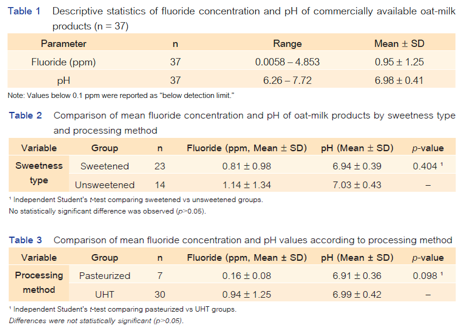
Results: Fluoride concentration ranged 0.0058–4.853 ppm (mean 0.95 ± 1.25 ppm) and pH 6.26–7.72
(mean 6.98 ± 0.41). No significant differences were found between sweetened vs unsweetened (p = 0.404)
or pasteurized vs UHT (p = 0.098) products.
Conclusion: Oat-milk products in Thailand show wide variation in fluoride concentration and near-neutral pH. Differences by sweetness type and processing method were not statistically significant.
Article Details

This work is licensed under a Creative Commons Attribution-NonCommercial-NoDerivatives 4.0 International License.
References
Amorello D, Barreca S, Pensato F, Orecchio S. Potentiometric analysis of fluoride in commonly consumed beverages: Method development, evaluation, and risk assessment. J Food Compos Anal. 2025 Jan; 137: 106836. doi: org/10.1016/j.jfca.2024.106836.
Townsend JA, Thompson T, Vaughn S, Wang Y, Yu Q, Xu X, et al. Analysis of fluoride content in alternative milk beverages. J Clin Pediatr Dent. 2019; 43(6): 388-392. doi: 10.17796/1053-4625-43.6.5.
Karoui R, Bouaicha I. A review on nutritional quality of animal and plant-based milk alternatives: a focus on protein. Front Nutr. 2024 Jul; 5; 11: 1378556. doi: 10.3389/fnut.2024.1378556.
Jeske S, Zannini E, Arendt EK. Evaluation of physicochemical and glycaemic properties of commercial plant-based milk substitutes. Plant Foods Hum Nutr. 2017 Mar; 72(1): 26-33. doi: 10.1007/s11130-016-0583-0.
Rirattanapong O, Rirattanapong P. Fluoride content of commercially available soy milk products in Thailand. Southeast Asian J Trop Med Public Health. 2016 Jan; 47(1): 160–164.
Rirattanapong P, Rirattanapong O. Fluoride content of commercially available nut-based milk products in Thailand. Southeast Asian J Trop Med Public Health. 2019 Jul; 50(4): 798–804.
Rirattanapong P, Rirattanapong O. Fluoride content of commercially available rice milk products in Bangkok, Thailand. Southeast Asian J Trop Med Public Health. 2019; 50(6): 1220–1223.
Buzalaf MAR, Levy SM. Fluoride intake of children: considerations for dental caries and dental fluorosis. Monogr Oral Sci. 2011 Jun; 22: 1–19. doi: 10.1159/000325101.
Iheozor-Ejiofor Z, Walsh T, Lewis SR, Riley P, Boyers D, Clarkson JE, et al. Water fluoridation for the prevention of dental caries. Cochrane Database Syst Rev. 2024 Oct;10(10): CD010856. doi: 10.1002/14651858.CD010856.pub3.
Casaglia A, Cassini MA, Condò R, Iaculli F, Cerroni L. Dietary fluoride intake by children: when to use a fluoride toothpaste? Int J Environ Res Public Health. 2021 May;18(11):5791. doi: 10.3390/ijerph18115791.
Rojanaworarit C, Claudio L, Howteerakul N, Siramahamongkol A, Ngernthong P, Kongtip P, et al. Hydrogeogenic fluoride in groundwater and dental fluorosis in Thai agrarian communities: a prevalence survey and case-control study. BMC Oral Health. 2021 Oct;21(1): 545. doi: 10.1186/s12903-021-01902-8.
Putraphan B, Nantanapiboon D, Osathanon T. Fluoride concentration in tap water from different regions in Thailand. Dentika Dent J. 2022 Jun; 25(1): 9–14. doi:10.32734/dentika.v25i1.7580.
Dash KK, Fayaz U, Dar AH, Shams R, Manzoor S, Sundarsingh A, et al. A comprehensive review on heat treatments and related impact on the quality and microbial safety of milk and milk-based products. Food Chemistry Advances. 2022 Oct;1:100041. doi:10.1016/j.focha.2022.100041.
Deeth HC. Effects of high-temperature milk processing. Encyclopedia. 2021 Dec; 1(4): 1312-1321. doi:10.3390/encyclopedia1040098.
Giacaman RA. Sugar and dental caries: new insights of an old problem and its implication in clinical management. J Oral Res. 2016 Mar; 5(2): 57-58; doi:10.17126/joralres.2016.011.
Rabbani A, Ayyash M, D’Costa CDC, Chen G, Xu Y, Kamal-Eldin A. Effect of heat pasteurization and sterilization on milk safety, composition, sensory properties, and nutritional quality. Foods. 2025 Apr;14(8):1342. doi:10.3390/foods14081342.
J da Silva Matos PZ, Azevedo JEG, Costa HF MJ, Lamarão CV, Sanches EA, Bezerra JA, et al. UHT processing in the context of plant-based beverages: A scientific review on product characteristics and the functional role of plant proteins. Food Chem Adv. 2024 Dec; 5:100848. doi: 10.1016/j.focha.2024.100848.
Lussi A, Carvalho TS. Erosive tooth wear: a multifactorial condition of growing concern and increasing knowledge. Monogr Oral Sci. 2014 Jun;25:1–15. doi:10.1159/000360380.
Daryani D, Pegua K, Aryaa SS. Review of plant-based milk analogues: preparation, nutritional, physicochemical and organoleptic properties. Food Sci Biotechnol. 2024 Feb; 33(5): 1059–1073. doi:10.1007/s10068-023-01482-z.
