
Fluoride concentrations and pH levels of bottled mineral water commercially available in Bangkok, Thailand
Article Sidebar
Main Article Content
Abstract
Objectives: To assess the fluoride concentrations and pH levels of commercially available bottled mineral water in Bangkok, Thailand.
Materials and Methods: Between April and June 2025, 41 brands of bottled mineral water were randomly purchased from retailers across Bangkok. Three bottles with different batch numbers were collected for each brand. Fluoride concentrations were analyzed using a fluoride ion-selective electrode with TISAB II, and pH levels were measured using a calibrated digital pH meter. Fluoride concentrations were compared among brands and among production batches within each brand using the Kruskal–Wallis test with Bonferroni-adjusted post hoc comparisons (α = 0.05).
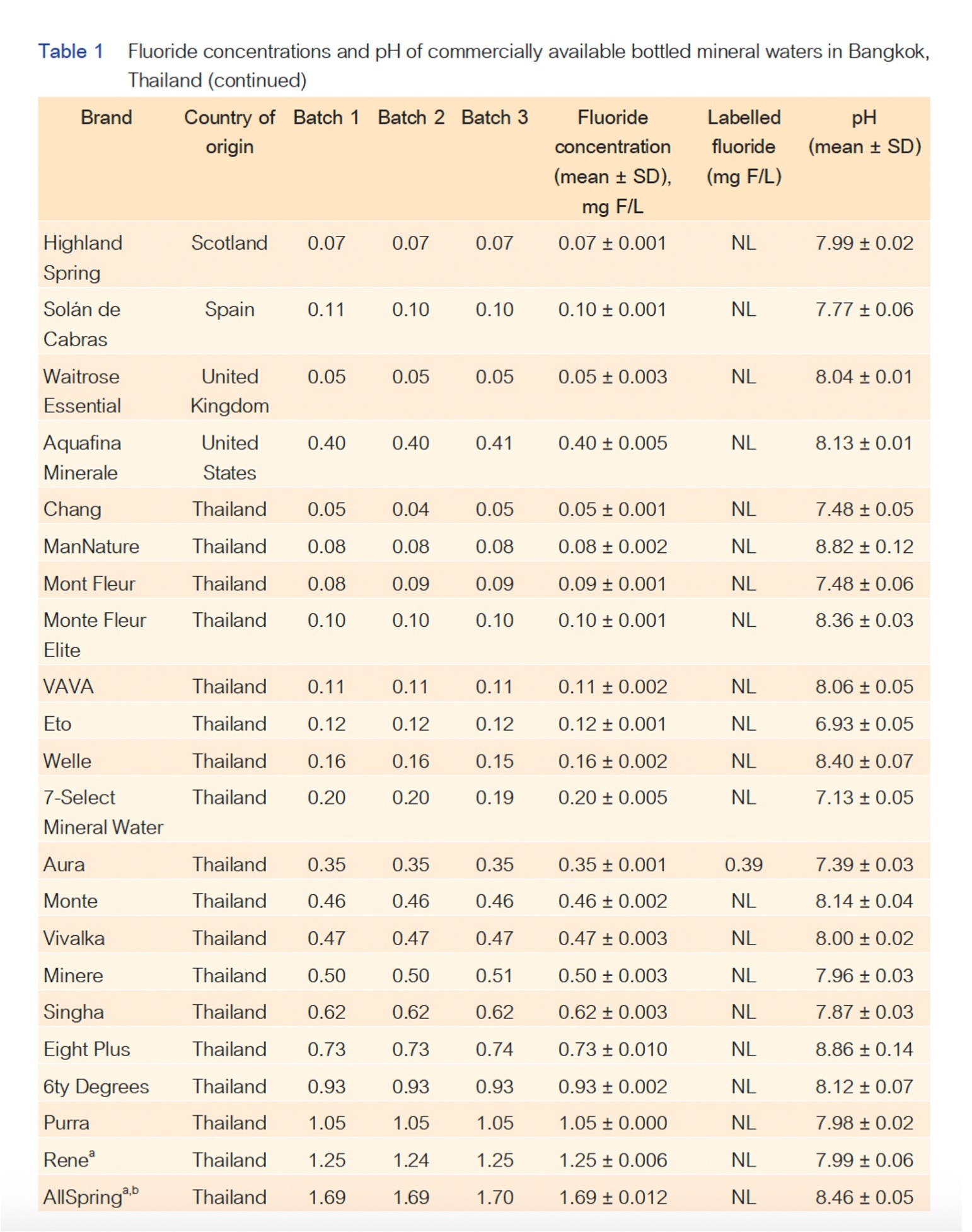
Results: Fluoride concentrations varied widely among brands, ranging from 0.02 to 1.69 mg/L (p < 0.001).
No significant differences were observed among batches within any brand (p > 0.05). Thai-sourced mineral waters demonstrated the highest fluoride levels and the greatest variability, with four brands containing approximately 1.0 mg/L or higher. pH values ranged from 5.65 to 8.86, with most products falling within the recommended range of 6.5–8.5. Only one of the 41 brands reported fluoride content on its label.
Conclusions: Fluoride concentrations in bottled mineral waters sold in Bangkok show substantial variation, with several Thai-sourced brands exceeding recommended levels for tropical climates. The absence of fluoride labelling limits consumer awareness and complicates clinical assessment of total fluoride intake. Regular monitoring and improved labelling regulations are recommended to reduce the risk of excessive fluoride exposure, particularly in young children.
Article Details

This work is licensed under a Creative Commons Attribution-NonCommercial-NoDerivatives 4.0 International License.
References
Huang Y, Ma X, Tan Y, Wang L, Wang J, et al. Consumption of very low mineral water is associated with lower bone mineral content in children. J Nutr. 2019 Nov;149(11):1994-2000. doi: 10.1093/jn/nxz161.
Pop MS, Cheregi DC, Onose G, Munteanu C, Popescu C, Rotariu M, et al. Exploring the potential benefits of natural calcium-rich mineral waters for health and wellness: A systematic review. Nutrients. 2023 Jul; 15(14): 3126. doi: 10.3390/nu15143126.
Putraphan B, Nantanapiboon D, Osathanon T. Fluoride concentration in tap water from different regions in Thailand. Dentika Dent J. 2022; 25: 9–14. doi: 10.32734/dentika.v25i1.7580
Sawangjang B, Hashimoto T, Wongrueng A, Wattanachira S, Takizawa S. Assessment of fluoride intake from groundwater and intake reduction from delivering bottled water in Chiang Mai Province, Thailand. Heliyon. 2019 Sep;5(9): e02391. doi: 10.1016/j.heliyon.2019.e02391.
Iheozor-Ejiofor Z, Walsh T, Lewis SR, Riley P, Boyers D, Clarkson JE, et al. Water fluoridation for the prevention of dental caries. Cochrane Database Syst Rev. 2024 Oct; 10(10): CD010856. doi: 10.1002/14651858.CD010856.pub3.
Browne D, Whelton H, O'Mullane D. Fluoride metabolism and fluorosis. J Dent. 2005 Mar; 33(3): 177-186. doi: 10.1016/j.jdent.2004.10.003.
Richards LF, Westmoreland WW, Tashiro M, McKay CH, Morrison JT. Determining optimum fluoride levels for community water supplies in relation to temperature. J Am Dent Assoc. 1967 Feb; 74(3): 389-397. doi: 10.14219/jada.archive.1967.0079.
Dhanuthai K, Thangpisityotin M. Fluoride content of commercially-available bottled water in Bangkok, Thailand. J Investig Clin Dent. 2011 May; 2(2): 144-147. doi: 10.1111/j.2041-1626.2010.00045.x.
Rirattanapong P, Rirattanapong O. Fluoride content of commercially available bottled drinking water in Bangkok, Thailand. Southeast Asian J Trop Med Public Health. 2016 Sep; 47(5): 1112-1116.
Ministry of Public Health, Thailand. Notification of the ministry of public health: drinking water in sealed containers (B.E. 2524). Royal gazette; 1981.
Ministry of Public Health, Thailand. Notification of the ministry of public health (No. 454) B.E. 2567: natural mineral waters. Royal gazette; 2024.
Promilton AAA, Ravindran AA, Pitchaimani VS, Kingston JV, Karuppannan S. Comprehensive hydrogeochemical characterization and seasonal water quality index analysis for sustainable groundwater management in Valliyur region, Southern Tamil Nadu, India. Sci Rep. 2025 Sep;15(1):33251. doi: 10.1038/s41598-025-18285-3.
Prasanjit N, Charerntanyarak L. Factors related to primary tooth fluorosis in young children of the child development center, Bang Rakam district, Phitsanulok province. KKU Journal for Public Health Research. 2022; 15(1): 61-71.
World Health Organization (WHO). pH in drinking-water: revised background document for development of WHO guidelines for drinking-water quality. Geneva: World Health Organization; 2007. Available from: https://cdn.who.int/media/docs/default-source/wash-documents/wash-chemicals/ph.pdf.
Haghgou HR, Haghgoo R, Asdollah FM. Comparison of the microhardness of primary and permanent teeth after immersion in two types of carbonated beverages. J Int Soc Prev Community Dent. 2016 Jul-Aug; 6(4): 344-348. doi: 10.4103/2231-0762.186803.
