
Force of colored intermaxillary latex elastics from different suppliers: A comparative in vitro study
Article Sidebar
Main Article Content
Abstract
Background: Colored orthodontic latex elastics are increasingly popular among younger patients, yet their mechanical behavior may vary. Differences in force delivery and degradation over time can compromise treatment efficiency. Understanding the force–extension relationship and relaxation behavior of these elastics is essential to ensure continuous, optimal orthodontic forces.
Objectives: This study evaluated and compared the standard force–extension index (three times the lumen diameter), initial force delivery, and force degradation of colored intermaxillary latex elastics from different manufacturers, with varying lumen diameters and declared force values, under simulated oral conditions.
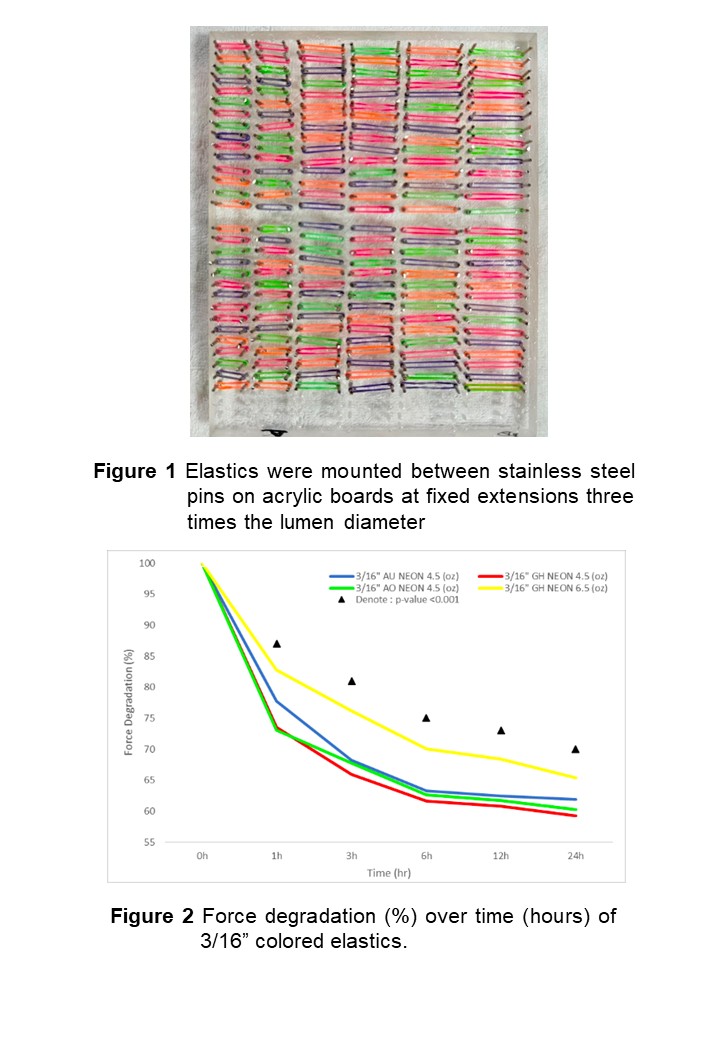
Materials and Methods: This in vitro study assessed the force characteristics of colored intermaxillary latex elastics from three manufacturers: American Orthodontics® (Sheboygan, WI, USA), AURAdontics, Inc. (Riverside, NJ, USA), and G&H Orthodontics® (Franklin, TN, USA). A total of 180 elastics (15 per group) were tested, yielding 1,080 force measurements. Elastics with declared forces of 4.5 oz from all manufacturers and 6.5 oz elastics from G&H were included in three lumen diameters (3/16, 1/4, 5/16 in). The standard force‑extension index was determined by stretching each elastic to three times its lumen diameter. To simulate oral conditions, elastics were extended to fixed distances (14.29, 19.05, 23.81 mm), immersed in distilled water at 37°C, and measured at baseline and after 1, 3, 6, 12, and 24 hours. Statistical analyses compared force values across manufacturers, lumen diameters, declared force levels, and time intervals.
Results: The standard force–extension index varied from -34.30% to 16.70%. Elastics with declared 4.5 oz forces showed closer agreement with the standard index (mean 1.13%) than 6.5 oz elastics (mean -26.84%). All elastics exhibited rapid force loss within the first hour, followed by a gradual decline. After 24 hours, the remaining force averaged 60.87% for 4.5 oz elastics and 69.71% for 6.5 oz elastics.
Article Details

This work is licensed under a Creative Commons Attribution-NonCommercial-NoDerivatives 4.0 International License.
References
Theodorou C, Kuijpers Jagtman AM, Bronkhorst EM, Wagener FADTG. Optimal force magnitude for bodily orthodontic tooth movement with fixed appliances: a systematic review. Am J Orthod Dentofacial Orthop. 2019 Nov;156(5):582 592. doi:10.1016/j.ajodo.2019.05.011
Aljabaa AH, Almoammar K, Al Kharboush G, Al Dayel RM, Alsaloom NS, Albarakati S. Colour preferences of elastic ligatures among orthodontic patients. J Clin Diagn Res. 2021 Jan;15(1):ZC01 ZC04. doi: 10.7860/JCDR/2021/45908.14408
Kanchana P, Godfrey K. Calibration of force extension and force degradation characteristics of orthodontic latex elastics. Am J Orthod Dentofacial Orthop. 2000 Sep;118(3):280 289. doi:10.1067/mod.2000.104493
Hain MA, Longman LP, Field EA, Harrison JE. Natural rubber latex allergy: implications for the orthodontist. J Orthod. 2007 Mar;34(1):6 11. doi:10.1179/146531207225021861
Pithon MM, Souza RF, Freitas LMA, Souza RA. Mechanical properties of intermaxillary latex and latex free elastics. J World Fed Orthod. 2013 Mar;2(1):e15 e18. doi:10.1016/j.ejwf.2013.01.004
Dos Santos RL, Pithon MM, Da Silva Mendes G, Romanos MT, De Oliveira Ruellas AC. Cytotoxicity of intermaxillary orthodontic elastics of different colors: an in vitro study. J Appl Oral Sci. 2009 Jul-Aug;17(4):326 329. doi:10.1590/S1678-77572009000400010
Holmes J, Barker MK, Walley EK, Tuncay OC. Cytotoxicity of orthodontic elastics. Am J Orthod Dentofacial Orthop. 1993 Aug;104(2):188 191. doi:10.1016/S0889-5406(05)81009-1
Andreasen GF, Bishara S. Comparison of elastic chains with elastics involved with intra arch molar to molar forces. Angle Orthod. 1970;40(2):151 154. doi:10.1016/0002-9416(71)90038-8
Elekdag Turk S, Ozkalayci N, Isci D, Turk T. Colour preferences of patients receiving elastic ligatures. Eur J Dent. 2010 Apr;4(2):171 174.
Bhatia N, Dinesh S, Nagesh S. Effect of electromagnetic radiation on the mechanical properties of orthodontic elastics: a preliminary in vitro study. J Clin Diagn Res. 2023 Oct;17(10):ZC28 ZC32. doi:10.7860/JCDR/2023/64131.18583
Fernandes DJ, Fernandes GMA, Artese F, Elias CN, Mendes AM. Force extension relaxation of medium force orthodontic latex elastics. Angle Orthod. 2011 Sep;81(5):812 819. doi:10.2319/120810-709.1
Gioka C, Zinelis S, Eliades T, Eliades G. Orthodontic latex elastics: a force relaxation study. Angle Orthod. 2006 May;76(3):475 479. doi:10.1043/0003-3219(2006)076[0475:OLE]2.0.CO;2.
Klabunde R, Grunheid T. Dynamic force decay evaluation of latex and non latex orthodontic elastics. J Orofac Orthop. 2022 Sep;83(4):318 324. doi:10.1007/s00056-021-00319-w.
Bales TR, Chaconas SJ, Caputo AA. Force extension characteristics of orthodontic elastics. Am J Orthod. 1977 Sep;72(3):296 302. doi:10.1016/0002-9416(77)90215-9
Lucisano MP, Romero MVE, da Silva RAB, da Silva LAB, Palma-Dibb RGP, Faraoni JJ, et al. In vitro study of structural and mechanical properties of latex and non latex intermaxillary orthodontic elastics. J Orofac Orthop. 2023 Apr;84(Suppl 2):111 122. doi:10.1007/s00056-022-00395-6
Hwang CJ, Cha JY. Mechanical and biological comparison of latex and silicone rubber bands. Am J Orthod Dentofacial Orthop. 2003 Oct;124(4):379 386. doi:10.1016/S0889-5406(03)00564-X
RusseIl KA, Milne AD, Khanna RA, Lee JM. In vitro assessment of the mechanical properties of latex and non latex orthodontic elastics. Am J Orthod Dentofacial Orthop. 2001 Jul;120(1):36 44. doi:10.1067/mod.2001.114642
Baty DL, Volz JE, von Fraunhofer JA. Force delivery properties of colored elastomeric modules. Am J Orthod Dentofacial Orthop. 1994 Jul;106(1):40 46. doi:10.1016/S0889-5406(94)70019-2
Kamisetty SK, Nimagadda C, Begam MP, Nalamotu R, Srivastav T, Gs S. Elasticity in elastics—an in vitro study. J Int Oral Health. 2014 Apr;6(2):96 105.
Notaroberto DFC, Martins MME, Goldner MTA, Mendes AM, Quintão CCA. Force decay evaluation of latex and non latex orthodontic intraoral elastics: in vivo study. Dent Press J Orthod. 2018 Nov-Dec;23(6):42 47. doi:10.1590/2177-6709.23.6.042-047.oar
Bian C, Zhang K, Yang K, Bai Y, Zhang N. An in vivo and in vitro study on the force degradation and surface morphology of orthodontic elastic ligatures. Am J Orthod Dentofacial Orthop. 2022 Dec;162(6):947 958. doi:10.1016/j.ajodo.2021.08.021
Wang T, Zhou G, Tan X, Dong Y. Evaluation of force degradation characteristics of orthodontic latex elastics in vitro and in vivo. Angle Orthod. 2007 Jul;77(4):688 693. doi:10.2319/022306-76
Wong AK. Orthodontic elastic materials. Angle Orthod. 1976 Apr;46(3):196 205. doi:10.1043/0003-3219(1976)046<0196:OEM>2.0.CO;2
Hershey HG, Reynolds WG. The plastic module as an orthodontic tooth moving mechanism. Am J Orthod. 1975 May;67(5):554 562. doi:10.1016/0002-9416(75)90300-0
Kersey ML, Glover K, Heo G, Raboud D, Major PW. An in vitro comparison of four brands of nonlatex orthodontic elastics. Am J Orthod Dentofacial Orthop. 2003 Apr;123(4):401 407. doi:10.1067/mod.2003.22
Qodcieh SM, Al Khateeb SN, Jaradat ZW, Abu Alhaija ES. Force degradation of orthodontic latex elastics: an in vivo study. Am J Orthod Dentofacial Orthop. 2017 Mar;151(3):507 512. doi:10.1016/j.ajodo.2016.08.023
Ptáčková L, Ličková B, Urbanová W, Sluka D, Portašíková K, Chamlarová S, et al. Force degradation of intermaxillary latex elastics: comparative in vitro and in vivo study. Clin Exp Dent Res. 2025 Feb;11(1):e70072. doi: 10.1002/cre2.70072.
Dubovská, I., Ličková, B., Voborná, I. ,Urbanová, W., Koťová, M. Force of intermaxillary latex elastics from different suppliers: A comparative in vitro study. Appl. Sci. 2023 Jan, 13(1), 657. doi: 10.3390/app13010657
Song B, Qi Y, Sun J, Gu Z, Liu R. Force distributions associated with different elastic traction methods for maxillary dentition distalization by clear aligners: an in-vitro study. BMC Oral Health. 2025 Apr;25(1):587. doi: 10.1186/s12903-025-05985-5.
