
Effect of chemical disinfectant on the hydrophilicity of elastomeric impression material
Article Sidebar
Main Article Content
Abstract
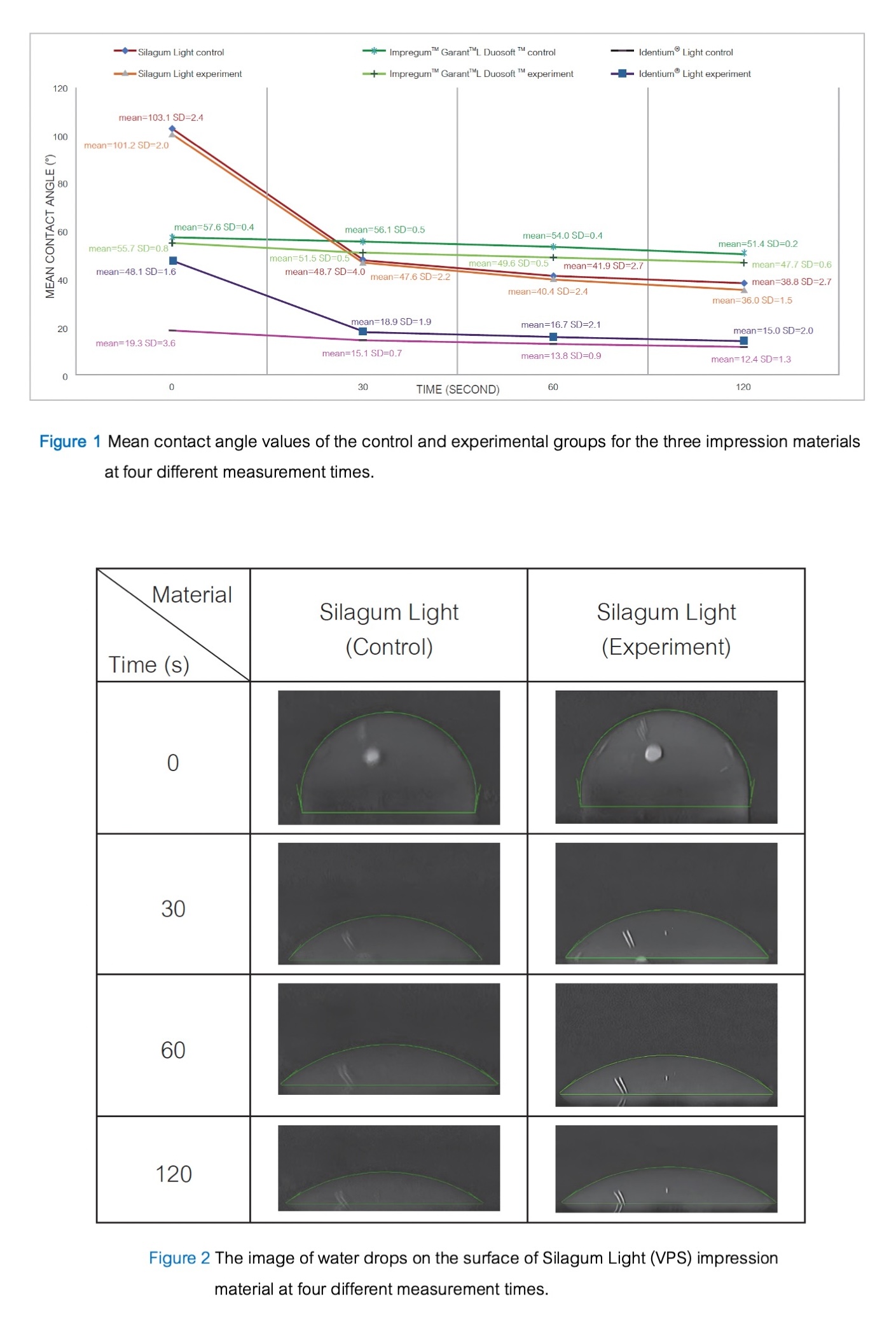
The aim of this study was to evaluate the effect of a chemical disinfectant on the hydrophilicity of elastomeric impression materials. Disc-shaped specimens (40 mm in diameter and 6 mm in thickness) of Silagum Light, Impregum™, Garant™, Duosoft™, and Identium® Light were prepared according to the manufacturers’ recommendations. Six specimens of each impression material were allocated to control and experimental groups. Specimens in the experimental group were sprayed with 0.5% UMONIUM38® disinfectant and allowed a contact time of 10 minutes. Surface wettability was evaluated by measuring the contact angle using a goniometer with the sessile drop method, and the measurements were recorded using a video camera. The advancing contact angle of a distilled water droplet on the impression surface was measured at 0 s (T0), 30 s (T30), 60 s (T60), and 120 s (T120) after droplet placement. For each specimen, three sessile drops were applied to three different surface areas and recorded. The data were analyzed using mixed design ANOVA (repeated measure ANOVA and two-way ANOVA), followed by Bonferroni multiple comparison tests, with the level of statistical significance set at α = 0.05. When comparing the disinfectant group (0.5% UMONIUM38®) to the control group, no significant differences in contact angles were observed for all materials at T30, T60, and T120. However, at the initial time point (T0), the disinfectant significantly increased the contact angle of Identium® compared to its control. For SilagumLight and Impregum™, no significant differences were found between the experimental and control groups at T0. Overall, Identium® exhibited the lowest contact angles (highest hydrophilicity) in both control and disinfected groups across all time intervals compared to the other materials. Within the limitations of this study, it can be concluded that disinfection with 0.5% UMONIUM38® spray did not adversely affect the hydrophilicity of the tested VPS, PE, and VPES impression materials over time. The results demonstrate that this specific disinfectant is compatible with these elastomeric materials in terms of surface wettability, as the transient increase in contact angle observed for the VPES material was not clinically significant in the context of standard laboratory procedures. However, these findings are limited to the particular disinfectant tested; therefore, caution should be exercised when generalizing these results to other types of chemical disinfectants. Additionally, further investigation into dimensional stability and surface integrity is warranted to ensure overall clinical performance and long-term prosthetic success.
Article Details

This work is licensed under a Creative Commons Attribution-NonCommercial-NoDerivatives 4.0 International License.
References
Rubel BS. Impression materials: a comparative review of impression materials most commonly used in restorative dentistry. Dent Clin North Am. 2007 Jul;51(3):629-642. doi: 10.1016/j.cden.2007.03.006.
McCabe JF, Carrick TE. Recording surface detail on moist surfaces with elastomeric impression materials. Eur J of Prosthodont Restor Dent. 2006 Mar;14(1):42-46.
Kanehira M, Finger WJ, Komatsu M. Surface detail reproduction with new elastomeric dental impression materials. Quintessence Int. 2007 Jun;38(6):479-488.
Stober T, Johnson GH, Schmitter M. Accuracy of the newly formulated vinyl siloxanether elastomeric impression material. J Prosthet Dent. 2010 April;103:228-239. doi: 10.1016/S0022-3913(10)60035-2.
Saini RS, Alshadidi AAF, Hassan SAB, Aldosari LIN, Mosaddad SA, Heboyan A. Properties of a novel composite elastomeric polymer vinyl polyether siloxane in comparison to its parent materials: a systemic review and meta-analysis. BMC Oral Health. 2024 Jan;24(1):54. doi: 10.1186/s12903-023-03830-1.
Pratten D, Craig R. Wettability of a hydrophilic addition silicone impression material. J Prosthet Dent.1989 Feb;61(2):197-202. doi: 10.1016/0022-3913(89)90373-9.
Chong YH, Soh G, Setchell DJ. Wettability of elastomeric impression materials: A comparative study of two measures. Clinical Materials.1990;6(3):239-249. doi: 10.1016/0267-6605(90)90061-Y.
Cullen DR, Mikesell JW, Sandrik JL. Wettability of elastomeric impression materials and voids in gypsum casts. J Prosthet Dent. 1991 Aug;66(2):261-265. doi: 10.1016/s0022-3913(05)80058-7.
Rupp F, Axmann D, Jacobi A, Groten M, Geis-Gerstorfer J. Hydrophilicity of elastomeric non-aqueous impression materials during setting. Dent Mater. 2005 Feb;21(2):94-102. doi: 10.1016/j.dental.2004.02.006.
Infection control recommendations for the dental office and the dental laboratory. ADA council on scientific affairs and ADA council on dental practice. J Am Dent Assoc. 1996 May;127(5):672-680. doi: 10.14219/jada.archive.1996.0280.
Kotsiomiti E, Tzialla A, Hatjivasiliou K. Accuracy and stability of impression materials subjected to chemical disinfection - a literature review. J Oral Rehabil. 2008 Apr;35(4):291-299. doi: 10.1111/j.1365-2842.2007.01771.x. PMID: 18321265.
Pratten DH, Covey DA, Sheats RD. Effect of disinfectant solution on the wettability of elastomeric impression materials. J Prosthet Dent.1990 Feb;63(2):223-227. doi: 10.1016/0022-3913(90)90109-p.
Lepe X, Johnson GH. Berg JC. Surface characteristics of polyether and addition silicone impression materials after long-term disinfection. J Prosthet Dent. 1995 Aug;74(2):181-186. doi: 10.1016/S0022-3913(05)80184-2.
Blalock JS, Cooper JR, Rueggeberg FA. The effect of chlorine-based disinfectant on wettability of a vinyl polysiloxane impression material. J Prosthet Dent. 2010 Nov;104(5):333-341. doi: 10.1016/S0022-3913(10)60151-5.
AlZain S. Effect of 0.5% glutaraldehyde disinfection on surface wettability of elastomeric impression materials. Saudi Dent J. 2019 Jan;31(1):122-128. doi: 10.1016/j.sdentj.2018.10.002.
Raffo P, Salliez AC, Collignon C, Clementi M. Antimicrobial activity of a formulation for the low temperature disinfection of critical and semi-critical medical equipment and surfaces. New Microbiol. 2007 Oct;30(4):463-469. doi: 10.1186/s13756-023-01341-w.
Norling BK, Reisbick MH. The effect of nonionic surfactants on bubble entrapment in elastomeric impression materials. J Prosthet Dent. 1979 Sep;42(3):342-347. doi: 10.1016/0022-3913(79)90227-0.
Singer L, Habib SI, Shalaby HE-A, Saniour SH, Bourauel C. Digital assessment of properties of the three different generations of dental elastomeric impression materials. BMC Oral Health. 2022 Sep;22(1):379. doi: 10.1186/s12903-022-02419-4.
Oh Y-I, Lee D-Y, Hwang S-Y, Kim K-N, Kim K-M. Effect of non-ionic surfactants on surface properties of hydrophilic polyvinyl siloxane impression materials. Colloids Surf A Physicochem Eng Asp. 2003 Nov;229(1-3):9-17. doi: 10.1016/j.colsurfa.2003.08.004.
Hosseinpour D, Berg JC. The dynamic interaction of water with four dental impression materials during cure. J Prosthodont. 2009 Jun;18(4):292-300. doi: 10.1111/j.1532-849X.2008.00423.x.
Theocharidou A, Tzimas K, Tolidis K, Tortopidis D. Evaluation of elastomeric impression materials’ hydrophilicity: an in vitro study. Acta Stomatol Croat. 2021 Sep;55(3): 256-263. doi: 10.15644/asc55/3/3.
Kugel G, Klettke T, Goldberg JA, Benchimol J, Perry RD, Sharma S. Investigation of a new approach to measuring contact angles for hydrophilic impression materials. J Prosthodont. 2007 Mar-Apr;16(2):84-92. doi: 10.1111/j.1532-849X.2007.00164.x.
Menees TS, Radhakrishnan R, Ramp LC, Burgess JO, Lawson NC. Contact angle of unset elastomeric impression materials. J Prosthet Dent. 2015 Oct;114(4):536-542. doi: 10.1016/j.prosdent.2015.05.004.
Huettig F, Klink A, Kohler A , Mutschler M, Rupp F. Flowability, tear strength, and hydrophilicity of current elastomers for dental impressions. Materials (Basel). 2021 Jun;14(11):2994. doi.org/10.3390/ma1412994.
Milward PJ, Waters MG. The effect of disinfection and a wetting agent on the wettability of addition-polymerized silicone impression materials. J Prosthet Dent. 2001 Aug;86(2):165-167. doi:10.1067/mpr.2001.116774.
Lad PP, Gurjar M, Gunda S, Gurjar V, Rao NK. The effect of disinfectants and a surface wetting agent on the wettability of elastomeric impression materials: an in vitro study. J Int Oral Health. 2015 Jun;7(6):80-83.
Reddy GV, Reddy NS, Itttigi J, Jagadeesh K. A comparative study to determine the wettability and castability of different elastomeric impression materials. J Contemp Dent Pract. 2012 May;13(3):356-363. doi: 10.5005/jp-journals-10024-1151.
