
The effect of surface roughness on the color stability of polyetheretherketone
Article Sidebar
Main Article Content
Abstract
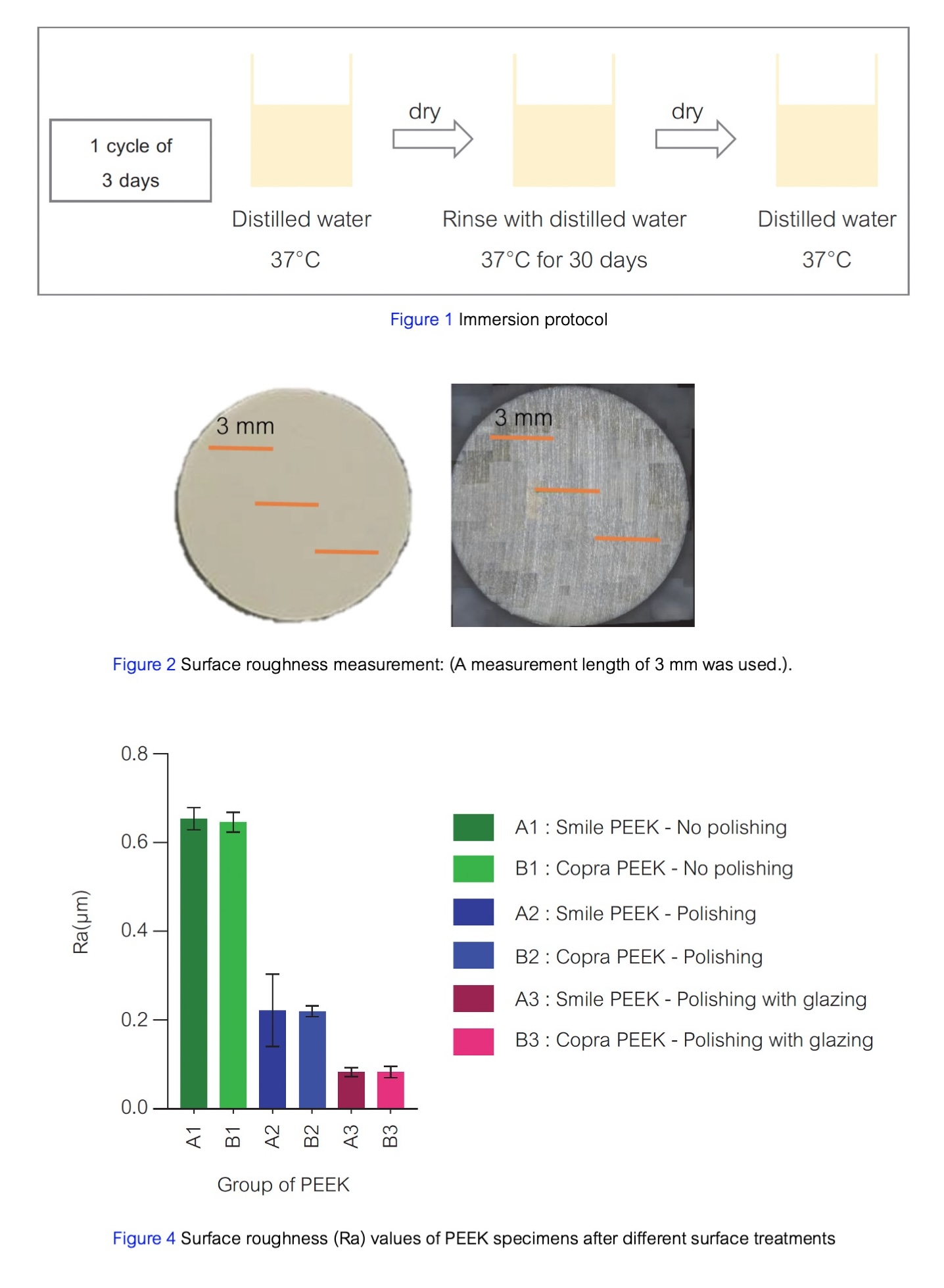
The study aimed to evaluate the effects of surface roughness, immersion time, material brand on the color stability of polyetheretherketone (PEEK). Two brands of PEEK (n=48), Smile PEEK and Copra PEEK, were used in this study. Disc-shaped specimens (15 mm in diameter and 3 mm in thickness) were fabricated using milling and sectioned with a high-speed saw. The specimens were then divided into six groups (n = 8 per group) based on the PEEK brand and surface treatment: no polishing, polishing, polishing with glazing. Surface roughness was measured using a 3D laser microscope, and baseline color values were recorded using a spectrophotometer according to the CIELAB system. The specimens were subsequently immersed in distilled water for 60 days. Color changes (ΔE*) were calculated at 15, 30, 45, and 60 days after immersion relative to baseline measurements. Two-way ANOVA revealed that the surface roughness of PEEK was significantly influenced by the polishing protocols. The polishing with glazing group exhibited the lowest surface roughness (Ra), which was significantly lower than that of all other groups (p<0.05). Color change data were analyzed using three-way mixed-design ANOVA. Color change (ΔE*) increased significantly with immersion time in distilled water. The polishing with glazing group demonstrated a significantly lower color change (p<0.05). No significant differences in ΔE* values were observed between Smile PEEK and Copra PEEK under the same surface treatment conditions (p>0.05). Polishing and glazing effectively enhanced the color stability of PEEK materials. Color change increased with immersion time, no significant difference in color stability was found between Smile PEEK and Copra PEEK when subjected to the same surface treatment conditions and immersion durations.
Article Details

This work is licensed under a Creative Commons Attribution-NonCommercial-NoDerivatives 4.0 International License.
References
Erdağ ÜH, Şahin O, Köroğlu A, Özdemir T, Dede DÖ. Performance of polyether ether ketone (peek) for dental applications: surface roughness and color stability. Polym Bull. 2023 Jun;80:6819–6834. doi: 10.1007/s00289-022-04393-x
Kurtz SM, Devine JN. PEEK biomaterials in trauma, orthopedic, and spinal implants. Biomaterials. 2007 Nov;28(32):4845-4869. doi: 10.1016/j.biomaterials.2007.07.013.
Fouad H, Elleithy R. High density polyethylene/graphite nano-composites for total hip joint replacements: processing and in vitro characterization. J Mech Behav Biomed Mater. 2011 Oct;4(7):1376-1383. doi: 10.1016/j.jmbbm.2011.05.00.8.
Bathala L, Majeti V, Rachuri N, Singh N, Gedela S. The role of polyether ether ketone (Peek) in dentistry - a review. J Med Life. 2019 Jan-Mar;12(1):5-9. doi: 10.25122/jml-2019-0003.
Porojan L, Toma FR, Bîrdeanu MI, Vasiliu RD, Uțu ID, Matichescu A. Surface characteristics and color stability of dental PEEK related to water saturation and thermal cycling. Polymers (Basel). 2022 May 25;14(11):2144. doi: 10.3390/polym14112144.
Kuhar M, Funduk N. Effects of polishing techniques on the surface roughness of acrylic denture base resins. J Prosthet Dent. 2005 Jan;93(1):76-85. doi: 10.1016/j.prosdent.2004.10.002.
Sahin O, Koroglu A, Dede DÖ, Yilmaz B. Effect of surface sealant agents on the surface roughness and color stability of denture base materials. J Prosthet Dent. 2016 Oct;116(4):610-616. doi: 10.1016/j.prosdent.2016.03.007.
Şahin O, Dede DÖ, Köroğlu A, Yılmaz B. Influence of surface sealant agents on the surface roughness and color stability of artificial teeth. J Prosthet Dent. 2015 Jul;114(1):130-137. doi: 10.1016/j.prosdent.2015.02.009.
Dede DÖ, Şahin O, Koroglu A, Yilmaz B. Effect of sealant agents on the color stability and surface roughness of nanohybrid composite resins. J Prosthet Dent. 2016 Jul;116(1):119-128. doi: 10.1016/j.prosdent.2015.11.024.
Al Taweel SM, Fouzan AA, Al-Otaibi HN, Labban N, AlShehri HA. Thermal-cycling, simulated brushing, and beverages induced color changes and roughness of CAD/CAM poly (methyl methacrylate) denture resins. Mater Res Express 2021 Dec;8(12):125401. doi: 10.1088/2053-1591/ac406e.
Alp G, Johnston WM, Yilmaz B. Optical properties and surface roughness of prepolymerized poly(methyl methacrylate) denture base materials. J Prosthet Dent. 2019 Feb;121(2):347-352. doi: 10.1016/j.prosdent.2018.03.001.
Heimer S, Schmidlin PR, Stawarczyk B. Discoloration of PMMA, composite, and PEEK. Clin Oral Investig. 2017 May;21(4):1191-1200. doi: 10.1007/s00784-016-1892-2.
Porojan L, Toma FR, Vasiliu RD, Topală FI, Porojan SD, Matichescu A. Optical properties and color stability of dental PEEK related to artificial ageing and staining. Polymers (Basel). 2021 Nov;13(23):4102. doi: 10.3390/polym13234102.
Bollen CM, Papaioanno W, Van Eldere J, Schepers E, Quirynen M, van Steenberghe D. The influence of abutment surface roughness on plaque accumulation and peri-implant mucositis. Clin Oral Implants Res. 1996 Sep;7(3):201-211. doi: 10.1034/j.1600-0501.1996.070302.x.
Jones CS, Billington RW, Pearson GJ. The in vivo perception of roughness of restorations. Br Dent J. 2004 Jan;196(1):42-45 doi: 10.1038/sj.bdj.4810881.
Kurahashi K, Matsuda T, Ishida Y, Ichikawa T. Effect of polishing protocols on the surface roughness of polyetheretherketone. J Oral Sci. 2020 Jan;62(1):40-42. doi: 10.2334/josnusd.18-0473.
Schwitalla A, Müller WD. PEEK dental implants: a review of the literature. J Oral Implantol. 2013 Dec;39(6):743-749. doi: 10.1563/AAID-JOI-D-11-00002.
Aksoy G, Polat H, Polat M, Coskun G. Effect of various treatment and glazing (coating) techniques on the roughness and wettability of ceramic dental restorative surfaces. Colloids Surf B Biointerfaces. 2006 Dec;53(2):254-259. doi: 10.1016/j.colsurfb.2006.09.016.
Parvizi Z, Ansarifard E, Taghva M, Mosaddad SA. Effect of glazing and hydrothermal aging on the fracture strength of metal-ceramic single restorations after additional firing: an in vitro study. BMC Oral Health. 2025 May;25(1):839. doi: 10.1186/s12903-025-05972-w.
Stawarczyk B, Beuer F, Wimmer T, Jahn D, Sener B, Roos M, et al. Polyetheretherketone-a suitable material for fixed dental prostheses? J Biomed Mater Res B Appl Biomater. 2013 Oct;101(7):1209-16. doi: 10.1002/jbm.b.32932.
Türkün LS, Leblebicioğlu EA. Stain retention and surface characteristics of posterior composites polished by one-step systems. Am J Dent. 2006 Dec;19(6):343-347.
Yap AU, Lye KW, Sau CW. Surface characteristics of tooth-colored restoratives polished utilizing different polishing systems. Oper Dent. 1997 Nov-Dec;22(6):260-265.
Lopes IAD, Monteiro PJVC, Mendes JJB, Gonçalves JMR, Caldeira FJF. The effect of different finishing and polishing techniques on surface roughness and gloss of two nanocomposites. Saudi Dent J. 2018 Jul;30(3):197-207. doi: 10.1016/j.sdentj.2018.04.003.
Ghazaee S, Moslehifard E, Ghaffari T, Nasirpouri F. Effect of surface glaze treatment and mechanical polishing on the color stability of two types of Cad/Cam ceramics. Glass Ceram. 2024 Jan;80(9):396-401. doi: 10.1007/s10717-023-00621-6.
Stamenković DD, Tango RN, Todorović A, Karasan D, Sailer I, Paravina RD. Staining and aging-dependent changes in color of CAD-CAM materials. J Prosthet Dent. 2021 Nov;126(5):672-678. doi: 10.1016/j.prosdent.2020.09.005.
Um CM, Ruyter IE. Staining of resin-based veneering materials with coffee and tea. Quintessence Int. 1991 May;22(5):377-386.
Cinel Sahin S, Mutlu Sagesen L. Effects of polishing protocols on the surface roughness and color stability of polyetheretherketone (PEEK). Eur Oral Res. 2024 Jan;58(1):1-7. doi: 10.26650/eor.20231066580.
Bagheri R, Burrow MF, Tyas M. Influence of food-simulating solutions and surface finish on susceptibility to staining of aesthetic restorative materials. J Dent. 2005 May;33(5):389-398. doi: 10.1016/j.jdent.2004.10.018.
Paravina RD, Ghinea R, Herrera LJ, Bona AD, Igiel C, Linninger M, et al. Color difference thresholds in dentistry. J Esthet Restor Dent. 2015 Mar-Apr;27Suppl1:S1-9. doi: 10.1111/jerd.12149.
Porojan L, Roxana Toma F, Diana Vasiliu R, Matichescu A. Surface roughness and color changes of dental PEEK related to staining beverages and cleaning methods. Mater Today Proc. 2023;78:221-226. doi: 10.1016/j.matpr.2022.10.174.
Song SY, Shin YH, Lee JY, Shin SW. Color stability of provisional restorative materials with different fabrication methods. J Adv Prosthodont. 2020 Oct;12(5):259-264. doi: 10.4047/jap.2020.12.5.259.
Polychronakis N, Lagouvardos P, Polyzois G, Sykaras N, Zoidis P. Color changes of polyetheretherketone (PEEK) and polyoxymethelene (POM) denture resins on single and combined staining/cleansing action by CIELab and CIEDE2000 formulas. J Prosthodont Res. 2020 Apr;64(2):159-166. doi: 10.1016/j.jpor.2019.06.005.
Kaya N, Sasany R, Yanıkoglu N, Tosun B. Investigation of color and physicomechanical properties of peek and pekk after storage in a different medium. Sci Rep. 2024 Mar;14(1):5357. doi: 10.1038/s41598-024-54695-5.
