
Fluoride content of toothpastes marketed for children in Thailand: an analytical study
Article Sidebar
Main Article Content
Abstract
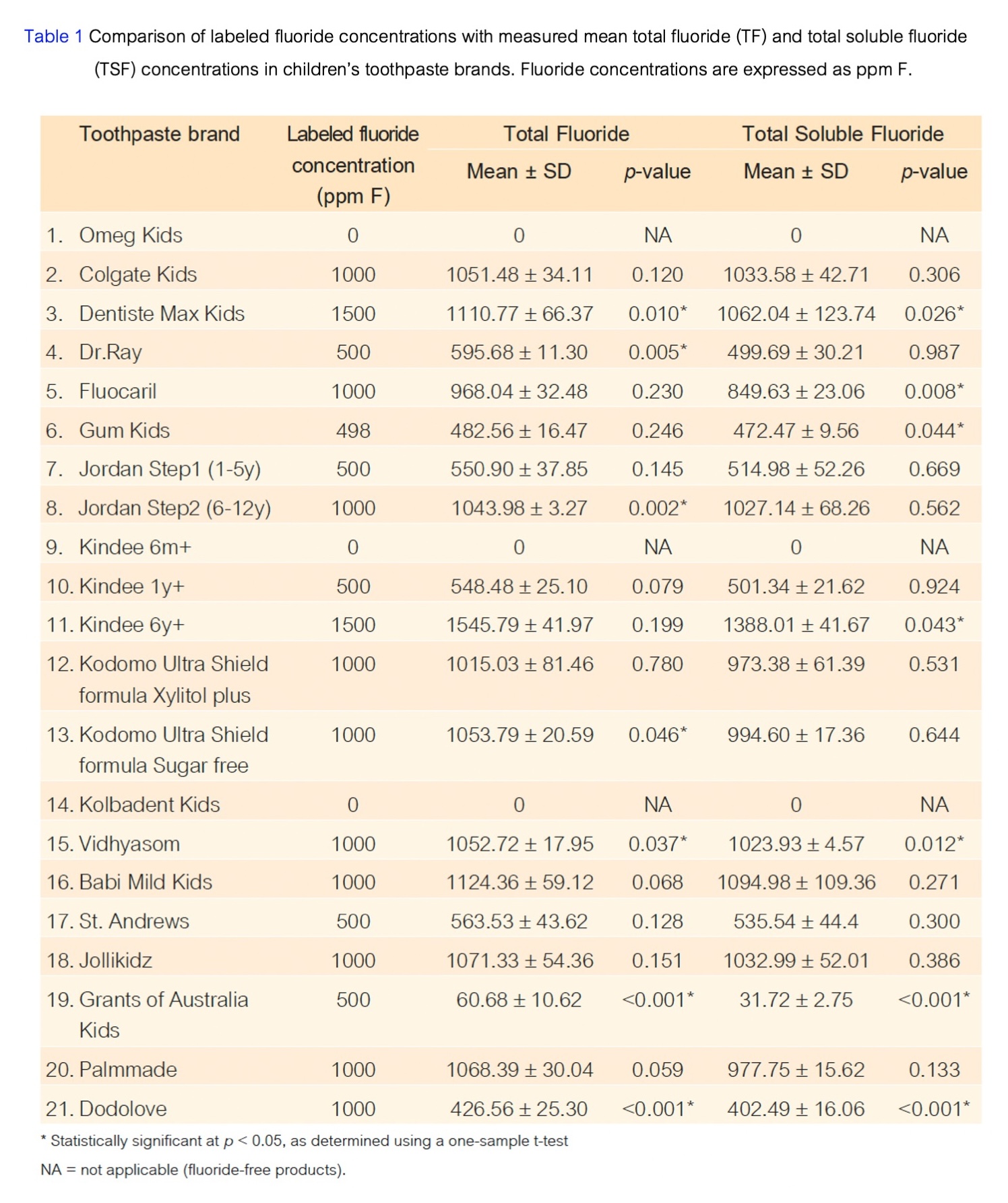
To evaluate the total fluoride and total soluble fluoride concentrations in children’s toothpaste products available in Thailand, and to compare measured values with labeled fluoride concentrations. Twenty-one brands of children’s toothpaste were purchased from supermarkets in Bangkok in 2024. Three samples from different manufacturing lots were collected for each brand. Total fluoride and total soluble fluoride concentrations were determined using a fluoride ion-selective electrode after appropriate acid hydrolysis, neutralization, and buffering. Measured fluoride concentrations were compared with labeled values using one-sample t-tests, with statistical significance set at p < 0.05. Twenty-one toothpaste brands were analyzed, 14 (66.67%) exhibited total fluoride concentrations consistent with their labeled fluoride values, while seven (33.33%) demonstrated significant discrepancies. Three brands (14.28%) contained total fluoride levels significantly lower than declared, whereas four brands (19.05%) demonstrated higher total fluoride concentrations than stated on their labels. For total soluble fluoride, 14 brands (66.67%) showed concentrations consistent with labeled claims. In contrast, six brands (28.57%) exhibited significantly lower total soluble fluoride levels than declared, and one brand (4.76%) showed a significantly higher total soluble fluoride concentration. Notably, several toothpaste products demonstrated adequate total fluoride levels but reduced total soluble fluoride concentrations, indicating limited fluoride bioavailability. The findings indicate that labeled fluoride concentrations in children’s toothpaste do not always reflect the amount of bioavailable fluoride. Although most products complied with declared total fluoride values, reduced total soluble fluoride levels were observed in several brands, potentially compromising their anticariogenic efficacy. Ongoing market surveillance focusing on both total and bioavailable fluoride is recommended to ensure the efficacy and safety of children’s toothpaste products in Thailand.
Article Details

This work is licensed under a Creative Commons Attribution-NonCommercial-NoDerivatives 4.0 International License.
References
GBD 2021 Oral Disorders Collaborators. Trends in the global, regional, and national burden of oral conditions from 1990 to 2021: a systematic analysis for the global burden of disease study 2021. Lancet. 2025 Mar;405(10482):897-910. doi: 10.1016/S0140-6736(24)02811-3.
Samaranayake L, Porntaveetus T, Tsoi J, Tuygunov N. Facts and fallacies of the fluoride controversy: A contemporary perspective. Int Dent J. 2025 Aug;75(4):100833. doi: 10.1016/j.identj.2025.04.013.
Yeh CH, Wang YL, Vo TTT, Lee YC, Lee IT. Fluoride in dental caries prevention and treatment: mechanisms, clinical evidence, and public health perspectives. Healthcare (Basel). 2025 Sep;13(17):2246. doi: 10.3390/healthcare13172246.
Walsh T, Worthington HV, Glenny AM, Marinho VC, Jeroncic A. Fluoride toothpastes of different concentrations for preventing dental caries. Cochrane Database Syst Rev. 2019 Mar;3(3):CD007868. doi: 10.1002/14651858.CD007868.pub3.
Martinez-Mier EA, Tenuta LMA, Carey CM, Cury JA, van Loveren C, Ekstrand KR, et al. ORCA fluoride in toothpaste analysis work group. European organization for caries research workshop: methodology for determination of potentially available fluoride in toothpastes. Caries Res. 2019;53(2):119-136. doi: 10.1159/000490196.
Sebastian ST, Siddanna S. Total and free fluoride concentration in various brands of toothpaste marketed in India. J Clin Diagn Res. 2015 Oct;9(10):ZC09-ZC12. doi: 10.7860/JCDR/2015/13382.6578.
Rani PD, Hegde V. Estimation of total fluoride concentration, total soluble fluoride concentration and pH among various brands of toothpastes. JCDR. 2021 Mar;15(3). ZM01-ZM04. doi:10.7860/JCDR/2021/46804.14598
Hwang S, Lee J, Choi JH, Lee K, Kang CM. Awareness of fluoride toothpaste among parents of children and adolescents. J Korean Acad Pediatr Dent. 2024 Nov;51:392-406. doi:10.5933/JKAPD.2024.51.4.392.
Ramadhani A, Wijaya S, Mardlianah A, Adiatman M, Setiawati F, Gunawan HA, et al. Fluoride content and labelling of toothpastes marketed in Indonesia. J Stoma. 2020 Aug;73(4):193-199. doi:10.5114/jos.2020.98265.
Marín LM, Castiblanco GA, Úsuga-Vacca M, Cury JA, Martignon S. Chemically soluble fluoride in toothpastes marketed in Colombia. Rev CES Odont. 2021;34(2):3–14. doi:10.21615/cesodon.5606.
Farooq I, Ali S, Al-Khalifa KS, Alhooshani K. Total and soluble fluoride concentration present in various commercial brands of children toothpastes available in Saudi Arabia: A pilot study. Saudi Dent J. Apr;30(2):161-165. doi: 10.1016/j.sdentj.2018.01.001.
Carrera CA, Giacaman RA, Muñoz-Sandoval C, Cury JA. Total and soluble fluoride content in commercial dentifrices in Chile. Acta Odontol Scand. 2012 Dec;70(6):583-588. doi: 10.3109/00016357.2011.640287.
Chávez BA, Vergel GB, Cáceres CP, Perazzo MF, Vieira-Andrade RG, Cury JA. Fluoride content in children's dentifrices marketed in Lima, Peru. Braz Oral Res. 2019 Jul;33:e051. doi: 10.1590/1807-3107bor-2019.vol33.0051.
