
Revisiting the incisor index for sex determination: development of cut-off values and validation of predictive accuracy
Article Sidebar
Main Article Content
Abstract
Objective: Sex estimation is a fundamental step in forensic human identification. Teeth are highly resistant to postmortem degradation and therefore provide valuable biological markers for sex determination. Among odontometric methods, the incisor index has long been recognized as a simple tool for sex assessment; however, the absence of clearly defined cut-off values has limited its practical application. This study aimed to establish cut-off values for the incisor index and to evaluate its predictive accuracy for sex determination in a Thai population.
Materials and Methods: The study was conducted in two sequential phases. In the first phase, mesiodistal crown widths of maxillary and mandibular incisors were measured and used to calculate the incisor index. Receiver Operating Characteristic (ROC) curve analysis was applied to determine optimal cut-off values using both Youden’s index and the Euclidean index. In the second phase, the predictive accuracy of these newly-derived cut-off values for sex classification was evaluated.
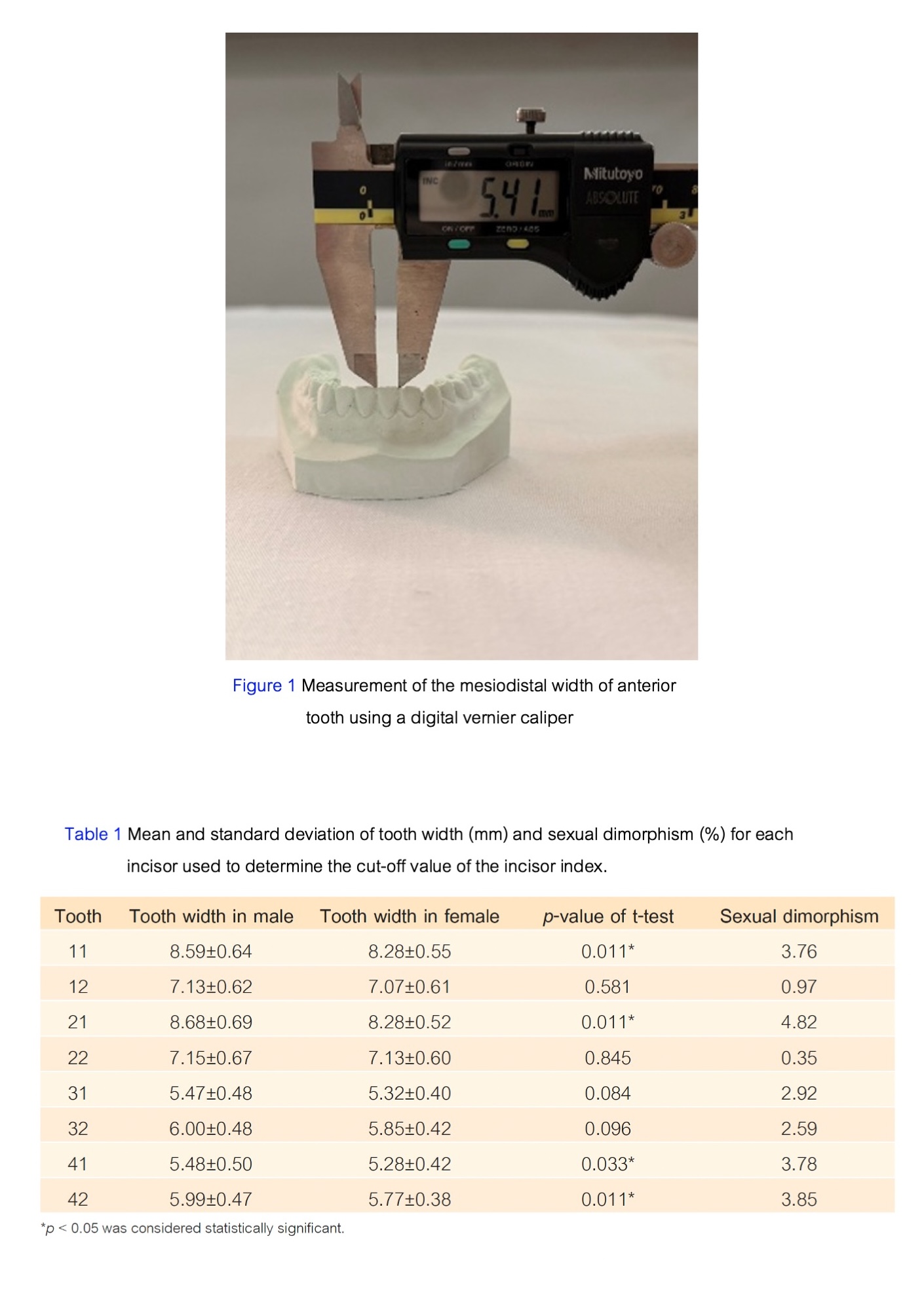
Results: Males exhibited greater mean mesiodistal tooth widths than females for all incisors, although statistically significant differences were observed in only four teeth. The highest predictive accuracy was obtained from the maxillary left incisor index with a cut-off value of 85.60, yielding an overall accuracy of 71.00%. The maxillary right incisor index demonstrated a similar performance with an accuracy of 70.00%. In contrast, mandibular incisor indices showed substantially lower predictive accuracies, all below 55%. These findings indicate that the discriminative potential of the incisor index depends primarily on the proportional relationship between central and lateral incisors rather than on their absolute dimensions.
Conclusion: The maxillary incisor index demonstrates moderate accuracy for sex estimation and may serve as a simple and practical tool for preliminary forensic assessment. However, the variability observed between dental arches highlights the importance of developing population-specific standards when applying incisor indices for forensic sex determination.
Article Details

This work is licensed under a Creative Commons Attribution-NonCommercial-NoDerivatives 4.0 International License.
References
Nagare SP, Chaudhari RS, Birangane RS, Parkarwar PC. Sex determination in forensic identification: a review. J Forensic Dent Sci. 2018 May-Aug;10(2):61-66. doi: 10.4103/jfo.jfds_55_17.
Chunhabundit P, Arayapisit T, Srimaneekarn N. Sex prediction from human tooth dimension by ROC curve analysis: a preliminary study. Sci Rep. 2025 Feb;15(1):6627. doi: 10.1038/s41598-025-90801-x.
Lacasella GV, Signorini L, Ballini A, Bizzoca ME, Musella G, Lo Muzio E, et al. Forensic odontology: a comprehensive review of advances and applications in dental forensic medicine. Minerva Dent Oral Sci. 2025 Aug;74(4):273-290. doi: 10.23736/S2724-6329.25.05187-3.
Smitha T, Sheethal HS, Hema KN, Franklin R. Forensic odontology as a humanitarian tool. J Oral Maxillofac Pathol. 2019 Jan-Apr;23(1):164. doi: 10.4103/jomfp.JOMFP_249_18.
Rothwell BR. Principles of dental identification. Dent Clin North Am. 2001 Apr;45(2):253-270.
Anuthama K, Shankar S, Ilayaraja V, Kumar GS, Rajmohan M, Vignesh. Determining dental sex dimorphism in South Indians using discriminant function analysis. Forensic Sci Int. 2011 Oct;212(1-3):86-89. doi: 10.1016/j.forsciint.2011.05.018.
Acharya AB, Prabhu S, Muddapur MV. Odontometric sex assessment from logistic regression analysis. Int J Legal Med. 2011 Mar;125(2):199-204. doi: 10.1007/s00414-010-0417-9.
Senol D, Secgin Y, Duman BS, Toy S, Oner Z. Sex and age estimation with machine learning algorithms using parameters obtained from cone beam computed tomography images of maxillary first molar and canine teeth. Egypt J Forensic Sci. 2023 June;13(1):27. doi: 10.1186/s41935-023-00346-1.
Nakayama M, Kondo O, Pesonen P, Alvesalo L, Lähdesmäki R. Influence of long and short arms of X chromosome on maxillary molar crown morphology. PLoS One. 2018 Nov;13(11):e0207070. doi: 10.1371/journal.pone.0207070.
Nagare SP, Chaudhari RS, Birangane RS, Parkarwar PC. Sex determination in forensic identification: a review. J Forensic Dent Sci. 2018 May-Aug;10(2):61-66. doi: 10.4103/jfo.jfds_55_17.
Aitchison J. Sex differences in teeth, jaws, and skulls. Dent Pract. 1963;14:52-57.
Rai B, Kaur J. Sex determination methods in forensic odontology; In: Rai B, Kaur J, editors. Evidence-based forensic dentistry. Berlin: Springer-Verlag, 2012; p.73-79.
Hemanth M, Pandey A. Forensic odontology and its applications; In: Jain N, editor. Textbook of forensic odontology. New Delhi: Jaypee Brothers Medical Publishers, 2013; p.10-42.
Heng D, Manica S, Franco A. Forensic dentistry as an analysis tool for sex estimation: a review of current techniques. Res Rep Forensic Med Sci. 2022 Dec;12:25-39. doi: 10.2147/RRFMS.S334796.
Garn SM, Lewis AB, Swindler DR, Kerewsky RS. Genetic control of sexual dimorphism in tooth size. J Dent Res. 1967 Sep-Oct;46(5):963-972. doi: 10.1177/00220345670460055801.
Youden WJ. Index for rating diagnostic tests. Cancer. 1950 Jan;3(1):32-35. doi: 10.1002/1097-0142(1950)3:1<32::aid-cncr2820030106>3.0.co;2-3.
Perkins NJ, Schisterman EF. The inconsistency of "optimal" cutpoints obtained using two criteria based on the receiver operating characteristics curve. Am J Epidemiol. 2006 Apr;163(7):670-675. doi: 10.1093/aje/kwj063.
Pereira C, Bernardo M, Pestana D, Santos JC, Mendonça MC. Contribution of teeth in human forensic identification--discriminant function sexing odontometrical techniques in Portuguese population. J Forensic Leg Med. 2010 Feb;17(2):105-110. doi: 10.1016/j.jflm.2009.09.001.
Prasanna S, Raj LSM, Krishna PS, Manikandan VJS, Srikant N. Evaluation of incisor index as a forensic tool in genderal dimorphism: a study in South Indian population. Indian J Forensic Med Toxicol. 2021 Aug;15(4):2319-2323. doi: 10.37506/ijfmt.v15i4.17053.
Rani ST. Applicability of odontometric dimensions and indices in sexual dimorphism among Nalgonda population. J Forensic Dent Sci. 2017 Sep-Dec;9(3):175. doi: 10.4103/jfo.jfds_42_16.
