
Ranking of interproximal reduction techniques by intrapulpal temperature changes: a systematic review and network meta-analysis
Article Sidebar
Main Article Content
Abstract
Objective: Interproximal reduction generates friction and subsequent heat that may lead to pulpal necrosis. This systematic review and network meta-analysis aimed to evaluate and rank the mean intrapulpal temperature increase (°C) associated with various interproximal reduction systems and cooling conditions to identify thermally safe protocols for clinical practice.
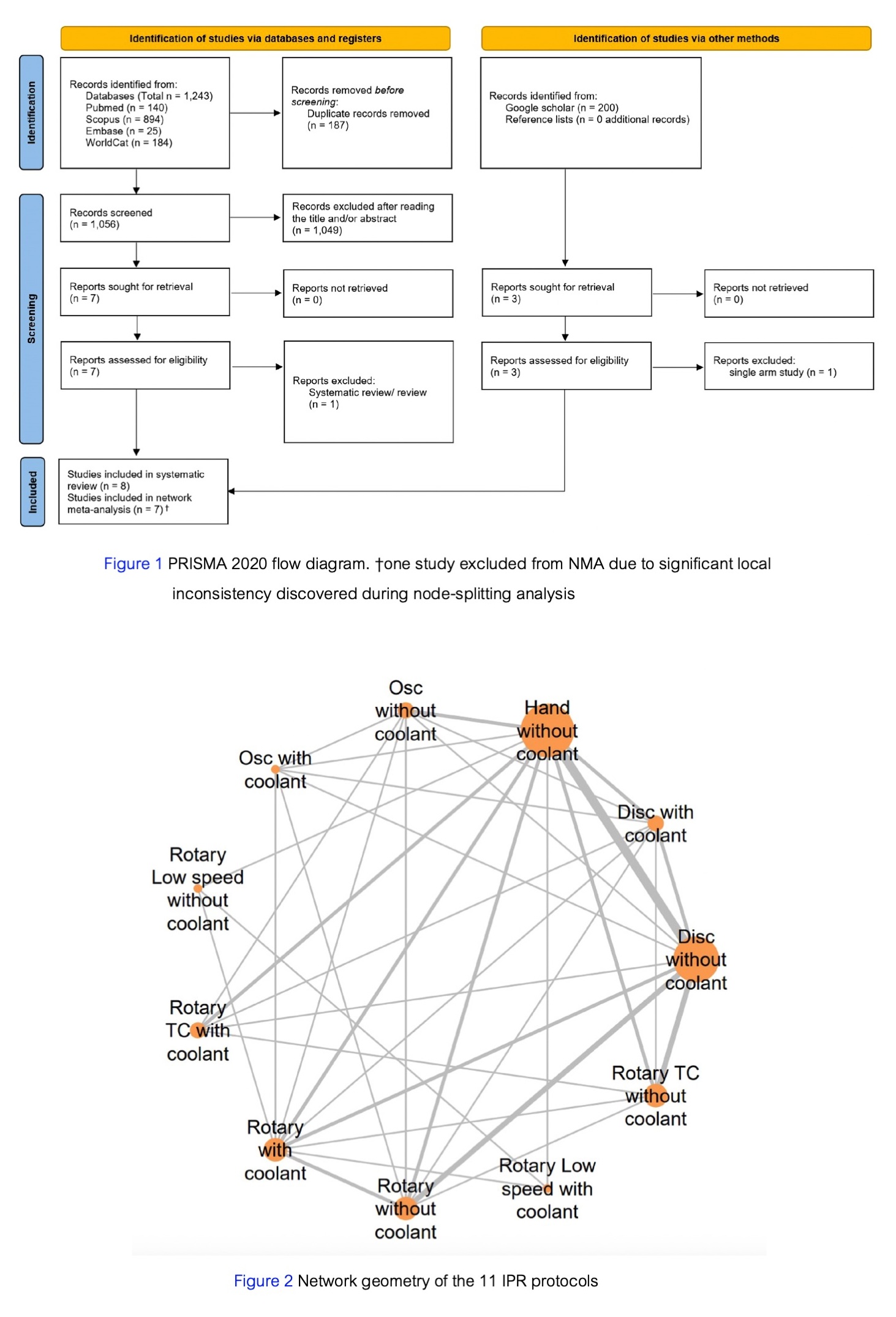
Materials and methods: A comprehensive search of PubMed, Scopus, Embase, WorldCat, and Google Scholar was conducted through January 31, 2026. Experimental and clinical studies evaluating the mean intrapulpal temperature increase (°C) during interproximal reduction in human permanent teeth were included. Internal validity was assessed using the QUIN and RoB 2 tools. A Bayesian network meta-analysis using a random-effects model was performed to calculate mean differences and 95% credible intervals. The thermal safety of 11 protocols was ranked using surface under the cumulative ranking curve (SUCRA) probabilities.
Results: Eight studies involving 712 interproximal measurement units, comparing 11 protocols, were included in the systematic review. Rotary tungsten carbide with coolant demonstrated the highest probability of minimizing temperature rise (SUCRA = 91.56%), followed by rotary low speed with coolant (SUCRA = 87.30%). However, differences among these highly ranked protocols and the control (hand without coolant) were not statistically significant. Conversely, non-cooled mechanical techniques were consistently ranked lower, with rotary tungsten carbide without coolant posing the highest thermal risk (SUCRA = 0.61%).
Conclusions: Rotary tungsten carbide, rotary low speed, rotary, and disc protocols (all with coolant), alongside hand without coolant, provide comparable thermal safety. Continuous water cooling is critical for motorized interproximal reduction. Motorized techniques without coolant pose significant thermal risks, particularly rotary tungsten carbide without coolant, which generates the highest temperature rise and should be avoided. When a dry working field is clinically necessary, oscillating and hand protocols without coolant serve as favorable alternatives.
Systematic review registration: PROSPERO CRD42022293226
Article Details

This work is licensed under a Creative Commons Attribution-NonCommercial-NoDerivatives 4.0 International License.
References
Livas C, Jongsma AC, Ren Y. Enamel reduction techniques in orthodontics: a literature review. Open Dent J. 2013 Oct;7:146-151. doi: 10.2174/1874210601307010146.
Zachrisson BU, Minster L, Ogaard B, Birkhed D. Dental health assessed after interproximal enamel reduction: caries risk in posterior teeth. Am J Orthod Dentofacial Orthop. 2011 Jan;139(1):90-98. doi: 10.1016/j.ajodo.2010.09.002.
Chudasama D, Sheridan JJ. Guidelines for contemporary air-rotor stripping. J Clin Orthod. 2007 Jun;41(6):315-320.
Banga K, Arora N, Kannan S, Singh AK, Malhotra A. Evaluation of temperature rise in the pulp during various IPR techniques-an in vivo study. Prog Orthod. 2020 Nov;21(1):40. doi: 10.1186/s40510-020-00340-6.
Dara A, Datla PKV, Priya CVP, Manda A, Kandikatla P, Polineti P. Evaluation and comparison of thermal changes in the pulp chamber in different Inter proximal reduction techniques: an in-vitro study. Uttar Pradesh J Zool. 2023;44(24):303-310. doi: 10.56557/UPJOZ/2023/v44i243843.
Omer ABA, Sanea JA. A Comparison of thermal changes among four different interproximal reduction systems in orthodontics. J Contemp Dent Pract. 2019 Jun;20(6):738-742.
Zach L, Cohen G. Pulp response to externally applied heat. Oral Surg Oral Med Oral Pathol. 1965 Apr;19:515-530. doi: 10.1016/0030-4220(65)90015-0.
Kwon SJ, Park YJ, Jun SH, Ahn JS, Lee IB, Cho BH, et al. Thermal irritation of teeth during dental treatment procedures. Restor Dent Endod. 2013 Aug;38(3):105-112. doi: 10.5395/rde.2013.38.3.105.
Lau XE, Liu X, Chua H, Wang WJ, Dias M, Choi JJE. Heat generated during dental treatments affecting intrapulpal temperature: a review. Clin Oral Investig. 2023 May;27(5):2277-2297. doi: 10.1007/s00784-023-04951-1.
Farah RI. Effect of cooling water temperature on the temperature changes in pulp chamber and at handpiece head during high-speed tooth preparation. Restor Dent Endod. 2018 Dec;44(1):e3. doi: 10.5395/rde.2019.44.e3
Baysal A, Uysal T, Usumez S. Temperature rise in the pulp chamber during different stripping procedures. Angle Orthod. 2007 May;77(3):478-482. doi: 10.2319/0003-3219(2007)077[0478:TRITPC]2.0.CO;2.
Gul Amuk N, Kurt G, Cakmak G, Er O. Evaluation of time-dependent temperature changes during different interdental stripping procedures by thermal imaging: an in vitro study. Oral Health Prev Dent. 2019;17(6):591- 598. doi: 10.3290/j.ohpd.a43274.
Sehgal M, Sharma P, Juneja A, Kumar P, Verma A, Chauhan V. Effect of different stripping techniques on pulpal temperature: in vitro study. Dental Press J Orthod. 2019 Jan-Feb;24(1):39-43. doi: 10.1590/2177-6709.24.1.039-043.oar.
Voodi S, Gorantla S, Muddada V, Lenka RR, Gurugubelli VK, Konathala SS. Evaluation of the temperature rise in the pulp chamber during different interproximal reduction procedures – an in vitro study. IJDSIR. 2021 Mar;4(2):470-478.
d'Ornellas Pereira JC Jr, Weissheimer A, de Menezes LM, de Lima EM, Mezomo M. Change in the pulp chamber temperature with different stripping techniques. Prog Orthod. 2014 Sep;15(1):55. doi: 10.1186/s40510-014-0055-8.
Kaewsirirat P, Chaweewannakorn C, Viwattanatipa N, Nanthavanich Saengfai N. Comparison of heat generation between manual metal strips and motor stripping discs for interproximal reduction: a systematic review and meta-analysis. Thai J Orthod. 2025 May;15(1):56-67.
Page MJ, McKenzie JE, Bossuyt PM, Boutron I, Hoffmann TC, Mulrow CD, et al. The PRISMA 2020 statement: an updated guideline for reporting systematic reviews. BMJ. 2021 Mar;372:n71. doi: 10.1136/bmj.n71.
Hutton B, Catalá-López F, Moher D. The PRISMA statement extension for systematic reviews incorporating network meta-analysis: PRISMA-NMA. Med Clin (Barc). 2016 Sep;147(6):262-266. doi: 10.1016/j.medcli.2016.02.025.
Sheth VH, Shah NP, Jain R, Bhanushali N, Bhatnagar V. Development and validation of a risk-of-bias tool for assessing in vitro studies conducted in dentistry: The QUIN. J Prosthet Dent. 2024 Jun;131(6):1038-1042. doi: 10.1016/j.prosdent.2022.05.019.
Sterne JAC, Savović J, Page MJ, Elbers RG, Blencowe NS, Boutron I, et al. RoB 2: a revised tool for assessing risk of bias in randomised trials. BMJ. 2019 Aug;366:l4898. doi: 10.1136/bmj.l4898.
Owen RK, Bradbury N, Xin Y, Cooper N, Sutton A. MetaInsight: An interactive web-based tool for analyzing, interrogating, and visualizing network meta-analyses using R-shiny and netmeta. Res Synth Methods. 2019 Dec;10(4):569-581. doi: 10.1002/jrsm.1373.
Nevill CR, Cooper NJ, Sutton AJ. A multifaceted graphical display, including treatment ranking, was developed to aid interpretation of network meta-analysis. J Clin Epidemiol. 2023 May;157:83-91. doi: 10.1016/j.jclinepi.2023.02.016.
Singh J, Gsteiger S, Wheaton L, Riley RD, Abrams KR, Gillies CL, et al. Bayesian network meta-analysis methods for combining individual participant data and aggregate data from single arm trials and randomised controlled trials. BMC Med Res Methodol. 2022 Jul;22(1):186. doi: 10.1186/s12874-022-01657-y.
Nikolakopoulou A, Higgins JPT, Papakonstantinou T, Chaimani A, Del Giovane C, Egger M, et al. CINeMA: An approach for assessing confidence in the results of a network meta-analysis. PLoS Med. 2020 Apr;17(4):e1003082. doi: 10.1371/journal.pmed.1003082.
Page MJ, Higgins JPT, Sterne JAC. Chapter 13: Assessing risk of bias due to missing evidence in a meta-analysis [updated August 2024]. In: Higgins JPT, Thomas J, Chandler J, Cumpston M, Li T, Page MJ, et al, editors. Cochrane Handbook for Systematic Reviews of Interventions. Version 6.5. Cochrane, 2024. Available from: cochrane.org/handbook.
Ercoli C, Rotella M, Funkenbusch PD, Russell S, Feng C. In vitro comparison of the cutting efficiency and temperature production of 10 different rotary cutting instruments. Part I: Turbine. J Prosthet Dent. 2009 Apr;101(4):248-261. doi: 10.1016/S0022-3913(09)60049-4.
Regev M, Judes H, Ben-Hanan U. Wear mechanisms of diamond coated dental burs. Tribol-Mater Surf Interfaces. 2010;4(1):38-42. doi: 10.1179/175158310X12626998129798.
Thomas MS, Kundabala M. Pulp hyperthermia during tooth preparation: the effect of rotary--instruments, lasers, ultrasonic devices, and airborne particle abrasion. J Calif Dent Assoc. 2012 Sep;40(9):720-731.
Runnacles P, Arrais CAG, Maucoski C, Coelho U, De Goes MF, Rueggeberg FA. Comparison of in vivo and in vitro models to evaluate pulp temperature rise during exposure to a Polywave® LED light curing unit. J Appl Oral Sci. 2019 May;27:e20180480. doi: 10.1590/1678-7757-2018-0480.
Ciora E, Miron M, Bojoga D, Lungeanu D, Jivanescu A. Evaluation of the pulp chamber temperature during tooth veneer preparation using burs with different degrees of wear-a preliminary in vitro study. Dent J (Basel). 2023 Aug;11(8):197. doi: 10.3390/dj11080197.
Harrel SK, Molinari J. Aerosols and splatter in dentistry: a brief review of the literature and infection control implications. J Am Dent Assoc. 2004 Apr;135(4):429-437. doi: 10.14219/jada.archive.2004.0207.
