Bond strength of a universal adhesive with different etching strategies to irradiated dentin
Article Sidebar
Main Article Content
Abstract
Objectives: To evaluate the effects of irradiation and etching strategies on the microtensile bond strength (μTBS) of a universal adhesive to dentin.
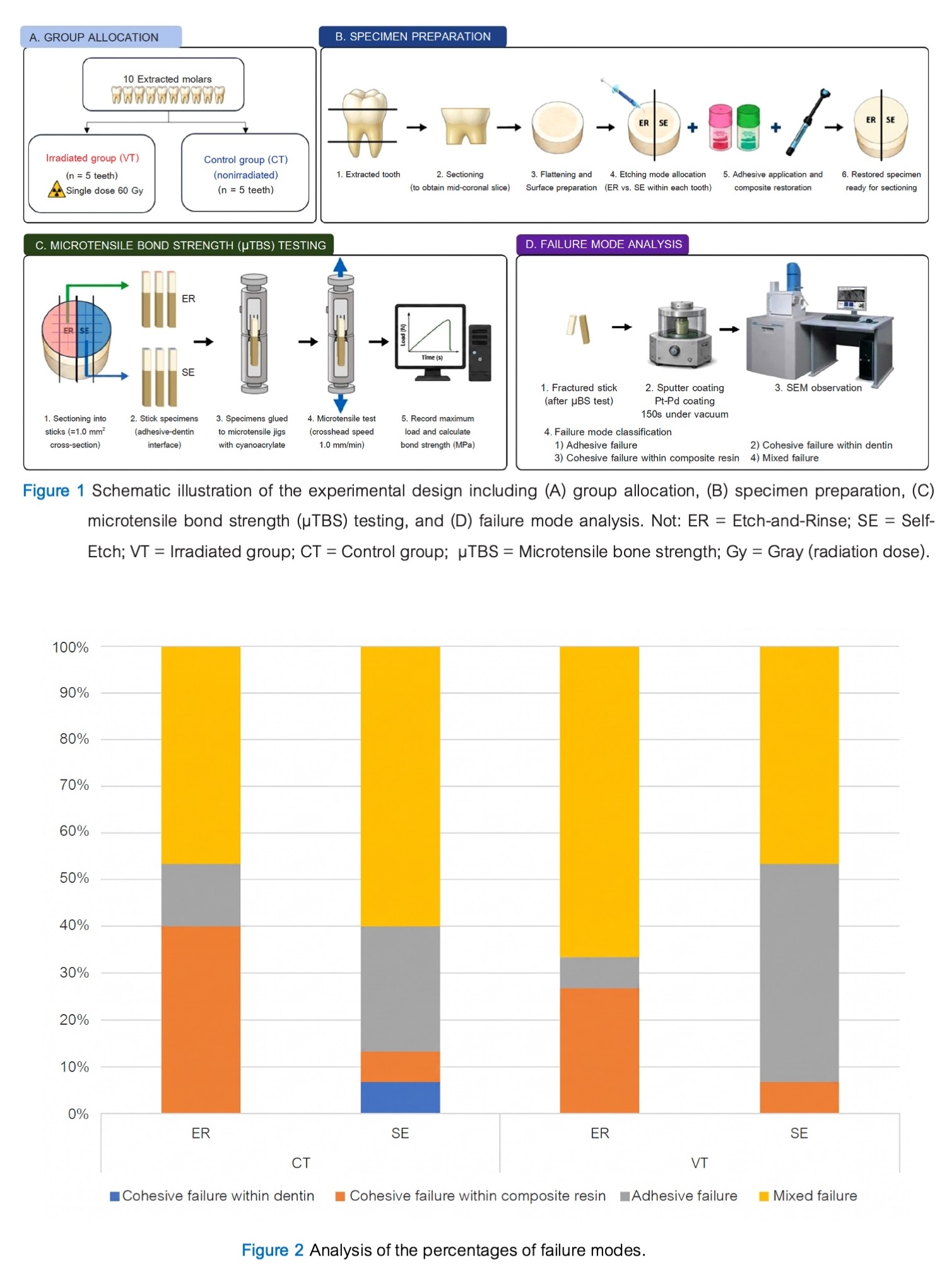
Materials and methods: Extracted human molars (n = 10) were divided into irradiated and non-irradiated groups. Five teeth received a single dose of 60 Gy, while the others served as controls. Mid-coronal dentin surfaces were prepared and bonded with a universal adhesive using etch-and-rinse (ER) and self-etch (SE) strategies. Resin composite build-ups were sectioned to obtain resin–dentin sticks. Three sticks per tooth were tested for μTBS at a crosshead speed of 1 mm/min. The mean value per tooth was used as the statistical unit. Data were analyzed using two-way ANOVA and Duncan test (p < 0.05). Failure modes were examined using scanning electron microscopy (SEM).
Results: Two-way ANOVA showed no significant effect of irradiation (p = 0.529) and no significant interaction between irradiation and etching strategy (p = 0.884). A significant effect of etching strategy was found, with higher μTBS in the ER groups compared with the SE groups (p = 0.021). However, one-way ANOVA with Duncan test showed no significant differences among the four groups (p > 0.05). The control and ER groups showed slightly higher mean values. Mixed failure predominated, followed by adhesive and cohesive failure within the resin composite, whereas cohesive failure in dentin was rare.
Conclusion: The etch-and-rinse approach provided higher bond strength than the self-etch approach regardless of irradiation.
Article Details

This work is licensed under a Creative Commons Attribution-NonCommercial-NoDerivatives 4.0 International License.
References
Davies L, Welch HG. Epidemiology of head and neck cancer in the United States. Otolaryngol Head Neck Surg. 2006 Sep;135(3):451- 457. doi: 10.1016/j.otohns.2006.01.029.
Gormley M, Creaney G, Schache A, Ingarfield K, Conway DI. Reviewing the epidemiology of head and neck cancer: definitions, trends and risk factors. Br Dent J. 2022 Nov;233(9):780-786. doi: 10.1038/s41415-022-5166-x.
Booth PW, Eppley BL, Schendel SA. Maxillofacial surgery. 2 ed. Philadelphia: Churchill Livingstone; 2006.
Lieshout HF, Bots CP. The effect of radiotherapy on dental hard tissue--a systematic review. Clin Oral Investig. 2014 Jan;18(1):17-24. doi: 10.1007/s00784-013-1034-z.
Douchy L, Gauthier R, Abouelleil-Sayed H, Colon P, Grosgogeat B, Bosco J. The effect of therapeutic radiation on dental enamel and dentin: a systematic review. Dent Mater. 2022 Jul;38(7):e181-e201. doi: 10.1016/j.dental.2022.04.014.
Madrid CC, de Pauli Paglioni M, Line SR, Vasconcelos KG, Brandão TB, Lopes MA, et al. Structural analysis of enamel in teeth from head-and-neck cancer patients who underwent radiotherapy. Caries Res. 2017;51(2):119-128. doi: 10.1159/000452866.
Gonçalves LM, Palma-Dibb RG, Paula-Silva FW, Oliveira HF, Nelson-Filho P, Silva LA, et al. Radiation therapy alters microhardness and microstructure of enamel and dentin of permanent human teeth. J Dent. 2014 Aug;42(8):986-992. doi: 10.1016/j.jdent.2014.05.011.
Lu H, Zhao Q, Guo J, Zeng B, Yu X, Yu D, et al. Direct radiation-induced effects on dental hard tissue. Radiat Oncol. 2019 Jan;14(1):5. doi: 10.1186/s13014-019-1208-1.
Tolentino Ede S, Centurion BS, Ferreira LH, Souza AP, Damante JH, Rubira-Bullen IR. Oral adverse effects of head and neck radiotherapy: literature review and suggestion of a clinical oral care guideline for irradiated patients. J Appl Oral Sci. 2011 Oct;19(5):448-454. doi: 10.1590/s1678-77572011000500003.
Kielbassa AM, Hinkelbein W, Hellwig E, Meyer-Lückel H. Radiation-related damage to dentition. Lancet Oncol. 2006 Apr;7(4):326-335. doi: 10.1016/S1470-2045(06)70658-1.
Oglakci B, Burduroğlu D, Eriş AH, Mayadağlı A, Arhun N. How does radiotherapy affect the adhesion of universal adhesive to enamel and dentin? A qualitative and quantitative analysis? Odovtos. 2022 Sep-Dec;24(3):75-90. doi: 10.15517/ijds.2022.50665.
Arid J, Palma-Dibb RG, de Oliveira HF, Nelson-Filho P, de Carvalho FK, da Silva LAB, et al. Radiotherapy impairs adhesive bonding in permanent teeth. Support Care Cancer. 2020 Jan;28(1):239-247. doi: 10.1007/s00520-019-04782-5.
Eggmann F, Hwang JD, Ayub JM, Mante FK. Impact of irradiation on the adhesive performance of resin-based dental biomaterials: a systematic review of laboratory studies. Materials (Basel). 2023 Mar;16(7):2580. doi: 10.3390/ma16072580.
Saeidnia S, Manayi A, Abdollahi M. From in vitro experiments to in vivo and clinical studies; pros and cons. Curr Drug Discov Technol. 2015;12(4):218-224. doi: 10.2174/1570163813666160114093140.
Gao L, Hu Y, Wang Y, Jiang W, He Z, Zhu C, et al. Exploring the variation of oral microbiota in supragingival plaque during and after head-and-neck radiotherapy using pyrosequencing. Arch Oral Biol. 2015 Sep;60(9):1222-1230. doi: 10.1016/j.archoralbio.2015.05.006.
Corporation TD. Palfique Universal Bond: Instructions Manual Tokyo: Tokuyama Dental Corporation; 2017 [cited ……….]. Available from: https://tokuyama-dental.com/pdf/instructionmanual/P254602305%20PUB.pdf.
Cohen J. Statistical Power Analysis for the Behavioral Sciences: 2nd ed. Hillsdale (NJ): Lawrence Erlbaum Associates; 1988.
Armstrong S, Breschi L, Özcan M, Pfefferkorn F, Ferrari M, Van Meerbeek B. Academy of dental materials guidance on in vitro testing of dental composite bonding effectiveness to dentin/enamel using micro-tensile bond strength (μTBS) approach. Dent Mater. 2017 Feb;33(2):133-143. doi: 10.1016/j.dental.2016.11.015.
Saikaew P, Chowdhury A, Sattabanasuk V, Srimaneekarn N, Teanchai C, Carvalho RM, et al. Bonding performance of self-etching adhesives to bur-cut dentin with active application mode. J Adhes Dent. 2021 Jul;23(4):357-365. doi: 10.3290/j.jad.b1645379.
Rodrigues RB, Soares CJ, Junior PCS, Lara VC, Arana-Chavez VE, Novais VR. Influence of radiotherapy on the dentin properties and bond strength. Clin Oral Investig. 2018 Mar;22(2):875-883. doi: 10.1007/s00784-017-2165-4.
Corporation TD. Palfique Universal bond technical report Ver. 1.2 Japan: Tokuyama Dental Corp; 2017 [updated 2017 Jul 20; cited….]. Available from: https://tokuyama-dental.com/pdf/technicalreport/PALFIQUE_UNIVERSAL_BOND_technical_report_170720.pdf.
da Cunha SR, Ramos PA, Haddad CM, da Silva JL, Fregnani ER, Aranha AC. Effects of different radiation doses on the bond strengths of two different adhesive systems to enamel and dentin. J Adhes Dent. 2016;18(2):151-156. doi: 10.3290/j.jad.a35841.
Junior MM, Rocha EP, Anchieta RB, Archangelo CM, Luersen MA. Etch and rinse versus self-etching adhesives systems: tridimensional micromechanical analysis of dentin/adhesive interface. Int J Adhes Adhes. 2012 June;35:114-119. doi: 10.1016/j.ijadhadh.2011.11.012.
Saikaew P, Sattabanasuk V, Harnirattisai C, Chowdhury AFMA, Carvalho R, Sano H. Role of the smear layer in adhesive dentistry and the clinical applications to improve bonding performance. Jpn Dent Sci Rev. 2022 Nov;58:59-66. doi: 10.1016/j.jdsr.2021.12.001.
Sivavong P, Sanon K, Thongthai P, Sukonthachat J, Homthua P, Sadr A, et al. Dual cure activator improves bond performance of etch-and-rinse mode universal adhesives to bleached enamel. Dent Mater. 2026 May;42(5):825-832. doi: 10.1016/j.dental.2026.01.006.
Gan RH, Lan LQ, Sun DN, Tang F, Niu G, Zheng DL, et al. Effect of different approaches of direct radiation on the surface structure and caries susceptibility of enamel. Sci Rep. 2024 Aug;14(1):20183. doi: 10.1038/s41598-024-71277-7.
