
The effects of cyclic loading on flexural strength and wear resistance of injectable and conventional resin composites
Article Sidebar
Main Article Content
Abstract
Objective: To evaluate the flexural strength and wear resistance of injectable and conventional resin composites after cyclic loading.
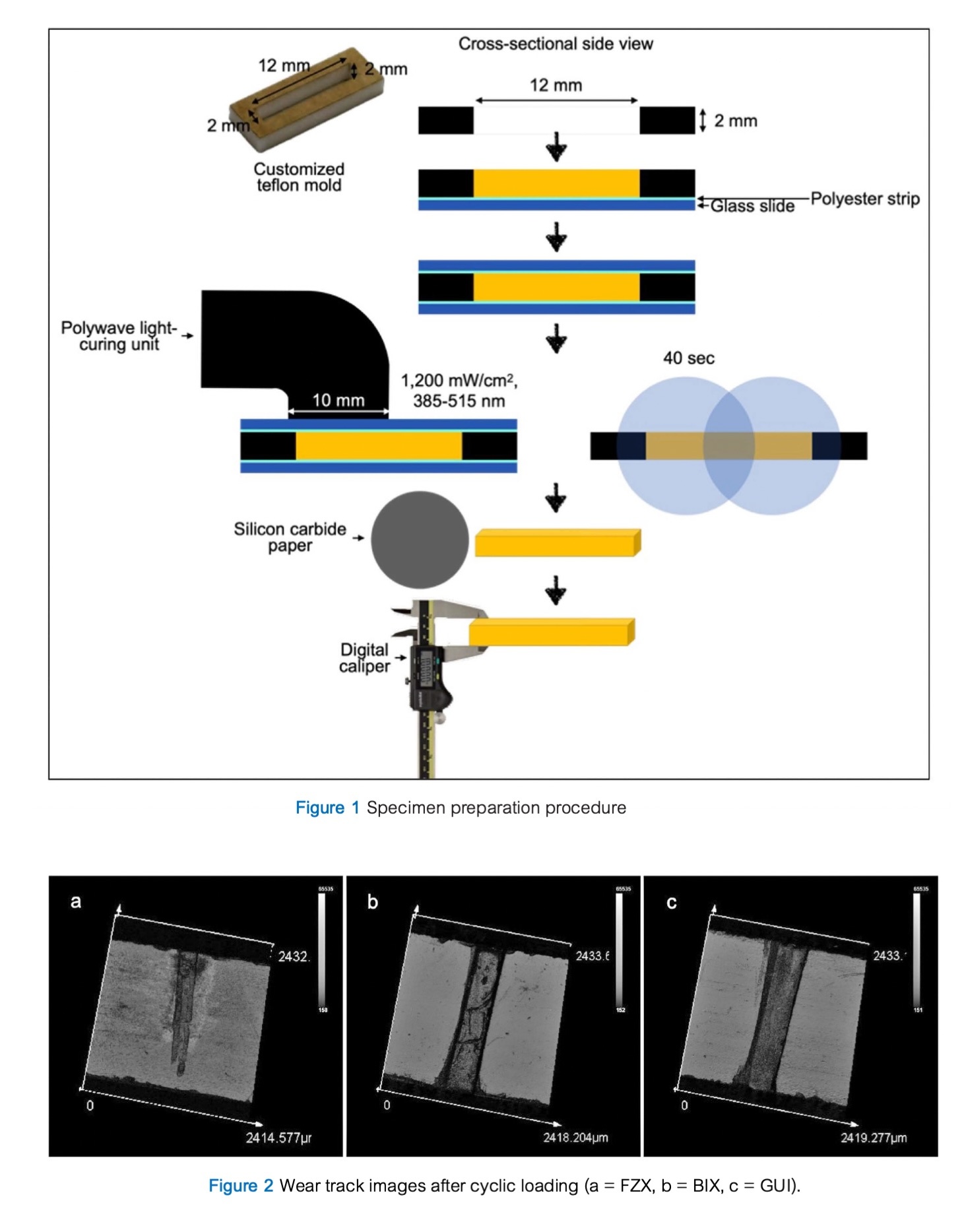
Materials and Methods: Three resin composites were evaluated: Filtek Z350XT (FZX), Beautifil Injectable X (BIX), and G-aenial Universal Injectable (GUI). Mini-flexural bar specimens (12 × 2 × 2 mm) were fabricated using Teflon molds and light-cured with a polywave LED unit. After 24 hours storage in a light-proof container, half of the specimens were tested directly, while the remaining half underwent cyclic loading (2.25 N, 60 Hz, 250,000 cycles) in distilled water. Flexural strength was determined using a three-point bending test with a 10-mm span at a crosshead speed of 0.5 mm/min. Wear resistance was assessed by wear volume loss measurement after cyclic loading.
Results: FZX showed the highest flexural strength under both non-cyclic and cyclic conditions (159.30 ± 5.66 MPa and 147.50 ± 9.12 MPa, respectively). The injectable composites demonstrated lower flexural strength values, with GUI showing slightly higher values than BIX. Cyclic loading reduced the flexural strength of all tested materials. For wear resistance, FZX exhibited the lowest wear volume loss (0.009±0.001 mm³), whereas BIX and GUI showed higher values (0.028 ± 0.008 mm³ and 0.033 ± 0.011 mm³, respectively), with no significant difference between the two injectable composites. The correlation analysis demonstrated a moderate negative relationship between wear volume loss and cyclic flexural strength (R²=0.487), indicating that materials with lower wear tended to exhibit higher flexural strength.
Conclusion: Cyclic loading reduced the flexural strength of all tested composites. The conventional composite, FZX, demonstrated superior flexural strength and wear resistance compared with the injectable composites. Higher cyclic flexural strength was associated with lower wear volume loss.
Article Details

This work is licensed under a Creative Commons Attribution-NonCommercial-NoDerivatives 4.0 International License.
References
Heintze SD, Loguercio AD, Hanzen TA, Reis A, Rousson V. Clinical efficacy of resin-based direct posterior restorations and glass-ionomer restorations – an updated meta-analysis of clinical outcome parameters. Dent Mater. 2022 May;38(5):e109-e35. doi: 10.1016/j.dental.2021.10.018.
Hilton TJ, Ferracane JL, Broome JC. Summitt’s fundamental operative dentistry: a contemporary approach. 4th ed. Hanover Park, IL: Quintessence Publishing, 2013.
Lapaschaone N, Maneenut C. Wear resistance and surface roughness of injectable resin composites after chewing simulation. J Dent Assoc Thai. 2024 Jan–Mar;74(1):34–44.
Anusavice KJ, Shen C, Rawls HR. Phillips' science of dental materials. 12th ed. St. Louis: Elsevier Saunders, 2012.
Tsujimoto A, Barkmeier WW, Fischer NG, Nojiri K, Nagura Y, Takamizawa T, et al. Wear of resin composites: current insights into underlying mechanisms, evaluation methods and influential factors. Jpn Dent Sci Rev. 2018 May;54(2):76-87. doi: 10.1016/j.jdsr.2017.11.002.
Francois P, Attal JP, Fasham T, Troizier-Cheyne M, Gouze H, Abdel-Gawad S, et al. Flexural properties, wear resistance, and microstructural analysis of highly filled flowable resin composites. Oper Dent. 2024 Sep;49(5):597-607. doi: 10.2341/24-033-L.
Suresh S. Fatigue of Materials. 2nd ed. Cambridge, UK:Cambridge University Press, 1998.
Kruzic JJ, Arsecularatne JA, Tanaka CB, Hoffman MJ, Cesar PF. Recent advances in understanding the fatigue and wear behavior of dental composites and ceramics. J Mech Behav Biomed Mater. 2018 Dec;88:504-533. doi: 10.1016/j.jmbbm.2018.08.008.
Drummond JL. Degradation, fatigue, and failure of resin dental composite materials. J Dent Res. 2008 Aug;87(8):710-719. doi: 10.1177/154405910808700802.
Yap AU, Eweis AH, Yahya NA. Dynamic and static flexural appraisal of resin-based composites: comparison of the ISO and mini-flexural tests. Oper Dent. 2018 Sep/Oct;43(5):e223–e231. doi: 10.2341/17-224-L.
Yap AU, Teoh SH. Comparison of flexural properties of composite restoratives using the ISO and mini-flexural tests. J Oral Rehabil. 2003 Feb;30(2):171–177. doi: 10.1046/j.1365-2842.2003.01004.x.
Calabrese L, Fabiano F, Bonaccorsi LM, Fabiano V, Borsellino C. Evaluation of the clinical impact of ISO 4049 in comparison with miniflexural test on mechanical performances of resin based composite. Int J Biomater. 2015;2015:149798. doi: 10.1155/2015/149798.
International Organization for Standardization. ISO 4049:2009. Dentistry—Polymer-based restorative materials. 4th ed. Geneva: International Organization for Standardization, 2009.
Curtis AR, Palin WM, Fleming GJ, Shortall AC, Marquis PM. The mechanical properties of nanofilled resin-based composites: the impact of dry and wet cyclic pre-loading on bi-axial flexure strength. Dent Mater. 2009 Feb;25:188-197. doi: 10.1016/j.dental.2008.06.003.
Rodríguez HA, Kriven WM, Casanova H. Development of mechanical properties in dental resin composite: effect of filler size and filler aggregation state. Mater Sci Eng C Mater Biol Appl. 2019 Aug;101:274-282. doi:10.1016/j.msec.2019.03.090.
Ferracane JL. Resin composite—state of the art. Dent Mater. 2011 Jan;27(1):29-38. doi: 10.1016/j.dental.2010.10.020.
Sideridou I, Tserki V, Papanastasiou G. Study of water sorption, solubility and modulus of elasticity of light-cured dimethacrylate-based dental resins. Biomaterials. 2003 Feb;24(4):655-665. doi: 10.1016/s0142-9612(02)00380-0.
Ferracane JL. Hygroscopic and hydrolytic effects in dental polymer networks. Dent Mater. 2006 Mar;22(3):211-222. doi: 10.1016/j.dental.2005.05.005.
Leprince JG, Palin WM, Vanacker J, Sabbagh J, Devaux J, Leloup G. Physico-mechanical characteristics of commercially available bulk-fill composites. J Dent. 2014 Aug;42(8):993-1000. doi: 10.1016/j.jdent.2014.05.009.
Ilie N, Hickel R. Investigations on a methacrylate-based flowable composite based on the SDR™ technology. Dent Mater. 2011 Apr;27(4):348-355. doi: 10.1016/j.dental.2010.11.014.
Zhang X, Zhang Q, Meng X, Ye Y, Feng D, Xue J, et al. Rheological and mechanical properties of resin-based materials applied in dental restorations. Polymers (Basel). 2021 Sep;13(17):2975. doi: 10.3390/polym13172975.
Imazato S, Nakatsuka T, Kitagawa H, Sasaki JI, Yamaguchi S, Ito S, et al. Multiple-ion releasing bioactive surface pre-reacted glass-ionomer (S-PRG) filler: innovative technology for dental treatment and care. J Funct Biomater. 2023 Apr;14(4):236. doi:10.3390/jfb14040236.
Shofu Dental Asia-Pacific Pte Ltd. BEAUTIFIL Injectable X [Internet]. Singapore: Shofu Dental Asia-Pacific; 2021 [cited 2026 May 18]. Available from: https://www.shofu.com.sg/wp-content/uploads/2021/06/ref-BInjectableX.pdf.
GC Corporation. G-ænial® Universal Injectable: technical manual. Version 1.0. 2018 [Internet]. [cited 2026 May 18]. Available from: https://www.gc.dental/india/sites/india.gc.dental/files/products/downloads/gaenialuniversalinjectable/technical%20manual/g-aenial-universal-injectable-technical-manual.pdf.
Sakaguchi RL, Douglas WH, DeLong R, Pintado MR. The wear of a posterior composite in an artificial mouth: a clinical correlation. Dent Mater. 1986 Dec;2(6):235-240. doi: 10.1016/s0109-5641(86)80034-3.
Tsujimoto A, Barkmeier WW, Erickson RL, Fischer NG, Markham MD, Takamizawa T, et al. Shear fatigue strength of resin composite bonded to dentin at physiological frequency. Eur J Oral Sci. 2018 Aug; 126(4):316-325. doi: 10.1111/eos.12537.
Lohbauer U, Belli R, Ferracane JL. Factors involved in mechanical fatigue degradation of dental resin composites. J Dent Res. 2013 Jul;92(7):584-591. doi: 10.1177/0022034513490734.
Curtis AR, Palin WM, Fleming GJ, Shortall AC, Marquis PM. The mechanical properties of nanofilled resin-based composites: characterizing discrete filler particles and agglomerates using a micromanipulation technique. Dent Mater. 2009 Feb;25(2):180-187. doi: 10.1016/j.dental.2008.05.013.
Lawson NC, Burgess JO. Wear of nanofilled dental composites at varying filler concentrations. J Biomed Mater Res B Appl Biomater. 2015 Feb;103(2):424-429. doi: 10.1002/jbm.b.33212.
Turssi CP, Ferracane JL, Vogel K. Filler features and their effects on wear and degree of conversion of particulate dental resin composites. Biomaterials. 2005 Aug;26(24):4932-4937. doi: 10.1016/j.biomaterials.2005.01.026.
