
Effects of toothbrushing on color stability, translucency, surface roughness, and wear of four composite resins for direct veneers
Article Sidebar
Main Article Content
Abstract
Objectives: This study assessed the impact of simulated long-term toothbrushing on the color stability, translucency, surface roughness, and wear of four composite resins used for direct veneers.
Materials and Methods: Rectangular specimens of four composites (Palfique Universal Flow, G-aenial Universal injectable, AELITEFLO, and Filtek Z350 XT) were prepared, finished, and polished. Each specimen underwent 20,000 brushing cycles under experimental conditions. Measurements for color change, translucency parameter, and surface roughness were taken before and after the brushing process. Additionally, surface loss depth and volume were evaluated. Data were analyzed using ANOVA and post hoc tests with a significance level set at α = 0.05.
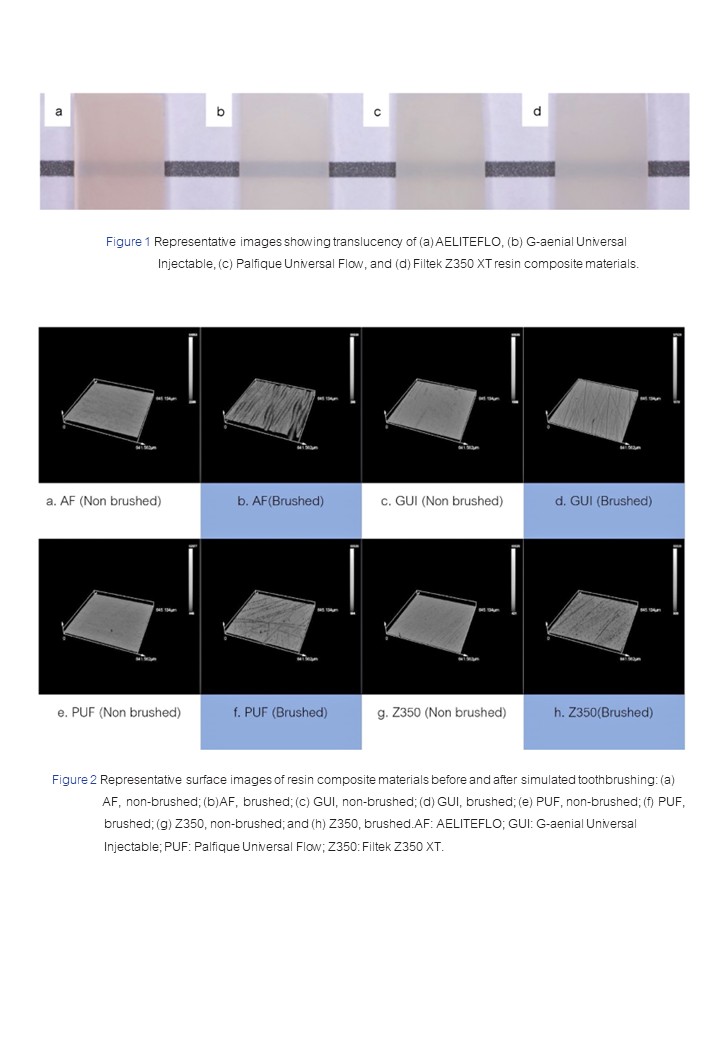
Results: Toothbrushing significantly increased surface roughness in all materials (p < 0.001), except Filtek Z350 XT (p = 0.280), with AELITEFLO showing the highest post-brushing value (0.2136 ± 0.0281 µm). Translucency decreased after brushing in all materials except G-aenial Universal Injectable, which showed no significant change (p = 0.812), with the greatest reduction observed in AELITEFLO (p < 0.001). Palfique Universal Flow showed the highest color change (4.2243 ± 0.3375), significantly higher than all other materials (p < 0.001), while G-aenial Universal Injectable and Filtek Z350 XT showed the lowest and comparable values (1.3121 ± 0.1248 and 1.3893 ± 0.3672, respectively). AELITEFLO demonstrated significantly greater depth loss (14.3936 ± 2.6607 µm) and volume loss (13,894,296.8 ± 2,606,997.24 µm³) than all other groups (p < 0.001).
Conclusion: Toothbrushing significantly degraded the surface and optical properties of the composites in a material-dependent manner. G-aenial Universal Injectable showed better optical stability and Filtek Z350 XT showed favorable wear resistance, emphasizing the need for material selection based on color stability and wear characteristics for direct veneers.
Article Details

This work is licensed under a Creative Commons Attribution-NonCommercial-NoDerivatives 4.0 International License.
References
Araujo E, Perdigão J. Anterior veneer restorations: an evidence-based minimal-intervention perspective. J Adhes Dent. 2021 Apr;23(2):91–110. doi: 10.3290/j.jad.b1079529.
Lim TW, Tan SK, Li KY, Burrow MF. Survival and complication rates of resin composite laminate veneers: a systematic review and meta-analysis. J Evid Based Dent Pract. 2023 Dec;23(4):101911. doi: 10.1016/j.jebdp.2023.101911.
Eltahlah D, Lynch CD, Chadwick BL, Blum IR, Wilson NHF. An update on the reasons for placement and replacement of direct restorations. J Dent. 2018 May;72:1–7. doi: 10.1016/j.jdent.2018.03.001.
Shimokawa C, Giannini M, André C, Sahadi B, Faraoni J, Palma-Dibb R, et al. In vitro evaluation of surface properties and wear resistance of conventional and bulk-fill resin-based composites after brushing with a dentifrice. Operative Dentistry. 2019 Nov/Dec;44(6):637–647. doi: 10.2341/18-200-L.
Sakae LO, Renzo ALM, Viana ÍEL, Niemeyer SH, Carvalho TS, Scaramucci T. Impact of different brushing/abrasion protocols on erosive tooth wear for in vitro studies. Arch Oral Biol. 2023 Apr;148:105657. doi: 10.1016/j.archoralbio.2023.105657.
Monteiro B, Spohr AM. Surface roughness of composite resins after simulated toothbrushing with different dentifrices. J Int Oral Health. 2015 Jul;7(7):1–5.
Francois P, Attal JP, Fasham T, Troizier-Cheyne M, Gouze H, Abdel-Gawad S, et al. Flexural properties, wear resistance, and microstructural analysis of highly filled flowable resin composites. Oper Dent. 2024 Sep;49(5):597–607. doi: 10.2341/24-033-L.
Baroudi K, Rodrigues JC. Flowable resin composites: A systematic review and clinical considerations. J Clin Diagn Res. 2015 Jun;9(6):Ze18–24. doi: 10.7860/jcdr/2015/12294.6129.
Aydın N, Karaoglanoglu S, Oktay EA. Investigation of the effects of whitening toothpastes on color change of resin-based CAD/CAM blocks. J Esthet Restor Dent. 2021 Sep;33(6):884–90. doi: 10.1111/jerd.12627.
Lapaschaone N, Maneenut C. Wear resistance and surface roughness of injectable resin composites after chewing simulation. J Dent Assoc Thai. 2024 Jan–Mar;74(1):34–44.
Forouzanfar A, Hasanpour P, Yazdandoust Y, Bagheri H, Mohammadipour HS. Evaluating the effect of active charcoal-containing toothpaste on color change, microhardness, and surface roughness of tooth enamel and resin composite restorative materials. Int J Dent. 2023 May;2023:6736623. doi: 10.1155/2023/6736623.
O'Neill C, Kreplak L, Rueggeberg FA, Labrie D, Shimokawa CAK, Price RB. Effect of tooth brushing on gloss retention and surface roughness of five bulk-fill resin composites. J Esthet Restor Dent. 2018 Jan;30(1):59–69. doi: 10.1111/jerd.12350.
Johnston WM, Ma T, Kienle BH. Translucency parameter of colorants for maxillofacial prostheses. Int J Prosthodont. 1995 Jan-Feb;8(1):79–86.
Luo M, Cui G, Rigg B. The development of the CIE 2000 colour-difference formula: CIEDE2000. Color Res Appl. 2001;26(5):340–350. doi: 10.1002/col.1049.
Paravina RD, Ghinea R, Herrera LJ, Bona AD, Igiel C, Linninger M, et al. Color difference thresholds in dentistry. J Esthet Restor Dent. 2015 Mar-Apr;27 Suppl 1:S1–9. doi: 10.1111/jerd.12149.
Salas M, Lucena C, Herrera LJ, Yebra A, Della Bona A, Pérez MM. Translucency thresholds for dental materials. Dent Mater. 2018 Aug;34(8):1168–1174. doi: 10.1016/j.dental.2018.05.001.
Tsujimoto A, Barkmeier WW, Fischer NG, Nojiri K, Nagura Y, Takamizawa T, et al. Wear of resin composites: current insights into underlying mechanisms, evaluation methods and influential factors. Jpn Dent Sci Rev. 2018 May;54(2):76–87. doi: 10.1016/j.jdsr.2017.11.002.
Elbishari H, Silikas N, Satterthwaite JD. Is deterioration of surface properties of resin composites affected by filler size? Int J Dent. 2020 Jan;2020:2875262. doi: 10.1155/2020/2875262.
Kobayashi M, Koi K, Wiskoski S, Watanabe H, Lewis S, Ferracane JL. Isolated effect of filler particle size on surface properties of experimental resin composites before and after toothbrush abrasion. J Esthet Restor Dent. 2023 Dec;35(8):1286–1292. doi: 10.1111/jerd.13105.
Yu P, Yang SM, Xu YX, Wang XY. Surface roughness and gloss alteration of polished resin composites with various filler types after simulated toothbrush abrasion. J Dent Sci. 2023 Jul;18(3):1016–1022. doi: 10.1016/j.jds.2022.12.004.
Bollen CM, Lambrechts P, Quirynen M. Comparison of surface roughness of oral hard materials to the threshold surface roughness for bacterial plaque retention: a review of the literature. Dent Mater. 1997 Jul;13(4):258–269. doi: 10.1016/s0109-5641(97)80038-3.
Keles ZH, Isik V, Sismanoglu S. Effect of simulated toothbrushing on surface roughness, color stability, and gloss of two single-shade composite resins. Materials (Basel). 2026 Apr;19(8):1523. doi: 10.3390/ma19081523.
Oivanen M, Keulemans F, Garoushi S, Vallittu PK, Lassila L. The effect of refractive index of fillers and polymer matrix on translucency and color matching of dental resin composite. Biomater Investig Dent. 2021 Apr;8(1):48–53. doi: 10.1080/26415275.2021.1906879.
Fidalgo-Pereira R, Carvalho Ó, Catarino SO, Henriques B, Torres O, Braem A, et al. Effect of inorganic fillers on the light transmission through traditional or flowable resin-matrix composites for restorative dentistry. Clin Oral Investig. 2023 Sep;27(9):5679–5693. doi: 10.1007/s00784-023-05189-7.
Lopez C, Nizami B, Robles A, Gummadi S, Lawson NC. Correlation between dental composite filler percentage and strength, modulus, shrinkage stress, translucency, depth of cure and radiopacity. Materials 2024 Aug;17(16) :3901. doi: 10.3390/ma17163901.
