
Fluoride release, rechargeability, and coating retention of surface pre-reacted glass ionomer coating on thermoplastic orthodontic retainers over a 35-day period
Article Sidebar
Main Article Content
Abstract
Purpose: This study aimed to evaluate the fluoride releasing and recharging abilities, along with the coating retention of Surface Pre-Reacted Glass-Ionomer (S-PRG) coating on thermoplastic retainer material.
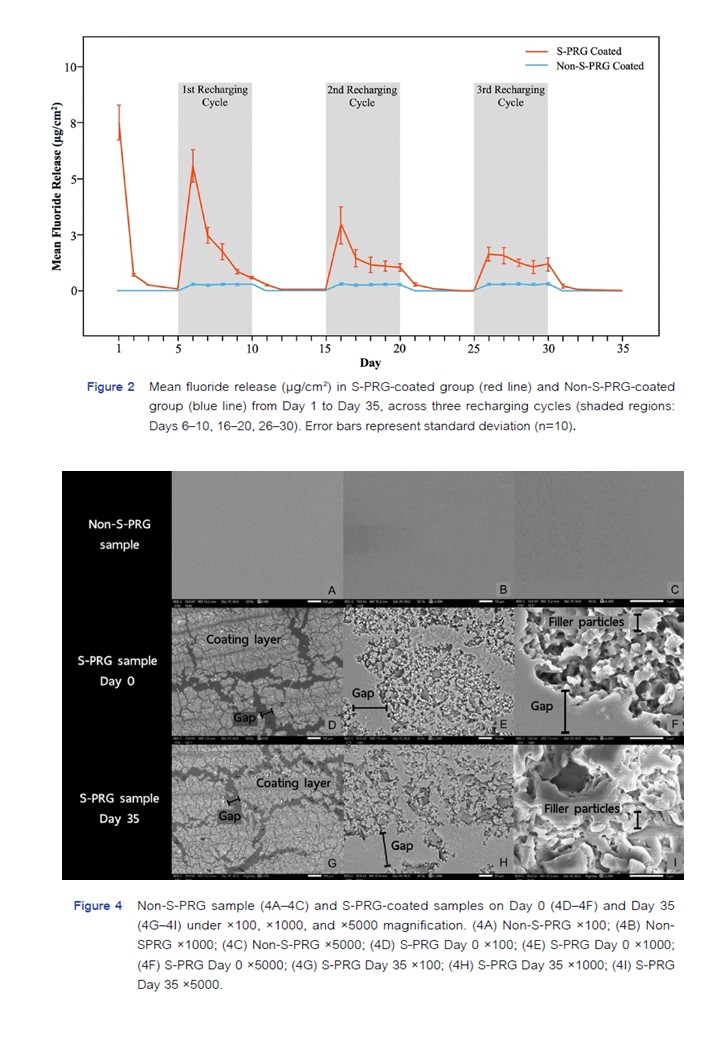
Materials and Methods: Samples were prepared by applying S-PRG paste (PRG Barrier, Shofu) onto orthodontic thermoplastic sheets (Essix A+, Dentsply). Fluoride release and recharge were alternately assessed in 10 coated and 10 non-coated samples over three cycles (each cycle consisted of a 5-day release followed by a 5-day recharge period). Adhesion testing was performed on Days 0 and 35, and surface characteristics were evaluated on Days 0 and 35. Statistical analyses were conducted at a significance level of p<.05.
Results: Fluoride release from S-PRG-coated samples was measured over multiple recharging cycles. On Day 1, fluoride release was highest (6.67 ± 1.73 μg/cm²), rapidly decreasing by Day 5. During the first recharging period (Days 6-10), fluoride release peaked at 4.25 ± 1.46 μg/cm² on Day 6, declining to 1.03 ± 0.39 μg/cm² by Day 10. Similar trends were observed in subsequent cycles, with peaks on Days 16 and 26, followed by steady declines. Fluoride levels dropped to low but detectable concentrations on Days 1 and 2 post-recharging (0.19–0.25 μg/cm² on Day 1; 0.07–0.09 μg/cm² on Day 2). Adhesion testing demonstrated no coating removal, indicating excellent coating retention. No changes were observed on the surface of coated samples before and after fluoride tests.
Conclusion: S-PRG paste demonstrates excellent coating retention on the thermoplastic retainer material, excellent short-term fluoride release and rechargeability, and sustained low-level fluoride release, suitable for extended use with periodic fluoride recharging over the 35-day experimental period.
Article Details

This work is licensed under a Creative Commons Attribution-NonCommercial-NoDerivatives 4.0 International License.
References
Choi YY. Relationship between orthodontic treatment and dental caries: results from a national survey. Int Dent J. 2020 Feb;70(1):38-44. doi: 10.1111/idj.12515.
Wishney M. Potential risks of orthodontic therapy: a critical review and conceptual framework. Aust Dent J. 2017 Mar;62 Suppl 1:86-96. doi: 10.1111/adj.12486.
Gorelick L, Geiger AM, Gwinnett AJ. Incidence of white spot formation after bonding and banding. Am J Orthod. 1982 Feb;81(2):93-98. doi: 10.1016/0002-9416(82)90032-x.
Mizrahi E. Enamel demineralization following orthodontic treatment. Am J Orthod. 1982 Jul;82(1):62-67. doi: 10.1016/0002-9416(82)90548-6.
Ogaard B. Prevalence of white spot lesions in 19-year-olds: a study on untreated and orthodontically treated persons 5 years after treatment. Am J Orthod Dentofacial Orthop. 1989 Nov;96(5):423-427. doi: 10.1016/0889-5406(89)90327-2.
Lovrov S, Hertrich K, Hirschfelder U. Enamel demineralization during fixed orthodontic treatment - incidence and correlation to various oral-hygiene parameters. J Orofac Orthop. 2007 Sep;68(5):353-363. doi: 10.1007/s00056-007-0714-1.
Takahashi N, Nyvad B. The role of bacteria in the caries process: ecological perspectives. J Dent Res. 2011 Mar;90(3):294-303. doi: 10.1177/0022034510379602.
Selwitz RH, Ismail AI, Pitts NB. Dental caries. Lancet. 2007 Jan;369(9555):51-59. doi: 10.1016/S0140-6736(07)60031-2.
Sun J, Yu YC, Liu MY, Chen L, Li HW, Zhang L, et al. Survival time comparison between Hawley and clear overlay retainers: a randomized trial. J Dent Res. 2011 Oct;90(10):1197-1201. doi: 10.1177/0022034511415274.
Alfadil L, Patel M, Pandis N, Fleming P. Assessment of wear characteristics, longevity and stiffness of Essix-type retainers. Clin Oral Investig. 2024 Mar;28(3):185. doi: 10.1007/s00784-024-05503-x.
Sandhya V, Arun AV, Mahendra S, Chandrashekar BS, Shetty B, Mahesh CM, et al. Retention protocols and use of vacuum-formed retainers among specialist orthodontists in India. J World Fed Orthod. 2019 Jun;8(2):64-67. doi: 10.1016/j.ejwf.2019.02.004.
Kiatwarawut K, Rokaya D, Sirisoontorn I. Antimicrobial activity of various disinfectants to clean thermoplastic polymeric appliances in orthodontics. Polymers (Basel). 2022 May;14(11):2256. doi: 10.3390/polym14112256.
Türköz C, Canigür Bavbek N, Kale Varlik S, Akça G. Influence of thermoplastic retainers on Streptococcus mutans and Lactobacillus adhesion. Am J Orthod Dentofacial Orthop. 2012 May;141(5):598-603. doi: 10.1016/j.ajodo.2011.11.021.
Birdsall J, Robinson S. A case of severe caries and demineralisation in a patient wearing an essix-type retainer. Prim Dent Care. 2008 Apr;15(2):59-61. doi: 10.1308/135576108784000203.
Yan D, Liu Y, Che X, Mi S, Jiao Y, Guo L, et al. Changes in the microbiome of the inner surface of clear aligners after different usage periods. Curr Microbiol. 2021 Feb;78(2):566-575. doi: 10.1007/s00284-020-02308-5.
Marsh PD. Microbial ecology of dental plaque and its significance in health and disease. Adv Dent Res. 1994 Jul;8(2):263-271. doi: 10.1177/08959374940080022001.
Gracco A, Mazzoli A, Favoni O, Conti C, Ferraris P, Tosi G, et al. Short-term chemical and physical changes in invisalign appliances. Aust Orthod J. 2009 May;25(1):34-40.
Papadopoulou AK, Cantele A, Polychronis G, Zinelis S, Eliades T. Changes in roughness and mechanical properties of invisalign(®) appliances after one- and two-weeks use. Materials (Basel). 2019 Jul;12(15):2406. doi: 10.3390/ma12152406.
ten Cate JM, Duijsters PP. Influence of fluoride in solution on tooth demineralization. II. microradiographic data. Caries Res. 1983;17(6):513-519. doi: 10.1159/000260711.
ten Cate JM. Fluorides in caries prevention and control: empiricism or science. Caries Res. 2004 May-Jun;38(3):254-257. doi: 10.1159/000077763.
ten Cate JM. Contemporary perspective on the use of fluoride products in caries prevention. Br Dent J. 2013 Feb;214(4):161-167. doi: 10.1038/sj.bdj.2013.162.
Featherstone JD. Dental caries: a dynamic disease process. Aust Dent J. 2008 Sep;53(3):286-291. doi: 10.1111/j.1834-7819.2008.00064.x.
Page DJ. A study of the effect of fluoride delivered from solution and dentifrices on enamel demineralization. Caries Res. 1991;25(4):251-255. doi: 10.1159/000261372.
Tokunaga Y, Nakano T, Kato K, Fukuta O. Fluoride release and recharge capabilities of orthodontic resin containing S-PRG filler. Japanese J Ped Dent. 2013;51(1):1-7. doi: 10.11411/jspd.51.1_1.
Kamijo K, Mukai Y, Tominaga T, Iwaya I, Fujino F, Hirata Y, et al. Fluoride release and recharge characteristics of denture base resins containing surface pre-reacted glass-ionomer filler. Dent Mater J. 2009 Mar;28(2):227-233. doi: 10.4012/dmj.28.227.
Amaechi BT, Key MC, Balu S, Okoye LO, Gakunga PT. Evaluation of the caries-preventive effect of toothpaste containing surface prereacted glass-ionomer filler. J Investig Clin Dent. 2017 Nov;8(4). doi: 10.1111/jicd.12249.
Kaga M, Kakuda S, Ida Y, Toshima H, Hashimoto M, Endo K, et al. Inhibition of enamel demineralization by buffering effect of S-PRG filler-containing dental sealant. Eur J Oral Sci. 2014 Feb;122(1):78-83. doi: 10.1111/eos.12107.
Ito S, Iijima M, Hashimoto M, Tsukamoto N, Mizoguchi I, Saito T. Effects of surface pre-reacted glass-ionomer fillers on mineral induction by phosphoprotein. J Dent. 2011;39(1):72-79. doi: 10.1016/j.jdent.2010.10.011.
Author. (2025). [Title removed].
Kaga N, Nagano-Takebe F, Nezu T, Matsuura T, Endo K, Kaga M. Protective effects of GIC and S-PRG filler restoratives on demineralization of bovine enamel in lactic acid solution. Materials (Basel). 2020 May;13(9):2140. doi: 10.3390/ma13092140.
Kiatsirirote K, Sitthisettapong T, Phantumvanit P, Chan DCN. Fluoride-releasing effect of a modified resin denture containing S-PRG fillers on salivary fluoride retention: a randomized clinical study. Caries Res. 2019;53(2):137-144. doi: 10.1159/000490627.
Ma S, Imazato S, Chen JH, Mayanagi G, Takahashi N, Ishimoto T, et al. Effects of a coating resin containing S-PRG filler to prevent demineralization of root surfaces. Dent Mater J. 2012;31(6):909-915. doi: 10.4012/dmj.2012-061.
Spinola MDS, Moecke SE, Rossi NR, Nakatsuka T, Borges AB, Torres CRG. Efficacy of S-PRG filler containing varnishes on enamel demineralization prevention. Sci Rep. 2020 Nov;10(1):18992. doi: 10.1038/s41598-020-76127-w.
Imazato S, Nakatsuka T, Kitagawa H, Sasaki J-I, Yamaguchi S, Ito S, et al. Multiple-ion releasing bioactive surface pre-reacted glass-ionomer (S-PRG) filler: innovative technology for dental treatment and care. J Funct Biomater. 2023 Apr;14(4):236. doi: 10.3390/jfb14040236.
Nicholson JW, Sidhu SK, Czarnecka B. Fluoride exchange by glass-ionomer dental cements and its clinical effects: a review. Biomater Investig Dent. 2023 Aug;10(1):2244982. doi: 10.1080/26415275.2023.2244982.
Mousavinasab SM, Meyers I. Fluoride release by glass ionomer cements, compomer and giomer. Dent Res J (Isfahan). 2009;6(2):75-81.
Ryu JH, Kwon JS, Jiang HB, Cha JY, Kim KM. Effects of thermoforming on the physical and mechanical properties of thermoplastic materials for transparent orthodontic aligners. Korean J Orthod. 2018 Sep;48(5):316-325. doi: 10.4041/kjod.2018.48.5.316.
Tamburrino F, D'Antò V, Bucci R, Alessandri-Bonetti G, Barone S, Razionale AV. Mechanical properties of thermoplastic polymers for aligner manufacturing: in vitro study. Dent J (Basel). 2020;8(2):47. doi: 10.3390/dj8020047.
Bradley T, Teske L, Eliades G, Zinelis S, Eliades T. Do the mechanical and chemical properties of invisalignTM appliances change after use? a retrieval analysis. Eur J Orthod. 2016 Feb;38(1):27-31. doi: 10.1093/ejo/cjv003.
Arabpour F, Aghili HA, Javaheri Mahd M, Arabpour Z, Yasaei S. Evaluation of aging effects on the physical, chemical, and mechanical properties of thermoplastic materials for orthodontic clear aligners: an in vivo study. BMC Oral Health. 2025 Oct;25(1):1557. doi: 10.1186/s12903-025-06966-4.
Dentsply Sirona. Essix A+ Plastic [Internet]. Charlotte (NC): Dentsply Sirona; 2024 [cited Jan 1, 2024]. Available from: https://www.dentsplysirona.com/en-us/shop/BP-110410/essix-a-plastic.html.
