
Effect of translucency and thickness of lithium disilicate ceramic on light transmission and composite cement polymerization
Article Sidebar
Main Article Content
Abstract
Objective: To evaluate the effect of translucency and thickness of lithium disilicate ceramic on the light irradiance (LI) and the degree of conversion (DC) of a dual-cure and a light-cure composite cement under two LED lightcuring units (LCUs).
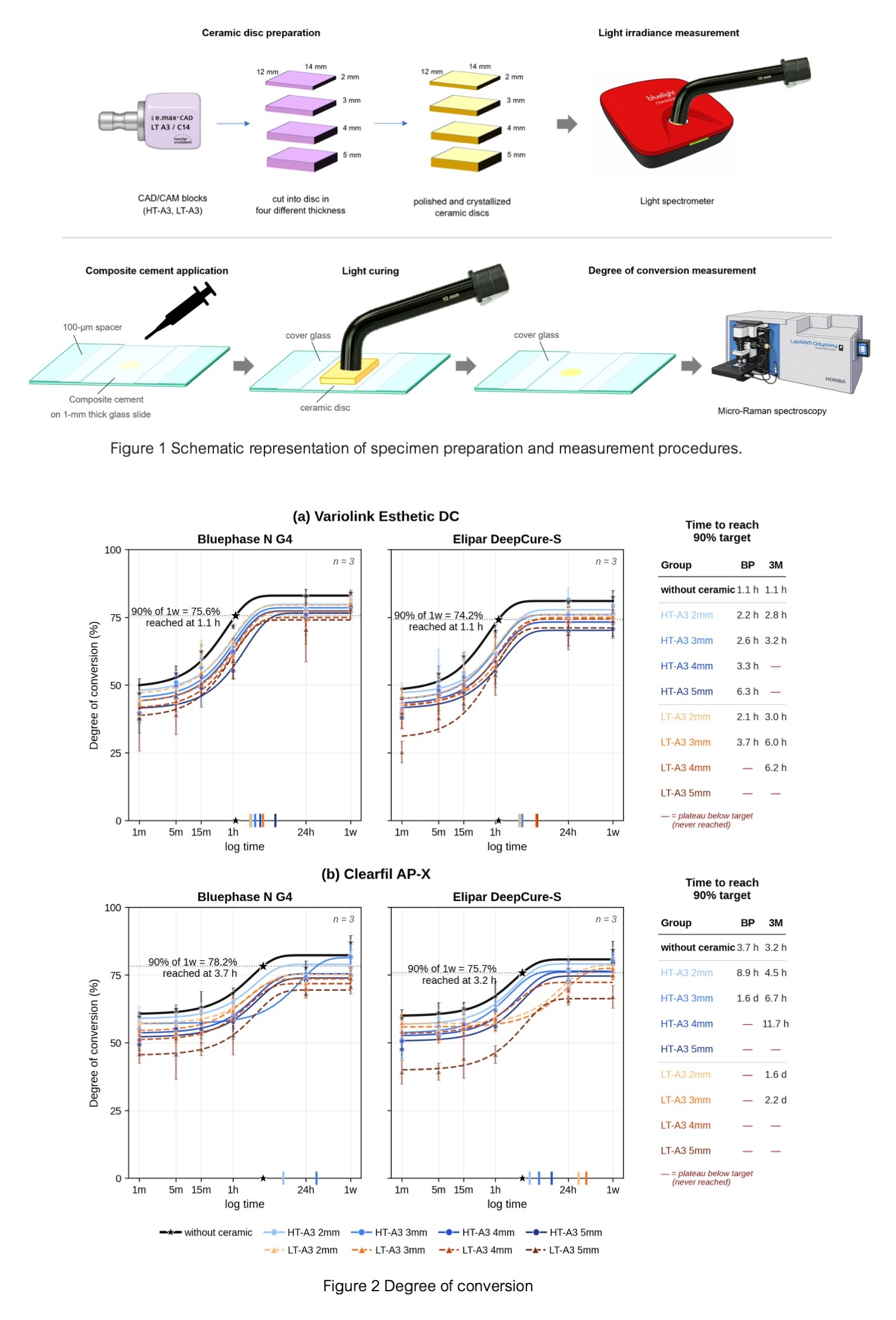
Materials and Methods: IPS e.max CAD discs were prepared in two translucencies (HT-A3, LT-A3) and four thicknesses (2, 3, 4, 5 mm), with no-ceramic controls. Two LED LCUs (Bluephase N G4, polywave; Elipar DeepCure-S, monowave) were used, both delivering ~1100 mW/cm² for 40 s. LI was measured with a light spectrometer (n = 2 per cell). DC of a dual-cure resin cement (Variolink Esthetic DC) and a light-cure restorative composite (Clearfil AP-X) was measured by micro-Raman spectroscopy at six time points (1 min, 5 min, 15 min, 1 h, 24 h, 1 week; n = 3 per cell). Non-parametric tests were used (α = 0.05).
Results: LI decreased with increasing ceramic thickness and lower translucency (Spearman’s ρ = −0.94 to −0.98, p ≤ 0.001) and fell below the detection limit at LT-A3 5 mm under both LCUs. DC increased over time, reaching a pooled mean of ~78% at one week; but the response depended on both cement chemistry and LCU spectrum. Variolink reached the 90% threshold in 6/8 ceramic groups under Bluephase N G4 and 5/8 under Elipar DeepCure-S, while Clearfil AP-X reached it in only 2/8 and 5/8, respectively. The worst-performing condition was Clearfil/LT-A3 5 mm (fitted plateau A = 66.27% under Elipar DeepCure-S).
Conclusion: Within the limitations of this in vitro study, lithium disilicate translucency and thickness markedly reduced LI and modulated DC in a cement- and LCU-dependent manner. Clinicians may consider a dual-cure cement combined with a polywave LCU when cementing thick or low-translucency lithium disilicate restorations.
Article Details

This work is licensed under a Creative Commons Attribution-NonCommercial-NoDerivatives 4.0 International License.
References
Phark JH, Duarte S, Jr. Microstructural considerations for novel lithium disilicate glass ceramics: a review. J Esthet Restor Dent. 2022 Jan;34(1):92-103. doi:10.1111/jerd.12864.
Hallmann L, Ulmer P, Kern M. Effect of microstructure on the mechanical properties of lithium disilicate glass-ceramics. J Mech Behav Biomed Mater. 2018 Jun;82:355-370. doi:10.1016/j.jmbbm.2018.02.032.
Lise DP, Van Ende A, De Munck J, Yoshihara K, Nagaoka N, Cardoso Vieira LC, et al. Light irradiance through novel cad-cam block materials and degree of conversion of composite cements. Dent Mater. 2018 Feb;34(2):296-305. doi:10.1016/j.dental.2017.11.008.
Fidalgo-Pereira R, Torres O, Carvalho O, Silva FS, Catarino SO, Ozcan M, et al. A scoping review on the polymerization of resin-matrix cements used in restorative dentistry. Materials (Basel). 2023 Feb;16(4):1560. doi:10.3390/ma16041560.
Politano G, Van Meerbeek B, Peumans M. Nonretentive bonded ceramic partial crowns: Concept and simplified protocol for long-lasting dental restorations. J Adhes Dent. 2018;20(6):495-510. doi:10.3290/j.jad.a41630.
Peumans M, Valjakova EB, De Munck J, Mishevska CB, Van Meerbeek B. Bonding effectiveness of luting composites to different CAD/CAM materials. J Adhes Dent. 2016;18(4):289-302. doi:10.3290/j.jad.a36155.
Watts DC. Light-curing dental resin-based composites: how it works and how you can make it work. Front Dent Med. 2023 Mar;4:1108316. doi:10.3389/fdmed.2023.1108316.
Fidalgo-Pereira R, Catarino SO, Carvalho O, Veiga N, Torres O, Braem A, et al. Light transmittance through resin-matrix composite onlays adhered to resin-matrix cements or flowable composites. J Mech Behav Biomed Mater. 2024 Mar;151:106353. doi:10.1016/j.jmbbm.2023.106353.
Inokoshi M, Pongprueksa P, De Munck J, Zhang F, Vanmeensel K, Minakuchi S, et al. Influence of light irradiation through zirconia on the degree of conversion of composite cements. J Adhes Dent. 2016;18(2):161-171. doi:10.3290/j.jad.a35842.
Egilmez F, Ergun G, Cekic-Nagas I, Vallittu PK, Lassila LV. Light transmission of novel CAD/CAM materials and their influence on the degree of conversion of a dual-curing resin cement. J Adhes Dent. 2017;19(1):39-48. doi:10.3290/j.jad.a37722.
Go YR, Kim KM, Park SH. Influence of inhomogeneity of the polymerization light beam on the microhardness of resin cement under a CAD-CAM block. J Prosthet Dent. 2022 May;127(5):802 e801-802 e810. doi:10.1016/j.prosdent.2022.02.004.
Hardy CMF, Bebelman S, Leloup G, Hadis MA, Palin WM, Leprince JG. Investigating the limits of resin-based luting composite photopolymerization through various thicknesses of indirect restorative materials. Dent Mater. 2018 Sep;34(9):1278-1288. doi:10.1016/j.dental.2018.05.009.
Harlow JE, Rueggeberg FA, Labrie D, Sullivan B, Price RB. Transmission of violet and blue light through conventional (layered) and bulk cured resin-based composites. J Dent. 2016 Oct;53:44-50. doi:10.1016/j.jdent.2016.06.007.
de Castro EF, Fronza BM, Soto-Montero J, Giannini M, Dos-Santos-Dias CT, Price RB. Effect of thickness of cad/cam materials on light transmission and resin cement polymerization using a blue light-emitting diode light-curing unit. J Esthet Restor Dent. 2023 Mar;35(2):368-380. doi:10.1111/jerd.12946.
Cadenaro M, Maravic T, Comba A, Mazzoni A, Fanfoni L, Hilton T, et al. The role of polymerization in adhesive dentistry. Dent Mater. 2019 Jan;35(1):e1-e22. doi:10.1016/j.dental.2018.11.012.
Pfeifer CS, Silva LR, Kawano Y, Braga RR. Bis-GMA co-polymerizations: Influence on conversion, flexural properties, fracture toughness and susceptibility to ethanol degradation of experimental composites. Dent Mater. 2009 Sep;25(9):1136-1141. doi:10.1016/j.dental.2009.03.010.
Mendonça LM, Ramalho IS, Lima LASN, Pires LA, Pegoraro TA, Pegoraro LF. Influence of the composition and shades of ceramics on light transmission and degree of conversion of dual-cured resin cements. J Appl Oral Sci. 2019 Jul;27:e20180351. doi:10.1590/1678-7757-2018-0351.
Leprince JG, Palin WM, Hadis MA, Devaux J, Leloup G. Progress in dimethacrylate-based dental composite technology and curing efficiency. Dent Mater. 2013 Feb;29(2):139-156. doi:10.1016/j.dental.2012.11.005.
Moszner N, Fischer UK, Ganster B, Liska R, Rheinberger V. Benzoyl germanium derivatives as novel visible light photoinitiators for dental materials. Dent Mater. 2008 Jul;24(7):901-907. doi:10.1016/j.dental.2007.11.004.
Halvorson RH, Erickson RL, Davidson CL. Energy dependent polymerization of resin-based composite. Dent Mater. 2002 Sep;18(6):463-469. doi:10.1016/s0109-5641(01)00069-0.
Calheiros FC, Daronch M, Rueggeberg FA, Braga RR. Degree of conversion and mechanical properties of a BisGMA:TEGDMA composite as a function of the applied radiant exposure. J Biomed Mater Res B Appl Biomater. 2008 Feb;84(2):503-509. doi:10.1002/jbm.b.30897.
Bouschlicher MR, Rueggeberg FA, Wilson BM. Correlation of bottom-to-top surface microhardness and conversion ratios for a variety of resin composite compositions. Oper Dent. 2004 Nov-Dec;29(6):698-704.
Miletic V, Pongprueksa P, De Munck J, Brooks NR, Van Meerbeek B. Curing characteristics of flowable and sculptable bulk-fill composites. Clin Oral Investig. 2017 May;21(4):1201-1212. doi:10.1007/s00784-016-1894-0.
