
Influence of model-less cementation on the accuracy of the implant-supported crown in a complete digital workflow
Article Sidebar
Main Article Content
Abstract
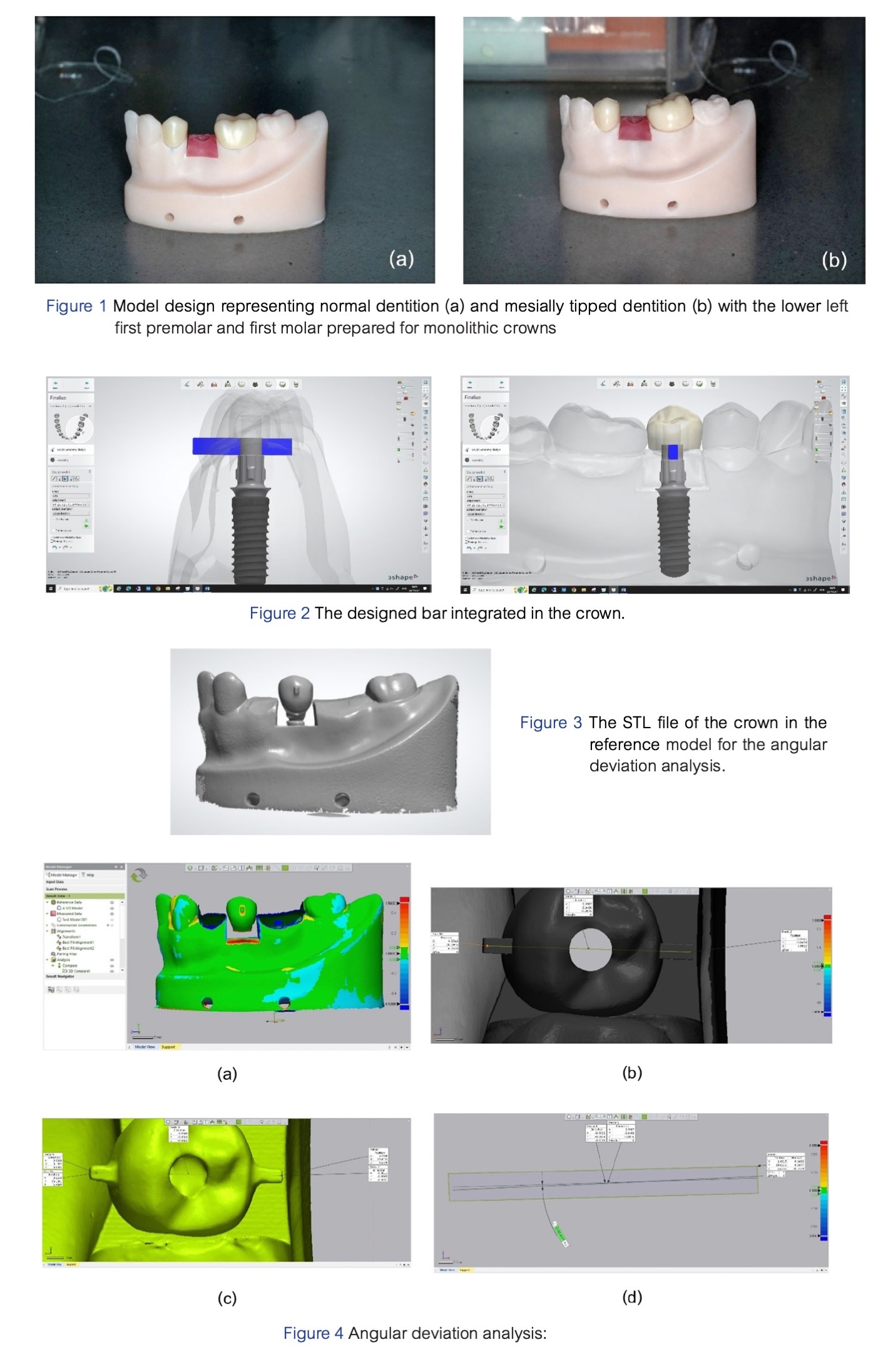
Objectives: This study compared the accuracy of single-unit implant crowns using a model-less digital workflow versus a complete digital workflow with a 3D printed model, with implants adjacent to normal dentition and mesially tipped adjacent teeth.
Materials and Methods: Two master models with a single implant at the lower left second premolar were scanned fifteen times using an intraoral scanner. Crowns were divided into two groups: fifteen crowns underwent modelless digital workflow (test) and fifteen crowns were adjusted with a 3D printed model (control). Interproximal adjustments, angular deviation, and adjustment time were measured and analyzed (p < 0.05).
Results: All crowns in the control group fit without further adjustment after being adjusted in the printed model. Median angular deviations were 2.67° (test) vs 1.53° (control) for normal dentition and 2.53° (test) vs 1.68° (control) for mesially tipped dentition. Mean adjustment times were 1.50 ± 0.54 min (test) vs 2.12 ± 0.59 min (control) for normal dentition, and 1.43 ± 0.42 min (test) vs 1.50 ± 0.54 min (control) for mesially tipped dentition. Maximum adjustment depths were comparable between groups. Light contacts were noted in the control group (1 for normal dentition, 7 for mesially tipped dentition). Statistically significant differences were observed only in angular deviation.
Conclusions: The model-less digital workflow had greater angular deviation compared to the 3D printed model workflow, but both techniques showed comparable adjustment time and amount.
Article Details

This work is licensed under a Creative Commons Attribution-NonCommercial-NoDerivatives 4.0 International License.
References
Alauddin MS, Baharuddin AS, Mohd Ghazali MI. The modern and digital transformation of oral health care: a mini review. Healthcare (Basel). 2021 Jan;9(2):118. doi:10.3390/healthcare9020118.
Joda T, Yeung AWK, Hung K, Zitzmann NU, Bornstein MM. Disruptive innovation in dentistry: what it is and what could be next. J Dent Res. 2021 May;100(5):448-453. doi:10.1177/0022034520978774.
van Noort R. The future of dental devices is digital. Dent Mater. 2012 Jan;28(1):3-12. doi:10.1016/j.dental.2011.10.014
Capparé P, Ferrini F, Ruscica C, Pantaleo G, Tetè G, Gherlone EF. Digital versus traditional workflow for immediate loading in single-implant restoration: a randomized clinical trial. Biology (Basel). 2021 Dec;10(12):1281. doi:10.3390/biology10121281.
Hanozin B, Li Manni L, Lecloux G, Bacevic M, Lambert F. Digital vs. conventional workflow for one-abutment one-time immediate restoration in the esthetic zone: a randomized controlled trial. Int J Implant Dent. 2022 Feb;8(1):7. doi:10.1186/s40729-022-00406-6.
Kunavisarut C, Jarangkul W, Pornprasertsuk-Damrongsri S, Joda T. Patient-reported outcome measures (PROMs) comparing digital and conventional workflows for treatment with posterior single-unit implant restorations: A randomized controlled trial. J Dent. 2022 Feb;117:103875. doi:10.1016/j.jdent.2021.103875.
Mangano F, Veronesi G. Digital versus analog procedures for the prosthetic restoration of single implants: a randomized controlled trial with 1 year of follow-up. Biomed Res Int. 2018 Jul;2018:5325032. doi:10.1155/2018/5325032.
Mühlemann S, Lamperti ST, Stucki L, Hämmerle CHF, Thoma DS. Time efficiency and efficacy of a centralized computer-aided-design/computer-aided-manufacturing workflow for implant crown fabrication: a prospective controlled clinical study. J Dent. 2022 Dec;127:104332. doi:10.1016/j.jdent.2022.104332.
Pan S, Guo D, Zhou Y, Jung RE, Hämmerle CHF, Mühlemann S. Time efficiency and quality of outcomes in a model-free digital workflow using digital impression immediately after implant placement: a double-blind self-controlled clinical trial. Clin Oral Implants Res. 2019 Jul;30(7):617-626. doi:10.1111/clr.13447
Ren S, Jiang X, Lin Y, Di P. Crown accuracy and time efficiency of cement-retained implant-supported restorations in a complete digital workflow: a randomized control trial. J Prosthodont. 2022 Jun;31(5):405-411. doi:10.1111/jopr.13447.
Zhang Y, Tian J, Wei D, Di P, Lin Y. Quantitative clinical adjustment analysis of posterior single implant crown in a chairside digital workflow: a randomized controlled trial. Clin Oral Implants Res. 2019 Nov;30(11):1059-1066. doi:10.1111/clr.13519.
Al-Thobity AM. Titanium base abutments in implant prosthodontics: a literature review. Eur J Dent. 2022 Feb;16(1):49-55. doi:10.1055/s-0041-1735423.
Parize H, Dias Corpa Tardelli J, Bohner L, Sesma N, Muglia VA, Cândido Dos Reis A. Digital versus conventional workflow for the fabrication of physical casts for fixed prosthodontics: a systematic review of accuracy. J Prosthet Dent. 2022 Jul;128(1):25-32. doi:10.1016/j.prosdent.2020.12.008.
Flügge T, van der Meer WJ, Gonzalez BG, Vach K, Wismeijer D, Wang P. The accuracy of different dental impression techniques for implant-supported dental prostheses: a systematic review and meta-analysis. Clin Oral Implants Res. 2018 Oct;29 Suppl 16:374-392. doi:10.1111/clr.13273.
Abdeen L, Chen YW, Kostagianni A, Finkelman M, Papathanasiou A, Chochlidakis K, et al. Prosthesis accuracy of fit on 3D-printed casts versus stone casts: a comparative study in the anterior maxilla. J Esthet Restor Dent. 2022 Dec;34(8):1238-1246. doi:10.1111/jerd.12954.
Alshawaf B, Weber HP, Finkelman M, El Rafie K, Kudara Y, Papaspyridakos P. Accuracy of printed casts generated from digital implant impressions versus stone casts from conventional implant impressions: a comparative in vitro study. Clin Oral Implants Res. 2018 Aug;29(8):835-842. doi:10.1111/clr.13297.
Mathey A, Brägger U, Joda T. Trueness and precision achieved with conventional and digital implant impressions: a comparative investigation of stone versus 3-D printed master casts. Eur J Prosthodont Restor Dent. 2021 Aug;29(3). doi:10.1922/EJPRD_2114Mathey08.
Papaspyridakos P, Chen YW, Alshawaf B, Kang K, Finkelman M, Chronopoulos V, et al. Digital workflow: in vitro accuracy of 3D printed casts generated from complete-arch digital implant scans. J Prosthet Dent. 2020 Nov;124(5):589-593. doi: 10.1016/j.prosdent.2019.10.029.
Revilla-León M, Gonzalez-Martín Ó, Pérez López J, Sánchez-Rubio JL, Özcan M. Position accuracy of implant analogs on 3D printed polymer versus conventional dental stone casts measured using a coordinate measuring machine. J Prosthodont. 2018 Jul;27(6):560-567. doi:10.1111/jopr.12708.
Tas H, Demirci F, Tuzlali M, Bahce E, Yildirim Avcu G. Evaluation of the accuracy of dental casts manufactured with 3D printing technique in the All-on-4 treatment concept. J Adv Prosthodont. 2022 Dec;14(6):379-387. doi:10.4047/jap.2022.14.6.379.
Tan S, Tan MY, Wong KM, Maria R, Tan KBC. Comparison of 3D positional accuracy of implant analogs in printed resin models versus conventional stone casts: effect of implant angulation. J Prosthodont. 2024 Jan;33(1):46-53. doi:10.1111/jopr.13647.
Alikhasi M, Siadat H, Nasirpour A, Hasanzade M. Three-dimensional accuracy of digital impression versus conventional method: effect of implant angulation and connection type. Int J Dent. 2018 Jun;2018:3761750. doi:10.1155/2018/3761750.
Chia VA, Esguerra RJ, Teoh KH, Teo JW, Wong KM, Tan KB. In vitro three-dimensional accuracy of digital implant impressions: the effect of implant angulation. Int J Oral Maxillofac Implants. 2017 Mar/Apr;32(2):313-321. doi:10.11607/jomi.5087.
Lin WS, Harris BT, Elathamna EN, Abdel-Azim T, Morton D. Effect of implant divergence on the accuracy of definitive casts created from traditional and digital implant-level impressions: an in vitro comparative study. Int J Oral Maxillofac Implants. 2015 Jan-Feb;30(1):102-109. doi:10.11607/jomi.3592.
Giménez B, Özcan M, Martínez-Rus F, Pradíes G. Accuracy of a digital impression system based on parallel confocal laser technology for implants with consideration of operator experience and implant angulation and depth. Int J Oral Maxillofac Implants. 2014 Jul-Aug;29(4):853-862. doi:10.11607/jomi.3343.
Tan MY, Yee SHX, Wong KM, Tan YH, Tan KBC. Comparison of three-dimensional accuracy of digital and conventional implant impressions: effect of interimplant distance in an edentulous arch. Int J Oral Maxillofac Implants. 2019 March/April;34(2):366–380. doi:10.11607/jomi.6855.
Ender A, Attin T, Mehl A. In vivo precision of conventional and digital methods of obtaining complete-arch dental impressions. J Prosthet Dent. 2016 Mar;115(3):313-320. doi:10.1016/j.prosdent.2015.09.011.
Ender A, Zimmermann M, Attin T, Mehl A. In vivo precision of conventional and digital methods for obtaining quadrant dental impressions. Clin Oral Investig. 2016 Sep;20(7):1495-1504. doi:10.1007/s00784-015-1641-y.
Joda T, Brägger U. Time-efficiency analysis of the treatment with monolithic implant crowns in a digital workflow: a randomized controlled trial. Clin Oral Implants Res. 2016 Nov;27(11):1401-1406. doi:10.1111/clr.12753.
Graf T, Güth JF, Diegritz C, Liebermann A, Schweiger J, Schubert O. Efficiency of occlusal and interproximal adjustments in CAD-CAM manufactured single implant crowns - cast-free vs 3D printed cast-based. J Adv Prosthodont. 2021 Dec;13(6):351-360. doi:10.4047/jap.2021.13.6.351.
Kim SY, Shin YS, Jung HD, Hwang CJ, Baik HS, Cha JY. Precision and trueness of dental models manufactured with different 3-dimensional printing techniques. Am J Orthod Dentofacial Orthop. 2018 Jan;153(1):144-153. doi:10.1016/j.ajodo.2017.05.025.
