
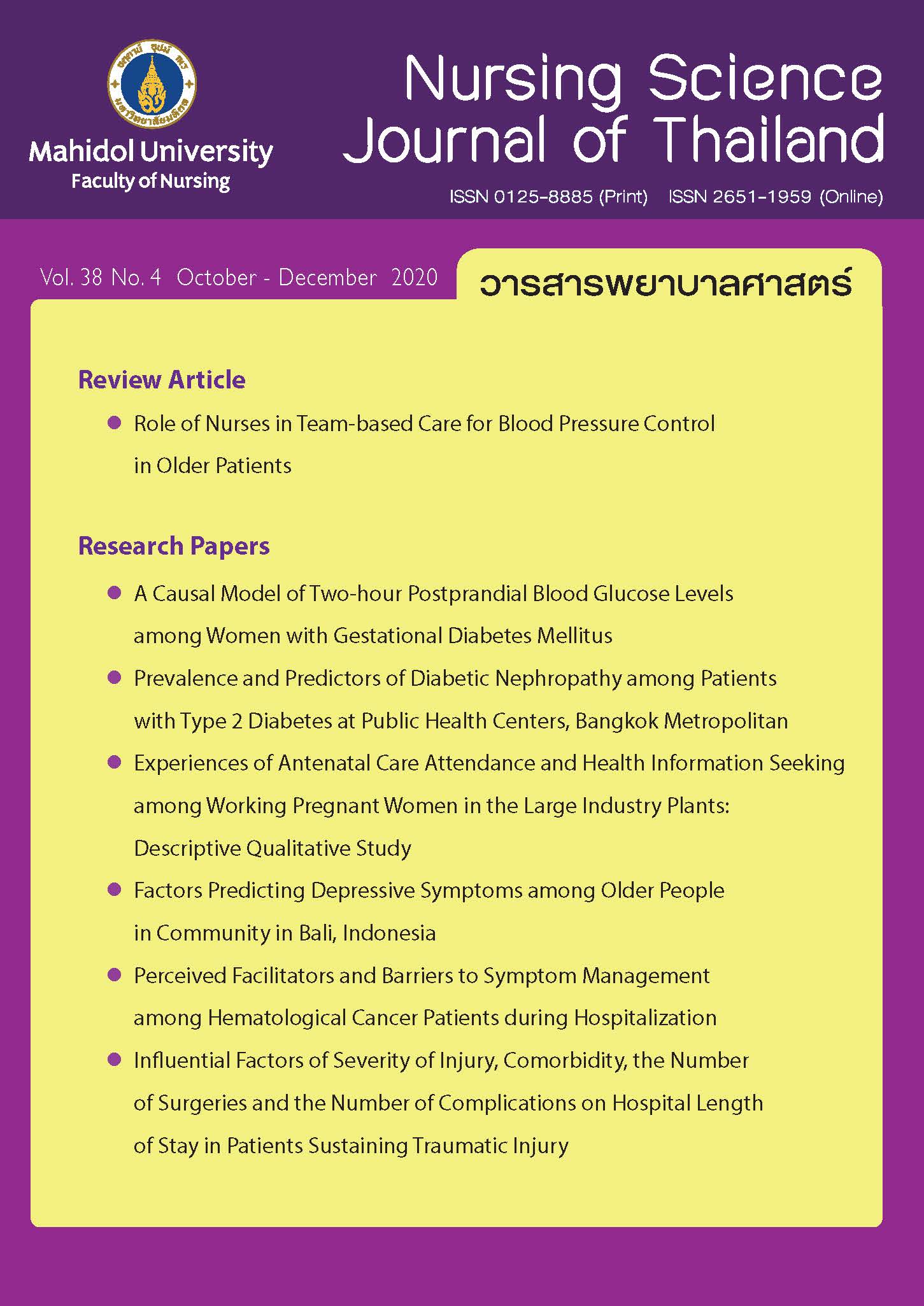
อิทธิพลของความรุนแรงของการบาดเจ็บ โรคร่วม จำนวนครั้งของการผ่าตัด จำนวนภาวะแทรกซ้อน ต่อจำนวนวันนอนโรงพยาบาล ในผู้บาดเจ็บจากอุบัติเหตุ
Article Sidebar
Main Article Content
บทคัดย่อ
วัตถุประสงค์: เพื่อศึกษาอิทธิพลของความรุนแรงของการบาดเจ็บ โรคร่วม จำนวนครั้งของการผ่าตัด จำนวนภาวะแทรกซ้อน ต่อจำนวนวันนอนโรงพยาบาล ในผู้บาดเจ็บจากอุบัติเหตุ
รูปแบการวิจัย: การศึกษาเชิงบรรยายแบบย้อนหลัง หาอำนาจทำนายแบบภาคตัดขวาง
วิธีดำเนินการวิจัย: กลุ่มตัวอย่างจำนวน 91 รายเป็นผู้บาดเจ็บจากอุบัติเหตุเข้ารับการรักษาในโรงพยาบาลตติยภูมิที่เลือก เก็บข้อมูลย้อนหลังจากการทบทวนแฟ้มประวัติ ระหว่างเดือนมกราคม 2558 ถึง เดือนธันวาคม 2561 กำหนดจำนวนตามสัดส่วนผู้ป่วยแต่ละปี ทำการสุ่มอย่างง่ายแบบชั้นภูมิในกลุ่มตัวอย่างที่เข้าเกณฑ์คัดเข้าตามจำนวน เครื่องมือใช้ในการวิจัย ประกอบด้วย แบบบันทึกข้อมูลส่วนบุคคลและแบบบันทึกปัจจัยที่เลือกศึกษา ได้แก่ แบบบันทึกความรุนแรงของการบาดเจ็บ แบบบันทึกโรคร่วม จำนวนครั้งของการผ่าตัด จำนวนภาวะแทรกซ้อน และจำนวนวันนอนโรงพยาบาล วิเคราะห์ข้อมูลด้วยสถิติเชิงบรรยายและการวิเคราะห์ถดถอยเชิงเส้น
ผลการวิจัย: ความรุนแรงของการบาดเจ็บ จำนวนครั้งของการผ่าตัด และจำนวนภาวะแทรกซ้อน มีอิทธิพลต่อจำนวนวันนอนในโรงพยาบาลของผู้บาดเจ็บจากอุบัติเหตุ โดยอธิบายความแปรปรวนได้ ร้อยละ 42.0 (R2 = .420, F = 8.662, p < .001) นั่นคือ หากความรุนแรงของการบาดเจ็บ จำนวนครั้งของการผ่าตัด และจำนวนภาวะแทรกซ้อนเพิ่มขึ้น จะทำให้จำนวนวันนอนในโรงพยาบาลเพิ่มขึ้น ในขณะที่โรคร่วมของผู้บาดเจ็บ ไม่มีอิทธิพลต่อจำนวนวันนอนในโรงพยาบาล
สรุปและข้อเสนอแนะ: ผลการวิจัยสรุปได้ว่า ผู้บาดเจ็บจากอุบัติเหตุที่มีความรุนแรงของการบาดเจ็บ จำนวนครั้งของการผ่าตัด และจำนวนภาวะแทรกซ้อนที่เพิ่มขึ้น จะพบจำนวนวันนอนโรงพยาบาลเพิ่มขึ้น พยาบาลอุบัติเหตุสามารถใช้หลักฐานเชิงประจักษ์จากการวิจัยนี้ไปพัฒนาแนวปฏิบัติในการดูแลผู้บาดเจ็บที่มีความรุนแรงของการบาดเจ็บมาก จำนวนการผ่าตัด 2 ครั้งขึ้นไป และมีภาวะแทรกซ้อนหลังผ่าตัดหลายชนิด เพื่อลดจำนวนวันนอนโรงพยาบาลและส่งเสริมการฟื้นหายอีกด้วย
Article Details
ลิขสิทธิ์: วารสารพยาบาลศาสตร์เป็นเจ้าของลิขสิทธิ์ในการเผยแพร่ผลงานที่ตีพิมพ์ ห้ามผู้ใดนำบทความที่ได้รับการตีพิมพ์ในวารสารพยาบาลศาสตร์ไปเผยแพร่ในลักษณะต่างๆ ดังต่อไปนี้ การส่งบทความไปตีพิมพ์เผยแพร่ที่อื่น การนำบทความเผยแพร่ออนไลน์ การถ่ายเอกสารบทความเพื่อกิจกรรมที่ไม่ใช่การเรียนการสอน ยกเว้นเสียแต่ได้รับอนุญาตจากวารสารพยาบาลศาสตร์

Disclaimer: เนื้อหาบทความหรือข้อคิดเห็นใดๆ ในวารสารพยาบาลศาสตร์ ถือเป็นความรับผิดชอบของผู้เขียน กองบรรณาธิการไม่จำเป็นต้องเห็นด้วยและไม่มีส่วนรับผิดชอบแต่อย่างใด
เอกสารอ้างอิง
Moore L, Stelfox HT, Turgeon AF, Nathens A, Bourgeois G, Lapointe J, et al. Hospital length of stay after admission for traumatic injury in Canada: a multicenter cohort study. Ann Surg. 2014;260(1):179-87. doi: 10.1097/SLA.0000000000000624.
Fernando DT, Berecki-Gisolf J, Newstead S, Ansari Z. Complications, burden and in-hospital death among hospital treated injury patients in Victoria, Australia: a data linkage study. BMC Public Health. 2019;19(1):798. doi: 10.1186/s12889-019-7080-y.
Kashkooe A, Yadollahi M, Pazhuheian F. What factors affect length of hospital stay among trauma patients? A single-center study, Southwestern Iran. Chin J Traumatol. 2020;23(3):176-80. doi: 10.1016/j.cjtee.2020.01.002.
Hwabejire JO, Kaafarani HMA, Imam AM, Solis CV, Verge J, Sullivan NM, et al. Excessively long hospital stays after trauma are not related to the severity of illness: let’s aim to the right target! JAMA Surg. 2013;148(10):956-61. doi: 10.1001/jamasurg.2013.2148.
Katsakun A, Thosingha O, Chayaput P, Chaotawee D. Factors predicting injury outcome in emergent phase among adults with traumatic injuries. Thai Journal of Nursing Council. 2011;26(4):30-42. (in Thai).
Kovindha A, Kammuang-lue P, Tongprasert S, Komaratat N, Mahachai R, Chotiyarnwong C, et al. A preliminary report on outcomes of inpatient rehabilitation services from tertiary care facilities in the Thai Spinal Cord Injury Registry (TSCIR) project. Journal of Thai Rehabilitation Medicine. 2017;27(3):101-7. doi: 10.14456/jtrm.2017.21.
Restrepo-Álvarez CA, Valderrama-Molina CO, Giraldo-Ramírez N, Constain-Franco A, Puerta A, León AL, et al. Trauma severity scores. Revista Colombiana de Anestesiología. 2016;44(4):317-23.
Javali RH, Krishnamoorthy, Patil A, Srinivasarangan M, Suraj, Sriharsha. Comparison of Injury Severity Score, New Injury Severity Score, Revised Trauma Score and Trauma and Injury Severity Score for Mortality Prediction in Elderly Trauma Patients. Indian J Crit Care Med. 2019;23(2):73-7. doi: 10.5005/jp-journals-10071-23120.
Pape H-C, Halvachizadeh S, Leenen L, Velmahos GD, Buckley R, Giannoudis PV. Timing of major fracture care in polytrauma patients - An update on principles, parameters and strategies for 2020. Injury. 2019;50(10):1656-70. doi: 10.1016/j.injury.2019.09.021.
Roy C, Bakan G, Li Z, Nguyen TH. Coping measurement: creating short form of coping and adaptation processing sale using item response theory and patients dealing with chronic and acute health conditions. Appl Nurs Res. 2016;32:73-9. doi: 10.1016/j.apnr.2016.06.002.
Junnaruemit K, Thosingha O, Chayaput P, Toskulkaw T. Correlation between adult patients’ emergency room discharge destination and the factors of physiological deterioration severity, age, and comorbidity. Thai Journal of Nursing Council. 2016;31(2):123-32. (in Thai).
Hsieh C-H, Chen Y-C, Hsu S-Y, Hsieh H-Y, Chien P-C. Defining polytrauma by abbreviated injury scale ≥ 3 for a least two body regions is insufficient in terms of short-term outcome: a cross-sectional study at a level I trauma center. Biomed J. 2018;41(5):321-7. doi: 10.1016/j.bj.2018.08.007.
Adler CR, Hopp A, Hrelic D, Patrie JT, Fox MG. Retrospective analysis of equestrian-related injuries presenting to a level 1 trauma center. Emerg Radiol. 2019;26(6):639-45. doi: 10.1007/s10140-019-01718-8.
Copanitsanou PP, Liaskos J, Tsarouchas TC. Predictive factors for in-hospital stay and complications after hip fracture. Int J Orthop Trauma Nurs. 2012;16(4):206-13. doi: 10.1016/j.ijotn.2011.12.005.
Lee SS, Hyun SY, Yang HJ, Lim YS, Cho JS, Woo JH. Comparison of penetrating and blunt traumatic diaphragmatic injuries. Journal of Trauma and Injury. 2019;32(4):210-9. doi: 10.20408/jti.2019.034.
Morris CFM, Tahir M, Arshid S, Castro MS, Fontes W. Reconciling the IPC and two-hit models: dissecting the underlying cellular and molecular mechanisms of two seemingly opposing frameworks. J Immunol Res. 2015;2015:697193. doi: 10.1155/2015/697193.
de Jongh MAC, Bosma E, Verhofstad MHJ, Leenen LPH. Prediction models for complications in trauma patients. Br J Surg. 2011;98(6):790-6. doi: 10.1002/bjs.7436.
Siritep U, Thosingha O, Chayaput P. Predictors of Multiple Organ Dysfunction Syndrome in Patients with Major Trauma. Siriraj Medical Journal. 2013;65(5):137-40.
Faul F, Erdfelder E, Buchner A, Lang A-G. Statistical power analyses using G*Power 3.1: tests for correlation and regression analyses. Behav Res Methods. 2009;41(4):1149-60. doi: 10.3758/BRM.41.4.1149.
Berben L, Sereika SM, Engberg S. Effect size estimation: methods and examples. Int J Nurs Stud. 2012;49(8):1039-47. doi: 10.1016/j.ijnurstu.2012.01.015.
Polit DF, Beck CT. Essentials of nursing research: appraising evidence for nursing practice. 9th ed. Philadelphia: Wolters Kluwer Health, 2018. 442 p.
Baker SP, O'Neill B, Haddon W, Jr., Long WB. The injury severity score: a method for describing patients with multiple injuries and evaluating emergency care. J Trauma. 1974;14(3):187-96.
