
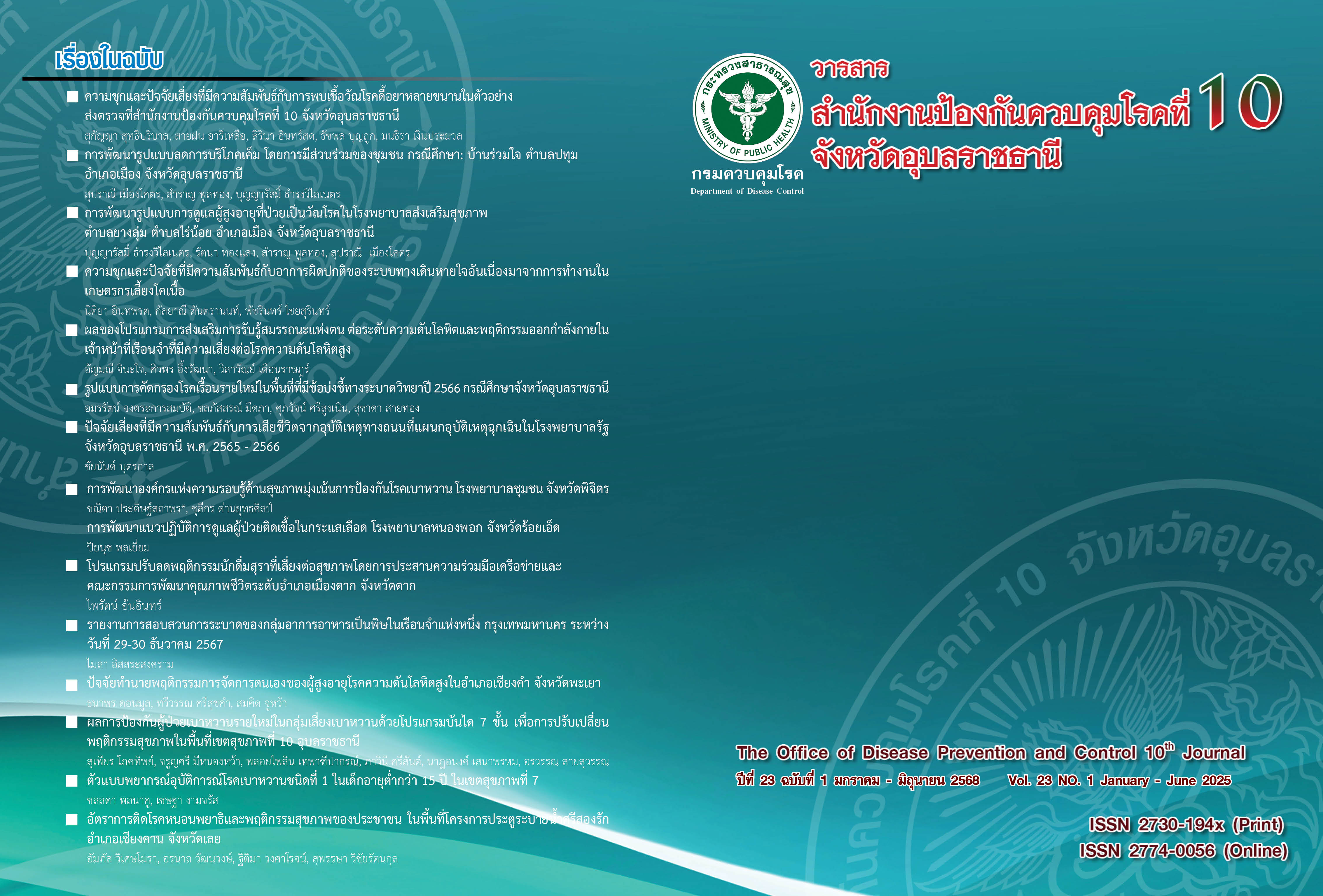
Prevalence and Risk Factors Associated with Multidrug-resistant Tuberculosis in Specimens at The Office of Disease Prevention and Control, Region 10 Ubon Ratchathani
Keywords:
Multidrug-resistant tuberculosis, Prevalence, Risk factorsAbstract
Multidrug-resistant tuberculosis (MDR-TB) remains a significant global public health concern due to its complexity in treatment and potential for transmission. Early identification of individuals at risk is crucial for timely diagnosis and effective control of the disease. Although several studies have reported various MDR-TB risk factors in different regions, no prior research has comprehensively assessed this issue within the jurisdiction of the Office of Disease Prevention and Control, Region 10, Ubon Ratchathani, Thailand. This cross-sectional analytical study aimed to examine the prevalence and risk factors associated with MDR-TB in specimens submitted for testing between fiscal years 2021 and 2023. A total of 8,168 samples positive for Mycobacterium tuberculosis were analyzed, of which 212 were confirmed as MDR-TB. Data were analyzed using descriptive statistics and inferential methods, including odds ratios (OR), 95% confidence intervals (CI), and Fisher’s exact test, with statistical significance set at p<0.05. The findings revealed that the prevalence of MDR-TB during 2021–2023 was 2.86%, 1.83%, and 2.99%, respectively, with an average prevalence of 2.60%. The most frequently observed pattern of first-line drug resistance was mono-resistant tuberculosis (Mono-resistant TB), particularly isoniazid-resistant tuberculosis (Hr-TB), which refers to Mycobacterium tuberculosis strains resistant to isoniazid alone. The annual prevalence rates of Hr-TB were 6.44%, 7.92%, and 7.97% for the fiscal years 2021, 2022, and 2023, respectively, with an average prevalence of 7.43%. and showing an increasing trend. Significant risk factors associated with MDR-TB included a history of previous TB treatment (p<0.001), contact with TB patients (p=0.013), diabetes mellitus (p=0.049), and smoking (p=0.046). Notably, individuals with a prior history of TB treatment had a 5.97 times greater risk of developing MDR-TB compared to those without such history (OR=5.970, 95% CI=4.504–7.916). These results highlight the urgent need to implement proactive surveillance measures targeting high-risk populations, including previously treated TB patients, close contacts of TB cases, individuals with diabetes, and smokers. The incorporation of molecular diagnostic method for rapid detection of resistance to isoniazid and rifampicin is recommended to enhance early identification and appropriate management of MDR-TB cases. These efforts align with the World Health Organization’s End TB Strategy, which emphasizes effective and sustainable TB control at both national and global levels.
References
กองวัณโรค กรมควบคุมโรค. แนวทางการควบคุมวัณโรคประเทศไทย พ.ศ. 2564. กรุงเทพฯ: สำนักพิมพ์อักษรกราฟฟิคแอนด์ดีไซน์; 2564.
สำนักวัณโรค กรมควบคุมโรค. แนวทางการบริหารจัดการผู้ป่วยวัณโรคดื้อยา. กรุงเทพฯ: โรงพิมพ์ชุมนุมสหกรณ์การเกษตรแห่งประเทศไทย; 2558.
World Health Organization. Global tuberculosis report 2023. Geneva: World Health Organization; 2023.
ชเลวัน ภิญโญโชติวงศ์. ความชุกและปัจจัยเสี่ยงต่อการเกิดวัณโรคดื้อยาหลายขนานในผู้ป่วยวัณโรคที่โรงพยาบาลเจริญกรุงประชารักษ์. วารสารโรงพยาบาลเจริญกรุงประชารักษ์ 2562; 14(2):1-10.
สุภาพร ทันตา, ธีรศักดิ์ พาจันทร์, สุทิน ชนะบุญ, กฤษณ์ ขุนลึก. ความชุกและปัจจัยที่มีความสัมพันธ์กับวัณโรคดื้อยาหลายขนานของผู้ป่วยวัณโรค เขตสุขภาพที่ 7. วารสารสำนักงานป้องกันควบคุมโรคที่ 7 ขอนแก่น 2567; 31(1):67-78.
อภิญญา นาคะพงษ์. ปัจจัยเสี่ยงต่อการเกิดวัณโรคดื้อยาหลายขนานในผู้ป่วยวัณโรคในโรงพยาบาลพระนครศรีอยุธยา ปี พ.ศ. 2561-2563. วารสารสมาคมเวชศาสตร์ป้องกันแห่งประเทศไทย 2564; 11(2):279-89.
Sinha P, Srivastava GN, Gupta A, Anupurba S. Association of Risk Factors and Drug Resistance Pattern in Tuberculosis Patients in North India. Journal of Global Infectious Diseases 2017; 9(4):139-45. doi:10.4103/jgid.jgid_167_16
Elmi OS, Hasan H, Abdullah S, Mat Jeab MZ, Bin Alwi Z, Naing NN. Multidrug-resistant tuberculosis and risk factors associated with its development: a retrospective study. The Journal of Infection in Developing Countries. 2015; 9(10):1076-85. doi:10.3855/jidc.6162
อติภา กมลวัทน์, นาตยา พันธุ์รอด. วัณโรคดื้อยาหลายขนานและผลการรักษาด้วยระบบยาระยะสั้นในโรงพยาบาลมหาราชนครราชสีมา ปี พ.ศ. 2550. วารสารควบคุมโรค 2551; 34(2):204-14.
สุชาติ ทองแป้น. ปัจจัยที่มีความสัมพันธ์ที่ก่อให้เกิดวัณโรคดื้อยาหลายขนานในผู้ป่วยที่ติดเชื้อวัณโรคปอด. วารสารกรมการแพทย์ 2561; 43(6):50-6.
สุชญา รักษ์ศรี, พิมาน ธีระรัตนสุนทร, จุฑารัตน์ สถิรปัญญา, สุภา เพ่งพิศ. สถานการณ์วัณโรคดื้อยาในผู้ป่วยวัณโรคที่โรงพยาบาลหาดใหญ่ จังหวัดสงขลา. วารสารสาธารณสุขและวิทยาศาสตร์สุขภาพ 2566; 6(1):1-12.
สมบัติ แทนประเสริฐสุข, จิตรลดา อุทัยพิบูลย์, ก่อพงษ์ ทศพรพงศ์, จันทิรา สุขะสิฐษ์วณิชกุล, วัลภา จุลเวช. ระบาดวิทยาเชิงพรรณนาวัณโรคดื้อยาหลายขนาน โรงพยาบาลมะการักษ์ ปี 2550-2558. วารสารควบคุมโรค 2560; 43(4):400-12.
ทรงยศ ชญานินปรเมศ. สถานการณ์วัณโรคดื้อยาในอำเภอเกาะสมุย จังหวัดสุราษฎร์ธานี พ.ศ. 2555-2557. วารสารควบคุมโรค 2558; 41(4):341-51.
Tenzin C, Chansatitporn N, Dendup T, Dorji T, Lhazeen K, Tshering D, et al. Factors associated with multidrug-resistant tuberculosis (MDR-TB) in Bhutan: A nationwide case-control study. Plos One 2020; 15(7): e0236250.
ณัฐพงศ์ ศรีธรรัตน์กุล, ธาตรี โบสิทธิพิเชฏฐ์, ธนกมล ลีศรี. ปัจจัยที่มีความสัมพันธ์กับการป่วยเป็นวัณโรคปอด ในกลุ่มผู้ป่วยเบาหวานชนิดที่ 2. วารสารศูนย์อนามัยที่ 9 2566; 17(2):604-17.
ธนกร โพธิ์วงศ์, ภิญญดา สมศรี, บัณฑิตา เนื่องคำ, วราพร ยิ้มแย้ม, ปัทมา กล่อมพร, สมศักดิ์ สินธุอุไร. รูปแบบการดื้อต่อยารักษาแนวที่หนึ่งของเชื้อวัณโรคในปอดด้วยวิธีการทดสอบความไวต่อยาในตัวอย่างเสมหะของผู้ป่วยวัณโรคปอดรายใหม่ในเขตสุขภาพที่ 2. วารสารวิทยาศาสตร์และเทคโนโลยีนอร์ทเทิร์น 2566;4(2):86-101.
Downloads
Published
How to Cite
Issue
Section
License
Copyright (c) 2025 The Office of Disease Prevention and Control 10th

This work is licensed under a Creative Commons Attribution-NonCommercial-NoDerivatives 4.0 International License.
บทความที่ได้รับการตีพิมพ์เป็นลิขสิทธิ์ของ สำนักงานป้องกันควบคุมโรคที่ 10 จังหวัดอุบลราชธานี
ข้อความที่ปรากฏในบทความแต่ละเรื่องในวารสารวิชาการเล่มนี้เป็นความคิดเห็นส่วนตัวของผู้เขียนแต่ละท่านไม่เกี่ยวข้องกับสำนักงานป้องกันควบคุมโรคที่ 10 จังหวัดอุบลราชธานีและบุคลากรท่านอื่นๆในสำนักงานฯ แต่อย่างใด ความรับผิดชอบองค์ประกอบทั้งหมดของบทความแต่ละเรื่องเป็นของผู้เขียนแต่ละท่าน หากมีความผิดพลาดใดๆ ผู้เขียนแต่ละท่านจะรับผิดชอบบทความของตนเองแต่ผู้เดียว


