
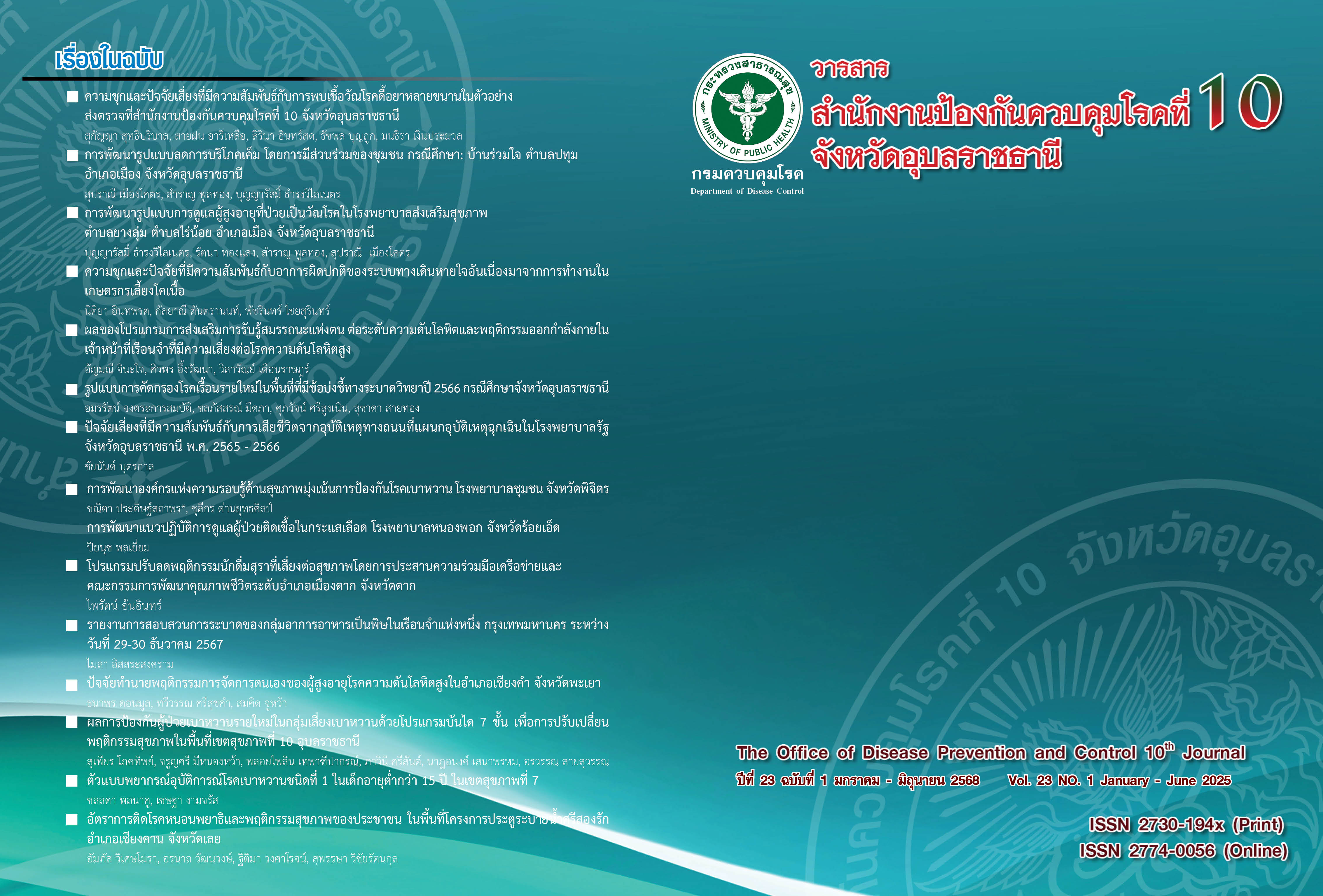
Screening Model for New Leprosy Cases in Areas with Epidemiological Indications in 2023: A Case Study of Ubon Ratchathani Province
Keywords:
Leprosy screening, Leprosy, Village Health Volunteers, Task ModelAbstract
This action study aimed to develop a leprosy screening model in the areas with specific epidemiological indicators. Two target groups were the stakeholders in model development consist of 20 people who responsible for leprosy control in Samrong District, and the participant who launched the model implementation consist of 46 Public Health volunteers (PHVs) and 3 officers from three districts of Kud Khaopun, Pho Sai, and Samrong, Ubon Ratchathani Province. The development process utilized questionnaires, interviews, group discussions, quantitative data analysis with a Pair T-Test, and qualitative data analysis through content analysis. The study took place from July 2023 to November 2024.
The research findings revealed that 80.4 percent of public health volunteers were female, and 52 percent had been involved in leprosy care for less than five years. Several issues was found PHVs lacked of knowledge, skills, and confidence for Leprosy screening, the media for educate PHVs was inappropriately, screening procedures was unclear, and data collection system was missing. The resulting form is the Task Model, which consists of Training, adopt an innovation, Skills, and Knowledge providing. This model was focuses on training and an adopt innovation of video clips of Leprosy knowledge which was a tool for providing knowledge and skills of Leprosy screening for PHVs, implementation of leprosy screening activities, evaluation and continuous monitoring. The Task Model was improvement in the knowledge of leprosy among public health volunteers significantly (P < 0.01), the average knowledge score before and after implementation was 3.59 (S.D. = 0.77) and 4.28 (S.D. = 0.72) respectively. The PHVs was screened 213 people in the community, discovering 7 individuals with skin lesions, 3 of whom met the criteria for suspected leprosy. They then scheduled appointments for further monitoring under DDC guidelines. Moreover, the PHVs reported greater confidence in their screening abilities. This showcases the effectiveness of the Task Model in enhancing the leprosy screening within the community by improving the knowledge and skills of PHVs and its also boosting their confidence. This approach has the potential to be adapted for use in other communities with similar epidemiological profiles to improve the efficiency of leprosy screening at the local level.
References
Peter S, Hailu T, Kaba M. Burden of neglected tropical diseases and progress towards their elimination in Ethiopia. Infect Dis Poverty 2017; 6(1):156.
ศิลธรรม เสริมฤทธิรงค์. การดำเนินการเฝ้าระวังโรคเรื้อนในประเทศไทย. วารสารการแพทย์แผนไทยและการแพทย์ทางเลือก 2561; 14(3):200-10.
World Health Organization. Global leprosy (Hansen disease) update, 2021: moving towards zero leprosy disease complications. Geneva: WHO; 2021.
สถาบันราชประชาสมาสัย. รายงานประจำปีสถานการณ์โรคเรื้อนในประเทศไทย พ.ศ. 2565. กรุงเทพฯ: สถาบันราชประชาสมาสัย; 2566.
สถาบันราชประชาสมาสัย. รายงานผู้ป่วยโรคเรื้อนจำแนกตามที่อยู่ของผู้ป่วย จำแนกรายจังหวัดและอำเภอ ปี พ.ศ. 2566. กรุงเทพฯ: สถาบันราชประชาสมาสัย; 2566.
สถาบันราชประชาสมาสัย. คู่มือการวินิจฉัยและรักษาโรคเรื้อน ปี พ.ศ. 2553. กรุงเทพฯ: สถาบันราชประชาสมาสัย; 2566.
สถาบันราชประชาสมาสัย. แผนยุทธศาสตร์การกำจัดโรคเรื้อนระยะ 5 ปี (พ.ศ. 2566–2570) [อินเตอร์เน็ต]. 2566 [เข้าถึงเมื่อ 24 มี.ค. 2568]. เข้าถึงได้จาก: http://rajpracha.ddc.moph.go.th/site/strategic.html
สำนักงานสภานโยบายการอุดมศึกษา วิทยาศาสตร์ วิจัยและนวัตกรรมแห่งชาติ. กระบวนการคิดเชิงออกแบบ (Design Thinking) [อินเตอร์เน็ต]. 2562 [เข้าถึงเมื่อ 24 มี.ค. 2568]. เข้าถึงได้จาก: https://www.nxpo.or.th/th/wp-content/uploads/2019/01/4
สุพัตรา สิมมาทัน, นิชนันท์ โยธา, นิภาพร ฮามพิทักษ์, สมัย ทองพูล, อิทธิเดช ไชยชนะ. รูปแบบการค้นหาผู้ป่วยโรคเรื้อนจากการตรวจผู้สัมผัสโรคร่วมบ้าน ภายใต้สภาวะความชุกต่ำในพื้นที่อำเภอนาดูน จังหวัดมหาสารคาม. วารสารสำนักงานป้องกันควบคุมโรคที่ 7 ขอนแก่น 2564; 28(3):55–69.
Jennifer ML, Ravinder K, Arun S. Community-based approaches to detect hidden leprosy cases: experiences from India. Leprosy Rev. 2017; 88(2):218–29.
ธนิษฐา ดิษสุวรรณ, ณิษา ไปรยายุตากุล, ปรียานุช กลิ่นศรีสุข. การศึกษารูปแบบการค้นหาผู้ป่วยโรคเรื้อนรายใหม่ในพื้นที่ภาคใต้ตอนล่าง. วารสารวิทยาศาสตร์สุขภาพ 2564; 29(1):45–57.
Stringer ET. Action research. 4th edition. Sage Publications; 2014.
สมชาย พัฒนกุล. การพัฒนาแนวทางการค้นหาผู้ป่วยโรคเรื้อนรายใหม่สำหรับอาสาสมัครสาธารณสุขประจำหมู่บ้าน: กรณีศึกษาบ้านโสก ตำบลบ้านโสก อำเภอคอนสวรรค์ จังหวัดชัยภูมิ. ชัยภูมิ: มหาวิทยาลัยราชภัฏชัยภูมิ; 2565.
ณัฐพงศ์ พัฒนกิจ, ราตรี เอี่ยมประดิษฐ์, กาญจนา ส่งสวัสดิ์, กนกพร ยิ้มนิล. การพัฒนาสื่อโมชันกราฟิกเพื่อป้องกันโรคผิวหนังสำหรับสามเณรในโรงเรียนพระปริยัติธรรม จังหวัดเชียงใหม่. วารสารวิจัยสุขภาพและการพัฒนาชุมชน 2565; 10(2):123-35.
Downloads
Published
How to Cite
Issue
Section
License
Copyright (c) 2025 The Office of Disease Prevention and Control 10th

This work is licensed under a Creative Commons Attribution-NonCommercial-NoDerivatives 4.0 International License.
บทความที่ได้รับการตีพิมพ์เป็นลิขสิทธิ์ของ สำนักงานป้องกันควบคุมโรคที่ 10 จังหวัดอุบลราชธานี
ข้อความที่ปรากฏในบทความแต่ละเรื่องในวารสารวิชาการเล่มนี้เป็นความคิดเห็นส่วนตัวของผู้เขียนแต่ละท่านไม่เกี่ยวข้องกับสำนักงานป้องกันควบคุมโรคที่ 10 จังหวัดอุบลราชธานีและบุคลากรท่านอื่นๆในสำนักงานฯ แต่อย่างใด ความรับผิดชอบองค์ประกอบทั้งหมดของบทความแต่ละเรื่องเป็นของผู้เขียนแต่ละท่าน หากมีความผิดพลาดใดๆ ผู้เขียนแต่ละท่านจะรับผิดชอบบทความของตนเองแต่ผู้เดียว


