
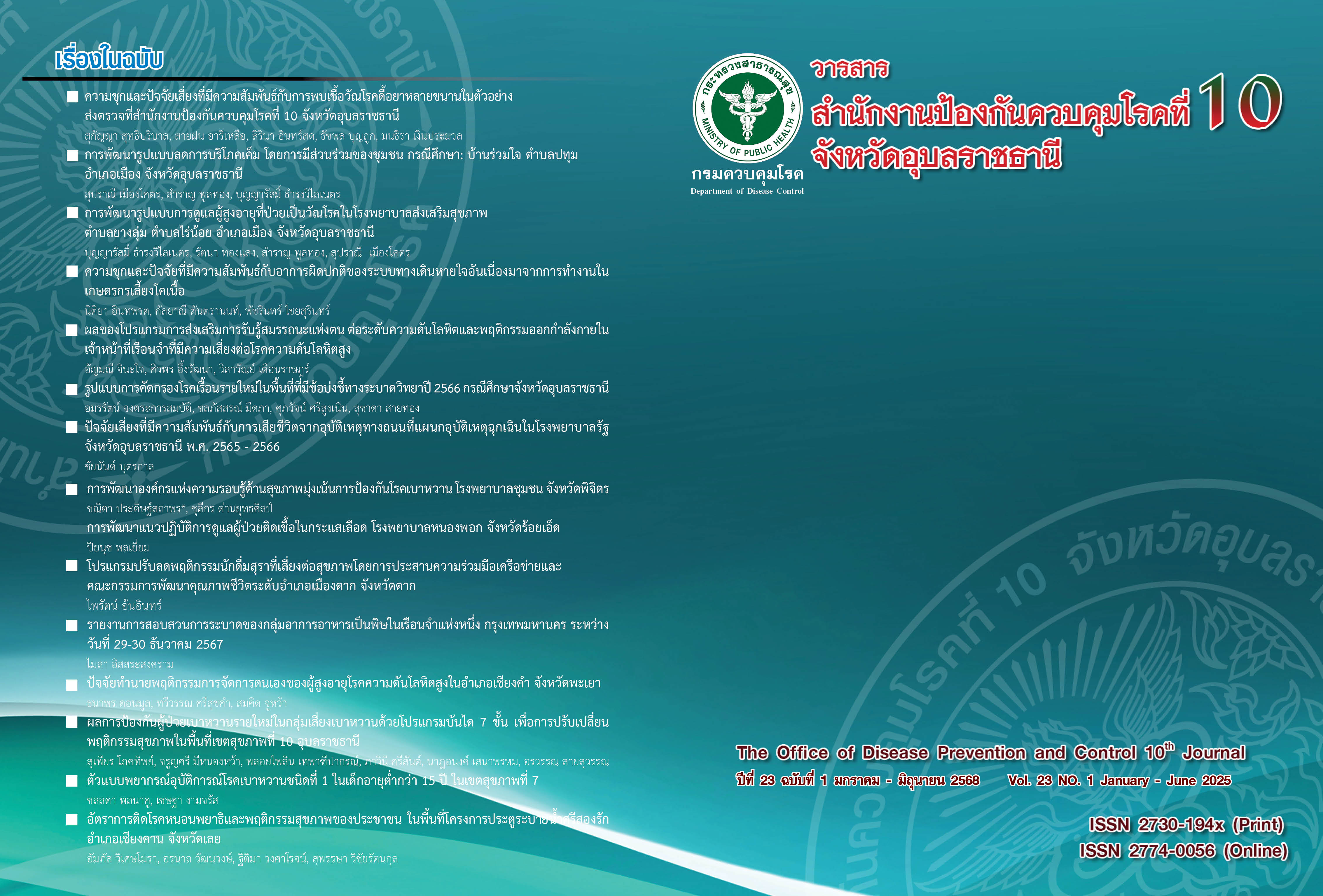
Outcome of 7steps Model for Changing Health Behavior of Diabetes Mellitus (DM) Risk Group, Health Region 10th Ubon Ratchathani
Keywords:
Diabetes Mellitus Risky Group (DMRG), Diabetes Mellitus, Health BehaviorAbstract
This research was aimed to study outcomes of the 7-steps ladder program implementation for changing health behavior of DM risk group in public health region 10. The study area was Public Health Region 10, Ubon Ratchathani. The study unit was Sub-district Health Promotion Hospital (SHPH), 15 SHPH from 5 provinces. Target groups were divided into two groups: the first group was Public Health Personnel (PHP), consisting of PHP from SHPH and health volunteer’s specialists (HVS) 45 people, and the second was Diabetes Mellitus Risky Group (DMRG), 30 people for each SHPH, total was 450 people. The tools comprised a 7-step ladder program of changing health behavior, which was developed from the 3E 2S and divided into three phrases: 1st is the preparing phases, 2nd is the intensive phases of promoting activities for changing health behavior as well as knowledge sharing among DMRG and empowerment site visits, and 3rd is the evaluation phases, to evaluate Capillary Blood Glucose (CBG) in the 3rd, 6th, and 9th months, and the final phases was to evaluate the Hemoglobin A1c (HbA1c). Data was analyzed by descriptive statistics, Wilcoxon Rank test, and Friedman test.
The results found that after participation a 7-step ladder program for changing health behavior, 438 DMRG, mostly female (70.5%). It was found that the DMRG had significantly higher knowledge of the 3E2S principles (p-value < 0.001). The mean behavior scores of the 3E2S principles in the 2nd, 3rd, and 9th months increased from the 0th month with statistical significance (p-value < 0.001). The the 7-steps ladder program was able to prevent new diabetes cases by 87.7%. However, the incidence of new diabetes cases was still found at 12.3%. The obstacle in implementing the program is that some high-risk individuals did not consistently engage in the program because they believe they are not sick.
References
วีรชัย ศรีวณิชชากร, เพชร รอดอารีย์. การป้องกันโรคเบาหวานในสภาพการณ์ของประเทศไทย. วารสารวิชาการสาธารณสุข 2565; 31(2):363-75.
ศักดิ์สิทธิ์ คำเกาะ, รุจิรา ดวงสงค์. ผลของโปรแกรมพัฒนาพฤติกรรมสุขภาพโดยการประยุกต์ความรอบรู้ด้านสุขภาพเพื่อป้องกันโรคเบาหวานชนิดที่ 2 ในกลุ่มเสี่ยงที่อยู่ในความรับผิดชอบของโรงพยาบาลส่งเสริมสุขภาพตำบลบ้านปานเจริญ อำเภอวานรนิวาส จังหวัดสกลนคร. วารสารสาธารณสุขศาสตร์ มหาวิทยาลัยขอนแก่น 2563; 13(3):56-68.
กรมควบคุมโรค กระทรวงสาธารณสุข. คู่มือคลินิก NCD คุณภาพ. นนทบุรี: กรมควบคุมโรค กระทรวงสาธารณสุข; 2557.
Corgatelli C, Dodge E, Bernstein J, Kruk J, Aboul-Enei BH. A comparative review of nutrition education intervention duration and impact on reduction of prediabetes or Type 2 diabetes mellitus among adults age 45 years older. Health Soc Care Community 2022; 30:e3733-e3745.
Young W, Gillibrand WP, Phillip S. The impact of pre-diabetes diagnosis on behavior change: an integrative literature review. Practical Diabetes 2016; 33(5):171-5.
Hu Z, Qin L, Xu H. One-Year Results of a Synthetic Intervention Model for the Primary Prevention of T2D among Elderly Individuals with Prediabetes in Rural China. International Journal of Environmental Research and Public Health 2017; 14(4):417.
Davies MJ, Gray LJ, Troughton J, Gray A, Tuomilehto J, Farooqi A, et al. A Community based primary prevention program for type 2 diabetes integrating identification and lifestyle intervention for prevention: the Let's Prevent Diabetes cluster randomized controlled trial. Preventive Medicine 2016; 84:48-56.
Kramer MK, Miller RG, Siminerio LM. Evaluation of a community Diabetes Prevention Program delivered by diabetes educators in the United States: One-year follow up. Diabetes Res Clin Pract. 2014; 106(3):e49-52.
Beavers KM, Case LD, Blackwell CS, Katula JA, Goff DC Jr, Vitolins MZ. Effects of weight regain following intentional weight loss on glucoregulatory function in overweight and obese adults with pre-diabetes. Obesity Research and Clinical Practice 2015; 9(3):266-73.
Ma J, Yank V, Xiao L, Lavori PW, Wilson SR, Rosas LG, et al. Translating the Diabetes Prevention Program Lifestyle Intervention for Weight Loss into Primary Care: A Randomized Trial. JAMA Intern Med. 2013;173(2):113-21.
Greaves CJ, Middlebrooke A, O'Loughlin L, Holland S, Piper J, Steele A, et al. Motivational interviewing for modifying diabetes risk: a randomized controlled trial. British Journal of General Practice 2008; 58(553):535-40.
Sattin RW, Williams LB, Dias J, Garvin JT, Marion L, Joshua TV, et al. Community Trial of a Faith-Based Lifestyle Intervention to Prevent Diabetes Among African Americans. J Community Health 2016; 41(1):87-96.
เทอดศักดิ์ เดชคง. แนวปฏิบัติการสนทนาสร้างแรงจูงใจ เพื่อปรับเปลี่ยนพฤติกรรมสุขภาพ. พิมพ์ครั้งที่ 1. นนทบุรี: บริษัท บียอนด์ พับลิสชิ่ง จำกัด; 2565.
ขนิษฐา พิศฉลาด, ฉันทนา แรงสิงห์, เกศมณี มูลปานันท์. การพัฒนารูปแบบการป้องกันการเกิดโรคเบาหวานชนิดที่ 2 สำหรับกลุ่มเสี่ยงเบาหวานในชุมชน จังหวัดเชียงราย. วารสารพยาบาลศาสตร์ จุฬาลงกรณ์มหาวิทยาลัย 2559;28(3):132-46.
ภทรพร บุตรวาปี, น้ำผึ้ง ดุงโคกกรวด, ศุภวดี แถวเพีย. ผลของโปรแกรมการเรียนรู้แบบมีส่วนร่วมโดยแกนนำชุมชนต่อพฤติกรรมการป้องกันโรคเบาหวานของกลุ่มเสี่ยงโรคเบาหวานโรงพยาบาลส่งเสริมสุขภาพตำบลสนามชัย ตำบลเหล่าหลวง อำเภอเกษตรวิสัย จังหวัดร้อยเอ็ด. วารสารโรงพยาบาลมหาสารคาม 2558; 12(1):97-103.
เพชรัตน์ ศิริสุวรรณ. ผลของโปรแกรมส่งเสริมสุขภาพเพื่อป้องกันการเกิดโรคเบาหวานรายใหม่ ตำบลสิงห์โคก อำเภอเกษตรวิสัย จังหวัดร้อยเอ็ด. ราชาวดีสาร วิทยาลัยพยาบาลบรมราชชนนี สุรินทร์ 2561; 8(1):45-58.
มุกดา งามวงศ์, ศิริวรรณ อุทธา, อ้อมทิพย์ พลบุบผา, ชลภัสสรณ์ มืดภา, อภิญญา จำปา. การสังเคราะห์โปรแกรมการปรับเปลี่ยนพฤติกรรมในกลุ่มเสี่ยงต่อโรคเบาหวาน. วารสารสำนักงานป้องกันควบคุมโรคที่ 10 จังหวัดอุบลราชธานี 2562; 17(1):56-71.
อรทัย ศรีทองธรรม. รายงานวิจัยการสังเคราะห์โปรแกรมการปรับเปลี่ยนพฤติกรรมในกลุ่มเสี่ยงต่อโรคเบาหวาน. กรุงเทพมหานคร: สำนักงานการวิจัยแห่งชาติ (วช.); 2563.
ละอองกลิ่น กนกแสง. ผลการสัมภาษณ์เพื่อเสริมสร้างแรงจูงใจต่อพฤติกรรมการดูแลตนเองและระดับน้ำตาลในเลือดสะสมของผู้ป่วยเบาหวานที่ควบคุมระดับน้ำตาลไม่ได้. วารสารวิชาการ สำนักงานสาธารณสุขจังหวัดมหาสารคาม 2564; 5(10):161-9.
Kim C, MacMillian F, Osuagwu UL, Simmons D. Peer support facilitator and peer perspectives of an inner-regional Australian diabetes prevention and self management peer support program. Health Soc Care Community 2022; 30(6):e4051-e4064.
Downloads
Published
How to Cite
Issue
Section
License
Copyright (c) 2025 The Office of Disease Prevention and Control 10th

This work is licensed under a Creative Commons Attribution-NonCommercial-NoDerivatives 4.0 International License.
บทความที่ได้รับการตีพิมพ์เป็นลิขสิทธิ์ของ สำนักงานป้องกันควบคุมโรคที่ 10 จังหวัดอุบลราชธานี
ข้อความที่ปรากฏในบทความแต่ละเรื่องในวารสารวิชาการเล่มนี้เป็นความคิดเห็นส่วนตัวของผู้เขียนแต่ละท่านไม่เกี่ยวข้องกับสำนักงานป้องกันควบคุมโรคที่ 10 จังหวัดอุบลราชธานีและบุคลากรท่านอื่นๆในสำนักงานฯ แต่อย่างใด ความรับผิดชอบองค์ประกอบทั้งหมดของบทความแต่ละเรื่องเป็นของผู้เขียนแต่ละท่าน หากมีความผิดพลาดใดๆ ผู้เขียนแต่ละท่านจะรับผิดชอบบทความของตนเองแต่ผู้เดียว


