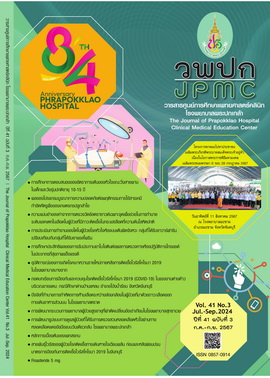
การศึกษาประสิทธิผลของการรับประทานยาไบโอตินต่อผลการตรวจทางห้องปฏิบัติการไทรอยด์ในประชากรที่สุขภาพแข็งแรงดี
Article Sidebar
Main Article Content
บทคัดย่อ
ที่มาของปัญหา: ไบโอตินเป็นวิตามินที่สามารถซื้อได้ตามร้านขายยาทั่วไป ผลของการรับประทานไบโอติน สามารถรบกวนผลการตรวจทางห้องปฏิบัติการไทรอยด์ที่มีการใช้ Streptavidin-based ได้ ซึ่งผลตรวจมักคลาดเคลื่อนทำให้ระดับ Free T3 และ Free T4 สูงขึ้น แต่ระดับ TSH ต่ำลง ทําให้ผู้ที่รับประทานไบโอตินถูกวินิจฉัยผิดว่าเป็นโรคไทรอยด์เป็นพิษได้
วัตถุประสงค์: ศึกษาเปรียบเทียบผลจากการรับประทานยาไบโอตินขนาด 10 มิลลิกรัมต่อวัน ต่อระดับ FT3, FT4 และ TSH
วิธีการศึกษา: การวิจัยเชิงทดลองโดยศึกษาเปรียบเทียบผลของการรับประทานยาไบโอตินขนาด 10 มิลลิกรัมต่อวัน ต่อระดับ FT3, FT4 และ TSH การศึกษานี้เกิดขึ้นระหว่างสิงหาคม พ.ศ. 2566 ถึงมกราคม พ.ศ. 2567 อาสาสมัครทุกรายรับประทานยาไบโอติน ขนาด 10 มิลลิกรัมต่อวัน เป็นระยะเวลา 7 วัน โดยอาสาสมัครทุกรายจะได้รับการเจาะเลือดก่อนรับประทานไบโอติน หลังรับประทานยาไบโอติน และหลังหยุดรับประทานยาไบโอติน 7 วัน ตัวอย่างเลือดเดียวกันจะถูกนําไปตรวจระดับ FT3, FT4 และ TSH จากทั้งเครื่อง Beckman UniCel DxI800 และเครื่อง Roche Cobas Elecsys e801
ผลการศึกษา: การศึกษานี้ได้รวบรวมอาสาสมัครที่แข็งแรงดีทั้งสิ้น 25 ราย ผลการตรวจจากเครื่อง Beckman Coulter DXI800 พบว่าหลังรับประทานยาไบโอตินนาน 7 วัน ระดับค่าเฉลี่ย FT3 และ FT4 เพิ่มขึ้นอย่างมีนัยสําคัญทางสถิติ (1.43 [95%CI 0.11, 2.75], p=0.04, 0.55 [95%CI 0.16, 0.95], p=0.008) หลังหยุดยาเป็นระยะเวลา 7 วัน พบว่า ระดับค่าเฉลี่ย FT3 และ FT4 ไม่แตกต่างกับระดับก่อนเริ่มยาอย่างมีนัยสําคัญทางสถิติ และพบว่า ระดับค่าเฉลี่ย TSH ไม่แตกต่างกับระดับก่อนเริ่มยาอย่างมีนัยสําคัญทางสถิติ พบว่า ร้อยละ 24 พบความผิดปกติของผลเลือดไทรอยด์ในลักษณะ Discordant ในขณะที่ผลการตรวจจากเครื่อง Cobas Elecsys e801 พบว่าหลังรับประทานยาไบโอตินนาน 7 วัน พบระดับค่าเฉลี่ย FT3, FT4, TSH ไม่แตกต่างกับระดับก่อนเริ่มยาอย่างมีนัยสําคัญทางสถิติ
สรุป: ไบโอตินมีผลรบกวนต่อการตรวจทางห้องปฏิบัติการไทรอยด์จริง ในกรณีที่รับประทานไบโอติน ยังมีความจําเป็นที่ต้องหยุดการรับประทานก่อนอย่างน้อย 7 วัน
Thaiclinicaltrials.org number, TCTR20240411004
Article Details

อนุญาตภายใต้เงื่อนไข Creative Commons Attribution-NonCommercial-NoDerivatives 4.0 International License.
เอกสารอ้างอิง
Hollowell JG, Staehling NW, Flanders WD, Hannon WH, Gunter EW, Spencer CA, et al. Serum TSH, T(4), and thyroid antibodies in the United States population (1988 to 1994): National Health and Nutrition Examination Survey (NHANES III). J Clin Endocrinol Metab 2002;87:489-99.
Aoki Y, Belin RM, Clickner R, Jeffries R, Phillips L, Mahaffey KR. Serum TSH and total T4 in the United States population and their association with participant characteristics: National Health and Nutrition Examination Survey (NHANES 1999-2002). Thyroid 2007;17:1211-23.
Konrády A. T3-thyrotoxicosis: incidence, significance and correlation with iodine intake. Orv Hetil 2000;141:337-40.
Soldin OP, Goughenour BE, Gilbert SZ, Landy HJ, Soldin SJ. Thyroid hormone levels associated with active and passive cigarette smoking. Thyroid 2009;19:817-23.
Soldin OP.Thyroid function testing in pregnancy and thyroid disease: trimester-specific reference intervals. Ther Drug Monit 2006;28:8-11.
Li D, Radulescu A, Shrestha RT, Root M, Karger AB, Killeen AA, et al. Association of biotin ingestion with performance of hormone and nonhormone assays in healthy adults. JAMA 2017;318:1150-60.
McBride M, Dasgupta A. Significant interference of biotin in thyroid function tests using Beckman analyzer: how to identify such interferences?. Ann Clin Lab Sci 2023;53:130-3.
Paketçi A, Köse E, GürsoyÇalan Ö, Acar S, Teke P, Demirci F, et al. Serum level of biotin rather than the daily dosage is the main determinant of interference on thyroid function assays. Horm Res Paediatr 2019;92:92-8.
Ylli D, Soldin SJ, Stolze B, Wei B, Nigussie G, Nguyen H, et al. Biotin interference in assays for thyroid hormones, thyrotropin and thyroglobulin. Thyroid 2021;31:1160-70.
James A, Stalan J, Kuzhively J. Biotin induced biochemical hyperthyroidism: a case report and review of the literature. J Med Case Rep [Internet]. 2023 [cited 2024 May 21];17(1):266. Available from: https://www.ncbi.nlm.nih.gov/pmc/articles/PMC10304644/pdf/13256_2023_Article_4002.pdf
Alvarez-Payares JC, Bello-Simanca JD, De La Peña-Arrieta EJ, Agamez-Gomez JE, Garcia-Rueda JE, Rodriguez-Arrieta A, et al. Common pitfalls in the interpretation of endocrine tests. Front Endocrinol (Lausanne) [Internet]. 2021[cited 2024 May 21];12:727628. Available from: https://www.ncbi.nlm.nih.gov/pmc/articles/PMC8453144/pdf/fendo-12-727628.pdf
Kabiri P, Weiskirchen R, van Helden J. The biotin interference within interference suppressed immunoassays. J Clin Lab Anal [Internet]. 2021 [cited 2024 May 21];35(9):e23940.Available from: https://www.ncbi.nlm.nih.gov/pmc/articles/PMC8418509/pdf/JCLA-35-e23940.pdf
Lim SK, Pilon A, Guéchot J. Biotin interferes with free thyroid hormone and thyroglobulin, but not TSH measurements using Beckman-access immunoassays. Ann Endocrinol (Paris) 2017;78:186-7.
Roche Diagnostics. Elecsys® T4 [Internet]. 2024 [cited 2024 May 21]. Available from: https://diagnostics.roche.com/global/en/products/lab/elecsys-t4-cps-000517.html#productSpecs
McBride M, Dasgupta A. Significant interference of biotin in thyroid function tests using Beckman analyzer: how to identify such interferences?. Ann Clin Lab Sci 2023;53:130-3.
