Peer Review Process
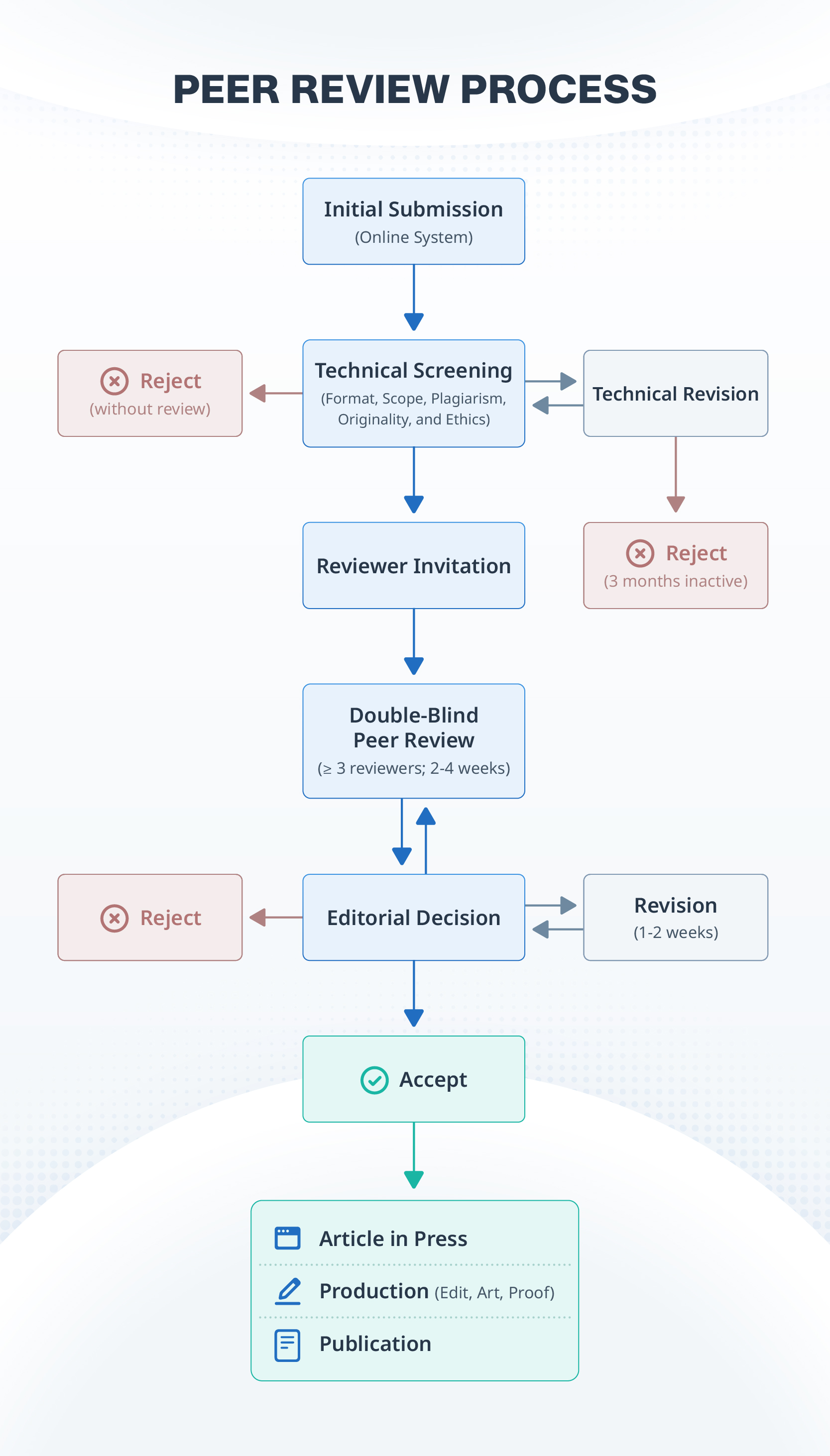
Initial Screening: All new submissions are checked for completeness and adherence to the journal's aims and scope, publication ethics, and instructions for authors. Authors are encouraged to complete the submission checklist to ensure their manuscript is prepared appropriately. Submissions that remain incomplete for more than 3 months may be declined; however, authors may resubmit once all requirements have been met. Manuscripts may be rejected without peer review if they lack originality, contain inappropriate or incomplete content, raise ethical concerns (including plagiarism), exhibit methodological flaws, demonstrate poor English grammar or readability, or fall outside the journal's scope or target audience. Additionally, manuscripts that primarily report technical or subject-specific content with insufficient medical relevance may be rejected for publication.
Double-Blind Peer Review: Manuscripts that pass the initial screening undergo a double-blind peer review by at least 3 reviewers with no conflicts of interest. Editorial decisions (accept, minor revision, major revision, reject) are based on reviewers’ recommendations and the discretion of the editor-in-chief or assigned editor.
Revisions and Final Decision: Manuscripts that require revision are returned to authors for modification. Revised manuscripts then undergo another round of review by the editor or reviewers before a final decision is made. Authors are kept informed about the final decision. Manuscripts rejected on scientific or ethical grounds cannot be resubmitted.
Production and Publication: Upon acceptance, manuscripts proceed to the production stage. Accepted manuscripts will be published online ahead of print as "Article in Press" while undergoing copyediting, formatting, artwork preparation, and proofreading, in accordance with the journal's style. After completing production, the finalized article will be assigned to and published in the next available journal issue.