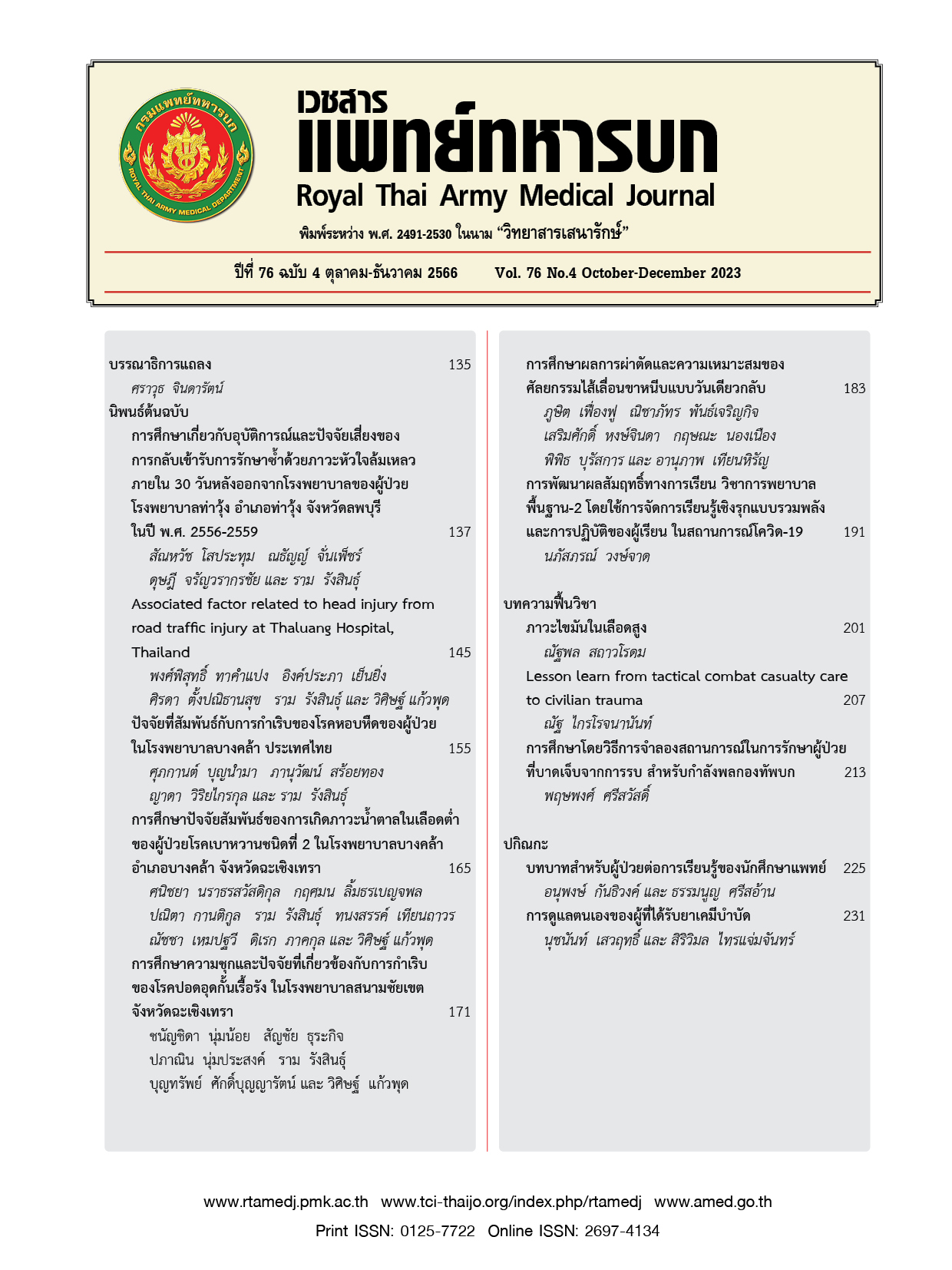
Development of the Basic Nursing-2 achievements using collaborative active learning and practice of students in the situation of Covid-19
Article Sidebar
Main Article Content
Abstract
Background and Objective: The Basic nursing-2 learning is essential for students in patient caring as they have low pre-test scores. Collaborative Active Learning and Practice has been used to solve problems in the classroom. This research aimed 1) to compare learning achievements from the Basic Nursing-2 of students after implementing Collaborative Active Learning and Practice in the situation of Covid-19 2) to study practice results of the Basic nursing-2 after implementing Collaborative Active Learning and Practice in the situation of Covid-19 with an established comparison criterion of 70 percent. Method: The population used in this research consisted of 145 non-commissioned officer (NCO) Medical Corp, class 25 of Army Medical Field Service School, Army Medical Department of the academic year 2022. The instruments used in this research were lesson plans for the Basic Nursing-2, a learning achievement test (pre-test/post-test), Quiz, Skill evaluation form of the Basic Nursing-2. Data were analyzed using descriptive and inferential statistics, percentage, mean, standard deviation and Dependent t-test. The statistical significance was set at a level of less than 0.05. Result: It was found that the achievement of students with Basic Nursing-2 learning was significantly higher than that before implementing Collaborative Active Learning and Practice in the situation of Covid-19 (the statistical significance p = 0.00). The practice results in the Basic Nursing-2 after implementing Collaborative Active Learning and Practice in the situation of Covid-19 of students (mean = 86.87 percentage, standard deviation = 0.51) were higher than the established criterion of 70 percent.
Downloads
Article Details

This work is licensed under a Creative Commons Attribution-NonCommercial-NoDerivatives 4.0 International License.
Articles in this journal are copyrighted by the Royal Thai Army Medical Department and published under the Creative Commons Attribution-NonCommercial-NoDerivatives 4.0 International (CC BY-NC-ND 4.0) license.
may be read and used for academic purposes, such as teaching, research, or citation, with proper credit given to the author and the journal.
Use or modification of the articles is prohibited without permission.
Statements expressed in the articles are solely the opinions of the authors.
Authors are fully responsible for the content and accuracy of their articles.
Any other republication of the articles requires permission from the journal.
References
Chang-Tik C. Introduction: Collaborative Active Learning - strategies, Assessment and Feedback. In: Chang-Tik C, Kidman G, Yew Tee M, editors. Collaborative Active Learning. Singapore: Springer; 2022; p. 3-31.
Goh J. In: Collaborative Learning in Informal Spaces: Formulating a Pedagogical Project of Student-Centred Active Learning in Gender Studies. In: Chang-Tik C, Kidman G, Yew Tee M, editors. Collaborative Active Learning. Singapore: Springer; 2022; p. 105-30.
Kidman G, Nguyet Nguyen M. Active Learning: An Integrative Review. In: Chang-Tik C, Kidman G, Yew Tee M, editors. Collaborative Active Learning. Singapore: Springer; 2022. p. 33-52.
Chang-Tik C. Student Collaboration Through Assessment, Feedback and Peer Instruction. In: Chang-Tik C, Kidman G, Yew Tee M, editors. Collaborative Active Learning. Singapore: Springer; 2022. p. 53-79.
Le H, Janssen J, Wubbels T. Collaborative learning practices: teacher and student perceived obstacles to effective student collaboration. Camb J Educ. 2018;48(1):103-22.
Erkens M, Bodemer D. Improving collaborative learning: Guiding knowledge exchange through the provision of information about learning partners and learning contents. Compt Educ. 2019;128: 452-72.
Soller A, Lesgold A. Collaborative Tools in Educational Practice. In: Ulrich Hoppe H. Ogata H, Soller A, Editors. The Role of Technology in CSCL. New York: Springer; 2023. p 117-20.
Wongpratoom W, Sranamkam T. The Effects of Blended Learning Using Collaborative Learning with Student Team Achievement Divisions (STAD) Technique to Enhance Analytical Thinking for Grade VII Students. Int J Learn Teach. 2019;5(4):280-4.
Scager K, Boonstra J, Peeters T, Vulperhorst J, Wiegant F. Collaborative Learning in Higher Education: Evoking Positive Interdependence. CBE Life Sci Educ. 2016;15(4):1-4.
Fung D, Hung V, Wai-mei L. Enhancing Science Learning Through the Introduction of Effective Group Work in Hong Kong Secondary Classrooms. Int J Sci Math Educ. 2018;16:1291-314.
