
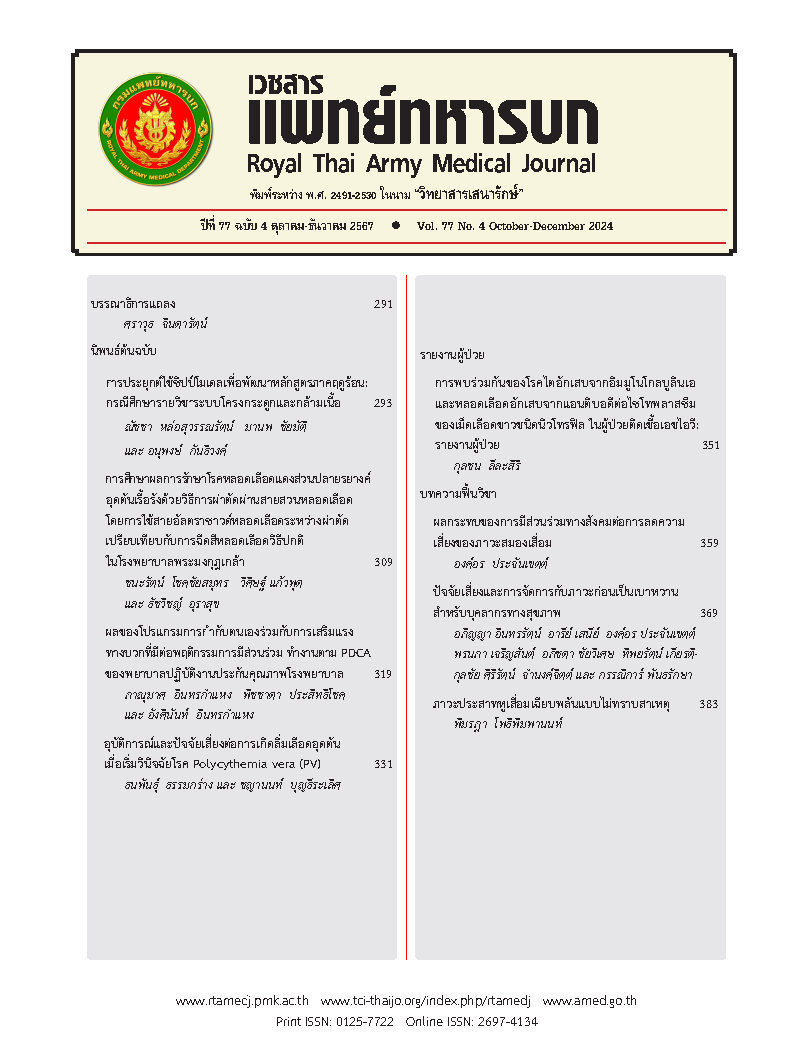
Using CIPP Model for Summer Course Development: Case Study in Musculoskeletal System
Article Sidebar
Main Article Content
Abstract
Background: During the past three consecutive years, it was found that a significant number of students did not meet the minimum passing criteria in the Musculoskeletal System I subject and had to retake the exam each year. In most educational institutions in Thailand, the use of the CIPP model is primarily used for evaluating the outcome of teaching and learning. However, this study has expanded the application of the CIPP model in curriculum development planning in order to improve the effectiveness of managing summer courses designed to meet the minimal knowledge requirements. Methods: The pilot study and cross-sectional descriptive study were conducted by analysing the four aspects of the CIPP model, namely, context, input, process, and product. This model is used as a foundation for problem-solving, curriculum development planning, and selecting appropriate learning methods to provide students in need of remedial and developmental education with sufficient knowledge in essential physical science topics. This knowledge is necessary for their advancement in higher-level studies, particularly in the fields of surgery, rehabilitation medicine, and otolaryngology. Data was collected through questionnaires and collaborative discussions, followed by statistical analysis. Results: Data obtained from clinical instructors, preclinical instructors, and 2nd-year and 5th-year medical students, totaling 161 individuals, were used to determine the teaching topics and suitable learning formats for the remedial summer course for medical students. For the product evaluation, curriculum appropriateness was rated at a high level (4.49/5.00), while student performance and competency were also rated at a high level (4.14/5.00). Conclusion: The CIPP model can be effectively used for the planning, developing, and solving problems related to curriculum by considering the aptitude and attitude of learners. It also takes into account feedback from instructors and the requirements of clinical faculty.
Downloads
Article Details

This work is licensed under a Creative Commons Attribution-NonCommercial-NoDerivatives 4.0 International License.
Articles in this journal are copyrighted by the Royal Thai Army Medical Department and published under the Creative Commons Attribution-NonCommercial-NoDerivatives 4.0 International (CC BY-NC-ND 4.0) license.
may be read and used for academic purposes, such as teaching, research, or citation, with proper credit given to the author and the journal.
Use or modification of the articles is prohibited without permission.
Statements expressed in the articles are solely the opinions of the authors.
Authors are fully responsible for the content and accuracy of their articles.
Any other republication of the articles requires permission from the journal.
References
Rohen JW, Yokochi C, Drecoll EL. Color Atlas of Anatomy. 7th ed. Germany: Lippincott Williams & Wilkins/A Wolters Kluwer Company; 2011.
Standring S. Gray’s Anatomy: The Anatomical Basis of Clinical Practice. 41st ed. Elsevier; 2016.
Netter FH. Atlas of Human Anatomy. 7th ed. Philadelphia: Elsevier Saunders; 2019. Available from: https://www.clinicalkey.com
Stufflebeam DL, Shinkfield AJ. Evaluation: Theory, models and applications. San Francisco, CA: Jossey-Bass; 2007.
Patphol, M. Curriculum evaluation for learning and development. 3rd ed. Bangkok: Charansanitwong Printing Co., Ltd.; 2015. Thai.
Iramaneerat C, Rangsisombatsiri C. Satisfaction Survey of Graduates from the Doctor of Medicine Program of the Faculty of Medicine Siriraj Hospital. Siriraj Medical Bulletin. 2010;3(2):86-99. Thai.
Kaewpila P, Prakongsilpa Y. Evaluation of Doctor of Medicine Program B.E. 2540. Journal of Education Graduate Studies Research. Khon Kaen University. 2012;6(2):97-105. Thai.
Damrongkijkosol C, Methapatra P, Stirayakorn P. The Development of Instructional Course Evaluation System for Institution under the Commission of Vocational Education. The Journal of Faculty of Applied Arts, King Mongkut’s University of Technology North Bangkok. 2015;8(1):80-8. Thai.
Chintapanyakun T, Ruaengsri S, Laksana K, Lhongsap P. The New Curriculum Evaluation: CIPPI EST Model. Journal of police nurses. 2017;9(2): 203-12. Thai.
Buasri T. Curriculum theory: Design and development. 2nd ed. Bangkok: Pattanasuksa Printing; 1999. Thai.
Srisaad B. Basic Research. 9th ed. Bangkok: Suweeyasarn; 2013. Thai.
Suttidej J, Boonyasopon T, Mathapatara P, Ratchusanti S. Development of Training Program on Vocational Education Qualification Framework of Subject Area in the Bachelor of Technology Degree Program under the Office of Vocational Education Commission. The Journal of King Mongkut’s University of Technology North Bangkok. 2012; 22(2):377-84. Thai.
Stufflebeam DL. The CIPP model for evaluation, in Kellaghan T, Stuffelebeam DL, editors. International Handbook of Educational Evaluation. Netherland: Kluwer Academic Publishers;2003. p. 31-62.
Watanasuntorn K. Application of Stufflebeam’s CIPP Model for Educational Project Evaluation. Suranaree Journal of Social Science. 2008;2(1): 67-83. Thai
World Agroforestry Center. The CIPP evaluation model [Internet]. 2015. [Cited 2015 Jan 16]. Available from: http://www.cglrc.cgiar.org/icraf/toolkit/default.htm#The_CIPP_evaluation_model.htm
Wanphet W. The quality assessment for development of strategic plan, Faculty of industrial technology in Rajabhat University. Faculty of Industrial Technology, Pranakhon Rajabhat University, Thailand. International Conference: The COMSA 2016: The 2nd conference on Management and Sustainability in Asian, 2016 on September 1-3, Hiroshima, Japan; 2016.
Thongtaninkwan R, Inted W, Thamta A, Boonkaew J, Jaiwandee W, Harnsiriwattanakit K, et al. Factors related to human gross anatomy knowledge retention in medical students. Chula Med J .2018; 62(3):593-605. Thai.
Nuallaong W. How to instruct the Generation Y medical students, Bangkok: Thammasat Medical Journal, .2010; 10(3):381-6. Thai.
Rangchaikul W. Project Evaluation: Concept and Practice. 8th ed. Bangkok: Chulalongkorn University Press; 2013. Thai.
