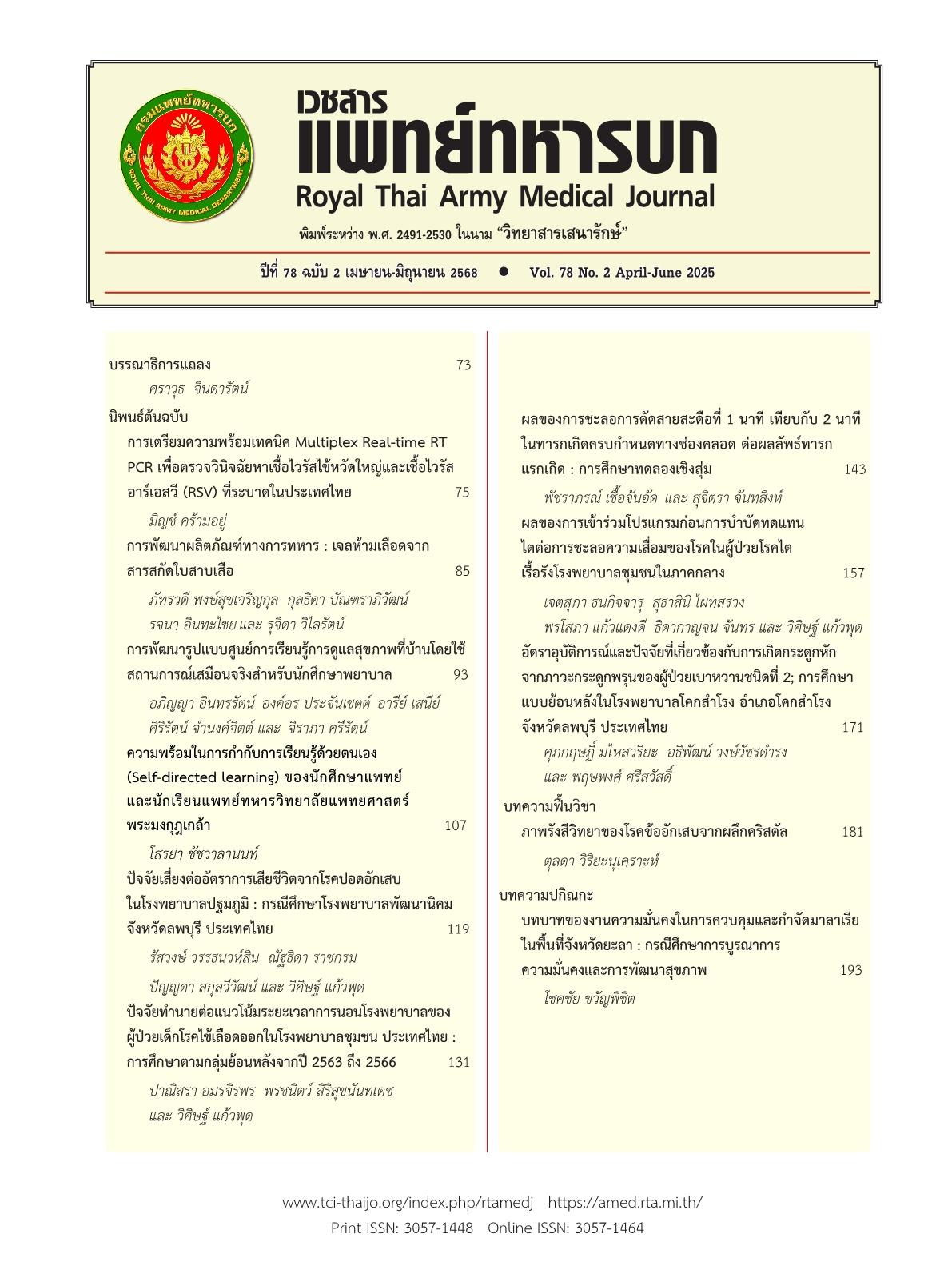
บทบาทของงานความมั่นคงในการควบคุมและกำจัดมาลาเรียในพื้นที่จังหวัดยะลา: กรณีศึกษาการบูรณาการความมั่นคงและการพัฒนาสุขภาพ
Article Sidebar
Main Article Content
Abstract
This study presents a successful case study of malaria control and elimination in Yala Province,Thailand,aligningwiththeWorldHealthOrganization’smalariaeliminationstrategyThrough integrated operations between the Medical Center of Southern Border Provinces and the Internal Security Operations Command Region 4 Forward Command, along with network partnerships from 2015 to 2022, the annual malaria cases decreased significantly from approximately 5,000 to fewer than 100 cases. This achievement reflects progress toward sustainable development goals2 and demonstrates the successful integration of security paradigms with community health development through multi-stakeholder engagement mechanisms.
Downloads
Article Details

This work is licensed under a Creative Commons Attribution-NonCommercial-NoDerivatives 4.0 International License.
Articles in this journal are copyrighted by the Royal Thai Army Medical Department and published under the Creative Commons Attribution-NonCommercial-NoDerivatives 4.0 International (CC BY-NC-ND 4.0) license.
may be read and used for academic purposes, such as teaching, research, or citation, with proper credit given to the author and the journal.
Use or modification of the articles is prohibited without permission.
Statements expressed in the articles are solely the opinions of the authors.
Authors are fully responsible for the content and accuracy of their articles.
Any other republication of the articles requires permission from the journal.
References
World Health Organization. World Malaria Report 2023. Geneva: WHO;2023.
The Global Fund. Technical Brief: Malaria, Gender and Human Rights [Internet]. Geneva: The Global Fund;2017 [Cited 2025 May 13]. Available from: t.ly/azCkI
Ministry of Public Health, Thailand. National Malaria Elimination Strategy Thailand 2017-2026 ; Malaria Elimination Operational Plan (2017-2021) [Internet]. Nontaburi, Thailand: Ministry of Public Health Thailand; 2017 [Cited 2025 May 13]. Available from: https://apmen.org/resources/thailandnational-malaria-elimination-strategy-2017-2026-malaria-elimination-operational
World Health Organization. A Framework for Malaria Elimination.Geneva: WHO;2017.
Roll Back Malaria Partnership. (2020). Action and Investment to defeat Malaria 2016-2030. Geneva: WHO;2017.
World Health Organization. Global Technical Strategy for Malaria 2016-2030. Geneva: WHO;2017.
World Health Organization. Guidelines for malaria vector control. Geneva: WHO;2019.
Gueye CS, Sanders KC, Galappaththy GN, Rundi C, Tobgay T, Sovannaroth S, et al. Active case detection for malaria elimination: a survey among Asia Pacific countries. Malar J. 2013;12(358): 9 Page. https://doi.org/10.1186/1475-2875-12-358
Asia Pacific Malaria Elimination Network. Vector Control [Internet]. 2024 [Cited 2025 May 13]. Available from: https://apmen.org/vector-control
World Health Organization. Tailoring malaria interventions in the COVID-19 response. Geneva: WHO;2022.
Global Malaria Programme. A Framework for Malaria Elimination: Field Manual. Geneva: WHO;2022.
WHO Regional Office for South-East Asia. South – East Asia [Internet]. 2024 [Cited 2025 May 13]. Available from: https://www.who.int/southeastasia/about
