
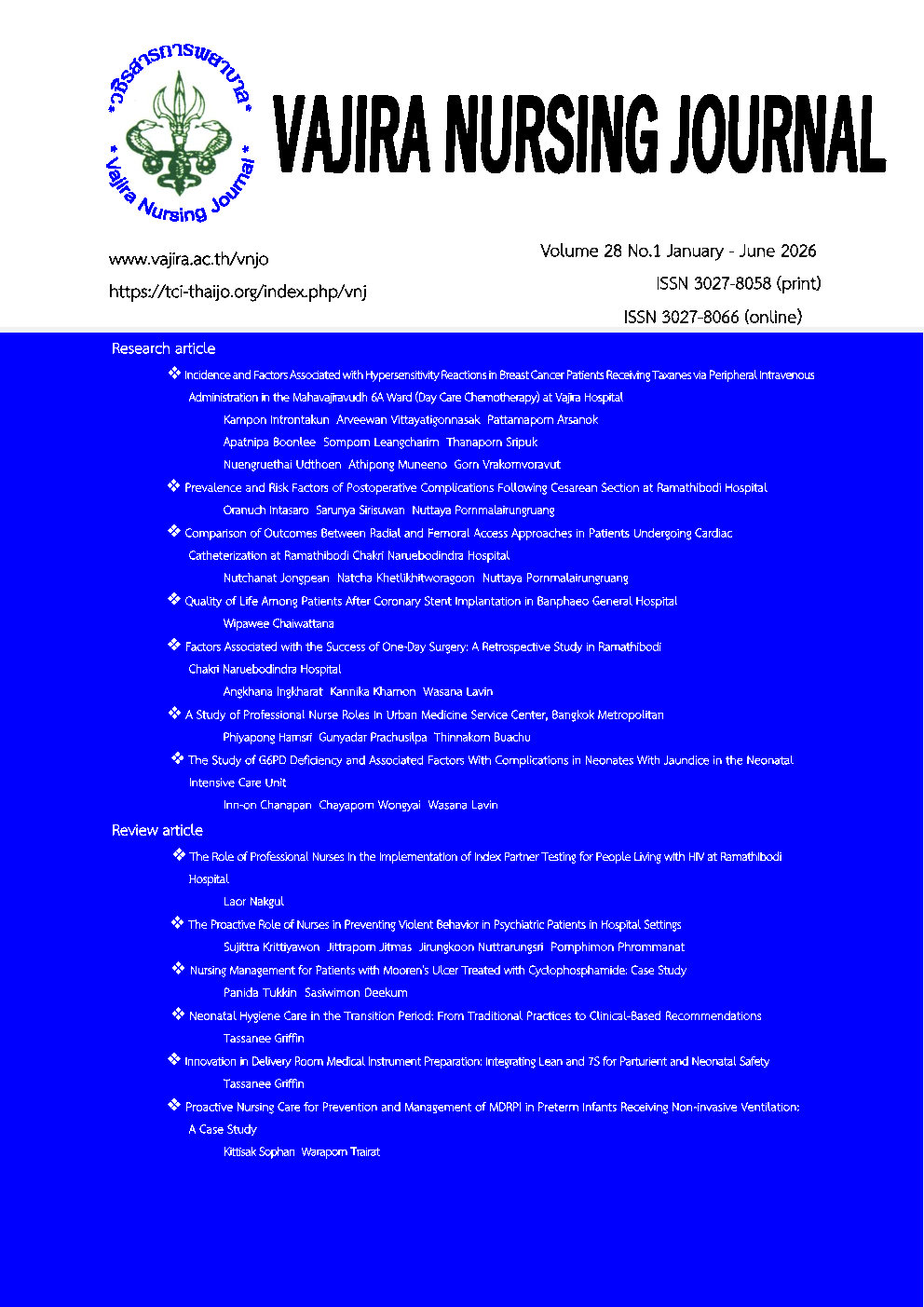
Nursing Management for Patients with Mooren's Ulcer Treated with Cyclophosphamide: Case Study
Article Sidebar
Main Article Content
Abstract
Mooren’s ulcer is an autoimmune disease causing corneal destruction with a high
risk of permanent vision loss. Although Cyclophosphamide treatment is highly
effective, it carries severe complication risks. This study aimed to evaluate
holistic nursing care and discharge preparation using the D-METHOD model in a
patient with severe Mooren’s Ulcer receiving Cyclophosphamide and Mesna. A
case study was conducted on a 51-year-old Thai female with bilateral severe
Mooren’s Ulcer. Gordon's Functional Health Patterns and the nursing process
were utilized, focusing on ocular assessment, pain management, corneal
perforation prevention, and safe chemotherapy administration.
The results revealed that the patient's pain score decreased from 9/10 to 3/10
within 48 hours. Corneal inflammation subsided without perforation, and no
chemotherapy-related complications occurred. Furthermore, the patient
demonstrated correct knowledge and self-care practices according to the
D-METHOD criteria before discharge. In conclusion, nursing care emphasizing
specialized ophthalmic competencies and clear discharge planning prevents
medication-related complications and enhances patient self-care, serving as a
standard clinical guideline in tertiary care settings.
Article Details

This work is licensed under a Creative Commons Attribution-NonCommercial-NoDerivatives 4.0 International License.
The content and information presented in articles published in the Vajira Nursing Journal reflect the views and responsibilities of the authors exclusively. The editorial board does not necessarily agree with or share any responsibility for these views.
All articles, information, content, images, etc., published in the Vajira Nursing Journal are the copyright of the journal. Any individual or organization wishing to reproduce, disseminate, or use any part or entirety of the published material must obtain prior written permission from the Vajira Nursing Journal.
References
Ou S, Zhang J, Feng Y, Zheng X, Lin Y, Zhang L, et al. Mooren's ulcer: a multifactorial autoimmune peripheral ulcerative keratitis and current treatment protocols. Front Med (Lausanne). 2025;12:1630585.
Hassanpour K, ElSheikh RH, Arabi A, Frank CR, Elhusseiny AM, Eleiwa TK, et al. Peripheral ulcerative keratitis: a review. J Ophthalmic Vis Res. 2022;17(2):252-275.
Chuephanich P, Kitsirilarp W, Keorochana N. Characteristics, etiologies, and outcomes of peripheral ulcerative keratitis in a tertiary referral hospital in Thailand: a 10-year study. Ocul Immunol Inflamm. 2024;32(8):1769-1776.
Höllhumer R. Peripheral ulcerative keratitis: a review of aetiology and management. Afr Vision Eye Health. 2022;81(1):a697.
Maleki A, Valerio T, Massoudi Y, Ruggeri ML, Foster CS, Anesi SD. Updates on Systemic Immunomodulation in peripheral ulcerative keratitis. J Clin Transl Ophthalmol. 2024;2(4):131-139.
Xiang Q, Yang M, Luo W, Cao Y, Shuai S, Wei X, et al. Combined glucocorticoids and cyclophosphamide in the treatment of Graves' ophthalmopathy: a systematic review and meta-analysis. BMC Endocr Disord. 2024;24(1):15.
Canberra Health Services. Cyclophosphamide Infusion (fixed low dose regime) – Adults [Internet]. Canberra: ACT Government; 2025 [cited 2026 Apr 20]. Available from: https://www.canberrahealthservices.act.gov.au
Reddy V, Winston NR. Mesna. [Updated 2024 Feb 28]. In: StatPearls [Internet]. Treasure Island (FL): StatPearls Publishing; 2024 Jan- [cited 2026 Apr 26]. Available from: https://www.ncbi.nlm.nih.gov/books/NBK556021/
Song A, Yang Y, Henein C, Bunce C, Qureshi R, Ting DSJ. Topical antibiotics for treating bacterial keratitis: a network meta-analysis. Invest Ophthalmol Vis Sci. 2025;66(8):1746.
