Editor-in-Chief:
Chuleeporn Jiraphongsa

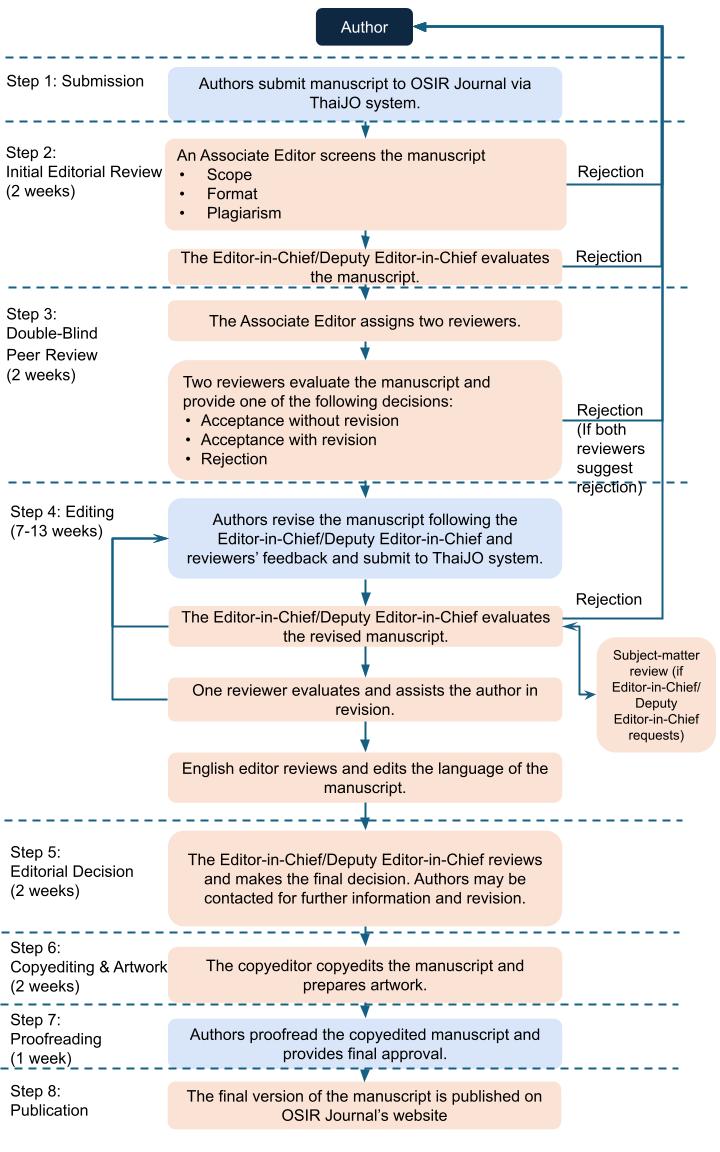
1. Submission
Authors submit their manuscript file, along with the OSIR clearance form, figures, and tables, through the ThaiJO system.
2. Initial Editorial Review (2 weeks)
Upon submission, articles are scrutinized for plagiarism via ThaiJO systems, while Associate Editor ensures that the articles conform to the submission preparation checklist with regard to formatting and clearance. The content of the articles is then subjected to a review by the Editor-in-Chief/Deputy Editor-in-Chief who is not listed as an author.
Manuscripts that do not adhere to the prescribed format or are partly/wholly incomprehensible text will be returned to the authors for revision. Manuscripts that are outside the scope of the journal or deemed to be in violation of ethical standards will be rejected.
3. Double-Blind Peer Review (2 weeks)
If the article is accepted from the initial editorial review process, it proceeds to the double-blind peer review step. The Associate Editor selects two reviewers unaffiliated with the corresponding author's institution. The reviewers provide feedback and results. There are three outcomes:
The Editor-in-Chief/Deputy Editor-in-Chief and reviewers' comments and decisions are sent to the corresponding author. If the manuscript is not rejected, the corresponding author is given an opportunity to revise the manuscript.
4. Editing (7-13 weeks)
The revised manuscript, along with necessary materials such as figures and tables, should be submitted with clear indications of the changes made. If authors disagree with comments, they must provide reasonable explanations. The authors have two weeks for the first revision, after that they have one week.
The Editor-in-Chief/Deputy Editor-in-Chief determines if the revised article should then be accepted or rejected and provides comments for improving the manuscript. One reviewer will assist the author in improving the quality of the article. Subject-matter review may be requested if further expertise is needed. If it is accepted by the Editor-in-Chief/Deputy Editor-in-Chief and reviewer, the English editing was then conducted by the English editor of the journal.
5. Editorial Decision (2 weeks)
After the peer-review and revision stages are completed, the Editor-in-Chief/Deputy Editor-in-Chief evaluates the revised manuscript, taking into consideration the reviewers’ comments and the authors’ responses. Based on this evaluation, the Editor-in-Chief/Deputy Editor-in-Chief makes the final editorial decision regarding the manuscript. If additional revisions are required, the authors will receive further comments and recommendations for improvement. Authors are expected to revise the manuscript accordingly and resubmit the revised version through the journal submission system.
6. Copyediting and Artwork (2 weeks)
Once a manuscript is accepted for publication, it proceeds to the copyediting stage. During this stage, the journal’s copyeditor reviews the manuscript to ensure consistency in language, grammar, formatting, and adherence to the journal’s style guidelines. Tables, figures, and other visual materials are also reviewed and prepared for publication to ensure clarity and quality. Minor editorial adjustments may be made to improve readability and presentation while preserving the authors’ original meaning.
7. Proofreading (1 week)
After copyediting is completed, the authors will receive the proof version of the manuscript. Authors are responsible for carefully reviewing the proof to identify any remaining typographical errors, formatting issues, or minor corrections. At this stage, only minor changes are permitted. Authors must provide their final approval of the manuscript before it proceeds to publication.
8. Publication
After the proofreading stage is completed and the authors provide final approval, the manuscript is prepared for publication. The final version of the article is then published on the OSIR Journal website, where it becomes part of the official journal record and is accessible to readers.
Note: The duration of the review and editing processes may vary depending on the quality of the manuscript and the availability of suitable reviewers. Turnaround time is approximately 4 to 7 months. Manuscripts reporting urgent public health events, such as outbreak investigations, may be processed more rapidly; however, they will still follow the same peer-review procedures as other submissions.
Chuleeporn Jiraphongsa







Visitors
Counter installed : 11 October 2022

