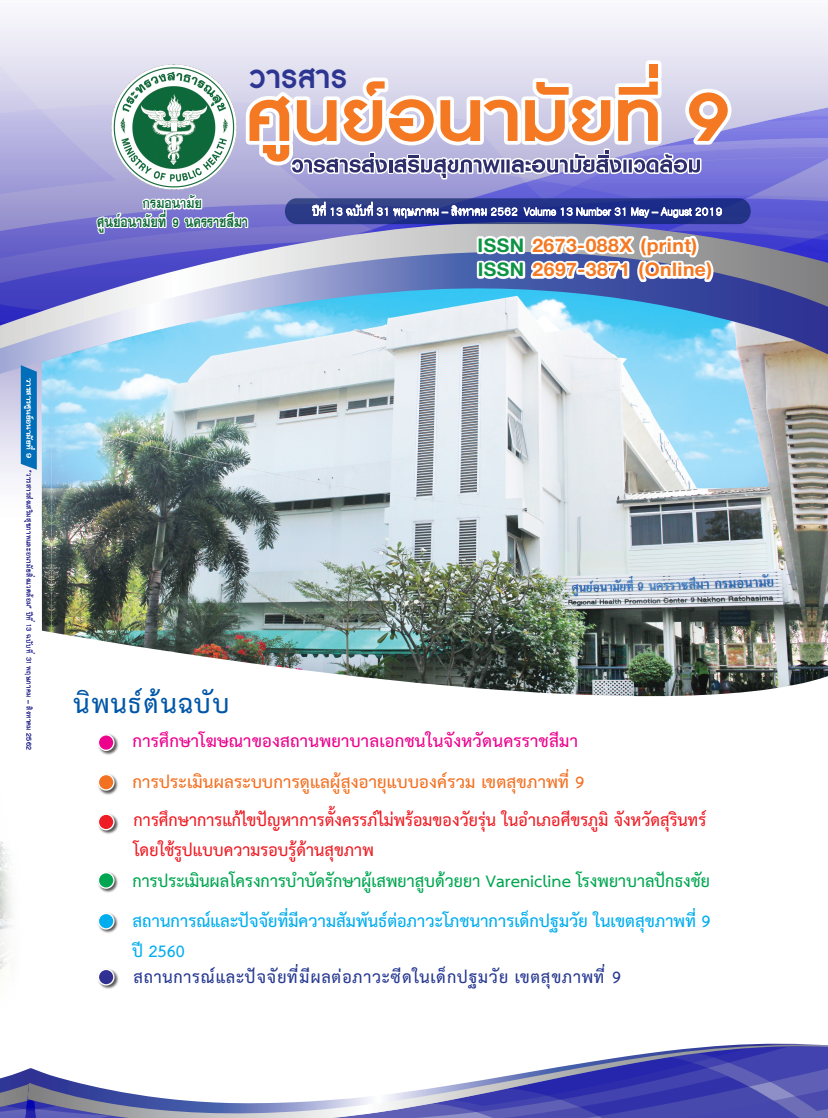
สถานการณ์และปัจจัยที่มีผลต่อภาวะซีดในเด็กปฐมวัย เขตสุขภาพที่ 9
คำสำคัญ:
ภาวะซีด, เด็กปฐมวัยบทคัดย่อ
การวิจัยครั้งนี้เป็นการวิจัยเชิงพรรณา ( Descriptive study ) มีวัตถุประสงค์ เพื่อศึกษาสถานการณ์และปัจจัยที่มีผลต่อภาวะซีดเด็กปฐมวัย เขตสุขภาพที่ 9 กลุ่มตัวอย่างเป็นเด็กแรกเกิดถึงเด็กอายุ 5 ปี 11 เดือน 29 วัน จำนวนทั้งสิ้น 663 คน ใช้วิธีสุ่มตัวอย่างแบบThree - Stratified sampling เครื่องมือที่ใช้ได้แก่แบบสอบถามศึกษาปัจจัยสำคัญที่มีผลต่อการเจริญเติบโตและรูปแบบการส่งเสริมการเจริญเติบโตเต็มศักยภาพของเด็กปฐมวัยไทย สมุดบันทึกสุขภาพแม่และเด็ก และประเมินภาวะซีดโดยวัดค่า Hemoglobin จากเครื่องมือ HemoCue® วิเคราะห์ข้อมูลโดยใช้สถิติเชิงพรรณนา เพื่ออธิบายข้อมูลทั่วไป ข้อมูลของบิดา มารดา ผู้เลี้ยงดูเด็ก ข้อมูลด้านสุขภาพเด็ก และภาวะซีดของเด็กปฐมวัย ส่วนการวิเคราะห์ความสัมพันธ์ของปัจจัยที่มีผลต่อภาวะซีดของเด็กปฐมวัย ใช้สถิติ Multiple Logistic Regression กำหนดระดับนัยสำคัญที่ 0.05
ผลการศึกษาพบว่าเด็กปฐมวัยอายุ 0 – 5 ปี จำนวน 663 คน มีภาวะซีดรวมร้อยละ 29.2 และเมื่อแยกตามรายกลุ่มอายุ พบว่าเด็กช่วงอายุ 0 – 2 ปี มีภาวะซีดร้อยละ 49.1 และเด็กโตอายุ 3 – 5 ปี มีภาวะซีดร้อยละ 21.3 พบปัจจัยที่มีผลต่อภาวะซีดของเด็กปฐมวัย ได้แก่ BMI มารดาน้อยในระหว่างการตั้งครรภ์ (OR 2.79 95% CI 1.06 - 8.22) การไม่ได้รับยาน้ำเสริมธาตุเหล็กของเด็กปฐมวัยมีผลต่อภาวะซีด ( OR 3.69 95% CI 1.18 - 11.58) การไม่ดื่มนมสดรสจืดมีผลต่อภาวะซีด (OR 4.05 95 % CI 1.18 - 13.88) การกินนมแม่ตั้งแต่แรกเกิดจนถึงปัจจุบันมีผลต่อภาวะซีด (OR 2.7 95% CI 1.53 - 4.99) และการไม่ส่งเด็กเข้าสถานรับเลี้ยงเด็กหรือศูนย์พัฒนาเด็กเล็กมีผลต่อภาวะซีด (OR 2.2 95% CI 1.19 - 4.25)
ข้อเสนอแนะ 1) ควรมีการพัฒนาระบบบริการแม่และเด็กให้มีคุณภาพ เช่น การส่งเสริมภาวะโภชนาการในหญิงตั้งครรภ์และของเด็กปฐมวัย การส่งเสริมการเลี้ยงลูกด้วยนมแม่ การเข้าถึงชุดสิทธิประโยชน์ของประชาชนกลุ่มแม่และเด็ก และการส่งเสริมศูนย์พัฒนาเด็กเล็กให้ได้มาตรฐาน 2) ควรมีการกำหนดแนวทางในการติดตามและเฝ้าระวังภาวะซีดของเด็กปฐมวัยในผู้เกี่ยวข้องทุกระดับในเขตสุขภาพ
เอกสารอ้างอิง
2. Iron deficiency anemia assessment, prevention, and control: a guide for program managers. Geneva: World Health Organization, 2001.
3. WHO/UNICEF. (2004). Focusing on anemia: towards an integrated approach for effective anemia control. World Health Organization.
4. UNICEF/UNU/WHO. (2001). Iron deficiency anemia – assessment, prevention and control – a guide for program manager. Geneva: World Health Organization.
5. Lopez A, Cacoub P, Macdougall IC, Peyrin-Biroulet L. Iron deficiency anemia. Lancet 2015; Aug 24 (published online). สืบค้น 10 ธันวาคม 2561.
6. สำนักโภชนาการ กรมอนามัย กระทรวงสาธารณสุข. คู่มือแนวทางการควบคุมและป้องกันโลหิตจางจากการขาดธาตุเหล็ก
7. Grantham-McGregor S, Ani C. A review of studies on the effect of iron deficiency on cognitive development in children. J Nutr. 2001;131 (2S–2):649S– 666S.
8. โครงการประเมินเทคโนโลยีและนโยบายด้านสุขภาพ (HITAP) รายงานผลการทบทวนนโยบายด้านการส่งเสริมสุขภาพและป้องกันโรคในกลุ่มเด็กอายุ 0-5 ปี ในประเทศไทย. กุมภาพันธ์ 2555.
9. วีณา มงคลพร. สถานการณ์และผลการรักษาภาวะโลหิตจางในคลินิกสุขภาพเด็กดี โรงพยาบาลส่งเสริมสุขภาพ ศูนย์อนามัยที่ 5 นครราชสีมา. [ออนไลน์]. เข้าถึงได้จาก: http://203.157.71.139/group_sr/allfile/1432796515.pdf. สืบค้น 10 เมษายน 2562.
10. Allen LH. Anemia and iron deficiency: effects on pregnancy outcome.Am J Clin Nutr. 2000 May; 71(5 Suppl): 1280S-4S.
11. American Academy of Pediatrics, Committee on Nutrition. Iron deficiency.In: Kleinman R, ed. Pediatric nutrition handbook. 5th ed. Elk Grove Village,IL: American Academy of Pediatrics, 2004:299–312.
12. มาตรฐานการการทำงาน การป้องกันภาวะโลหิตจาง (HITAP). [ออนไลน์]. เข้าถึงได้จาก:http://www.hitap.net/wp-content/uploads/2014/12/QS-animia.pdf. สืบค้น 10 เมษายน 2562.
13. Koletzko, B., Brands, B., Poston, L., Godfrey, K., Demmelmair, H.; Early Nutrition Project. (2012). Early Nutrition Programming of long term health. Proceedings of Nutrition Society. 71(3):371-8.
14. กาญจนา ศรีสวัสดิ์ พรศิริ พันธสี. ดัชนีมวลกายและโภชนาการในสตรีตั้งครรภ์. [ออนไลน์]. เข้าถึงได้จาก:file:///C:/Users/Administrator/Downloads/128893-Article%20Text-338461-1-10-20180616.pdf.สืบค้น 10 เมษายน 2562.
15. เสาวรส พงษ์พิพัฒน์. ผลการติดตามภาวะโลหิตจางในเด็กไทยอายุ 6 – 12 เดือน ที่ได้รับการตรวจคัดกรองเมื่อ พ.ศ.2558 ที่คลินิกเด็กสุขภาพดี สถาบันสุขภาพเด็กแห่งชิมหาราชินี. [ออนไลน์]. เข้าถึงได้จาก:http://library.childrenhospital.go.th/elib/multim/km/1075.pdf. สืบค้น 10 เมษายน 2562.
16. สุจิตรา บางสมบุญ. การศึกษาความชุกและปัจจัยที่มีความเกี่ยวข้องกับภาวะโลหิตจางจากการขาดธาตุเหล็ก ในทารกอายุ 6 เดือน ที่มารับบริการที่คลินิกตรวจสุขภาพเด็กดีโรงพยาบาลส่งเสริมสุขภาพ ศูนย์อนามัยที่ 3 นครสวรรค์. [ออนไลน์]. เข้าถึงได้จาก:http://advisor.anamai.moph.go.th/download/Journal_health/2561/HEALTH41_1/HEALTH_Vol41No1_10.pdf. สืบค้น 10 เมษายน 2562.
17. Sawasdisorn S MD,Taewiriyakul S MD. Are infants exclusively breastfed up to 6 months of age at risk of anemia? J Med Assoc Thai. 2011;94(3):S178-182.
18. มาตรฐานสถานพัฒนาเด็กปฐมวัยแห่งชาติ. [ออนไลน์]. เข้าถึงได้จาก:http://www.dla.go.th/upload/ebook/column/2019/2/2229_6020.pdf. สืบค้น 10 เมษายน 2562.
ดาวน์โหลด
เผยแพร่แล้ว
รูปแบบการอ้างอิง
ฉบับ
ประเภทบทความ
สัญญาอนุญาต
บทความหรือข้อคิดเห็นใด ๆ ที่ประกฎในวารสารศูนย์อนามัยที่ 9 เป็นความคิดเห็นของผู้เขียน บรรณาธิการ คณะผู้จัดทำ และศูนย์อนามัยที่ 9 นครราชสีมา (เจ้าของ) ไม่จำเป็นต้องเห็นด้วย ผู้เขียนต้องรับผิดชอบต่อบทความของตนเอง
ผลการพิจารณาของกองบรรณาธิการและผู้ทรงคุณวุฒิถือเป็นที่สิ้นสุด คณะบรรณาธิการวารสารฯ ขอสงวนสิทธิ์ในการตรวจแก้ไขข้อความให้ถูกต้องตามหลักภาษาและมีความเหมาะสม
กองบรรณาธิการวารสารฯ ขอสงวนสิทธิ์มิให้นำเนื้อหาใด ๆ ของบทความ หรือข้อคิดเห็นใด ๆ ของผลการประเมินบทความในวารสารฯ ไปเผยแพร่ก่อนได้รับอนุญาตจากกองบรรณาธิการ อย่างเป็นลายลักษณ์อักษร และผลงานที่ได้รับการตีพิมพ์ถือเป็นลิขสิทธิ์ของวารสารศูนย์อนามัยที่ 9

