
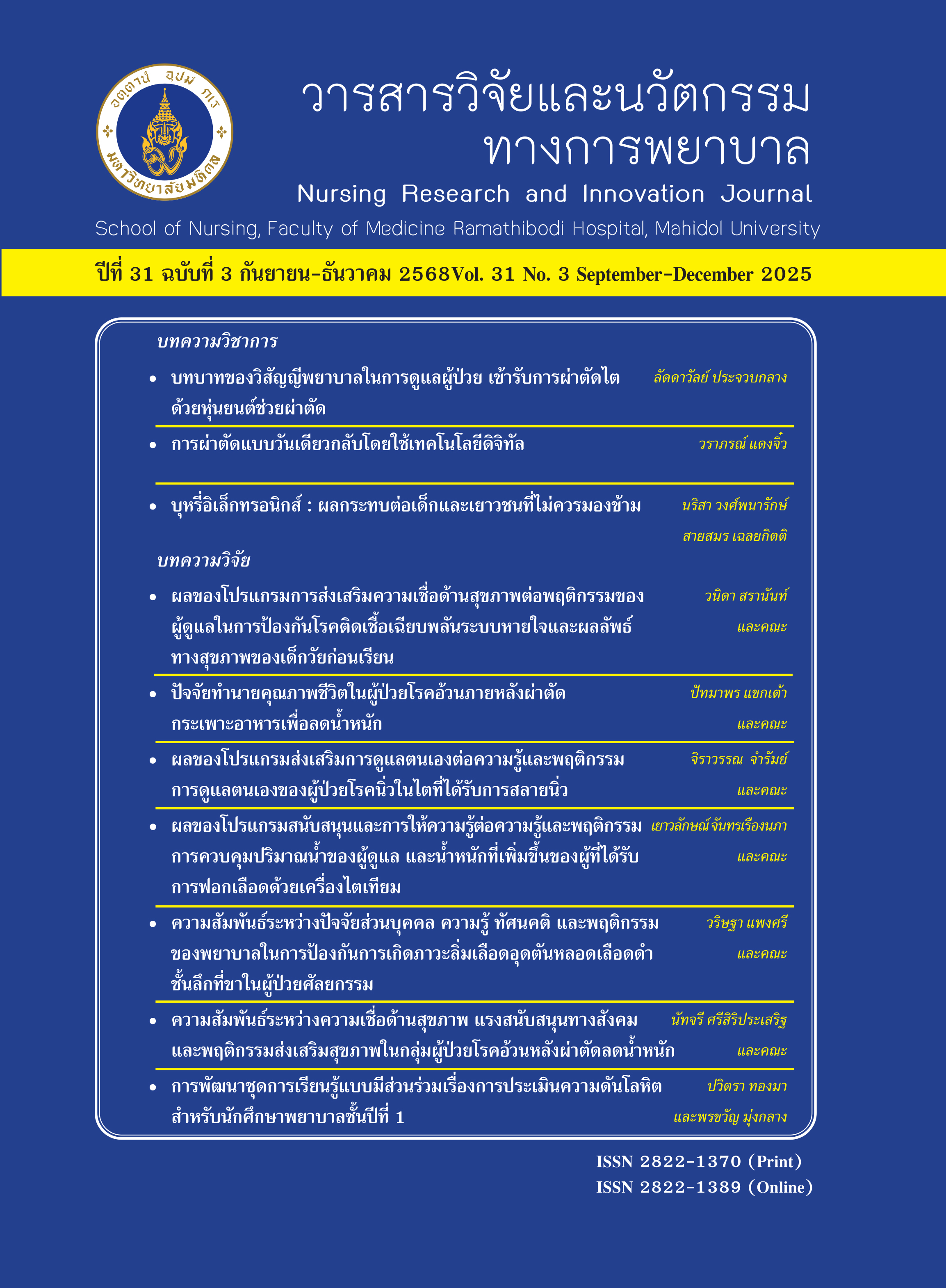
Roles of Nurse Anesthetists in Caring for Patients Undergoing Robot-Assisted Nephrectomy
Article Sidebar
Main Article Content
Abstract
Currently, robot-assisted nephrectomy is increasingly important in the medical field.Nurse anesthetists, as part of the anesthesia team, play a crucial role in patient care during robotic nephrectomy. This surgical method offers clear advantages, including smaller incisions, faster patient recovery, reduced pain, reduced blood loss, and fewer potential surgical complications.This article presents practice guidelines for preoperative, intraoperative, and postoperative care of patients undergoing robotic-assisted nephrectomy, enabling nurse anesthetists, anesthesiologists,and other relevant medical personnel to perform their duties efficiently and safely.
Robot-assisted nephrectomy differs significantly from conventional nephrectomy in several aspects. In the preoperative period, the preparation includes patient positioning, airway management, and intraoperative operating room management. The robotic system requires multiple mechanical arms positioned around the patient, which restricts the anesthetic team's workspace.Careful preoperative planning is essential for airway and venous access. Additionally, patient positioning in the lateral decubitus position with table flexion is crucial for expanding the operative field and facilitating surgical access. Securing the patient's hips and chest to the operating table to prevent movement, along with the use of padding to minimize nerve and soft-tissue injuries, are critical components. Furthermore, carbon dioxide insufflation affects the respiratory and circulatory systems; therefore, the anesthesia care team necessitates a deep understanding of physiological changes to plan anesthetic management appropriately.
During surgery, nurse anesthetists play a vital role in continuously monitoring the patient's vital signs to minimize cardiovascular complications. They are also responsible for fluid management to maintain hemodynamic stability and kidney function, and the use of non-depolarizing muscle relaxants to ensure optimal muscle relaxation and prevent unwanted movements.
Postoperatively, nurse anesthetists are responsible for comprehensive monitoring of recovery from anesthesia, including checking vital signs every five minutes during the first hour and every 15 minutes thereafter until stability is achieved. They must also monitor for complications, such as subcutaneous carbon dioxide accumulation, by assessing oxygen saturation, respiratory rate, and lung sounds, and by observing for numbness in the patient's extremities. Also, pain levels must be continuously assessed using a Numeric Pain Rating Scale, ranging from 0 (no pain) to 10 (the worst imaginable pain), along with monitoring for additional complications such as nausea and vomiting.
Comprehensive care roles by nurse anesthetists throughout all phases of management not only enhance patient safety and surgical success but also promote the delivery of high-quality care and support the effective and safe use of robotic technology.
Keywords: Anesthesia, Anesthesia services, Robotic-assisted nephrectomy, Nurse anesthetists
Author Contribution
LP: Conceptualization, Literature review, and Writing – original draft.
Article Details

This work is licensed under a Creative Commons Attribution-NonCommercial-NoDerivatives 4.0 International License.
บทความ ข้อมูล เนื้อหา รูปภาพ ฯลฯ ที่ได้รับการตีพิมพ์ในรามาธิบดีพยาบาลสาร ถือเป็นลิขสิทธิ์ของวารสาร หากบุคคลหรือหน่วยงานใดต้องการนำทั้งหมดหรือส่วนหนึ่งส่วนใดไปเผยแพร่หรือเพื่อกระทำการใด ใด จะต้องได้รับอนุญาตเป็นลายลักษณ์อักษรจากรามาธิบดีพยาบาลสารก่อนเท่านั้น
References
Thanyarat T. Knowledge about kidney diseases for the public. Bangkok: Health Work; 2013. p. 5-27. (in Thai)
Ramathibodi Hospital. Medical record of a patient withkidney cancer undergoing surgery. [Medical record].Ramathibodi Hospital; 2024.
Lim PC, Kang E. How to prepare the patient for roboticsurgery: before and during the operation. Best Pract ResClin Obstet Gynaecol. 2017;45:32-47. doi:10.1016/j.bpobgyn.2017.04.008.
College of Anesthesiologists of Thailand. Practice advisory for preanesthesia evaluation. Bangkok: College of Anesthesiologists of Thailand; 2019. p. 2-4. (in Thai)
Sirithanapol W. Laparoscopic surgery in urology [Internet].Khon Kaen: Faculty of Medicine, Khon Kaen University;2018 [cited 2024 Aug 18]. Unpublished internal document. (in Thai)
Mills JT, Burris MB, Warburton DJ, Conaway MR,Schenkman NS, et al. Positioning injuries associated with robotic assisted urological surgery. J Urol. 2013;190(2):580-4. doi: 10.1016/j.juro.2013. 02.3185.
Lew MW, Sullivan MJ. Anesthesia for laparoscopic and robotic-assisted urological procedures. In: Gainsburg DM,editor. Anesthesia for urology surgery. New York: Springer Science; 2014. p. 93-126.
Lyu X, Ma X, Li H, Zhang X. Robot assisted laparoscopic partial nephrectomy. In: Zhang X, editor. Laparoscopic and robotic surgery in urology. Singapore: Springer; 2020.p. 107-26.
Rord-anun O. Anesthesia for laparoscopic surgery. In:Yok B, Ruang N, Phat N, editors. Do you have anesthesia knowledge?. 1st ed. Bangkok: P.A. Living; 2021. p.111-47. (in Thai)
Jirattiwanon T. Anesthesia for laparoscopic abdominal surgery. In: Phoonthitikorn A, Raksakiatsak M, Charoenrat P, Ruang-anukun N, editors. Basic textbook of anesthesiology. 1st ed. Bangkok: Royal College of Anesthesiologists of Thailand; 2015. p. 247-57. (in Thai)
Danic MJ, Chow M, Alexander G, Bhandari A, Menon M, et al. Anesthesia considerations for robotic-assistedlaparoscopic
prostatectomy: a review of 1,500 cases. J Robot Surg. 2007;1(2):119-23. doi: 10.1007/s11701-007-0024-z.
Piegeler T, Dreessen P, Graber SM, Haile SR, Schmid DM, et al. Impact of intraoperative fluid administration onoutcome in patients undergoing robotic-assisted laparoscopic prostatectomy: a retrospective analysis. BMC Anesthesiol. 2014 Jul 30;14:61. doi:10.1186/1471-
-14-61.
Pasutharnchat K. Physiology and anesthesiology in laparoscopic and robotic renal surgery. In: Kittinart K,editor. Textbook of laparoscopic and robotic renal surgery.Bangkok: Ramathibodi Textbook Project, Faculty of Medicine, Mahidol University; 2018. p.41-63. (in Thai)
Trabulsi EJ, Patel J, Viscusi ER, Gomella LG, Lallas CD.Preemptive multimodal pain regimen reduces opioid analgesia for patients undergoing robotic-assisted laparoscopic radical prostatectomy. Urology. 2010 Nov;76(5):1122-4. doi: 10.1016/j.urology.2010.03.052.
Elvir-Lazo OL, White PF. Postoperative pain management after ambulatory surgery: role of multimodal analgesia.Anesthesiol Clin. 2010 Jun;28(2):217-24. doi:10.1016/j.anclin.2010.02.011.
Royal College of Anesthesiologists of Thailand, Thai Association for the Study of Pain. Clinical guidance for acute postoperative pain management. 2nd ed. Bangkok:Royal College of Anesthesiologists of Thailand; 2019. p.16-29.
Veiga-Gil L, Pueyo J, López-Olaondo L. Postoperative nausea and vomiting: physiopathology, risk factors,prophylaxis and treatment. Rev Esp Anestesiol Reanim.2017 Apr;64(4):223-32. doi: 10.1016/j.redar.2016.10.001.
Gan TJ, Belani KG, Bergese S, Chung F, Diemunsch P,et al. Fourth consensus guidelines for the management of postoperative nausea and vomiting. Anesth Analg. 2020 Aug;131(2):411-48. doi: 10.1213/
Royal College of Anesthesiologists of Thailand. Prevention and treatment guideline for postoperative nausea and vomiting [Internet]. Bangkok: Royal College of Anesthesiologists of Thailand; 2024 [cited 2025 Mar 17]. Available from: https://www.rcat.org / _files/ugd/82246c_3ca7253020344933ae10a7aaa20ecdc9.pdf
Hfocus.org. Ramathibodi teams up with French doctors to perform the first 3 robotic kidney transplants in Thailand and Southeast Asia for free! [Internet]. 2024 [cited 2024 Aug 18]. Available from: https://www.hfocus.org/content/2024/04/30222 (in Thai)
