
Hospital-Based versus Home-Based Phototherapy: Patient Perceptions and Preferences in Thailand
Keywords:
Home-Based Phototherapy, Hospital-Based Phototherapy, Narrowband UVB Phototherapy, Vitiligo, PsoriasisAbstract
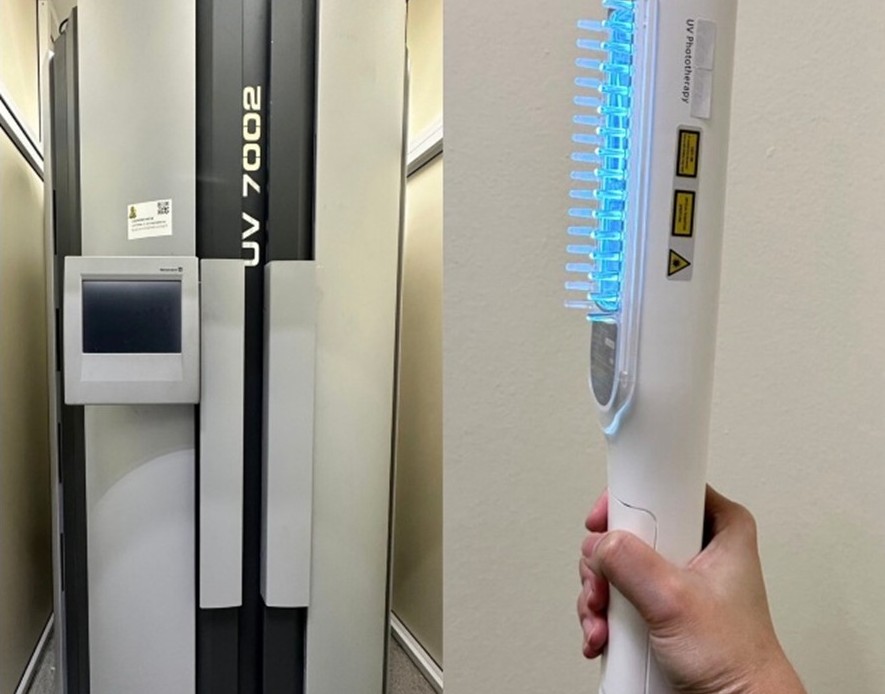
Background: Narrowband UVB (NB-UVB) phototherapy is an effective treatment for various dermatologic conditions. However, hospital-based phototherapy poses accessibility challenges for many patients. This study aimed to explore Thai patients' perceptions, experiences, and barriers related to phototherapy, particularly home-based NB-UVB treatment.
Materials and Methods: A cross-sectional survey was conducted among 240 dermatology patients at Siriraj Hospital who had received phototherapy for at least one month. Data on demographics, treatment experiences, and factors influencing phototherapy choices were collected and analyzed.
Results: Among 240 Thai patients undergoing phototherapy, 96.7% had exclusively received hospital-based phototherapy, while only 3.3% had current or prior experience with home-based devices. Hospital-based phototherapy was most frequently perceived as the safest (93.7%) and most effective (84.9%) treatment modality. Only 2.5% and 3.8% of patients, respectively, perceived home-based phototherapy as the safest or most effective option. For long-term treatment, hospital-based phototherapy remained the preferred modality for 76.1% of patients and was considered the most cost-effective by 69.0%. Half of the participants (50.0%) identified home-based phototherapy as the most convenient option, compared with 47.5% favoring hospital-based treatment. Despite limited prior use, 47.1% of patients expressed interest in home-based phototherapy, with major perceived barriers including high device cost (66.1%), concerns regarding treatment efficacy (46.6%), and safety (44.3%). No significant differences were found in phototherapy perceptions across dermatologic conditions.
Conclusion: Despite limited use, there is growing interest in home-based phototherapy among Thai patients. Addressing awareness, affordability, and safety concerns-alongside integrating telehealth and supportive policies, may improve access and adherence while reducing healthcare burdens.
References
Gambichler T, Breuckmann F, Boms S, Altmeyer P, Kreuter A. Narrowband UVB phototherapy in skin conditions beyond psoriasis. J Am Acad Dermatol 2005;52:660-70.
Barros NM, Sbroglio LL, Buffara MO, Baka J LCES, Pessoa AS, Azulay-Abulafia L. Phototherapy. An Bras Dermatol 2021;96:397-407.
Medical Advisory Secretariat. Ultraviolet Phototherapy Management of Moderate-to-Severe Plaque Psoriasis: An Evidence-Based Analysis. Ont Health Technol Assess Ser 2009;9:1-66.
Pearce DJ, Higgins KB, Stealey KH, et al. Adverse events from systemic therapies for psoriasis are common in clinical practice. J Dermatolog Treat 2006;17:288-93.
Franken SM, Vierstra CL, Rustemeyer T. Improving access to home phototherapy for patients with psoriasis: current challenges and future prospects. Psoriasis (Auckl) 2016;6:55-64.
Koek MB, Sigurdsson V, van Weelden H, Steegmans PH, Bruijnzeel-Koomen CA, Buskens E. Cost effectiveness of home ultraviolet B phototherapy for psoriasis: economic evaluation of a randomised controlled trial (PLUTO study). BMJ 2010;340:c1490.
Torosian A, Porter CL, Feldman SR. Factors Influencing Patient Preferences for Phototherapy: A Survey Study. Cutis 2022;110:E3-E7.
Koek MB, Buskens E, van Weelden H, Steegmans PH, Bruijnzeel-Koomen CA, Sigurdsson V. Home versus outpatient ultraviolet B phototherapy for mild to severe psoriasis: pragmatic multicentre randomised controlled non-inferiority trial (PLUTO study). BMJ 2009;338:b1542.
Singh S, Khandpur S, Sharma VK, Bhari N, Pandey RM. An Open-Label Non-Randomized Preliminary Noninferiority Study Comparing Home-Based Handheld Narrow-Band UVB Comb Device with Standard Hospital-Based Whole-Body Narrow-Band UVB Therapy in Localized Vitiligo. Indian Dermatol Online J 2023;14:510-5.
Liu B, Sun Y, Song J, Wu Z. Home vs hospital narrowband UVB treatment by a hand-held unit for new-onset vitiligo: A pilot randomized controlled study. Photodermatol Photoimmunol Photomed 2020;36:14-20.
Seneschal J, Speeckaert R, Taïeb A, et al. Worldwide expert recommendations for the diagnosis and management of vitiligo: Position statement from the international Vitiligo Task Force-Part 2: Specific treatment recommendations. J Eur Acad Dermatol Venereol 2023;37:2185-95.
Tien Guan ST, Theng C, Chang A. Randomized, parallel group trial comparing home-based phototherapy with institution-based 308 excimer lamp for the treatment of focal vitiligo vulgaris. J Am Acad Dermatol 2015;72:733-5.
Dillon JP, Ford C, Hynan LS, Pandya AG. A cross-sectional, comparative study of home vs in-office NB-UVB phototherapy for vitiligo. Photodermatol Photoimmunol Photomed 2017;33:282-3.
Smith MP, Ly K, Thibodeaux Q, Bhutani T, Nakamura M. Home phototherapy for patients with vitiligo: challenges and solutions. Clin Cosmet Investig Dermatol 2019;12:451-9.
Bhutani T, Liao W. A Practical Approach to Home UVB Phototherapy for the Treatment of Generalized Psoriasis. Pract Dermatol 2010;7:31-5.
Jacob J, Pona A, Cline A, Feldman S. Home UV Phototherapy. Dermatol Clin 2020;38:109-26.
Ashraf AZ, Azurdia RM, Cohen SN. The effectiveness of home-based phototherapy for vitiligo: A systematic review of randomised controlled trials. Photodermatol Photoimmunol Photomed 2022;38:409-17.
Downloads
Published
How to Cite
Issue
Section
License
Copyright (c) 2026 Thai Journal of Dermatology

This work is licensed under a Creative Commons Attribution-NonCommercial-NoDerivatives 4.0 International License.
เนื้อหาและข้อมูลในบทความที่ลงตีพิมพ์ในวารสารโรคผิวหนัง ถือเป็นข้อคิดเห็นและความรับผิดชอบของผู้เขียนบทความโดยตรงซึ่งกองบรรณาธิการวารสาร ไม่จำเป็นต้องเห็นด้วย หรือร่วมรับผิดชอบใดๆ
บทความ ข้อมูล เนื้อหา รูปภาพ ฯลฯ ที่ได้รับการตีพิมพ์ในวารสารโรคผิวหนัง ถือเป็นลิขสิทธิ์ของวารสารฯ หากบุคคลหรือหน่วยงานใดต้องการนำทั้งหมดหรือส่วนหนึ่งส่วนใดไปเผยแพร่ต่อหรือเพื่อกระทำการใดๆ จะต้องได้รับอนุญาตเป็นลายลักอักษรจากบรรณาธิการวารสารโรคผิวหนังก่อนเท่านั้น

