
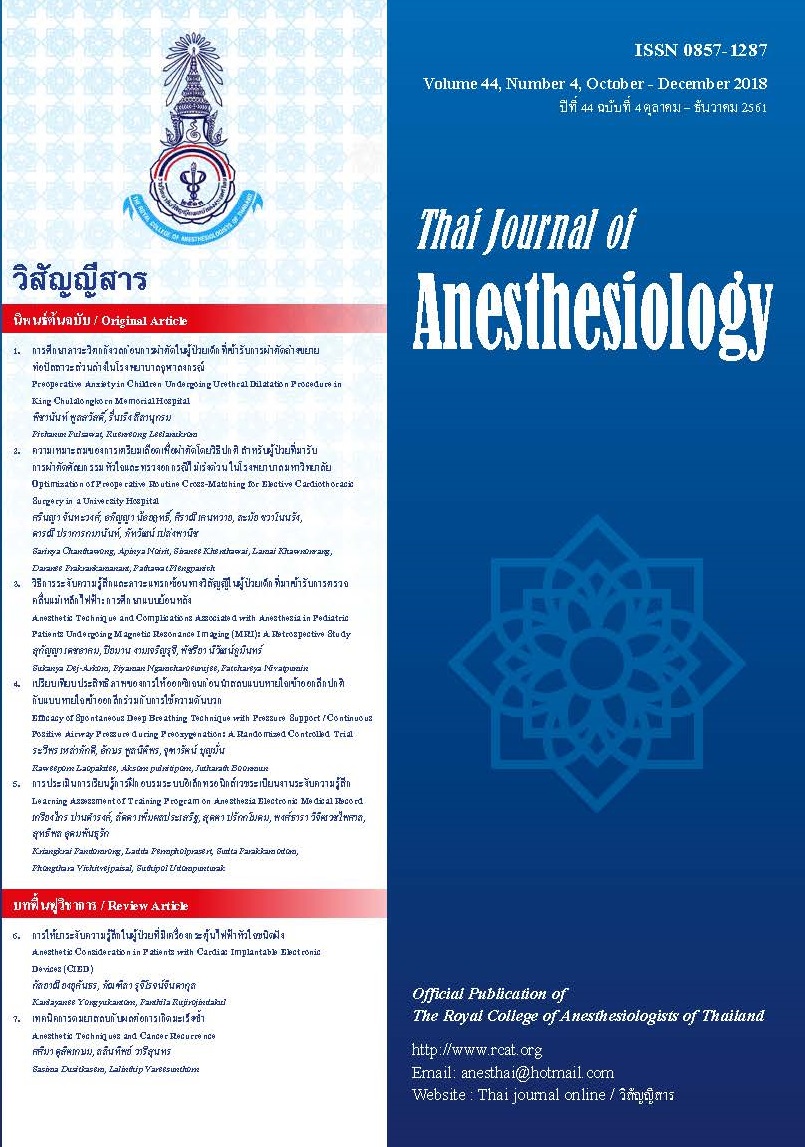
Optimization of Preoperative Routine Cross-Matching for Elective Cardiothoracic Surgery in a University Hospital
Keywords:
cardiovascular and thoracic surgery, cross-match to transfusion ratio, routine blood cross-matchingAbstract
Background: Blood transfusion plays a major role in the resuscitation and management of blood loss in surgical patients, especially cardiothoracic surgery. However, excessive blood cross-matching may be a common problem.
Objectives: To evaluate the efficiency of routine preoperative blood ordering and transfusion practices for patients undergoing elective cardiothoracic surgery.
Methods: This is a retrospective descriptive study. Preoperative blood ordering, intraoperative and postoperative blood transfusion within 24 hours postoperatively were recorded from elective cardiothoracic surgery at Srinagarind Hospital and Queen Sirikit Heart Center of the Northeast, Khon Kaen University during a one-year period (January to December 2014). The optimal blood ordering was calculated by cross-match to transfusion ratio (C/T ratio), Transfusion probability (%T) and Transfusion index (Ti).
Results: During the study period, the total of 792 patients were enrolled. Most patients (791 cases) had preoperative red cells cross-matching, but only 650 (82.17%) received red cells transfusion on the day of the operation. The total of 4,055 units of red cells was prepared, but only 2,336 units (57.61%) of red cells were used. The C/T ratio, %T and Ti index in all operations were 1.73, 81.17 and 2.95, respectively that indicated an appropriate use of blood. Classified by type of operations, only the open heart surgery and open aneurysmorraphy were appropriated use of blood(The C/T ratio was 1.58 and 2.06, respectively). While the closed heart surgery, thoracic surgery and endovascular procedure were over blood-ordering (The C/T ratio was 8.67, 12.68 and 3.63, respectively). The cost of preparing blood in those operations in this study was 1,054,300 baht, and the cost of preparing non- transfused blood was wasted 447,460 baht.
Conclusions: The overall preoperative blood cross-matching for elective cardiothoracic surgery was appropriated. However, the closed heart surgery, thoracic surgery and endovascular procedure were over blood-ordering that meant to not appropriate use of blood. The introduction of maximum surgical blood-order schedule from these results will lead to a reduction of unnecessary demand and cross match workload.
References
2. Lin JS, Chen YJ, Tzeng CH, Lyou JY, Lee CH. Revisiting of preoperative blood ordering policy--a single institute’s experience in Taiwan. J Chin Med Assoc. 2006;69(11):507-11.
3. Thabah R, Sailo LT, Bardoloi J, Lanleila M, Lyngdoh NM, Yunus M, Bhattacharyya P. Maximum Surgical Blood order Schedule in a newly set-up tertiary care hos-pital. Anaesthesia, Pain and Intensive Care 2013;17:28-32.
4. Mann K, Sim I, Ali T, Chong P, Leopold P, Hatrick A, et al. Removing the need for crossmatched blood in elective EVAR. Eur J Vasc Endovasc Surg. 2012;43(3):282-5.
5. Davoudi-kiakalayeh A, Faranoush M, Haghbin A, Behboudi F. Reviewing the Blood Ordering Schedule in Tertiary Trauma Center. Iranian Journal of Blood and Cancer 2013;6:27-31.
6. Mahattanobon S, Sunpaweravong S. Blood order guideline for elective surgery: impact of a guideline. Songkla Med J 2008;26(5):491-500.
7. Jayaranee S, Prathiba R, Vasanthi N, Lopez CG. An analysis of blood utilization for elective surgery in a tertiary medical centre in Malaysia. Malays J Pathol. 2002;24(1):59-66.
8. Chanthawong S, Neramittagapong A, Silarat S, Naewthong P, Boonmala S. Optimizing Preoperative Blood Ordering for Pediatric Cardiovascular and Thoracic Surgery in Srinagarind Hospital and Queen Sirikit Heart Center of the Northeast, Khon Kaen University. Srinagarind Med J 2017;32(3):244-51.
9. Poomsawat S, Jitjuk M, Chau-in W, Wittayapairoj A, Wittayapairoj A. Preoperative blood preparing for electivespine surgery: ratio of actual usage, expense and appropriate use of resources. Thai J Anesthesiol. 2015;41(3):155-65.
10. Litu D, Simajareuk S, Chau-in W, Boonsangcharoen P, Vachirodom D. Pre-operative routine cross-match for elective breast surgery: An appropriate use of resources. Srinagarind Med J 2012;27:401-7.
11. Chotisukarat H, Akavipat P, Sookplung P, Damrongbul K. Effectiveness index of preoperative blood preparation for elective neurosurgery at Prasat Neurological Institute. Thai J Anesthesiol. 2017;43(3):232-40.
12. Frank SM, Rothschild JA, Masear CG, Rivers RJ, Merritt WT, Savage WJ, et al. Optimizing preoperative blood ordering with data acquired from an anesthesia information management system. Anesthesiology 2013;118:1286-97.
13. Novis DA, Renner S, Friedberg R, Walsh MK, Saladino AJ. Quality indicators of blood utilization: three College of American Pathologists Q-Probes studies of 12,288,404 red blood cell units in 1639 hospitals. Arch Pathol Lab Med 2002;126:150-6.
14. Miller RD. Transfusion therapy. In: Miller RD, editor. Anesthesia 7th ed. Philadelphia: Churchill Livingstone Inc; 2009;1739-66.
15. Friedman BA, Oberman HA, Chadwick AR, Kingdon KI. The maximum surgical blood order schedule and surgical blood use in the United States. Transfusion. 1976;16(4):380-7.
16. Mahar FK, Moiz B, Khurshid M, Chawla T. Implementation of Maximum Surgical Blood Ordering Schedule and an Improvement in Transfusion Practices of Surgeons subsequent to Intervention. Indian J Hematol Blood Transfus. 2013;29(3):129-33.
17. Mangwana S, Bedi N, Yadav P, Chugh R. Optimization of blood transfusion services: Analysis of blood requisition and utilization practices in cardiac surgical patients in a tertiary care hospital, India. 2017;2(1):47-51.
18. Geissler RG, Rotering H, Buddendick H, Franz D, Bunzemeier H, Roeder N, et al. Utilisation of blood components in cardiac surgery: a single-centre retrospective analysis with regard to diagnosis-related procedures. Transfus Med Hemother. 2015;42(2):75-82.
19. Brevig J, McDonald J, Zelinka ES, Gallagher T, Jin R, Grunkemeier GL. Blood transfusion reduction in cardiac surgery: multidisciplinary approach at a community hospital. Ann Thorac Surg. 2009;87(2):532-9.
20. Alghamdi S, Gonzalez B, Howard L, Zeichner S, LaPietra A, Rosen G, et al. Reducing blood utilization by implementation of a type-and-screen transfusion policy a single-institution experience. Am J Clin Pathol. 2014;141(6):892-5.
Downloads
Published
How to Cite
Issue
Section
License
Copyright
Copyright of all articles published in the Thai Journal of Anesthesiology is held by the Thai Journal of Anesthesiology, the Royal College of Anesthesiologists of Thailand. Submission of a manuscript constitutes the authors' agreement that, upon acceptance for publication, copyright of the work is transferred to the Journal. The content and any opinions expressed in published articles are the sole responsibility of the authors and do not necessarily reflect the views of the editorial board or the Royal College of Anesthesiologists of Thailand.
Licensing
All articles are published open access under the Creative Commons Attribution-NonCommercial-NoDerivatives 4.0 International License (CC BY-NC-ND 4.0). Under this license, anyone may copy and redistribute published articles in any medium or format for non-commercial purposes, provided that appropriate credit is given to the authors and to the Thai Journal of Anesthesiology as the original source of publication, a link to the license is included, and the material is not modified in any way. Requests for commercial use or for adaptation of published material should be directed to the editorial office.
Authors' Rights
Although copyright is held by the Journal, authors retain the right to reuse their own published material in their future scholarly works, theses and dissertations, teaching, and academic presentations, and to deposit the final published version (PDF) in institutional or subject repositories or on personal and institutional websites, without embargo, provided that the Thai Journal of Anesthesiology is clearly acknowledged as the original place of publication.