
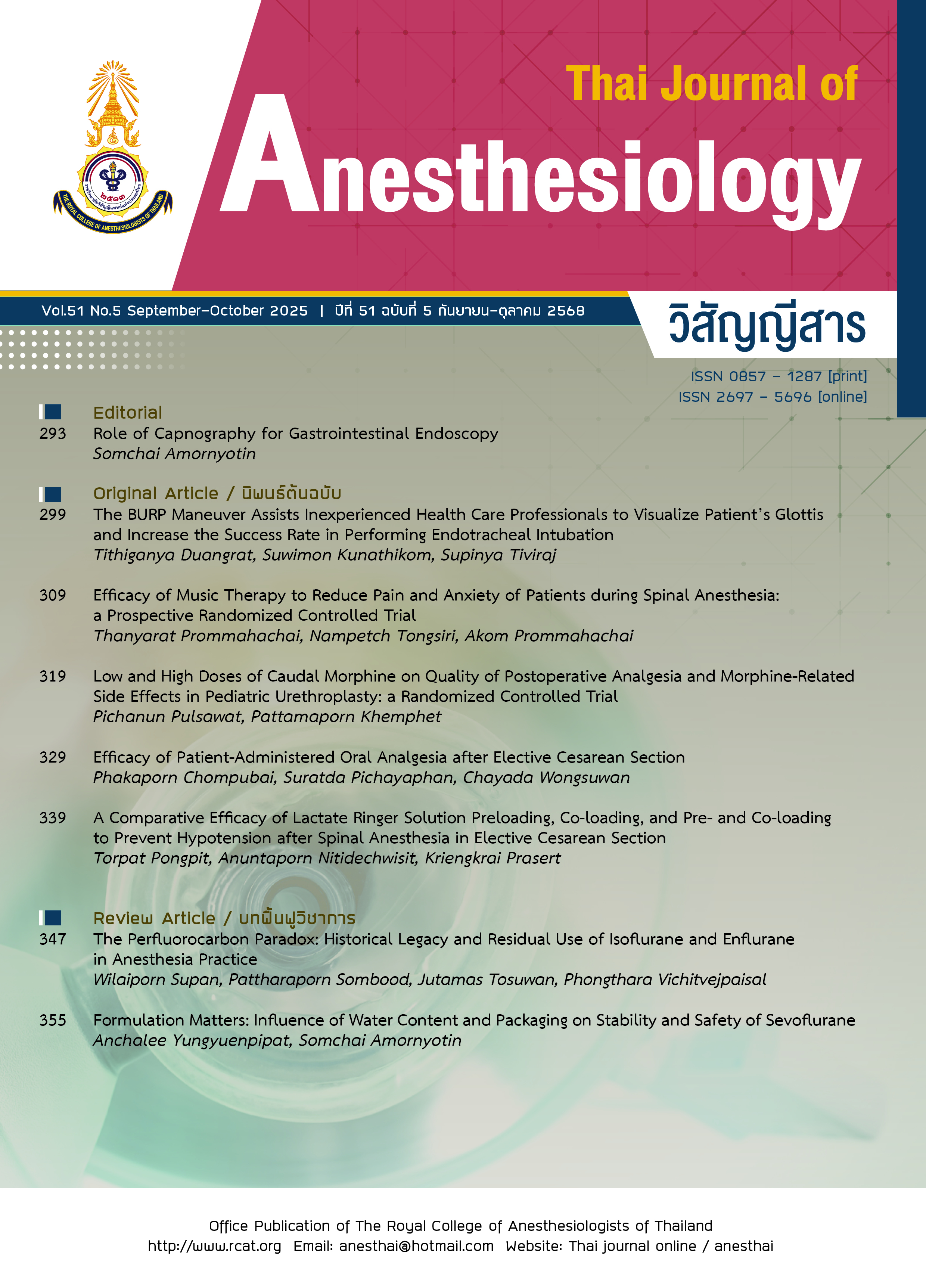
Efficacy of Patient-Administered Oral Analgesia after Elective Cesarean Section
Keywords:
cesarean section, nurse-controlled analgesia, patient-administered oral analgesia, postoperative pain managementAbstract
Introduction: Oral analgesics are convenient to use and cost-effective. This study aims to compare the pain relief effects of self-administered oral analgesia versus nurse- controlled analgesia Methods: An observational study was conducted on postpartum women after cesarean section under spinal anesthesia and 0.2 mg intrathecal morphine. The study included a self-administered oral analgesia (SAOA) group and a nurse-controlled analgesia (NCA) group. The SAOA group received oral medications consisting of 500 mg paracetamol, 50 mg tramadol, and 10 mg morphine, taken one tablet every hour as needed. The NCA group received 50 mg tramadol intravenously every 6 hours as needed. Results: A total of 80 participants were included, with 39 in the SAOA group and 41 in the NCA group. The characteristics of the two groups showed no significant differences in the education level and surgical procedure. Pain scores at rest and on movement were lower in the SAOA group compared to the NCA group, though not clinically significant. Paracetamol was the most frequently used medication, followed by tramadol and morphine in the SAOA group. Side effects differed between the groups: dizziness was more common in the SAOA group, whereas nausea was more frequent in the NCA group. However, the satisfaction levels between the groups did not differ significantly. Conclusion: Self-administered oral analgesia provided pain relief and patient satisfaction comparable with nurse-controlled analgesia. The most common side effect observed was dizziness.
References
Songthamwat M, Norsuwan S, Napamadh P, Songthamwat S. Factors associated with post-cesarean pain. Clin Acad. 2019;43:163-70.
Chou R, Gordon DB, de Leon-Casasola OA, et al. Management of postoperative pain: a clinical practice guideline from the American Pain Society, the American Society of Regional Anesthesia and Pain Medicine, and the American Society of Anesthesiologists’ Committee on Regional Anesthesia, Executive Committee, and Administrative Council. J Pain. 2016;17:131-57.
Woldehaimanot TE, Eshetie TC, Kerie MW. Postoperative pain management among surgically treated patients in an Ethiopian hospital. PLoS One. 2014;9:e102835.
จิราพร คำแก้ว, สิริพรรณ พัฒนาฤดี, ณัฏฐดา อารีเปี่ยม. การจัดการความปวดของผู้ป่วยผู้ใหญ่ หลังการผ่าตัดช่องท้อง แผนกศัลยกรรมทั่วไป โรงพยาบาลนพรัตนราชธานี. ธรรมศาสตร์เวชสาร. 2558;15:80-90.
ปาริฉัตต์ นิลแย้ม, ลัดดา เพิ่มผลประเสริฐ, ปาริชาต อภิเดชากุล, ชุษณา รุ่งจินดามัย. การเปรียบเทียบการประเมินความปวดของผู้ป่วยหลังการผ่าตัดคลอดบุตรในโรงพยาบาลศิริราชโดยพยาบาลประจำหอผู้ป่วยและบุคลากรจากหน่วยระงับปวดในโรงพยาบาลศิริราช. วิสัญญีสาร. 2559;42:291-9.
Ebneshahidi A, Akbari M, Heshmati B. Patient-controlled versus nurse-controlled post-operative analgesia after caesarean section. Adv Biomed Res. 2012;1:6.
Guo J, Long S, Li H, Luo J, Han D, He T. Early versus delayed oral feeding for patients after cesarean. Int J Gynecol Obstet. 2015;128:100-5.
Macones GA, et al. Guidelines for postoperative care in cesarean delivery: Enhanced Recovery After Surgery (ERAS) Society recommendations (part 3). Am J Obstet Gynecol. 2019;221:247.e1-247.e9.
Niwatphoomin P. Acute pain management in pregnancy and breastfeeding mother. In: Sanansilp W, Tangwiwat S, Raksakiatsak M, eds. Acute pain management. Bangkok: P.A. Living; 2019:p307-20.
Charoenpol F, Pathanasethpong A, Ouypron P, et al. Assessing the minimal clinically important difference and patient-accepted symptom state using visual analog scales and numerical rating scales in postoperative patients: a prospective descriptive study. Thai J Anesthesiol. 2023;49:319-28.
Kastanias P, Gowans S, Tumber PS, Snaith K, Robinson S. Patient-controlled oral analgesia for postoperative pain management following total knee replacement. Pain Res Manage. 2010;15:11-6.
Sultan P, Halpern SH, Pushpanathan E, Patel S, Carvalho B. The effect of intrathecal morphine dose on outcomes after elective cesarean delivery: a meta-analysis. Anesth Analg. 2016;123:154-64.
Mäkelä K, Palomäki O, Pokkinen S, Yli-Hankala A, Helminen M, Uotila J. Oral versus patient-controlled intravenous administration of oxycodone for pain relief after cesarean section. Arch Gynecol Obstet. 2019;300:903-9.
Davis KM, Esposito MA, Meyer BA. Oral analgesia compared with intravenous patient-controlled analgesia for pain after cesarean delivery: a randomized controlled trial. Am J Obstet Gynecol. 2006;194:967-71.
Bonnal A, Dehon A, Nagot N, Macioce V, Nogue E, Morau E. Patient-controlled oral analgesia versus nurse-controlled parenteral analgesia after caesarean section: a randomised controlled trial. Anaesthesia. 2016;71:535-43.
Yefet E, Nassar S, Carmeli J, et al. Oral analgesia in fixed-time interval administration versus spinal morphine for post-cesarean pain: a randomised controlled trial. Arch Gynecol Obstet. 2022;305:893-901.
Wirz S, Seidensticker S, Shtrichman R. Patient-controlled analgesia (PCA): intravenous administration (IV-PCA) versus oral administration (Oral-PCA) by using a novel device (PCoAR Acute) for hospitalized patients with acute postoperative pain-a comparative retrospective study. Pain Res Manag. 2021;2021:2542010.
Lu L, Ryan M, Harnett M, Atiee GJ, Reines SC. Comparing the pharmacokinetics of 2 novel intravenous tramadol dosing regimens to oral tramadol: a randomized 3-arm crossover study. Clin Pharmacol Drug Dev. 2019;9:537-46.
Jirasiritham S, Thamjamrassri T, Jarutat P, Jaovisidha A. Can 0.15 mg intrathecal morphine be effective in post-cesarean pain control in comparison with 0.2 mg? Thai J Anesthesiol. 2015;41:127-8.
Wong JY, Carvalho B, Riley ET. Intrathecal morphine 100 and 200 µg for post-cesarean delivery analgesia: a trade-off between analgesic efficacy and side effects. Int J Obstet Anesth. 2013;22:36-41.
Neall G, Bampoe S, Sultan P. Analgesia for Caesarean section. BJA Educ. 2022;22:197-203.
Roofthooft E, Joshi GP, Rawal N,Van de Velde M. PROSPECT guideline for elective caesarean section: an update. Anaesthesia. 2023;78:1170-1.
Downloads
Published
How to Cite
Issue
Section
License

This work is licensed under a Creative Commons Attribution-NonCommercial-NoDerivatives 4.0 International License.
Copyright
Copyright of all articles published in the Thai Journal of Anesthesiology is held by the Thai Journal of Anesthesiology, the Royal College of Anesthesiologists of Thailand. Submission of a manuscript constitutes the authors' agreement that, upon acceptance for publication, copyright of the work is transferred to the Journal. The content and any opinions expressed in published articles are the sole responsibility of the authors and do not necessarily reflect the views of the editorial board or the Royal College of Anesthesiologists of Thailand.
Licensing
All articles are published open access under the Creative Commons Attribution-NonCommercial-NoDerivatives 4.0 International License (CC BY-NC-ND 4.0). Under this license, anyone may copy and redistribute published articles in any medium or format for non-commercial purposes, provided that appropriate credit is given to the authors and to the Thai Journal of Anesthesiology as the original source of publication, a link to the license is included, and the material is not modified in any way. Requests for commercial use or for adaptation of published material should be directed to the editorial office.
Authors' Rights
Although copyright is held by the Journal, authors retain the right to reuse their own published material in their future scholarly works, theses and dissertations, teaching, and academic presentations, and to deposit the final published version (PDF) in institutional or subject repositories or on personal and institutional websites, without embargo, provided that the Thai Journal of Anesthesiology is clearly acknowledged as the original place of publication.