
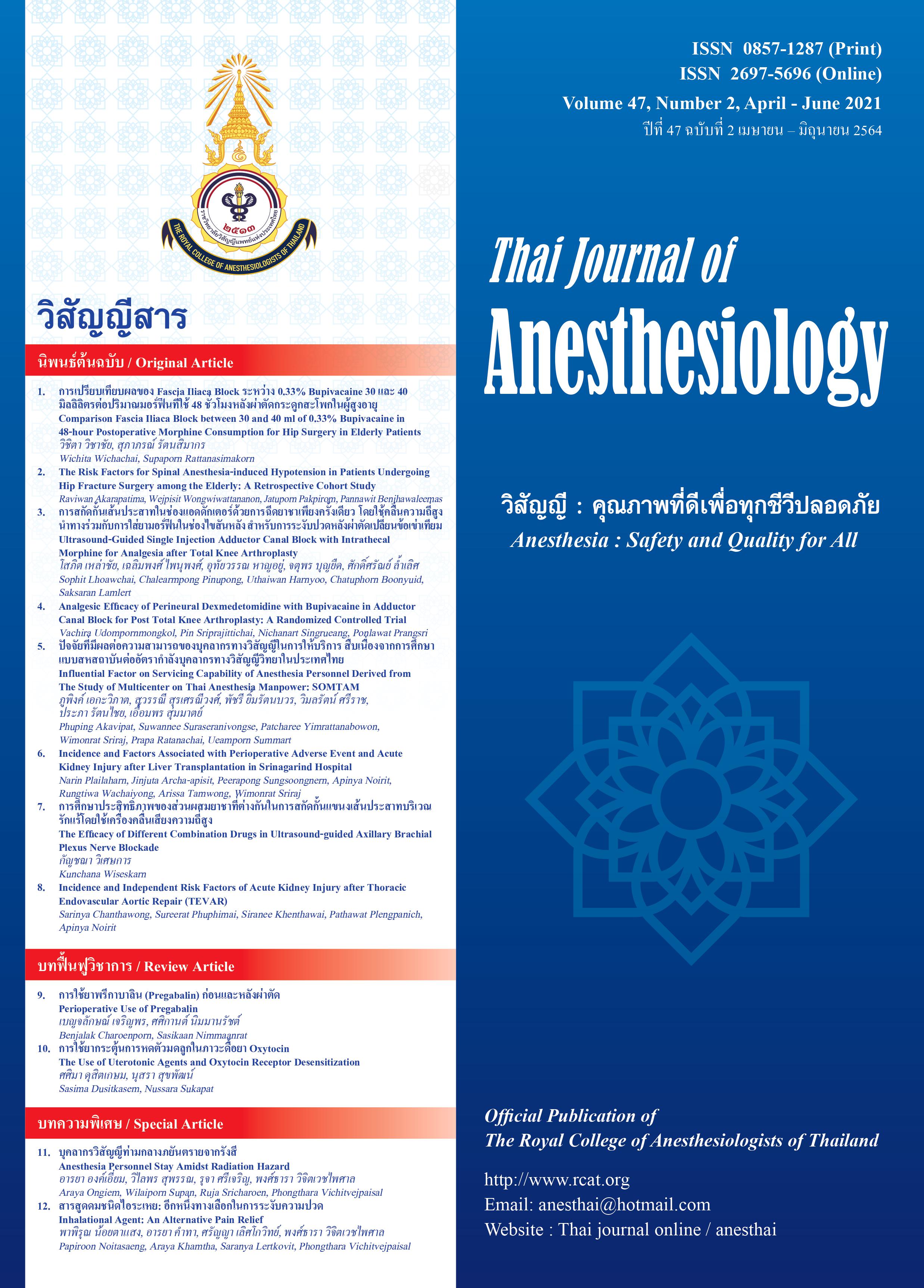
ปัจจัยที่มีผลต่อความสามารถของบุคลากรทางวิสัญญีในการให้บริการ สืบเนื่องจาก การศึกษาแบบสหสถาบันต่ออัตรากำลังบุคลากรทางวิสัญญีวิทยาในประเทศไทย
Article Sidebar
Main Article Content
บทคัดย่อ
วัตถุประสงค์: ความหลากหลายของระดับความสามารถของ ผู้ให้บริการทางวิสัญญี เป็นปัจจัยสำคัญที่สัมพันธ์กับคุณภาพ การบริการ ดังนั้นการศึกษานี้จึงได้จัดทำขึ้น เพื่อศึกษาปัจจัย ต่างๆ ที่มีผลต่อระดับความสามารถของบุคลากรทางวิสัญญี เพื่อการบริหารจัดการด้านบริการที่เหมาะสมในประเทศไทย วิธีการศึกษา: เป็นการศึกษาภาคตัดขวาง แบบพหุสถาบัน โดยเป็นงานวิจัยย่อยและต่อเนื่องจากโครงการวิจัยเรื่อง การศึกษาแบบสหสถาบันต่ออัตรากำลังบุคลากรทาง วิสัญญีวิทยาในประเทศไทย (Study Of Multicenter on Thai Anesthesia Manpower; SOMTAM) ทำการศึกษาใน โรงพยาบาลสังกัดกระทรวงสาธารณสุข จากทุกเขตสุขภาพ ตั้งแต่โรงพยาบาลทั่วไปขนาดเล็ก โรงพยาบาลทั่วไประดับ จังหวัด โรงพยาบาลศูนย์ และโรงพยาบาลเฉพาะทาง ศึกษา ข้อมูลพื้นฐานด้านบุคลากร ปัจจัยด้านผู้ป่วย ปัจจัยด้านการ ผ่าตัดและปัจจัยด้านวิสัญญี ที่มีผลต่อระดับความสามารถของบุคลากรที่ให้บริการผู้ป่วยรายนั้นๆ โดยรวบรวมจากการ ให้บริการทางวิสัญญีทุกชนิดที่เกิดขึ้นในช่วงระยะเวลา 5 วัน ทำการ และ 2 วันหยุดราชการ ตั้งแต่ 16 มิถุนายน-27 กรกฎาคม 2562 โดยกำหนดให้ระดับความสามารถบุคลากร มีค่าตั้งแต่ 1-5 (novice to expert) วิเคราะห์ข้อมูลทางสถิติ แบบพรรณนา และ logistic regression analysis แสดงผล ด้วย odds ratio (OR); 95% confidence interval (95%CI) โดยถือว่ามีนัยสำคัญทางสถิติเมื่อ p-value<0.05 ผลการศึกษา: มีผู้เข้าร่วมศึกษาทั้งสิ้น 3,774 คน จาก 18 โรงพยาบาล (2,677 คน ในกลุ่มศึกษาความสัมพันธ์และ 1,097 คน ในกลุ่มทดสอบ) ระดับความสามารถของบุคลากร ในการให้บริการทางวิสัญญีทั้งกระบวนการ มีค่า 3.57±1.41 โดยในโรงพยาบาลศูนย์อยู่ในระดับ 3.66±0.35 โรงพยาบาล ทั่วไประดับจังหวัดอยู่ในระดับ 3.78±0.34 โรงพยาบาลทั่วไป ขนาดเล็กอยู่ในระดับ 3.38±0.48 และโรงพยาบาลเฉพาะทาง อยู่ในระดับ 3.44±0.34 ส่วนปัจจัยที่สัมพันธ์กับระดับความ สามารถของบุคลากรทางวิสัญญี ได้แก่ ระดับของโรงพยาบาล (OR 0.56; 0.4-0.9 ในโรงพยาบาลเฉพาะทาง ถึง OR 7.62; 4.9-11.9 ในโรงพยาบาลทั่วไประดับจังหวัด) ASA physical status (OR 1.17; 0.9-1.5 ใน ASA II ถึง OR 1.97; 1.2-3.3 ใน ASA IV และ V) การเตรียมความพร้อมของผู้ป่วยก่อน การให้ยาระงับความรู้สึก (OR 1.5; 1.1-1.9) การเฝ้าระวัง (OR 2.3; 1.5-3.6) เทคนิคพิเศษอื่นที่ใช้ประกอบการให้ยา ระงับความรู้สึก (OR 1.9; 1.2-3.1) การใช้เครื่องให้ความ อบอุ่นร่างกาย (OR 1.6; 1.4-2.0) และระยะเวลาที่ใช้ในการ ดูแลผู้ป่วยในห้องพักฟื้น (OR 1.1; 1.1-1.2) โดยมีค่า area under the receiver operating characteristic curve (AUC) 0.73 ในกลุ่มศึกษาความสัมพันธ์และ 0.77 ในกลุ่มทดสอบ สรุป: ระดับความสามารถของบุคลากรทางวิสัญญีสำหรับ การดูแลผู้ป่วยก่อนการให้ยาระงับความรู้สึก ระหว่างการให้ ยาระงับความรู้สึก และหลังการให้ยาระงับความรู้สึก มีค่า แตกต่างกัน โดยปัจจัยที่มีผลสำคัญคือระดับของโรงพยาบาล ปัจจัยด้านวิสัญญี และปัจจัยด้านตัวผู้ป่วย
Article Details
เอกสารอ้างอิง
anaesthesia workforce map shows huge shortages impacting
5 billion people worldwide 2017 [updated May 24, 2017;
cited 2018 October 18]. Available from: https://medicalxpress.com/news/2017-05-anaesthesia-workforce-hugeshortages-impacting.html.
2. Hoyler M, Finlayson SR, McClain CD, Meara JG, Hagander
L. Shortage of doctors, shortage of data: a review of the
global surgery, obstetrics, and anesthesia workforce
literature. World J Surg 2014;38:269-80.
3. Miseda MH, Were SO, Murianki CA, Mutuku MP, Mutwiwa
SN. The implication of the shortage of health workforce
specialist on universal health coverage in Kenya. Hum
Resour Health 2017;15:80.
4. Cherian MN, Merry AF, Wilson IH. The World Health
Organization and anaesthesia. Anaesthesia 2007;62 Suppl
1:65-6.
5. Akavipat P, Duangrat T, Srirojanakul W. Workload, stress,
life satisfaction and quality of life among anesthesiologists
in Thailand. Thai J Anesthesiol 2017;41:8-18.
6. The Royal College of Anesthesiologists of Thailand. The total
number of anesthesiologists in Thailand. Administrative
committee meeting minutes. Bangkok, Thailand; 2019
December 17. Contract No.: 12/2561.
7. Department of Information Technology, Health Administration
Division. Fundamental data of the hospital authorized by the
office of the permanent secretary, Ministry of Public Health
2018 [cited 2020 18 April]. Available from: http://www.
amnathos.moph.go.th/file_news/amnathosTox4L2408256
150416.pdf.
8. Khan FA, Merry AF. Improving anesthesia safety in
low-resource settings. Anesth Analg 2018;126:1312-20.
9. Steurer MP, Ganter MT. Comparison and contrast of
anethesia practice in Europe and U.S. ASA Monitor 2015;79:
18-20.
10. Lam P, Lopez FA, Middleton C, McGillicuddy P. Exploring
healthcare professionals’ perceptions of the anesthesia
assistant role and its impact on patients and interprofessional collaboration. J Interprof Care 2018;32:24-32.
11. Kudsk-Iversen S, Shamambo N, Bould MD. Strengthening
the anesthesia workforce in low- and middle-income
countries. Anesth Analg 2018;126:1291-7.
12. Thai Health Coding Center. Classification of office of
permanent secretary health care center according to
geographic information system 2017 [cited 2018 May 14].
Available from: www.thcc.or.th/download/GIS54.pdf.
13. Dracup K, Bryan-Brown CW. From novice to expert to mentor:
shaping the future. Am J Crit Care 2004;13:448-50.
14. Brown TA. Surgical risk classification system: Medical
University of South Carolina. 2013 [cited 2020 March 13].
Available from: https://web.musc.edu/-/sm/medicine/departments/anesthesia/f/surgical-risk-classification-system.ashx
15. Zambouri A. Preoperative evaluation and preparation for
anesthesia and surgery. Hippokratia 2007;11:13-21.
16. Persky AM, Robinson JD. Moving from novice to expertise
and its implications for instruction. Am J Pharm Educ
2017;81:6065.
17. Federspiel F, Mukhopadhyay S, Milsom P, Scott JW, Riesel
JN, Meara JG. Global surgical and anaesthetic task shifting:
a systematic literature review and survey. Lancet 2015;385
Suppl 2:S46.
18. Orser BA, Wilson CR, Rotstein AJ, et al. Improving access
to safe anesthetic care in rural and remote communities in
affluent countries. Anesth Analg 2019;129:294-300.
19. Carey C. Securing the future anaesthetic workforce. Best
Pract Res Clin Anaesthesiol 2018;32:25-37.
20. Nat E. The step by step guide to go from novice to expert in
any skill: Nathaniel Eliason; 2017 [updated June 26, 2017;
cited 2020 July 8]. Available from: https://www.nateliason.
com/blog/become-expert-dreyfus.
21. Driver R, Jr., Grose B, Serafini M, Cottrell S, Sizemore D,
Vallejo M. A focused observation tool using dreyfus stages
of skill acquisition as an evaluative scale. W V Med J
2017;113:36-41.
22. Zozus MN, Pieper C, Johnson CM, et al. Factors affecting
accuracy of data abstracted from medical records. PLoS
One 2015;10:e0138649.
23. Rabbitts JA, Groenewald CB, Moriarty JP, Flick R.
Epidemiology of ambulatory anesthesia for children in the
United States: 2006 and 1996. Anesth Analg 2010;111:
1011-5.
24. Young S, Shapiro FE, Urman RD. Office-based surgery and
patient outcomes. Curr Opin Anaesthesiol 2018;31:707-12.
25. Alvarenga WA, de Carvalho EC, Caldeira S, Vieira M,
Nascimento LC. The possibilities and challenges in providing
pediatric spiritual care. J Child Health Care 2017;21:435-45.
26. Douglas S, Cartmill R, Brown R, et al. The work of adult and
pediatric intensive care unit nurses. Nurs Res 2013;62:50-8.
27. Jain A, Muralidhar V, Aneja S, Sharma AK. A prospective
observational study comparing criteria-based discharge
method with traditional time-based discharge method for
discharging patients from post-anaesthesia care unit
undergoing ambulatory or outpatient minor surgeries under
general anaesthesia. Indian J Anaesth 2018;62:61-5.
28. Ahmed OMA, Azher I, Gallagher AG, Breslin DS, O’Donnell
BD, Shorten GD. Deliberate practice using validated metrics
improves skill acquisition in performance of ultrasoundguided peripheral nerve block in a simulated setting. J Clin
Anesth 2018;48:22-7.
29. Ratif RK, Bautista A, Duan X, et al. Teaching basic fiberoptic
intubation skills in a simulator: initial learning and skills decay.
J Anesth 2016;30:12-9.
30. Olotu C, Weimann A, Bahrs C, Schwenk W, Scherer M,
Kiefmann R. The perioperative care of older patients. Dtsch
Arztebl Int 2019;116:63-9.
31. Kibwana S, Teshome M, Molla Y, et al. Education, practice,
and competency gaps of anesthetists in Ethiopia: task
analysis. J Perianesth Nurs 2018;33:426-35.
